Food processing plants operate under the strictest sanitation requirements of any food-related facility in Australia. As a commercial restaurant cleaning company that also services food manufacturing environments across Sydney, we see the difference in scale and consequence firsthand—a contamination event in a processing plant can affect thousands of consumers through a single production run, compared to the dozens a restaurant serves in a shift.
Food processing facilities face sanitation challenges that go well beyond what commercial kitchens encounter. The scale of production, the complexity of equipment, and the regulatory intensity all compound.
Product distribution reach means a single contamination event during manufacturing can affect thousands of consumers across multiple states before detection. Cross-contamination prevention requires complete segregation of different product lines, allergen zones, and production stages—each with its own cleaning protocols and verification testing.
Equipment complexity in processing plants includes conveyor systems, filling machines, pasteurisers, packaging lines, and CIP (clean-in-place) circuits that require specialised disassembly and cleaning procedures. Standard commercial kitchen cleaning methods are inadequate for this equipment.
Allergen management is particularly critical. Facilities handling multiple allergens—nuts, dairy, gluten, egg, soy—must demonstrate complete removal of allergenic residues between production changeovers. We use validated allergen swab testing after every changeover clean, with results documented for each production line.
Regulatory scrutiny on food manufacturers exceeds what restaurants face. The NSW Food Authority, FSANZ, and export certification bodies all conduct detailed audits that examine cleaning validation records, chemical usage logs, and environmental monitoring data going back months.
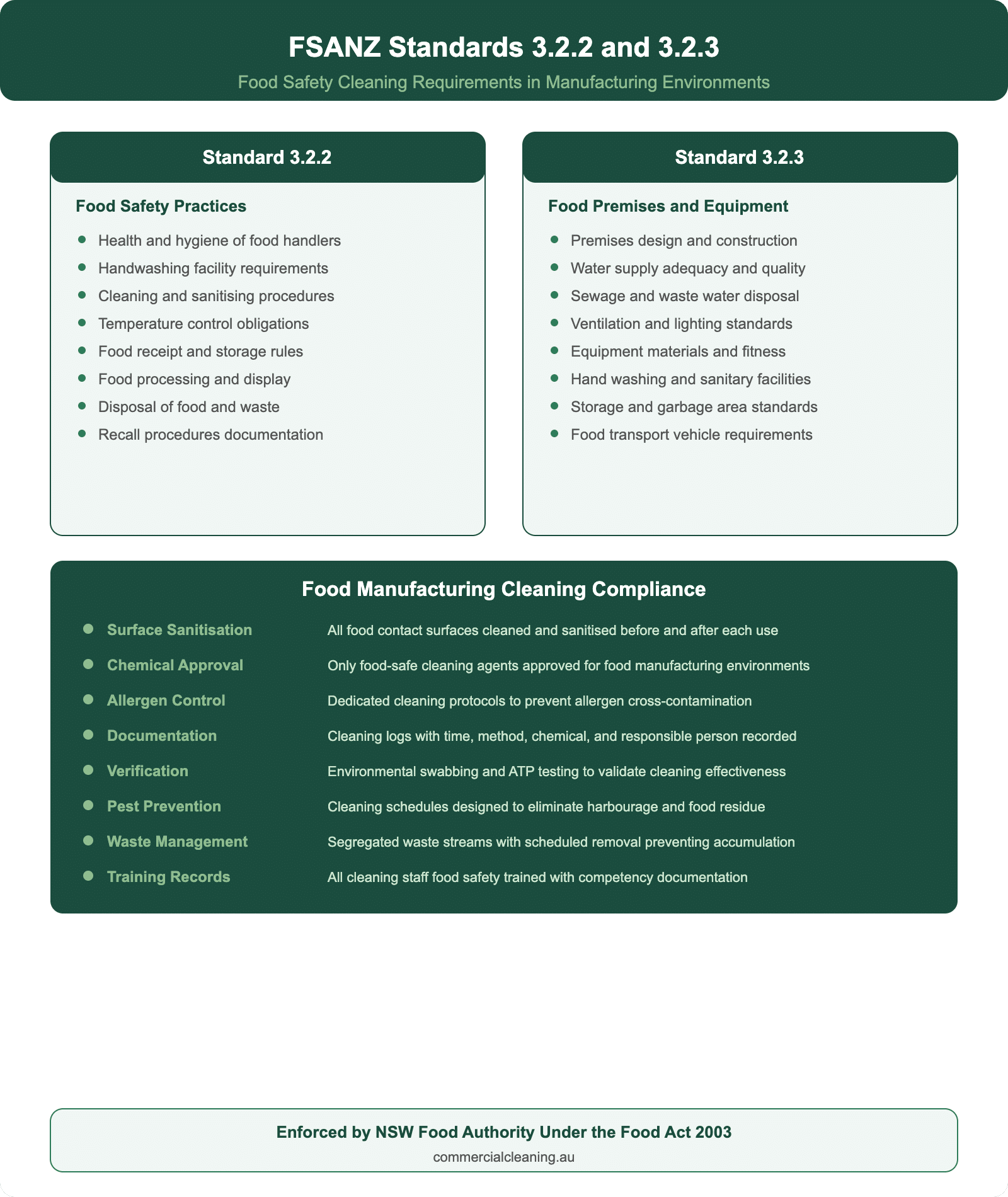
FSANZ Standards 3.2.2 and 3.2.3 infographic showing food safety practices premises requirements and manufacturing cleaning compliance checklist
FSANZ 3.2.2 and 3.2.3 in Food Manufacturing
FSANZ Standard 3.2.2 applies to all food businesses, but its requirements take on additional weight in manufacturing environments where production volumes amplify any compliance failure.
Clause 24 requires all equipment and fittings to be maintained in a condition that permits effective cleaning. In manufacturing, this extends to production line components, conveyor belts, filling heads, sealing equipment, and bulk storage vessels—every surface that contacts product during processing.
Clause 6 mandates ventilation systems that control airborne contamination. Manufacturing facilities generate particulate from processing operations—flour dust in bakery plants, aerosols in spray-drying operations, steam in pasteurisation areas. Extraction systems must capture these contaminants before they settle on product contact surfaces.
FSANZ 3.2.3 introduces mandatory food safety management requirements that apply to all businesses handling potentially hazardous foods. For manufacturers, this means documented cleaning validation, environmental monitoring programmes, and systematic hazard controls verified through ongoing testing—not just visual inspection.
We design cleaning validation programmes for manufacturing clients that include ATP bioluminescence testing on critical surfaces after every production clean, with results below 100 RLU recorded and retained for audit purposes.
Commercial Kitchen Cleaning Zone Guide
Zone
Clean Frequency
Method
Compliance
Penalty Risk
Cooking Line
After each service
Degrease + sanitise
Food Standards 3.2.2
Up to $275,000
Cold Storage
Weekly deep clean
Strip, clean, temp log
Food Standards 3.2.2
Closure risk
Exhaust Hood & Filters
Monthly
Chemical soak + pressure
AS 1851 (fire safety)
Insurance void
Dining Floor
After each service
Sweep, mop, spot treat
WHS Reg 2017
Slip injury claim
Grease Trap
Quarterly pump-out
Licensed contractor
EPA Protection Act
Up to $1M fine
NSW Food Authority Compliance for Manufacturers
Commercial Kitchen Cleaning Zone Guide requires specific protocols that we tailor to each facility based on its layout, traffic, and compliance requirements. The NSW Food Authority conducts detailed audits of food manufacturing facilities that go well beyond the inspection format used for restaurants. Manufacturing audits examine documented cleaning procedures, chemical usage records, environmental monitoring data, and cleaning validation results.
NSW Food Authority Compliance for Manufacturers includes specific protocols that we tailor to each facility based on its layout, traffic, and compliance requirements. Auditors assess production line cleanliness by swabbing equipment surfaces and requesting historical testing records. They examine cleaning chemical concentrations against manufacturer specifications and verify that staff training records for sanitation procedures are current.
We provide manufacturing clients with detailed service documentation after every clean—chemical concentration records, contact times, rinse verification, ATP swab results on critical surfaces, and photographic evidence of pre-clean and post-clean conditions. These records satisfy NSW Food Authority auditors and export certification bodies simultaneously.
Enforcement for manufacturing non-compliance is severe. Product recalls, mandatory production shutdowns, and prosecution under the Food Act 2003 are all enforcement tools available to the Authority. The financial impact of a single product recall typically exceeds $100,000 in direct costs before reputational damage is calculated.
HACCP Implementation in Manufacturing Sanitation
HACCP systems in food manufacturing are more complex than restaurant implementations because production lines contain multiple critical control points, each requiring validated cleaning procedures.
Pre-operational sanitation verification confirms that all product contact surfaces are clean before production begins each shift. We conduct pre-operational ATP swab testing on critical surfaces—filling heads, conveyor contact points, mixing vessels, and packaging equipment—with results documented before production approval is given.
Operational hygiene monitoring during production verifies that cleaning standards are maintained throughout the run. Mid-shift equipment wipe-downs, floor cleaning in high-risk zones, and waste removal must occur without interrupting production flow.
Post-production cleaning validates that all equipment has been returned to a sanitary condition before the next production run. For allergen changeovers, this includes validated allergen testing that confirms complete removal of the previous product’s allergens from all contact surfaces.
Our cleaning protocols integrate with each facility’s HACCP plan, ensuring cleaning frequencies, chemical specifications, and verification testing align with documented critical control points and prerequisite programmes.
AS 1668.1 Ventilation in Food Manufacturing
AS 1668.1 ventilation requirements in manufacturing facilities address airborne contamination control that is critical to product safety and worker health.
Processing areas generating particulate—bakery dust, spray-drying aerosols, grinding operations—require extraction systems sized to capture contaminants at source before they migrate to other production zones. Cross-contamination through airborne particulate is a documented allergen transfer pathway that HACCP plans must address.
We have tested extraction systems in food manufacturing facilities across western Sydney where filter loading had reduced airflow to 40 percent of rated capacity. In one Parramatta bakery plant, flour dust was settling on packaging equipment three production lines away from the mixing area because extraction could no longer contain the particulate at source.
Manufacturing extraction systems require more frequent filter maintenance than restaurant kitchens because production volumes generate higher particulate loads over longer operating hours. We service manufacturing extraction on weekly to fortnightly cycles depending on production intensity.
AS 3660 Pest Management in Manufacturing
AS 3660 pest management in manufacturing facilities requires integrated pest management programmes that combine facility maintenance, professional cleaning, and monitoring systems.
Food processing plants attract pests through raw material receiving areas, waste processing zones, and any location where organic residue accumulates. The consequences of pest contamination in manufacturing are amplified by production volume—a single pest-related contamination event can require recall of thousands of product units.
We have found pest harbourage in manufacturing facilities in Bankstown and Liverpool where organic residue had accumulated in equipment cavities, drainage channels, and wall-floor junctions that standard cleaning protocols missed. Systematic deep cleaning of these harbourage points eliminated the pest pressure at its source.
Environmental monitoring through strategically placed monitoring stations provides early detection of pest activity. Our cleaning programmes include inspection of monitoring stations during every service visit, with findings documented and reported to facility management.
Critical Sanitation Zones in Food Processing
Manufacturing facilities contain zones with distinct sanitation requirements based on product exposure risk.
High-Risk Production Areas: Zones where product is exposed to the environment—filling stations, mixing areas, and open conveyor sections—require the highest sanitation standards. Surfaces must be cleaned and sanitised to validated microbial targets before every production run. We use food-grade quaternary ammonium and peracetic acid sanitisers depending on the target organisms specified in each facility’s food safety plan.
CIP Systems: Clean-in-place circuits for enclosed processing equipment—pasteurisers, heat exchangers, pipe runs, and storage tanks—require chemical circulation at specified temperatures and contact times. We verify CIP effectiveness through conductivity testing of rinse water and ATP swabbing of accessible surfaces after every CIP cycle.
Raw Material Receiving and Storage: Incoming ingredients carry environmental contamination from transport and primary production. Receiving areas and raw material storage zones require cleaning protocols that prevent cross-contamination between incoming materials and production areas.
Packaging Areas: Product packaging zones must maintain controlled environmental conditions—particulate levels, temperature, and humidity—that prevent recontamination of finished product. Extraction systems in packaging areas must operate at rated capacity to maintain positive pressure differentials that keep contaminants out.
Waste Processing Zones: Waste streams from production create concentrated organic matter that attracts pests and generates odours. Waste areas require daily sanitisation and must be physically separated from production zones with sealed barriers and separate drainage systems.
Building a Manufacturing Sanitation Programme
Effective manufacturing sanitation operates on layered frequencies matched to each zone’s contamination risk and production schedule.
Pre-Operational: ATP swab testing of all critical contact surfaces before production approval. Visual inspection of equipment condition. Verification of CIP completion on enclosed systems. Environmental monitoring station checks.
Post-Production: Full equipment disassembly cleaning for open production lines. CIP cycles for enclosed systems. Floor and drain cleaning in all production zones. Waste area sanitisation. Documentation of all cleaning actions with chemical concentrations, contact times, and verification results.
Weekly: Deep cleaning of wall surfaces, ceiling panels, and overhead structures in production zones. Extraction filter replacement or cleaning. Equipment cavity cleaning in areas inaccessible during daily operations.
Monthly: Full facility deep clean including storage areas, receiving zones, and maintenance workshops. Drainage system degreasing and sanitisation. External waste area pressure cleaning. Detailed environmental swab testing across all production zones.
We build custom sanitation programmes for each manufacturing facility based on production type, operating hours, product risk profile, and regulatory requirements. A dairy processing plant in Liverpool with pasteurisation and filling lines needs fundamentally different protocols from a dry goods packaging facility in Penrith.
Frequently Asked Questions About Food Manufacturing Cleaning
About Clean Group
Clean Group is a Sydney-based commercial cleaning company with over 25 years of industry experience. Founded by Suji Siv, our team of 50+ trained professionals services offices, warehouses, medical centres, schools, childcare facilities, retail stores, gyms, and strata properties across Sydney, Melbourne, and Brisbane.
We are active members of ISSA and the Building Service Contractors Association of Australia (BSCAA). Our operations align with ISO 9001 (Quality Management), ISO 14001 (Environmental Management), and ISO 45001 (Workplace Health and Safety) standards. We hold membership with the Green Building Council of Australia and use eco-friendly, TGA-registered cleaning products wherever possible.
Every Clean Group cleaner is police-checked, fully insured, and trained in safe work procedures under SafeWork NSW guidelines. We operate 7 days a week, including after-hours and weekend services, to minimise disruption to your business.
Conclusion
Food manufacturing cleaning represents the most demanding and specialized food cleaning discipline. Professional manufacturing cleaning ensures compliance with FSANZ 3.2.2, NSW Food Authority standards, HACCP prerequisites, AS 1668.1 ventilation requirements, and AS 3660 pest management compliance.
The investment in professional food manufacturing cleaning protects consumers, maintains regulatory compliance, supports market access, and prevents product recalls. Every food manufacturer should prioritize professional cleaning as a critical operational priority required to safe, compliant, consumer-trusted food manufacturing operations.
For more on this topic, read our guide on commercial dishwasher maintenance.
For more on this topic, read our guide on commercial dishwasher maintenance.
Conclusion
Conclusion addresses specific protocols that we tailor to each facility based on its layout, traffic, and compliance requirements. Food processing plant sanitation is the most demanding cleaning discipline in the food industry. FSANZ 3.2.2 and 3.2.3 requirements, NSW Food Authority manufacturing audits, HACCP validation demands, and export certification standards all converge on a single expectation: documented, validated, verifiable cleanliness at every stage of production.
We have built sanitation programmes for food manufacturing facilities across Sydney—from dairy processing in Liverpool to bakery production in Parramatta, from meat processing in Bankstown to packaging operations in Penrith. The facilities that maintain structured professional sanitation programmes pass audits consistently, avoid product recalls, and protect their brands from contamination events that can destroy years of market position overnight.
Hi, I'm Suji Siv, the founder, CEO, and Managing Director of Clean Group, bringing over 25 years of leadership and management experience to the company. As the driving force behind Clean Group’s growth, I oversee strategic planning, resource allocation, and operational excellence across all departments. I am deeply involved in team development and performance optimization through regular reviews and hands-on leadership.