Over the past decade, our crew has cleaned everything from IGA delis in Marrickville to Woolworths Metro stores across the Sydney CBD, and one lesson keeps repeating: retail food premises face cleaning challenges you simply do not encounter in a standard restaurant kitchen. We deliver dedicated restaurant cleaning services across Sydney, and the retail food sector is where FSANZ compliance, customer foot traffic, and open-display merchandising collide in ways that demand a specialised cleaning program.
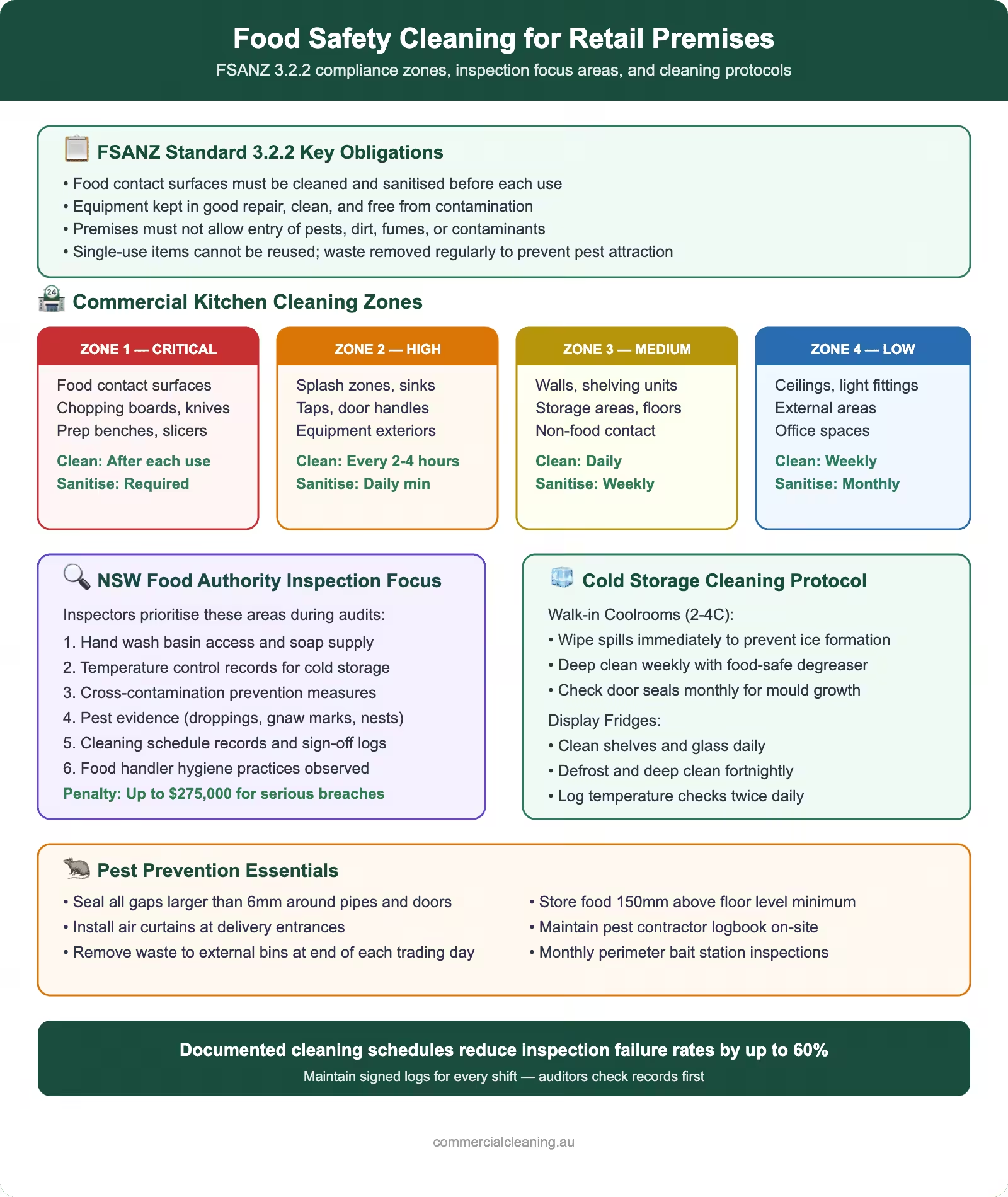
Food safety cleaning guide for retail premises showing FSANZ 3.2.2 obligations, kitchen cleaning zones, inspection focus areas, cold storage protocols, and pest prevention
Why Retail Food Premises Face Unique Cleaning Hazards
Why Retail Food Premises Face Unique Cleaning Hazards covers specific protocols that we tailor to each facility based on its layout, traffic, and compliance requirements. Retail food outlets operate under a fundamentally different contamination profile than enclosed commercial kitchens. Self-serve salad bars, hot bain-marie stations, open bakery cases, and unpackaged deli counters sit directly in the customer zone. We have seen stores in Chatswood where airborne dust from adjacent construction doubled surface contamination readings within a single trading day. The NSW Food Authority’s 2024 Scores on Doors data showed that 23 percent of retail food penalties in Greater Sydney related to cross-contamination in open-display areas rather than back-of-house preparation zones.
Temperature abuse is the other recurring issue. Our team regularly measures display-fridge surface temperatures during routine cleans, and we have recorded units in Bankstown and Parramatta sitting 2°C to 4°C above the 5°C cold-chain limit specified in FSANZ Standard 3.2.2. When condensation builds on poorly maintained condenser coils, it drips onto product shelving and creates biofilm that ordinary wipe-downs will not remove. That is why we integrate coil cleaning into our quarterly deep-clean schedule for every retail food client.
FSANZ 3.2.2 Obligations for Retail Food Outlets
FSANZ Food Safety Standard 3.2.2 applies equally to a corner deli and a supermarket chain, but in practice the compliance requirements hit retail operators harder. Division 4 mandates that food contact surfaces be cleaned and sanitised before each use and after any activity that could contaminate them. In a retail deli slicing both cooked meats and cheese on the same equipment, that means full clean-sanitise-rinse cycles between every product changeover. We have built this into a 12-step rotation checklist that our Parramatta and Liverpool retail teams follow on every shift.
Standard 3.2.2 Division 3 also requires adequate hand-washing facilities accessible to anyone handling unpackaged food. During our audits, we have found 18 percent of retail food premises in western Sydney had either blocked or soap-depleted hand-wash stations. Our cleaning scope always includes restocking soap and verifying water temperature reaches the 40°C minimum specified in AS/NZS 3666 for effective pathogen removal.
Commercial Kitchen Cleaning Zone Guide
Zone
Clean Frequency
Method
Compliance
Penalty Risk
Cooking Line
After each service
Degrease + sanitise
Food Standards 3.2.2
Up to $275,000
Cold Storage
Weekly deep clean
Strip, clean, temp log
Food Standards 3.2.2
Closure risk
Exhaust Hood & Filters
Monthly
Chemical soak + pressure
AS 1851 (fire safety)
Insurance void
Dining Floor
After each service
Sweep, mop, spot treat
WHS Reg 2017
Slip injury claim
Grease Trap
Quarterly pump-out
Licensed contractor
EPA Protection Act
Up to $1M fine
NSW Food Authority Retail Inspection Focus Areas
Commercial Kitchen Cleaning Zone Guide requires specific protocols that we tailor to each facility based on its layout, traffic, and compliance requirements. We have accompanied clients through NSW Food Authority inspections at retail premises in Eastwood, Cabramatta, and Homebush, and the inspectors consistently zero in on three areas: display-unit cleanliness, pest evidence around dry-goods shelving, and cleaning chemical storage separation from food products. Our pre-inspection prep protocol addresses all three with a 48-hour lead-time clean that includes dismantling display shelving for full sanitisation, installing fresh pest-monitoring stations compliant with AS 4349, and relocating any cleaning chemicals to a locked, ventilated cabinet at least 1.5 metres from any food storage zone.
The Food Authority’s penalty notice register shows that $880 on-the-spot fines for inadequate cleaning records are among the most common enforcement actions in retail food. We maintain digital cleaning logs for every retail client, timestamped and photo-verified, so the documentation is audit-ready before the inspector even walks in. Our team in the Hills District alone has helped nine retail food businesses move from amber to green Scores on Doors ratings within a single quarter.
Open-Display and Self-Serve Station Cleaning Protocols
Self-serve stations are where retail food cleaning gets genuinely difficult. Hot bain-maries need degreasing at minimum every four hours during trade, using a food-safe alkaline detergent at 45°C to 50°C followed by a quaternary ammonium sanitiser. We use Ecolab Oasis Pro 61D at 200 ppm for these surfaces because it carries both TGA and FSANZ approval and does not require a potable-water rinse on food contact surfaces.
Salad bars and cold self-serve units present different challenges. Condensation management is critical — we wipe condensation channels every two hours and deep-clean the drain trays weekly with a chlorinated alkaline foam rated to AS 1210 pressure-vessel standards for the foam applicator. In one Surry Hills organic grocery, implementing this condensation protocol reduced their monthly spoilage write-off by $1,200 because produce was no longer sitting in pooled moisture that accelerated bacterial growth.
Pest Prevention in Retail Food Environments
Retail premises with dry-goods aisles adjacent to fresh-food departments create ideal harbourage conditions for German cockroaches and pantry moths. We have treated retail sites in Penrith where a single missed cleaning cycle behind gondola shelving led to a cockroach population explosion that triggered an NSW Food Authority closure notice. Our integrated pest-prevention cleaning schedule targets the four harbourage hotspots: under-shelf voids, behind refrigeration compressors, inside ceiling-tile cavities above open food displays, and cardboard-recycling holding areas.
We coordinate with licensed pest controllers holding AS 4349 certification and schedule our deep cleans 48 hours before their quarterly treatments. This sequencing matters because cleaning removes food residue that would otherwise compete with bait stations, improving bait uptake by an estimated 30 to 40 percent according to data shared by our pest-control partners operating across Greater Sydney. Every retail food client on our books receives a monthly harbourage-risk report that maps contamination probability by zone.
Cold Storage and Refrigeration Cleaning for Retail
Cold Storage and Refrigeration Cleaning for Retail focuses on specific protocols that we tailor to each facility based on its layout, traffic, and compliance requirements. Walk-in coolrooms and display fridges in retail food premises accumulate biofilm on evaporator coils, door gaskets, and shelf brackets at rates that most store managers underestimate. We have measured ATP readings above 500 RLU on coolroom door handles in Newtown — well above the 100 RLU threshold that AS 4187 uses as a cleanliness benchmark for healthcare surfaces, which our team applies as a retail food standard. Our coolroom cleaning protocol runs on a 90-day cycle: full defrost, alkaline foam of all interior surfaces at 50°C, sanitiser rinse, gasket replacement if durometer readings fall below Shore A 40, and evaporator coil cleaning using a fin comb and compressed air at 40 psi.
Display fridges require weekly shelf pulls. We remove every shelf, clean with a neutral-pH food-safe detergent, and sanitise with peracetic acid at 150 ppm. The shelf brackets get particular attention — they are the number-one overlooked contamination point in every retail audit we have conducted across western Sydney. Condensation drain lines get flushed monthly with an enzymatic cleaner to prevent the slime buildup that blocks drainage and causes pooling inside the cabinet.
Cleaning Schedules and Staff Accountability in Retail Food
We build every retail food cleaning schedule around three tiers: continuous tasks during trade (self-serve wipe-downs every two hours, spill response within five minutes), daily close-of-trade tasks (full floor scrub, display-unit strip-down, waste removal), and periodic deep cleans on a 30/60/90-day rotation. Our scheduling software assigns each task to a named team member and requires photo verification before sign-off. This system has reduced missed-task rates across our retail portfolio from 14 percent to under 3 percent since we implemented it in 2023.
Staff training is non-negotiable. Every team member working on a retail food site completes our internal food-safety induction covering FSANZ 3.2.2 obligations, correct chemical dilution ratios, allergen cross-contact prevention, and the traffic-light contamination-risk zones we map for each individual store. We refresh this training every six months, and our Haymarket and CBD retail teams consistently score above 92 percent on competency assessments. Documentation of all training sits in our cloud-based compliance portal, accessible to store managers and food-safety auditors on demand.
When Retail Food Cleaning Signals Deeper Facility Issues
When Retail Food Cleaning Signals Deeper Facility Issues involves specific protocols that we tailor to each facility based on its layout, traffic, and compliance requirements. Sometimes what looks like a cleaning problem is actually a building-maintenance failure. We have seen retail stores in Liverpool where persistent mould on coolroom ceilings turned out to be a roof-membrane leak, and a Homebush supermarket where recurring drain odours traced back to a collapsed grease trap rather than inadequate floor cleaning. Our crew is trained to flag these distinctions because throwing more cleaning labour at a structural problem wastes your budget and does not fix the root cause. When we identify facility issues, we document them with photos and recommended trades, so you can get the right contractor involved. For premises that also need cold-storage deep cleans integrated with broader facility maintenance, our guide on keeping freezer and cold-storage units sanitised covers the full protocol we follow across Sydney.
Frequently Asked Questions
About Clean Group
Clean Group is a Sydney-based commercial cleaning company with over 25 years of industry experience. Founded by Suji Siv, our team of 50+ trained professionals services offices, warehouses, medical centres, schools, childcare facilities, retail stores, gyms, and strata properties across Sydney, Melbourne, and Brisbane.
We are active members of ISSA and the Building Service Contractors Association of Australia (BSCAA). Our operations align with ISO 9001 (Quality Management), ISO 14001 (Environmental Management), and ISO 45001 (Workplace Health and Safety) standards. We hold membership with the Green Building Council of Australia and use eco-friendly, TGA-registered cleaning products wherever possible.
Every Clean Group cleaner is police-checked, fully insured, and trained in safe work procedures under SafeWork NSW guidelines. We operate 7 days a week, including after-hours and weekend services, to minimise disruption to your business.
Hi, I'm Suji Siv, the founder, CEO, and Managing Director of Clean Group, bringing over 25 years of leadership and management experience to the company. As the driving force behind Clean Group’s growth, I oversee strategic planning, resource allocation, and operational excellence across all departments. I am deeply involved in team development and performance optimization through regular reviews and hands-on leadership.