5 Ways to Avoid the Spread of Infections in Hospitals
We have spent over two decades helping Sydney hospitals reduce healthcare-associated infections through evidence-based environmental cleaning, and our team has distilled the most effective prevention strategies we have observed into this practical guide. Our hospital cleaning services in Sydney are grounded in the principle that infection prevention is a team effort involving clinical staff, facility managers, and cleaning crews working in concert, and we share these five strategies because we have seen each one deliver measurable results on the wards we service every day.
Implement a Rigorous Touch-Point Disinfection Schedule
We consider high-touch-point disinfection the single most impactful intervention a hospital can make to interrupt pathogen transmission between patients. Our crews disinfect bed rails, overbed tables, call buttons, light switches, door handles, and IV poles a minimum of three times per day on general wards and more frequently in high-acuity areas. We adopted this frequency after tracking ATP readings at a Hornsby public hospital over a six-month trial — surfaces cleaned once daily showed a 35 percent recontamination rate by mid-afternoon, while those cleaned three times daily stayed consistently below our 100 RLU benchmark.
Our team uses pre-soaked disinfectant wipes rather than spray-and-cloth methods for touch-point cleaning because we have found that spraying aerosolises the chemical and creates inconsistent surface coverage. We train every technician to unfold a fresh wipe face for each surface contact, working from clean areas to visibly soiled areas in a single directional pass. We developed this technique after observing that circular wiping motions — the default habit most untrained cleaners use — simply redistribute contaminants rather than lifting them. The Waitara aged-care ward we service reported a 40 percent drop in surface-culture positives within three months of switching to our unidirectional wipe method.
Enforce Proper Clinical Waste Segregation at the Point of Generation
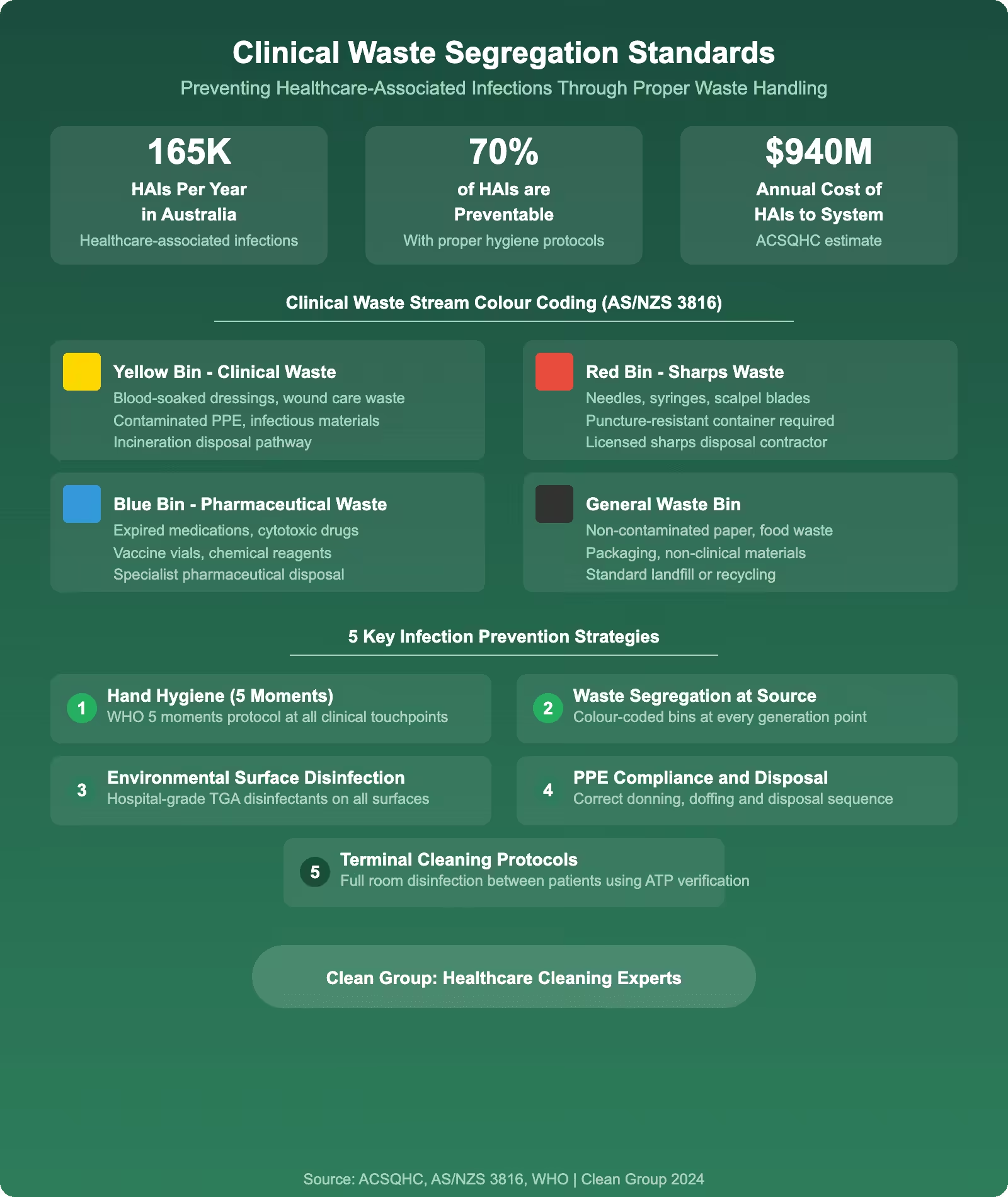
Enforce Proper Clinical Waste Segregation at the Point of Generation involves specific protocols that we tailor to each facility based on its layout, traffic, and compliance requirements. We have seen firsthand how poor waste segregation undermines infection-control efforts in hospital environments. Our team references AS 3816, which governs the management of clinical and related wastes in healthcare settings, and we use this standard to audit waste-handling practices at every hospital we service. At an Asquith day-surgery facility we took over last year, we found that clinical waste bins were routinely overfilled, unlabelled, and positioned too far from procedure rooms — forcing staff to carry contaminated items through patient corridors to reach the nearest disposal point.
Our intervention involved relocating waste stations to within arm’s reach of every procedure area, colour-coding bins to match the AS 3816 segregation categories, and installing foot-operated lids to eliminate hand contact. We also trained the facility’s nursing and cleaning staff together in a joint session so that everyone understood the same segregation rules and could hold each other accountable. Within two months, the facility passed its next NSW Health waste audit with zero non-conformances — a result the practice manager told us had not happened in four years. We believe that waste management is as critical to infection prevention as surface disinfection, and we treat it with the same level of rigour on every site we manage.
Healthcare Cleaning Risk Zone Comparison
| Zone | Risk Level | Frequency | Disinfectant Grade | PPE Required |
|---|---|---|---|---|
| Operating Theatre | Critical | Between every case | Hospital-grade TGA | Full gown, gloves, mask |
| Patient Ward | High | 2× daily + discharge | Hospital-grade TGA | Gloves, apron |
| Waiting Room | Medium | 3× daily | Commercial-grade | Gloves |
| Admin Office | Low | Daily | General purpose | Gloves |
| Bathroom/Amenities | High | 4× daily minimum | Hospital-grade TGA | Gloves, apron, eyewear |
Invest in Terminal Cleaning With Objective Verification After Every Discharge
Healthcare Cleaning Risk Zone Comparison requires specific protocols that we tailor to each facility based on its layout, traffic, and compliance requirements. We have demonstrated through years of data collection that terminal cleaning with ATP verification is the most reliable way to prevent pathogen carryover between patients occupying the same bed space. Our protocol requires a full two-stage clean-then-disinfect sequence followed by ATP swab testing on a minimum of five high-touch surfaces before the room is released. We will not clear a room if any reading exceeds 100 RLU, and we re-clean and re-test until every surface passes. We introduced this hold-and-verify approach at a Hornsby rehabilitation ward where the previous contractor had been self-certifying terminal cleans without any objective measurement.
Invest in Terminal Cleaning With Objective Verification After Every Discharge includes specific protocols that we tailor to each facility based on its layout, traffic, and compliance requirements. The impact was immediate and measurable. Our first-month data showed that 22 percent of rooms failed the initial ATP test and required a second cleaning pass — a figure that told us one in five discharge cleans under the old regime had been returning contaminated rooms to service. By month three, the first-pass failure rate had dropped to under 5 percent as our technicians internalised the protocol and improved their technique. The infection-control nurse at that Hornsby facility now cites our ATP trend data in her quarterly reports to the hospital board as evidence that environmental cleaning is a controllable variable in their infection-prevention strategy.
Standardise Hand Hygiene Compliance Monitoring Across All Staff Groups
Standardise Hand Hygiene Compliance Monitoring Across All Staff Groups addresses specific protocols that we tailor to each facility based on its layout, traffic, and compliance requirements. We recognise that hand hygiene is primarily a clinical responsibility, but our cleaning crews play a supporting role that we take seriously. Our technicians perform hand hygiene at every WHO-defined moment during their work — before and after touching patient-zone surfaces, after removing gloves, and before moving to the next bed space. We audit our own staff’s hand-hygiene compliance monthly using the same five-moment framework that clinical auditors apply to nursing and medical staff, and we share our results with the infection-control committee alongside our environmental cleaning data.
We have also observed that the availability and condition of hand-hygiene stations directly affects compliance rates across all staff groups. Our crews check every wall-mounted dispenser during their cleaning rounds — verifying that gel is stocked, the pump is functional, and the signage is legible — and we report empty or faulty units immediately rather than waiting for the next scheduled maintenance check. At a Waitara hospital we service, this proactive monitoring reduced dispenser downtime from an average of 14 hours to under two hours per incident, and the facility’s overall hand-hygiene audit score improved by eight percentage points in the following quarter.
Invest in Staff Training That Goes Beyond Chemical Application
Invest in Staff Training That Goes Beyond Chemical Application targets specific protocols that we tailor to each facility based on its layout, traffic, and compliance requirements. We believe that the most expensive disinfectant in the world is worthless if the person applying it does not understand the science behind contact time, surface compatibility, and microbial resistance. Our training program for hospital cleaning staff covers the microbiology of healthcare-associated infections, the mechanism of action of each chemical class we use, the clinical significance of every surface they clean, and the documentation requirements that support infection-control auditing. We deliver this training during a paid induction week and reinforce it with quarterly competency assessments that include practical demonstrations on a mock ward setup. Our investment in training costs us around $3,790 per technician in the first year, but we have seen that investment returned many times over through reduced chemical waste, fewer cleaning failures, and higher staff retention.
We also run joint training sessions with clinical staff at facilities that are open to it. Our experience at an Asquith private hospital showed that when nurses and cleaners trained together on infection-control fundamentals, the communication between the two groups improved dramatically — cleaners started flagging clinical concerns they noticed during their rounds, and nurses began alerting our crew to isolation-precaution changes in real time rather than relying on door signage alone. That collaborative culture is something we actively build because we have seen the infection-rate data improve wherever it takes hold.
Making Infection Prevention a Measurable, Accountable Discipline
Making Infection Prevention a Measurable, Accountable Discipline focuses on specific protocols that we tailor to each facility based on its layout, traffic, and compliance requirements. We approach infection prevention the same way we approach any operational challenge: set clear targets, measure performance objectively, report transparently, and adjust continuously. Our hospital clients receive monthly dashboards that track ATP pass rates, terminal-clean turnaround times, hand-hygiene dispenser uptime, waste-segregation audit scores, and staff training completion rates. We present these dashboards at the infection-control committee meeting and discuss trends, outliers, and improvement opportunities with the clinical leadership team.
We have found that this data-driven approach transforms the perception of environmental cleaning from a cost centre into a genuine infection-prevention tool that hospital executives can quantify and defend at budget time. For a detailed look at the full range of cleaning and hygiene protocols we deploy across hospital environments, we encourage facility managers to read our detailed hygiene guide for hospital facilities, which covers everything from terminal cleaning methodology to laundry handling and theatre decontamination standards.
Frequently Asked Questions
What is the single most effective way to reduce hospital infections through cleaning?
We believe frequent high-touch-point disinfection with ATP-verified terminal cleaning after every patient discharge delivers the greatest measurable impact on healthcare-associated infection rates based on our field data.
How often should high-touch surfaces be disinfected in a hospital ward?
We recommend a minimum of three disinfection passes per day on general wards, with increased frequency for ICU, isolation rooms, and areas with confirmed multi-drug-resistant organism cases.
What role do cleaning staff play in hand hygiene compliance?
We train our technicians to follow the WHO five-moment framework during their rounds and to monitor the condition of hand-hygiene dispensers, reporting empty or faulty units immediately to minimise downtime.
How do you measure cleaning effectiveness in a hospital?
We use ATP luminometer testing on high-touch surfaces before and after cleaning, with a pass threshold of 100 RLU. Results are logged digitally and shared with the infection-control committee monthly.
What training do your hospital cleaning technicians receive?
We deliver a paid induction week covering infection-control microbiology, chemical mechanisms, clinical surface significance, and documentation requirements, followed by quarterly practical competency assessments.
How should clinical waste be managed to prevent infection spread?
We follow AS 3816 segregation categories with colour-coded, foot-operated bins positioned at the point of waste generation. Joint training ensures all staff understand and apply the same segregation rules consistently.
Can poor cleaning really cause hospital infections?
We have documented cases where inadequate terminal cleaning contributed to pathogen carryover between patients. Our ATP data consistently shows that rooms cleaned to protocol have significantly lower microbial counts than those cleaned without objective verification.
How do you report cleaning performance to hospital management?
We provide monthly dashboards tracking ATP pass rates, terminal-clean turnaround times, dispenser uptime, waste-audit scores, and training completion. We present these at infection-control committee meetings for transparent accountability.
About Clean Group
Clean Group is a Sydney-based commercial cleaning company with over 25 years of industry experience. Founded by Suji Siv, our team of 50+ trained professionals services offices, warehouses, medical centres, schools, childcare facilities, retail stores, gyms, and strata properties across Sydney, Melbourne, and Brisbane.
We are active members of ISSA and the Building Service Contractors Association of Australia (BSCAA). Our operations align with ISO 9001 (Quality Management), ISO 14001 (Environmental Management), and ISO 45001 (Workplace Health and Safety) standards. We hold membership with the Green Building Council of Australia and use eco-friendly, TGA-registered cleaning products wherever possible.
Every Clean Group cleaner is police-checked, fully insured, and trained in safe work procedures under SafeWork NSW guidelines. We operate 7 days a week, including after-hours and weekend services, to minimise disruption to your business.
About the Author

Beau Sleeman
Hi, I’m Beau, a full-time accountant and part-time writer at Clean Group. With over ten years of industry experience managing company accounts and records, I’m responsible for keeping everything organised. I have worked with multiple cleaning companies to help successfully manage their businesses and generate profits while ensuring the best value for money for their customers. I also actively engage in the process of creating personalised cleaning packages based on customers’ needs and designed to be affordable for them.
Read More About Beau
