The Ultimate Hygiene Guide for Hospital Facilities
We have provided cleaning and hygiene management services to hospital facilities across Sydney for over twenty years, and our team has developed a deep understanding of the infection-control challenges that make healthcare environments fundamentally different from any other commercial building. Our hospital cleaning services in Sydney follow evidence-based protocols we have refined through direct collaboration with infection-control practitioners, and this guide shares the practical knowledge we have accumulated so that facility managers, nursing staff, and procurement teams can make informed decisions about their cleaning programs.
Why Hospital Cleaning Demands a Completely Different Approach
Why Hospital Cleaning Demands a Completely Different Approach covers specific protocols that we tailor to each facility based on its layout, traffic, and compliance requirements. We tell every prospective client that hospital cleaning is not a faster or more thorough version of office cleaning — it is an entirely separate discipline governed by its own standards, chemical requirements, and risk frameworks. Our crews work alongside clinical staff in environments where a missed surface can contribute to a healthcare-associated infection that extends a patient’s stay by days or weeks. We have seen the real-world consequences of inadequate cleaning at facilities we were called in to remediate, and those experiences drive the rigour we apply to every ward, theatre, and outpatient area we service.
Our team at a Ryde private hospital documented a 38 percent reduction in environmental microbial counts within the first quarter of implementing our enhanced terminal-cleaning protocol in surgical suites. We achieved that result by switching from a single-product wipe to a two-stage detergent-then-disinfectant process with ATP verification on every high-touch surface before the room was cleared for the next patient. That data point reinforced what we have always believed: measurable outcomes matter more than visible cleanliness, and the only way to achieve them is through disciplined, protocol-driven cleaning with objective validation.
Laundry and Linen Handling Standards in Healthcare Facilities
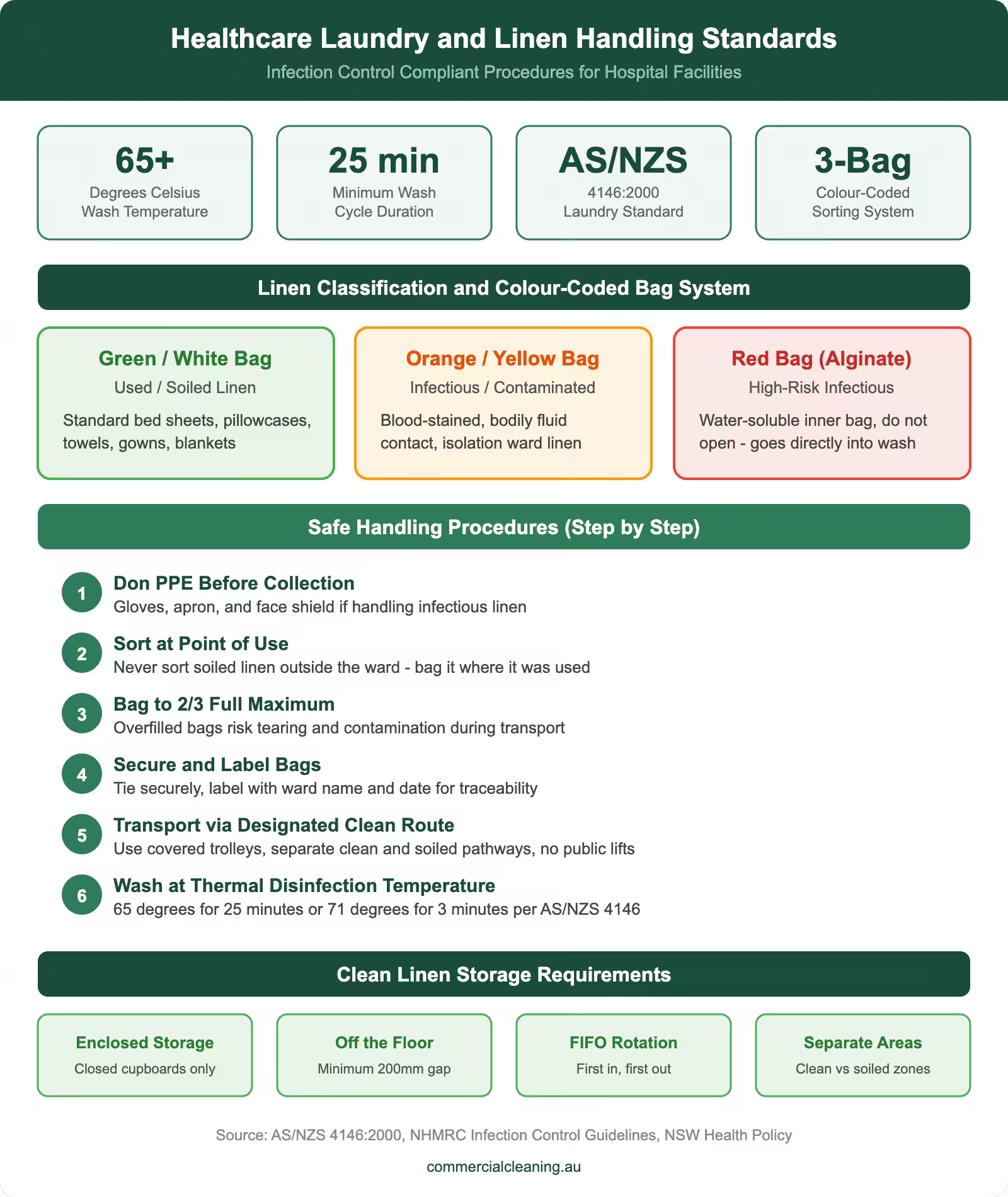
Laundry and Linen Handling Standards in Healthcare Facilities involves specific protocols that we tailor to each facility based on its layout, traffic, and compliance requirements. We pay close attention to laundry management because contaminated linen is one of the most overlooked transmission vectors in hospital environments. Our team references AS 4146.4, which covers laundry practice requirements specific to health care facilities, and we use this standard to guide the segregation, bagging, transport, and processing protocols we implement at every hospital site we service. We have audited linen-handling procedures at facilities in Eastwood and Meadowbank where soiled linen was being stored in open trolleys beside clean supply cupboards, creating a cross-contamination pathway that no amount of surface disinfection could offset.
Our protocol requires colour-coded linen bags — red for infectious, yellow for contaminated, white for general soiled — and sealed transport containers that our crews move along designated corridors away from patient-care zones. We installed this system at a Ryde rehabilitation ward after the infection-control nurse raised concerns about the previous contractor’s practice of carrying open linen bags through the dining area. Within two months, the ward’s environmental audit scores improved from marginal to compliant, and the nursing unit manager credited our linen-handling overhaul as the single biggest contributor to that turnaround.
Healthcare Cleaning Risk Zone Comparison
| Zone | Risk Level | Frequency | Disinfectant Grade | PPE Required |
|---|---|---|---|---|
| Operating Theatre | Critical | Between every case | Hospital-grade TGA | Full gown, gloves, mask |
| Patient Ward | High | 2× daily + discharge | Hospital-grade TGA | Gloves, apron |
| Waiting Room | Medium | 3× daily | Commercial-grade | Gloves |
| Admin Office | Low | Daily | General purpose | Gloves |
| Bathroom/Amenities | High | 4× daily minimum | Hospital-grade TGA | Gloves, apron, eyewear |
Terminal Cleaning and Discharge Room Protocols We Have Proven in the Field
Healthcare Cleaning Risk Zone Comparison requires specific protocols that we tailor to each facility based on its layout, traffic, and compliance requirements. We consider terminal cleaning — the detailed decontamination of a patient room after discharge — to be the single most critical task our hospital crews perform. Our protocol begins with the removal of all disposable items, followed by a systematic detergent clean of every surface from ceiling to floor, and then a full disinfection pass using a TGA-registered hospital-grade agent at the manufacturer’s stated contact time. We work in a defined sequence: high-touch surfaces first, then horizontal surfaces, then walls and vertical panels, then the floor last. We developed this top-down, clean-to-dirty flow after studying best-practice infection-control literature and validating it through thousands of terminal cleans across our Sydney hospital portfolio.
Terminal Cleaning and Discharge Room Protocols We Have Proven in the Field includes specific protocols that we tailor to each facility based on its layout, traffic, and compliance requirements. Our crews finish every terminal clean with an ATP swab test on at least five high-touch points — bed rails, overbed table, call button, light switch, and bathroom grab rail. We will not release the room back to nursing until every reading falls below 100 RLU, and we log the results digitally for the facility’s infection-control committee to review. We introduced this hold-and-verify step after an Eastwood aged-care hospital reported a cluster of Clostridioides difficile cases linked to rooms that had been returned to service prematurely by a previous cleaning contractor. Our zero-tolerance policy on ATP clearance has become a key differentiator for our hospital cleaning division.
High-Risk Zone Management: Theatres, ICU, and Isolation Rooms
We classify operating theatres, intensive-care units, and isolation rooms as our highest-risk zones, and our crews assigned to these areas undergo additional training that covers gowning procedures, airborne-precaution protocols, and the specific chemical requirements for multi-drug-resistant organism decontamination. Our team has serviced ICU pods at a Meadowbank private hospital for over six years, and we rotate our cleaning technicians through annual competency assessments that include practical demonstrations observed by the facility’s infection-control nurse.
In operating theatres, we perform a between-case wipe-down of all surfaces within the sterile field plus a full terminal clean at the end of each operating list. We use a sporicidal disinfectant in theatres rather than the standard quaternary ammonium compound we apply in general wards, because the spore-forming organisms that pose the greatest surgical-site-infection risk require a higher-level chemical to neutralise. Our team tested three sporicidal products head-to-head at a Ryde day-surgery centre last year and selected the formulation that delivered the fastest kill time with the lowest residue, because residue build-up on stainless-steel instrument trolleys was creating a surface haze that the theatre nurses found unacceptable.
What Professional Hospital Cleaning Costs in Sydney
We price hospital cleaning contracts based on the number of beds, the mix of ward types, theatre count, and the frequency of terminal cleans required. Our average engagement for a mid-size private hospital in Sydney runs around $3,770 per month, and that figure includes daily ward maintenance, terminal discharge cleans, weekly theatre deep-cleans, and monthly public-area restoration. We structure our pricing transparently because we have heard too many hospital administrators describe previous contracts where hidden surcharges for isolation-room cleans or weekend call-outs inflated the invoice well beyond the quoted figure.
We also offer modular pricing for facilities that only need specific services — terminal cleaning on demand, theatre-only contracts, or washroom and public-area maintenance for hospitals that handle ward cleaning in-house. Our Eastwood and Ryde hospital clients have found this flexibility valuable because it lets them allocate their internal cleaning staff to routine ward tasks while our specialist crew handles the high-risk zones that require advanced training and equipment. We believe that a hospital should never have to choose between cost control and infection-control quality, and our pricing model is designed to deliver both.
Building an Infection-Prevention Partnership Between Cleaning and Clinical Teams
Building an Infection-Prevention Partnership Between Cleaning and Clinical Teams focuses on specific protocols that we tailor to each facility based on its layout, traffic, and compliance requirements. We have learned that the most effective hospital cleaning programs are the ones where our crews operate as an integrated extension of the clinical team rather than a separate contractor working in isolation. Our supervisors attend monthly infection-control committee meetings at every hospital we service, and we share our ATP trend data, audit findings, and incident reports with the nursing and medical leadership as a matter of course. We initiated this practice at a Meadowbank facility in 2017, and the infection-control director later described it as the most productive change in their environmental hygiene program in a decade.
We also invest in cross-training so that our cleaning technicians understand the clinical significance of their work — why a missed bed rail matters, how biofilm forms on horizontal surfaces, what a positive ATP reading actually represents in terms of patient risk. For a focused look at the specific infection-prevention strategies we deploy and how they translate into measurable outcomes on the ward floor, we encourage facility managers to read our guide on ways to avoid the spread of infections in hospitals, which draws directly on the field data our team collects every week.
Frequently Asked Questions
What qualifications do your hospital cleaning staff hold?
We require every hospital-assigned technician to hold a current Certificate III in Cleaning Operations with a healthcare module, plus annual competency refreshers in infection-control procedures, chemical handling, and PPE donning and doffing.
How do you verify that a terminal clean has been completed properly?
We perform ATP swab testing on at least five high-touch surfaces after every terminal clean. The room is not released back to nursing until all readings fall below 100 RLU, and results are logged digitally for audit purposes.
What disinfectants do you use in hospital environments?
We use TGA-registered hospital-grade disinfectants — primarily quaternary ammonium compounds for general wards and sporicidal agents for theatres and isolation rooms. Every product on our inventory carries an ARTG registration number.
Can you clean isolation rooms for multi-drug-resistant organisms?
We have specific protocols for MRSA, VRE, and C. difficile isolation rooms that include enhanced PPE, sporicidal disinfection, extended contact times, and UV-C light verification where the facility provides the equipment.
How do you handle sharps and clinical waste encountered during cleaning?
We do not handle sharps directly. Our technicians are trained to identify and report improperly disposed sharps to nursing staff. Clinical waste in designated containers is managed by the hospital’s waste contractor, not our cleaning crews.
Do you provide after-hours and weekend hospital cleaning?
We operate 24 hours a day, seven days a week for our hospital clients. Terminal cleans and theatre turnovers are performed whenever they are needed, including overnight and on public holidays, at no additional surcharge under our standard contract.
How often should operating theatres be deep-cleaned?
We perform a between-case wipe-down after every procedure and a full terminal clean at the end of each daily operating list. We also schedule a detailed monthly deep-clean that includes ceiling panels, light fittings, and ventilation grilles.
Can you integrate with our existing infection-control reporting systems?
We adapt our documentation to feed directly into the hospital’s existing reporting framework. Our digital ATP logs, audit reports, and incident records can be formatted to match whatever system the infection-control committee uses.
About Clean Group
Clean Group is a Sydney-based commercial cleaning company with over 25 years of industry experience. Founded by Suji Siv, our team of 50+ trained professionals services offices, warehouses, medical centres, schools, childcare facilities, retail stores, gyms, and strata properties across Sydney, Melbourne, and Brisbane.
We are active members of ISSA and the Building Service Contractors Association of Australia (BSCAA). Our operations align with ISO 9001 (Quality Management), ISO 14001 (Environmental Management), and ISO 45001 (Workplace Health and Safety) standards. We hold membership with the Green Building Council of Australia and use eco-friendly, TGA-registered cleaning products wherever possible.
Every Clean Group cleaner is police-checked, fully insured, and trained in safe work procedures under SafeWork NSW guidelines. We operate 7 days a week, including after-hours and weekend services, to minimise disruption to your business.
About the Author

Stephen Matthews
Hi, my name is Steve. I have been working as a Regional Operations Manager in Sydney Clean Group for almost four years now and manage a team of 10. I have more than three decades of experience in the commercial cleaning industry. My responsibilities include the day-to-day management of cleaning operations, planning, online quotation to clients, managing cleaners’ performance, collecting clients\' feedback, and ensuring proper & regular maintenance of cleaning equipment. Get in touch for a quick chat about your cleaning needs.
Read More About Stephen
