Kitchen and Food Preparation Area Cleaning for Childcare Centres
The kitchen and food preparation areas in childcare centres are among the most critical spaces we service at Clean Group. Unlike standard commercial kitchens, childcare centre cleaning demands we balance health protection with the reality that young children—from infants in high chairs to toddlers exploring everything—spend time nearby. We’ve worked across the greater Sydney region, including Parramatta, Castle Hill, Bella Vista, Chatswood, Bankstown, Liverpool, Penrith, and Hornsby, and we’ve learned that food safety in childcare isn’t just about meeting Food Standards Australia New Zealand (FSANZ) regulations. It’s about creating an environment where children can be safe while they develop healthy eating habits.
The legal and regulatory framework is substantial. The Education and Care Services National Regulations 2011 (specifically Regulations 77 and 78) set the baseline, but it’s the ACECQA National Quality Standard (NQS), particularly Quality Area 2: Children’s Health and Safety, that sets the real standard for professional childcare cleaning. Add the NSW Food Act 2003, the NSW Food Authority’s guidance, and the Food Standards Code requirements for food premises, and you’ll understand why we treat childcare kitchen cleaning as a specialist service. Our team combines HACCP principles with the specific demands of childcare environments to deliver cleaning that protects children while meeting every regulatory requirement.
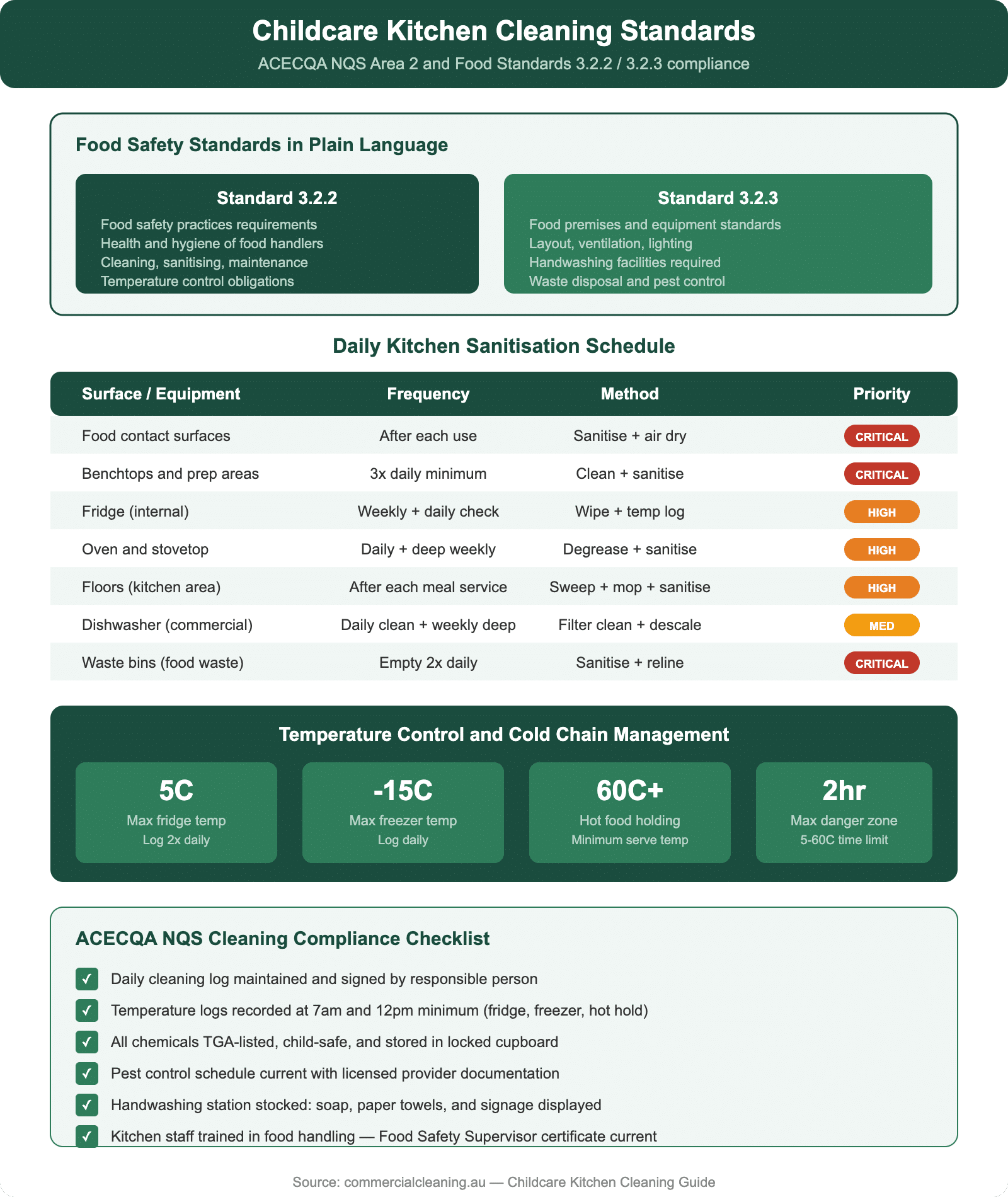
Childcare kitchen cleaning standards showing ACECQA NQS Area 2 requirements, daily sanitisation schedule, temperature control, and compliance checklist
ACECQA NQS Area 2: Kitchen Cleaning Requirements for Childcare
ACECQA, the Australasian Children’s Education & Care Quality Authority, doesn’t publish a single “kitchen cleaning checklist,” but Quality Area 2 makes the expectations clear: childcare services must maintain a clean, hygienic environment and manage risks to children’s health and safety. We’ve conducted over 25 years of professional cleaning in Sydney, and we can tell you that ACECQA assessors scrutinise kitchen facilities intensively during quality assessment visits. They’re looking for evidence that the service understands food safety, implements preventive cleaning schedules, and maintains control over cross-contamination risks.
The standard breaks down into observable practices. Your kitchen surfaces must be visibly clean and free from food residue; equipment must be maintained and sanitised; storage must prevent pest access; handwashing facilities must be clean and accessible; and the team must follow documented food preparation and cleaning procedures. We’ve worked with centres in Bella Vista and Castle Hill where previous cleaners had overlooked grease accumulation on exhaust hoods or missed regular sanitisation of food contact surfaces. When we took over their cleaning schedule, we introduced structured daily and weekly protocols aligned with NQS expectations, and the difference in their quality assessment outcomes was marked.
From our experience, the centres that perform best in ACECQA assessments are those with professional cleaning support. We document our work, provide evidence of sanitiser use (product name, dilution, contact time), photograph baseline conditions, and maintain communication logs. The NSW Food Authority and ACECQA expect to see this level of record-keeping, even if staff conduct routine daily cleaning between our professional visits.
Food Safety Standards 3.2.2 and 3.2.3 in Plain Language
The Food Standards Code Chapter 3, Standards 3.2.2 (Food Safety Practices and General Requirements) and 3.2.3 (Food Premises and Equipment) are the backbone of legal food safety in Australia. We translate these into actionable cleaning tasks for childcare kitchens. Standard 3.2.2 requires that food be handled in a manner that prevents contamination; standard 3.2.3 sets physical and operational requirements for food premises themselves. The NSW Food Authority enforces these through inspections, and while childcare centres aren’t food businesses under the standards, if they operate on-site kitchens preparing food for children, these standards apply to the physical facilities and practices.
In practical terms, this means your kitchen must meet three conditions: the premises design allows for effective cleaning and sanitation; equipment is food-grade and properly maintained; and the layout prevents cross-contamination. We’ve encountered kitchens where equipment was old, difficult to clean, or positioned in ways that made proper sanitisation impossible. Our recommendations have included equipment replacement advice, layout optimization, and the introduction of colour-coded chopping boards and storage zones to separate raw foods (especially proteins), ready-to-eat foods, and allergen-containing items.
Standard 3.2.3 also touches on NHMRC Staying Healthy guidance, which recommends specific surface material choices, handwashing facilities, and food storage conditions. When we specify cleaning methods and product choices for childcare kitchens, we’re working within these standards. For example, a surface that’s difficult to sanitise or harbours bacteria in porous crevices fails the standard. We favour smooth, non-porous surfaces (stainless steel, commercial-grade laminates, sealed concrete) and make sureour cleaning methods can reach every millimetre.
Daily Kitchen Sanitisation: High-Touch Surfaces and Food Contact Areas
Daily Kitchen Sanitisation: High-Touch Surfaces and Food Contact Areas requires specific protocols that we tailor to each facility based on its layout, traffic, and compliance requirements. We divide childcare kitchen cleaning into three frequencies: constant (during food preparation), daily (end of shift and between meal services), and weekly (deep cleaning). Our team at Clean Group has learned that consistent daily sanitisation of high-touch surfaces and food contact areas is where most childcare foodborne illness risks are actually eliminated, far more than occasional deep cleans. The temperature danger zone (5–60°C) and time-temperature abuse are real risks; bacteria multiply rapidly on surfaces left at room temperature with food residue. Our daily protocols neutralise that risk through targeted sanitisation.
High-touch surfaces in a childcare kitchen include taps, door handles, light switches, appliance controls, benchtops used for food preparation, and serve-over areas where staff hand food to children. Food contact areas include chopping boards, knives, food containers, and serving spoons. We sanitise these differently. For high-touch non-food surfaces, we use sodium hypochlorite solution at 200 parts per million (ppm) or a food-grade quaternary ammonium compound like Viraclean (where approved for food-contact areas), applied with contact time of 30 seconds minimum for wet surfaces, 60 seconds for dry. For food contact surfaces, we always use products approved by the TGA for food contact and follow the product’s contact time.
A typical daily schedule we implement for Parramatta and Chatswood centres includes:
The reason we emphasise daily high-touch surface sanitisation is backed by food safety research. FSANZ and the NSW Food Authority recognise that cross-contamination happens through hands, utensils, and surfaces. A tap handle touched by a staff member who’s just handled raw chicken, then touched by another staff member preparing a bottle for an infant, is a contamination pathway. Our sanitisation protocols break that chain. In our experience across Sydney childcare centres, the ones with the lowest rates of foodborne illness incidents are those that combine staff handwashing discipline with professional daily surface sanitisation.
Temperature Control and Cold Chain Management
Cold chain management—maintaining correct temperatures for refrigerated and frozen foods—is mandated by Standard 3.2.2, and the NSW Food Authority enforces it vigorously. For childcare centres, this is critical because young children have less developed immune systems and are more vulnerable to foodborne illness from temperature-abused foods. We don’t control temperature settings (that’s the kitchen staff’s responsibility), but we support cold chain integrity through cleaning and monitoring.
Our role includes: regular cleaning and defrosting of refrigeration equipment to prevent frost buildup that insulates and reduces cooling efficiency; clearing vents and condenser coils; ensuring thermometer placement and readability; and inspecting for signs of temperature abuse (ice crystals, leakage, condensation patterns). We’ve seen centres in Liverpool and Penrith where industrial fridges were heavily iced over—a sign of poor maintenance that compromises food safety. We coordinate with facility managers to schedule defrosting during times that don’t disrupt meal preparation.
The temperature danger zone (5–60°C) is where bacteria multiply exponentially. Food left on benchtops, in room-temperature stores, or in failing fridges can move through this zone rapidly. During our professional cleaning visits, we check that refrigerator thermometers are visible and accurate. Many centres don’t realise that a fridge reading 6°C might actually be 8–10°C in the warmest zone, which risks food safety. We document these observations and communicate them to the centre’s educational leader and kitchen manager. The Education and Care Services National Regulations 2011 place responsibility on the service, but professional cleaning oversight supports that responsibility.
Allergen Segregation and Cross-Contamination Prevention
Allergen Segregation and Cross-Contamination Prevention addresses specific protocols that we tailor to each facility based on its layout, traffic, and compliance requirements. Allergen management in childcare is both a clinical issue (related to Anaphylaxis Management Training and EpiPen availability) and a cleaning issue. We treat allergen segregation as a core cleaning responsibility, not a secondary task. Common major allergens include peanuts, tree nuts, milk, eggs, soy, wheat, fish, and shellfish. Some centres also manage sesame and lupin allergies. When a child has a severe allergy, the entire kitchen must prevent cross-contamination through food debris, shared utensils, shared surfaces, or airborne particles (for example, airborne peanut dust from crushing nuts).
Our approach across Hornsby, Chatswood, Castle Hill, and other Sydney suburbs includes:
Segregated Storage: We support the implementation of separate shelves or colour-coded zones for allergen-containing foods. Allergen-containing foods are stored above non-allergen foods to prevent drips and contamination. We keep these areas clearly labelled and maintain them during cleaning visits.
Dedicated Utensils and Cutting Boards: Allergy-friendly zones use separate chopping boards (colour-coded, for example, red for allergen-containing foods), knives, and utensils. We sanitise these separately and store them apart from general kitchen tools. Our team verifys these tools are never mixed with general kitchen equipment.
Surface Segregation: We designate specific benchtops or preparation areas for allergen-containing food preparation when possible. We sanitise allergen-preparation areas last or clean and sanitise them between allergen and non-allergen tasks to prevent cross-contact.
Hand Hygiene Protocols: Staff who handle allergen-containing foods must wash their hands before preparing non-allergen foods. Our cleaning routines support this by ensuring handwashing stations are clean, well-stocked with soap, and free from contamination.
Cleaning Product Choices: Allergens aren’t killed by sanitisers; they must be physically removed by detergent cleaning. We use food-grade, allergen-friendly detergents and make surerinsing is thorough. Some centres have protocols where allergen-contaminated surfaces are cleaned with detergent, rinsed multiple times, and dried with single-use paper towels (not cloth towels that might harbour allergen residue).
The legal framework here includes the Education and Care Services National Regulations 2011 (Regulation 77), which requires safe food handling and allergy management. Many centres also have formal allergen management plans developed by their educational leaders, nurses, and kitchen staff. Our cleaning protocols align with these plans. We’ve worked with centres in Bankstown and Parramatta where the allergen management plan explicitly detailed our cleaning responsibilities, and we follow those specifications exactly.
Bottle Warming Stations and Infant Feeding Equipment
Bottle warming stations and infant feeding equipment are areas where childcare cleaning differs markedly from general commercial kitchen cleaning. Infants are particularly vulnerable to foodborne illness, and bottle and feeding-equipment contamination can cause serious illness. The NHMRC Staying Healthy guidelines and the Education and Care Services National Regulations 2011 specify requirements for bottle and equipment sanitisation and storage.
We’ve designed specific protocols for bottle warming stations used at our client centres in Bella Vista, Chatswood, and surrounding areas. A typical protocol includes:
Bottle Warmer Cleaning: The warmer itself (the water bath and heating element) is cleaned daily. We drain the old water, wipe the interior and exterior, and refill with fresh water. We remove any mineral scale buildup using a food-safe descaling solution. The warmer is then sanitised by bringing water to 70°C and maintaining that temperature for 10 minutes, or by using an approved sanitiser solution.
Feeding Equipment Sanitisation: Bottles, teats, lids, and other feeding equipment are cleaned by hand with hot water and detergent, or in a dishwasher approved for food contact. After cleaning, they’re sanitised either by boiling (for 5+ minutes), steam sterilisation (if equipment allows), or chemical sanitisation using a TGA-approved sterilant. Our team doesn’t perform the hand-washing of bottles (that’s typically done by staff immediately after use), but we oversee the sanitation of the warmer, storage areas, and sterilisation equipment.
Storage of Sanitised Equipment: Sanitised bottles and equipment must be stored in a clean, dry container, protected from dust and contamination. We make surestorage areas are cleaned daily, shelves are wipe-down clean, and containers are sanitised weekly. If a sterilisation drum or storage box is used, it’s cleaned inside and out weekly with detergent, rinsed, dried, and filled with fresh or boiled water if required by the manufacturer.
Handwashing Before Bottle Handling: Staff handling bottles, formula, or feeding equipment must wash their hands thoroughly. We clean and sanitise handwashing stations used in or near bottle preparation areas multiple times daily, ensuring soap and single-use paper towels are always available.
The liability and safety stakes here are high. Contamination of infant formula or feeding equipment can cause serious illness or death. We treat these areas with the highest care and make sureour team is trained specifically in these protocols. Many of our team members working on childcare sites have completed Food Safety Supervisor certification and understand the microbiology behind these cleaning requirements.
Food-Grade Sanitisers and Product Selection for Childcare Kitchens
Product selection for childcare kitchen sanitisation is constrained by two factors: the product must be effective against foodborne pathogens and environmental contaminants, and it must be safe for use in an environment where young children are present or where food will be consumed. We don’t use heavy-duty institutional sanitisers (like some hospital-grade disinfectants) on food preparation surfaces without extensive rinsing, because residues could be toxic to children.
The approved sanitisers we use in childcare kitchens across Sydney include:
Sanitiser Type
Approved Uses
Typical Dilution & Contact Time
Advantages
Sodium Hypochlorite (household bleach)
High-touch surfaces, non-porous work surfaces (NOT recommended for food-contact surfaces without extensive rinsing)
200 ppm (about 1:50 dilution of 5% solution); 30–60 seconds contact time
As per product label, typically 10–60 seconds contact time; no rinsing required for food-contact surfaces (check product)
Suitable for food contact, no rinsing required (most), leaves residue that repels bacteria
Iodine-Based Sanitisers
Food contact surfaces, equipment; used in commercial kitchens
Typically 12.5 ppm iodine; 30 seconds contact time on wet surfaces; must rinse for food contact
Effective, but staining; less preferred in childcare due to colour residue and iodine sensitivity concerns
Alcohol-Based (Ethanol 70%)
High-touch surfaces, equipment; not suitable for heavy food residue
70% ethanol; 30 seconds contact time; leave to air-dry
Quick-drying, no rinsing, non-toxic residue; not effective on organic matter unless surface is pre-cleaned
Hydrogen Peroxide-Based
Food contact surfaces, equipment; breaks down to water and oxygen
Varies by product; typically 3–35% hydrogen peroxide; contact time 5–15 minutes
Environmentally friendly residue, safe for childcare, effective against many pathogens
Our team at Clean Group selects products based on the surface, the level of contamination risk, and the safety profile for childcare. For food-contact surfaces (chopping boards, utensils, benchtops used for food prep), we prefer food-grade quaternary ammonium products like Viraclean, which are TGA-approved and require no rinsing. For high-touch non-food surfaces, we use sodium hypochlorite at 200 ppm. For infant feeding equipment and bottle warmers, we often recommend hydrogen peroxide-based sanitisers or steam sterilisation, which leave no chemical residue.
We also respect allergen considerations. Some sanitisers (particularly iodine-based) can trigger reactions in children with iodine sensitivities, and we avoid them in centres where this is a known risk. We document all product choices, batch numbers, and dilutions in our cleaning logs, which are provided to the centre’s educational leader and retained for audit purposes. The NSW Food Authority and ACECQA expect to see this documentation during inspections.
Frequently Asked Questions
How often should a childcare kitchen be professionally deep-cleaned?
We recommend weekly deep cleaning for the kitchen spaces most heavily used (prep areas, benchtops, fridges, equipment) and fortnightly for less-used areas (walls, light fixtures, high shelves, underneath equipment). Many childcare centres we work with in Parramatta, Penrith, and Liverpool operate on a weekly deep-clean schedule because the regulatory risk and child safety stakes are too high for longer intervals. However, the exact frequency depends on the centre’s food volume, number of meals prepared on-site, and the findings of recent inspections. If ACECQA or the NSW Food Authority identifies non-compliances, we may recommend more frequent cleaning until the issues are resolved.
What’s the difference between sanitising and disinfecting?
Sanitising reduces microorganisms to safe levels (typically 99.99% reduction) and is appropriate for food-contact surfaces and food preparation areas. Disinfecting kills a broader spectrum of microorganisms (99.999%+ reduction) and is appropriate for non-food surfaces or after known contamination. In childcare kitchens, we sanitise food-contact surfaces (using food-grade products) and disinfect high-touch non-food surfaces like taps and door handles. The product, dilution, and contact time differ between the two, which is why product selection is so important.
Can staff use the same cloth to wipe down food-contact and non-food surfaces?
No, and we recommend against it. We advise childcare centres to use colour-coded cloths: one colour exclusively for food-contact surfaces, another for non-food surfaces. Between each use, cloths are rinsed and wrung out, and they’re replaced daily or more often if visibly soiled. We’ve seen cross-contamination incidents occur because cloths used on floors were then used on benchtops. At the start of our engagement with a centre, we supply colour-coded cloth systems and train staff on their use. We replace and sanitise these cloths as part of our cleaning service.
How do we manage a child’s severe food allergy in a shared kitchen?
Severe allergies require a written allergy management plan developed by the centre’s educational leader, nominated supervisor, and parents. From a cleaning perspective, we implement strict segregation: dedicated storage, separate utensils and cutting boards, designated preparation areas, and cleaning protocols that make sureno cross-contact. Some centres prepare the allergic child’s meals in a separate room or at a separate time, which simplifies our cleaning management. We coordinate with the centre to make sureour cleaning schedule supports these protocols. The NSW Food Authority and ACECQA both expect to see documented procedures, and we make sureour cleaning logs show that segregation protocols are maintained.
What should a childcare kitchen do if there’s a suspected foodborne illness outbreak?
If a centre suspects a foodborne illness outbreak (multiple children or staff with gastrointestinal symptoms linked to a meal), they should notify the NSW Food Authority immediately, retain any remaining food for testing, and conduct an enhanced cleaning. We’ve supported centres through these situations by providing rapid deep disinfection of all food preparation areas, equipment, and high-touch surfaces using approved disinfectants at full strength or appropriate dilutions for extended contact time. We also coordinate with staff to identify possible contamination sources. While we’re not food safety investigators (that’s the NSW Food Authority’s role), our technical knowledge helps centres respond quickly and prevent spread.
For more information on standards specific to childcare facility cleaning across Sydney, see our detailed guide on OSHC cleaning standards, which covers similar protocols adapted for school-age care environments.
About Clean Group
Clean Group is a leading commercial cleaning company in Sydney, providing professional cleaning services to offices, strata buildings, medical facilities, schools, gyms, and retail spaces across the greater Sydney region. With over 25 years of experience and a commitment to WHS compliance, eco-friendly practices, and consistent quality, Clean Group delivers tailored cleaning solutions backed by a 100% satisfaction guarantee.
Hi, I'm Suji Siv, the founder, CEO, and Managing Director of Clean Group, bringing over 25 years of leadership and management experience to the company. As the driving force behind Clean Group’s growth, I oversee strategic planning, resource allocation, and operational excellence across all departments. I am deeply involved in team development and performance optimization through regular reviews and hands-on leadership.