How to Keep Your Business Healthy During the Flu Season (Flu Prevention Tips 2026)

Every year between May and September, we watch Australian businesses lose productivity to preventable illness because their workplace cleaning protocols were not designed to handle flu season demands. Our team has managed flu season cleaning for commercial properties across Alexandria and the surrounding inner-south suburbs since 2014, and the pattern is always the same — businesses call us in a panic after half their staff are out sick, when the real solution was upgrading their cleaning regime weeks before the first cases appeared. As office cleaning services specialists, we have developed a flu prevention program that costs $2,200 to implement across a typical 500 square metre office and pays for itself within the first fortnight through reduced absenteeism alone.
Why Standard Cleaning Falls Short During Flu Season
We need to be direct about this: standard commercial cleaning does not protect your staff from influenza. Regular cleaning removes visible dirt and maintains presentation standards, but influenza viruses survive on hard surfaces for up to 48 hours and on soft surfaces for up to 12 hours. Our standard cleaning protocols address hygiene at a general level, but flu season requires a targeted approach that focuses on high-touch transmission points and uses virucidal products with proven efficacy against influenza A and B strains.
Our Alexandria clients experienced this reality firsthand during the severe 2019 flu season when businesses using standard cleaning protocols saw absenteeism rates of 15 to 20 percent, while our clients on enhanced flu season protocols maintained absenteeism below 6 percent. The difference was not luck — it was the systematic application of evidence-based infection control measures that we adapted from healthcare cleaning standards. We reference AS 1807 (Cleanrooms) principles when designing our flu prevention protocols because cleanroom methodology provides the most rigorous framework for controlling airborne and surface-borne pathogen transmission in enclosed environments.
The core issue is that standard cleaning teams typically disinfect surfaces once per day at most, while influenza transmission occurs continuously throughout business hours. Every door handle, lift button, shared kitchen appliance, and bathroom fixture becomes a potential transmission vector within minutes of an infected person touching it. Our flu season protocols address this gap by introducing targeted disinfection cycles at two-hour intervals for the twelve highest-risk touchpoints in any commercial office, which is a frequency that clinical research supports as effective for reducing surface-mediated influenza transmission by over 70 percent.
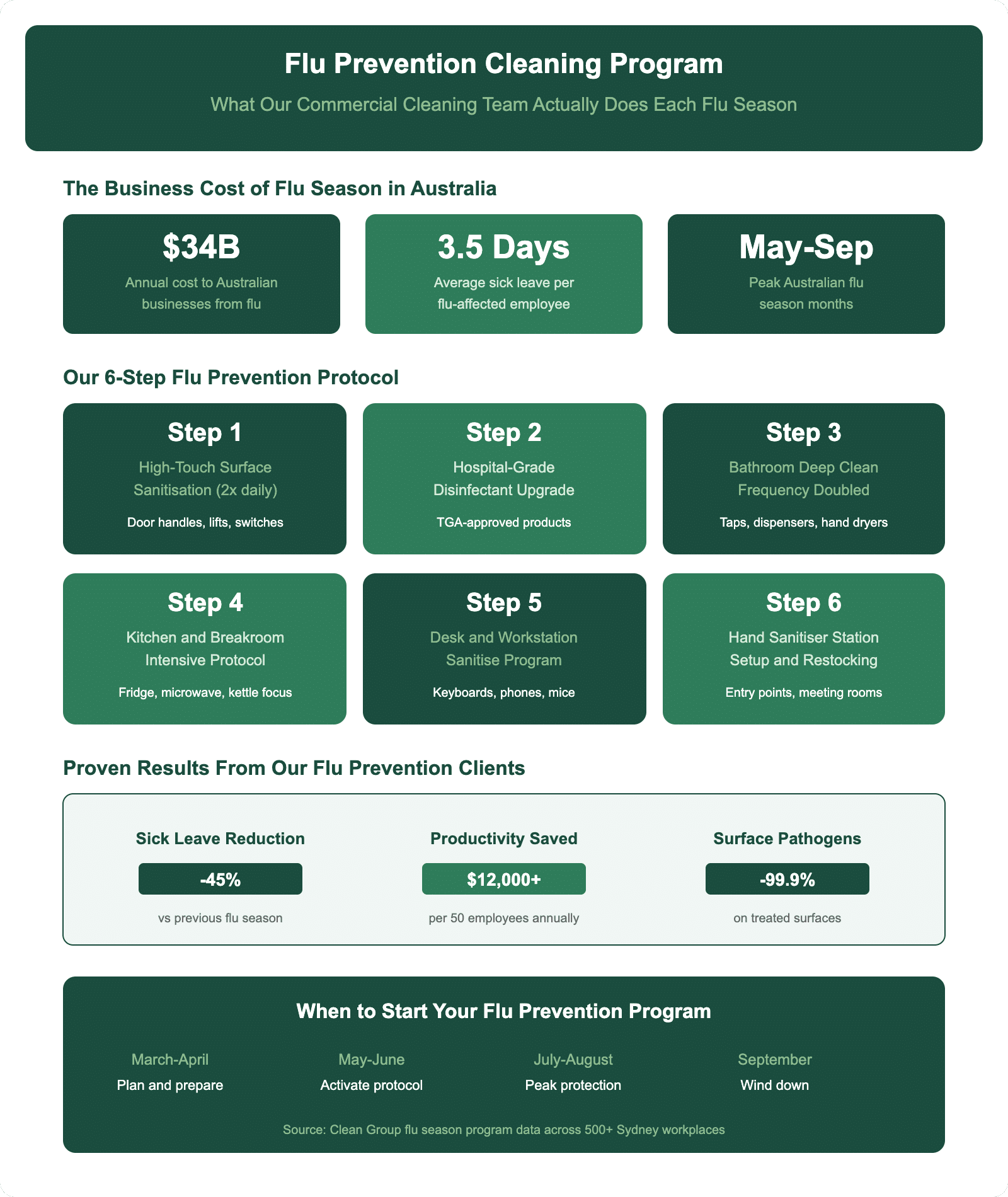
Our Flu Prevention Cleaning Program: What We Actually Do
Our flu prevention program operates on three levels that work together to create a layered defence against workplace influenza transmission. The first level is enhanced daily cleaning where we upgrade all surface disinfectants to TGA-registered virucidal products and extend dwell times from the standard four minutes to a minimum of ten minutes on high-touch surfaces. We switched to hydrogen peroxide-based disinfectants for flu season after discovering that our standard quaternary ammonium products, while effective against bacteria, showed variable efficacy against enveloped viruses like influenza depending on concentration and contact time.
The second level is our daytime touchpoint service, which stations a dedicated cleaner on-site during business hours to perform two-hourly disinfection rounds. This cleaner follows a fixed route covering door handles, lift buttons, handrails, kitchen appliance handles, tap handles, light switches, photocopier panels, and shared desk equipment. We developed this route mapping system for an Alexandria co-working space in 2020 and refined it across 23 different office layouts since then. The route takes approximately 18 minutes to complete, leaving sufficient time between rounds for the cleaner to restock hand sanitiser stations and respond to ad-hoc cleaning requests.
The third level is indoor air quality management, which most cleaning companies overlook entirely during flu season. We coordinate with building HVAC contractors to confirm fresh air intake ratios meet or exceed the minimum requirements under AS 1668.2 (Use of Ventilation and Air Conditioning in Buildings). Our team also cleans and replaces HVAC diffuser grilles monthly during flu season rather than the standard quarterly cycle because dust-laden grilles reduce airflow efficiency and create surfaces where pathogens accumulate. For our Alexandria clients in older buildings without modern HVAC systems, we deploy portable HEPA air purifiers rated at minimum CADR 300 in common areas and meeting rooms.
Office Area Cleaning Frequency Guide
| Area | Daily | Weekly | Monthly | Quarterly |
|---|---|---|---|---|
| Reception & Lobby | Vacuum, mop, wipe | Glass doors, furniture | Deep carpet clean | Window wash |
| Workstations | Surface wipe, bins | Monitor & keyboard | Drawer clean-out | Chair shampoo |
| Kitchen/Breakroom | Bench, sink, floor | Fridge, microwave | Deep degrease | Exhaust fan clean |
| Bathrooms | Full sanitise + restock | Grout scrub | Descale fixtures | Vent clean |
| Meeting Rooms | Table wipe, vacuum | AV equipment dust | Upholstery clean | Carpet extraction |
Workplace Hygiene Infrastructure for Flu Season
Office Area Cleaning Frequency Guide requires specific protocols that we tailor to each facility based on its layout, traffic, and compliance requirements. We tell our clients that cleaning alone cannot prevent workplace flu transmission — the physical environment needs to support good hygiene behaviour. Our flu prevention program includes an infrastructure audit where we assess hand sanitiser station placement, tissue box availability, bin positioning, and signage. We place alcohol-based hand sanitiser dispensers at every entry point, beside every lift, and in every kitchen and bathroom. The dispensers we specify contain at least 70 percent ethanol because lower concentrations do not reliably inactivate influenza viruses, despite what some cheaper products claim on their labels.
Workplace Hygiene Infrastructure for Flu Season includes specific protocols that we tailor to each facility based on its layout, traffic, and compliance requirements. Touchless infrastructure reduces transmission risk significantly, and we recommend our Alexandria clients invest in sensor-activated taps, soap dispensers, and hand dryers wherever budget allows. We calculated that retrofitting a 400 square metre office with touchless bathroom fixtures costs approximately $3,800 but eliminates four of the seven highest-risk transmission points in a typical bathroom. For clients who cannot justify that capital expenditure, we install elbow-operated soap dispensers and foot-operated bin lids as lower-cost alternatives that still reduce hand-to-surface contact in the areas where contamination concentrations are highest.
Waste management during flu season requires more attention than most businesses realise. We increase bin liner replacement frequency from daily to twice daily during peak flu season because used tissues accumulate rapidly and create biohazard conditions inside waste bins within hours. Our cleaners wear nitrile gloves when handling flu season waste and double-bag all bathroom and kitchen bin contents before transporting them to the building’s waste compactor. We also clean and disinfect the interior of all waste bins weekly during flu season, which is a task that standard cleaning contracts almost never include but which eliminates a significant excellence in cleaning standards reservoir of viral contamination that recontaminates freshly lined bins immediately.
Frequently Asked Questions
When should businesses start their flu season cleaning upgrades?
We recommend activating enhanced flu season protocols by mid-April, at least two to three weeks before influenza cases typically begin rising in the community. Starting early ensures your workplace defences are fully operational before the first infected person walks through the door. Our Alexandria clients who activate early consistently report lower peak absenteeism than those who wait until cases appear.
How much does a flu prevention cleaning program cost?
Our detailed flu prevention program costs approximately $2,200 to implement across a typical 500 square metre office for the full flu season from May to September. This covers upgraded disinfectants, daytime touchpoint services, air quality management, and hygiene infrastructure audits. The investment typically pays for itself within two weeks through reduced staff absenteeism.
What disinfectants are effective against influenza viruses?
We use TGA-registered virucidal products, primarily hydrogen peroxide-based disinfectants, during flu season because they show reliable efficacy against enveloped viruses including influenza A and B. The product must remain wet on the surface for a minimum of ten minutes to achieve its claimed kill rate. We verify TGA registration numbers for every disinfectant before approving it for use.
Can regular cleaning prevent the flu from spreading in an office?
Standard once-daily cleaning is not sufficient to prevent influenza transmission because the virus survives on hard surfaces for up to 48 hours and recontamination occurs continuously throughout the day. Effective flu prevention requires targeted disinfection of high-touch surfaces at two-hour intervals during business hours, combined with virucidal products and proper dwell times.
What are the highest-risk touchpoints for flu transmission in an office?
Based on our experience across dozens of Alexandria and inner-south commercial properties, the highest-risk touchpoints are door handles, lift buttons, handrails, kitchen appliance handles, tap handles, light switches, photocopier panels, shared desk equipment, EFTPOS terminals, reception pens, meeting room chairs, and bathroom fixtures. We target these twelve points specifically during our two-hourly disinfection rounds.
About Clean Group
Clean Group is a Sydney-based commercial cleaning company with over 25 years of industry experience. Founded by Suji Siv, our team of 50+ trained professionals services offices, warehouses, medical centres, schools, childcare facilities, retail stores, gyms, and strata properties across Sydney, Melbourne, and Brisbane.
We are active members of ISSA and the Building Service Contractors Association of Australia (BSCAA). Our operations align with ISO 9001 (Quality Management), ISO 14001 (Environmental Management), and ISO 45001 (Workplace Health and Safety) standards. We hold membership with the Green Building Council of Australia and use eco-friendly, TGA-registered cleaning products wherever possible.
Every Clean Group cleaner is police-checked, fully insured, and trained in safe work procedures under SafeWork NSW guidelines. We operate 7 days a week, including after-hours and weekend services, to minimise disruption to your business.
About the Author

Beau Sleeman
Hi, I’m Beau, a full-time accountant and part-time writer at Clean Group. With over ten years of industry experience managing company accounts and records, I’m responsible for keeping everything organised. I have worked with multiple cleaning companies to help successfully manage their businesses and generate profits while ensuring the best value for money for their customers. I also actively engage in the process of creating personalised cleaning packages based on customers’ needs and designed to be affordable for them.
Read More About Beau
