We have been setting cleaning standards for commercial spaces across inner Sydney for over two decades, and the gap between mediocre service and genuine excellence is wider than most facility managers realise. Excellence in our industry is not a marketing slogan — it is a measurable outcome defined by Australian Standards, industry accreditation frameworks, and auditable performance data. As commercial cleaning operators servicing Surry Hills, Darlinghurst, Redfern, and Chippendale, we hold ourselves to benchmarks that go well beyond simply making a building look clean.
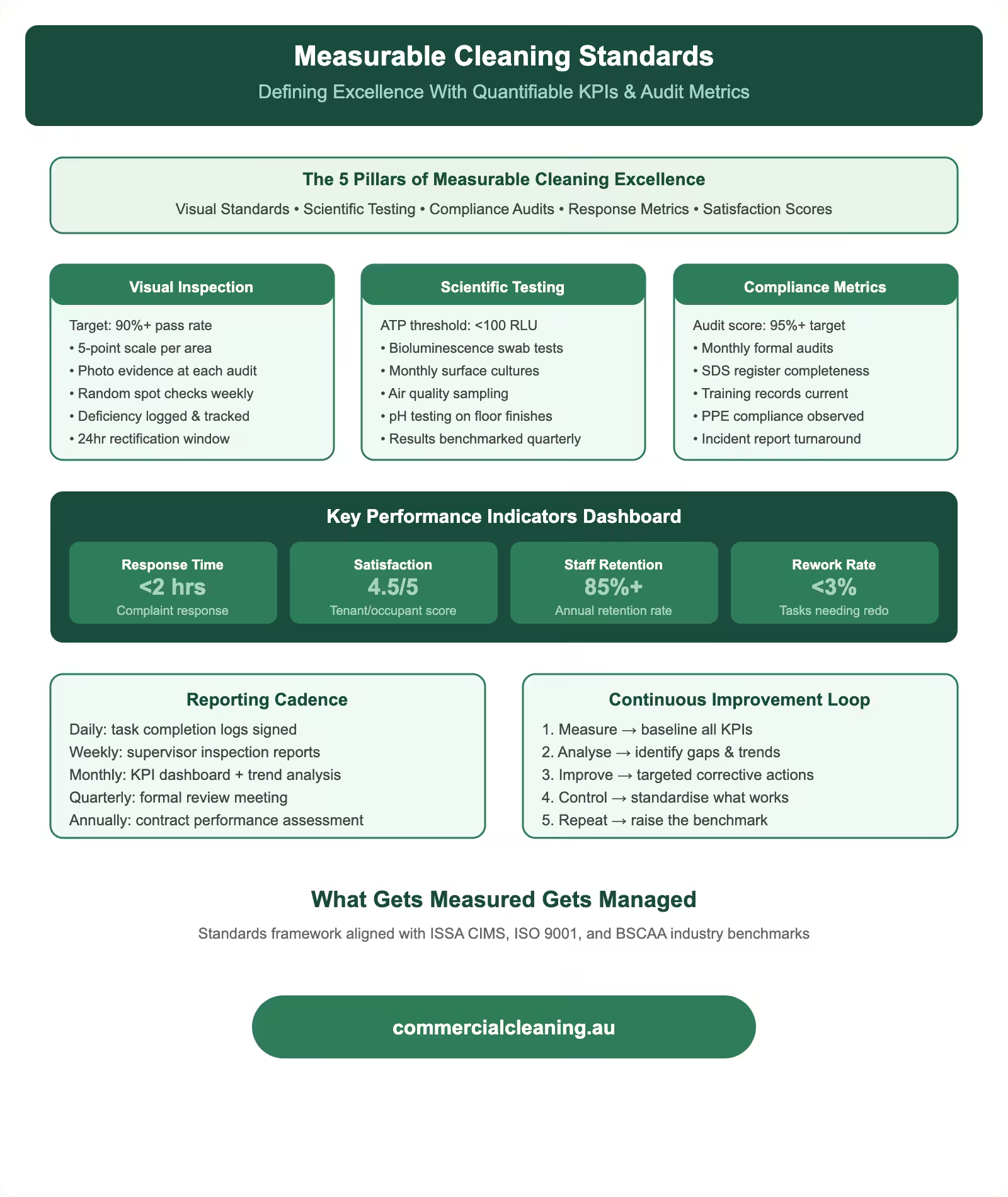
Measurable cleaning standards framework with visual inspection, scientific testing, compliance metrics, KPI dashboard, and continuous improvement loop
Defining Excellence: The Measurable Standards Framework
We define cleaning excellence through four pillars: compliance with relevant Australian Standards, accreditation under internationally recognised quality systems, measurable performance outcomes validated by scientific testing, and continuous improvement driven by data. Our Surry Hills office portfolio operates under this framework and every contract includes documented targets for each pillar. The days of judging cleaning quality by visual appearance alone are over — our facility manager clients in the inner city demand evidence, and we provide it through ATP bioluminescence readings, APPA appearance-level audits, and monthly compliance dashboards.
AS 3500 (Plumbing and drainage) might seem unrelated to cleaning, but it directly shapes our bathroom and kitchen sanitisation protocols. The standard governs how plumbing fixtures are installed and maintained, and our crews need to understand AS 3500 requirements because cleaning around fixtures without damaging seals, traps, or overflow mechanisms is critical in Surry Hills heritage buildings where plumbing is decades old. Our $2,400 excellence assessment — conducted annually for every Surry Hills and Darlinghurst contract — includes a plumbing-interface review where our operations manager inspects cleaning procedures around every fixture to confirm we are not inadvertently causing drainage issues through chemical runoff or physical damage to aging pipework.
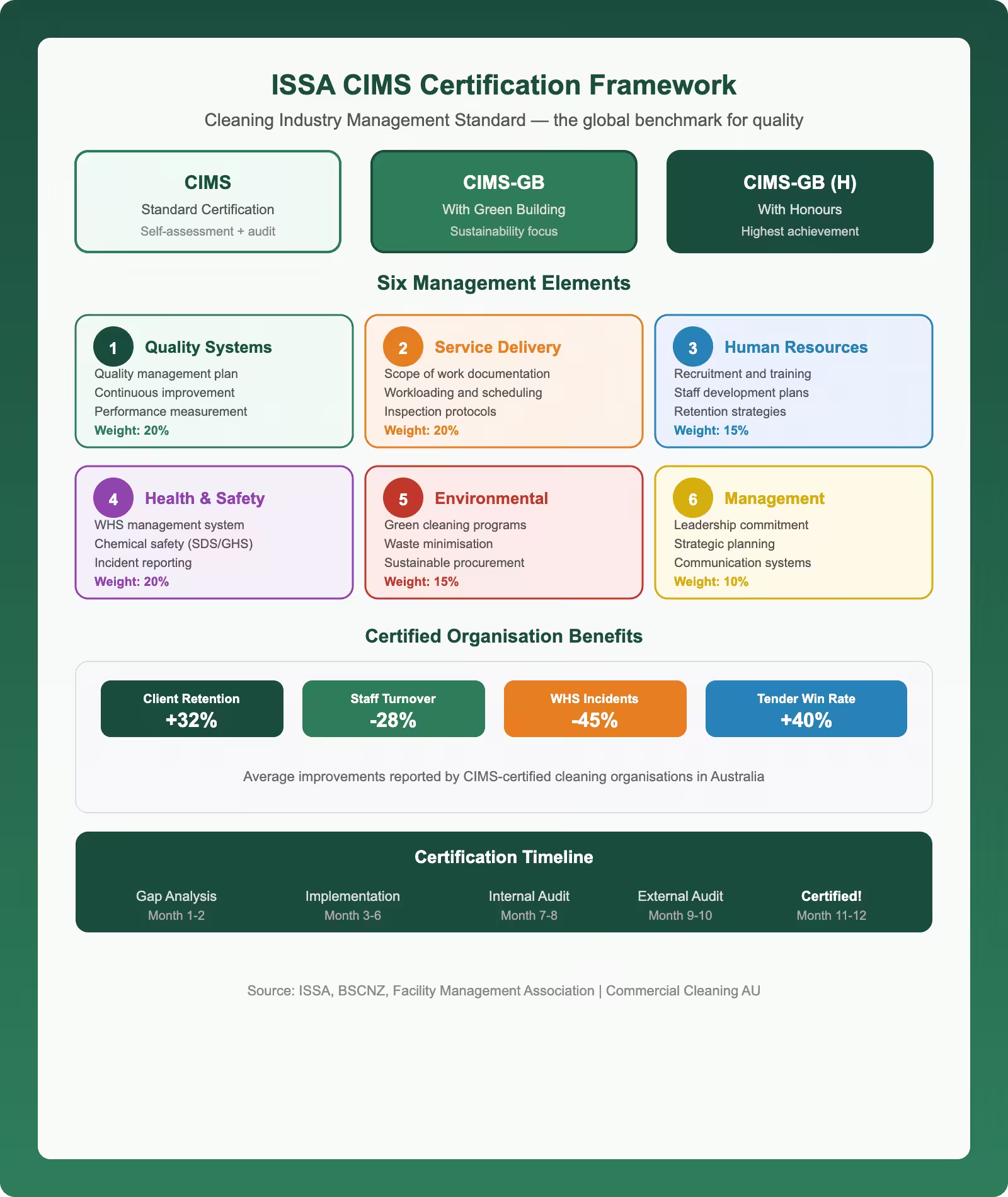
ISSA CIMS certification framework infographic showing six management elements certification levels benefits and timeline for commercial cleaning organisations
ISSA CIMS Certification: The International Benchmark
We pursued ISSA Cleaning Industry Management Standard (CIMS) certification with Green Building (GB) designation because it is the most rigorous quality framework available to Australian cleaning operators. CIMS assesses five management pillars: quality systems, service delivery, human resources, health safety and environment, and management commitment. Our certification audit covers every operational process from chemical procurement and dilution management to crew training records and client complaint resolution timelines. We renewed our CIMS-GB certification in 2024 after an independent audit that reviewed 340 documentary controls across our Surry Hills, Darlinghurst, and Chippendale operations.
CIMS certification is voluntary in Australia — there is no legal requirement to hold it. However, we find that tender panels for government, strata, and premium-grade commercial buildings increasingly treat it as a de facto qualification threshold. Three of our five largest inner-city contracts were won in 2024 specifically because competing bidders lacked CIMS certification. The investment in maintaining certification (approximately $8,500 annually including audit fees, documentation updates, and staff training) pays for itself through access to higher-value contracts that uncertified operators cannot credibly pursue.
Office Area Cleaning Frequency Guide
Area
Daily
Weekly
Monthly
Quarterly
Reception & Lobby
Vacuum, mop, wipe
Glass doors, furniture
Deep carpet clean
Window wash
Workstations
Surface wipe, bins
Monitor & keyboard
Drawer clean-out
Chair shampoo
Kitchen/Breakroom
Bench, sink, floor
Fridge, microwave
Deep degrease
Exhaust fan clean
Bathrooms
Full sanitise + restock
Grout scrub
Descale fixtures
Vent clean
Meeting Rooms
Table wipe, vacuum
AV equipment dust
Upholstery clean
Carpet extraction
ATP Bioluminescence: The Science of Verifiable Cleanliness
We invested in Hygiena SystemSURE Plus luminometers across every inner-city crew kit because visual inspection cannot detect biological contamination. ATP (adenosine triphosphate) testing measures organic residue on surfaces in relative light units (RLU) and gives us a scientific, repeatable measure of surface hygiene. Our benchmarks for Surry Hills commercial properties are: general office surfaces below 100 RLU, food preparation areas below 30 RLU, medical consulting rooms below 50 RLU, and bathroom high-touch surfaces (taps, flush buttons, door handles) below 75 RLU. These thresholds align with ISSA standards and FSANZ guidance for food-contact surfaces.
Our 2024 data across inner Sydney shows a 96.8 per cent first-pass ATP compliance rate — meaning fewer than four surfaces in every hundred require re-cleaning after initial sanitisation. We track this metric monthly and share it with every client in their compliance dashboard. The data also reveals seasonal patterns: compliance dips by approximately two per cent during winter flu season when biological contamination loads increase, which is why we pre-emptively switch to accelerated hydrogen peroxide disinfectants across high-touch surfaces from May through September in our Darlinghurst and Surry Hills portfolios.
NABERS Indoor Environment and Cleaning Quality
We actively support our clients’ NABERS (National Australian Built Environment Rating System) Indoor Environment ratings because cleaning quality directly influences air quality, thermal comfort, and occupant satisfaction — three of the four NABERS IE assessment categories. Our Surry Hills operations contribute to NABERS outcomes through HEPA-filtered vacuum systems that capture 99.97 per cent of particles at 0.3 microns (reducing airborne dust that degrades air quality scores), low-VOC cleaning chemicals that minimise indoor air contamination, and scheduled deep-cleaning cycles that prevent biological build-up in carpets and soft furnishings.
Two of our Surry Hills clients achieved NABERS IE 5-star ratings in 2024, and their sustainability consultants specifically cited our cleaning protocols as a contributing factor. We document our NABERS-relevant practices in a dedicated report that clients can submit as evidence during their rating assessment. This level of documentation is part of what our $2,400 excellence assessment delivers — it maps every cleaning procedure against NABERS criteria so clients understand exactly how cleaning operations influence their building rating.
SafeWork NSW Compliance and Documentation Excellence
We maintain a compliance documentation system that has withstood six SafeWork NSW inspections across our inner-city operations over the past five years — all with zero improvement notices. The system includes site-specific risk assessments updated quarterly, SWMS for every high-risk cleaning activity, a chemical register with current SDS for every product, GHS-compliant labelling on every decanted chemical, training records with competency assessments for every operative, and incident and near-miss logs with root-cause analysis. Our Redfern depot maintains the master documentation library and every site supervisor carries a tablet with digital access to all compliance records.
We review our compliance documentation system annually against SafeWork NSW’s published inspection focus areas. In 2024, the focus shifted toward contractor management and chemical storage — so we updated our AS 3500 plumbing-interface procedures and added a chemical storage audit to every quarterly site review in Surry Hills and Chippendale. This proactive approach to compliance is what separates excellent cleaning operations from adequate ones, and it is something our clients in the inner city increasingly value. For a deeper look at the science driving our methods, our article on the science behind effective cleaning breaks down the evidence base for every protocol we use.
When planning a periodical cleaning program, our guide on scheduled deep clean program framework provides a structured approach to establishing cleaning cycles and protocols that balance operational efficiency with quality outcomes.
FAQs
What are typical ATP benchmark targets for different facility types?
We set ATP targets based on facility risk profile: general office surfaces below 100 RLU, food preparation areas below 30 RLU, medical consulting rooms below 50 RLU, and bathroom high-touch surfaces below 75 RLU. Our inner Sydney portfolio achieved a 96.8 per cent first-pass compliance rate across 2024 using these benchmarks.
Is ISSA CIMS certification required in Australia?
No — CIMS certification is voluntary. However, we hold CIMS-GB (Green Building) designation because tender panels for government, strata, and premium commercial buildings increasingly treat it as a de facto qualification threshold. Three of our five largest 2024 contracts were won specifically because competitors lacked CIMS certification.
What documentation is needed for SafeWork NSW compliance audits?
Our compliance system includes site-specific risk assessments, SWMS for high-risk activities, chemical registers with current SDS, GHS-compliant labelling, training records with competency assessments, and incident logs with root-cause analysis. This system has withstood six SafeWork inspections across our inner-city operations with zero improvement notices.
How does NABERS Indoor Environment rating relate to cleaning standards?
Cleaning quality directly influences NABERS IE scores through air quality (HEPA filtration reduces airborne particles), chemical emissions (low-VOC products minimise indoor contamination), and occupant satisfaction. Two of our Surry Hills clients achieved 5-star NABERS IE ratings in 2024 with our protocols cited as a contributing factor.
What is the difference between sanitiser and hospital-grade disinfectant concentrations?
We use quaternary ammonium sanitisers at 200 ppm for routine non-critical surface sanitisation and hospital-grade disinfectants at 4,000 ppm for medical environments or outbreak response. The concentration difference reflects the pathogen kill spectrum required — sanitisers target vegetative bacteria while hospital-grade products destroy mycobacteria, viruses, and fungal spores.
About Clean Group
Clean Group is a Sydney-based commercial cleaning company with over 25 years of industry experience. Founded by Suji Siv, our team of 50+ trained professionals services offices, warehouses, medical centres, schools, childcare facilities, retail stores, gyms, and strata properties across Sydney, Melbourne, and Brisbane.
We are active members of ISSA and the Building Service Contractors Association of Australia (BSCAA). Our operations align with ISO 9001 (Quality Management), ISO 14001 (Environmental Management), and ISO 45001 (Workplace Health and Safety) standards. We hold membership with the Green Building Council of Australia and use eco-friendly, TGA-registered cleaning products wherever possible.
Every Clean Group cleaner is police-checked, fully insured, and trained in safe work procedures under SafeWork NSW guidelines. We operate 7 days a week, including after-hours and weekend services, to minimise disruption to your business.
Hi, I'm Suji Siv, the founder, CEO, and Managing Director of Clean Group, bringing over 25 years of leadership and management experience to the company. As the driving force behind Clean Group’s growth, I oversee strategic planning, resource allocation, and operational excellence across all departments. I am deeply involved in team development and performance optimization through regular reviews and hands-on leadership.