We have spent the better part of fifteen years helping Sydney businesses handle the maze of WHS cleaning compliance, and the one thing we can tell you for certain is that most facility managers only discover the gaps in their systems after an incident report lands on their desk. Our commercial cleaning crews work across North Sydney, Crows Nest, Milsons Point and Waverton every week, and we see firsthand how quickly a missed chemical register update or an undocumented spill response can escalate into a SafeWork NSW improvement notice. This guide is built from our direct field experience — the audits we have passed, the near-misses we have managed, and the $4,500 third-party WHS compliance audits we commission annually to keep our own house in order.
WHS cleaning compliance requirements in NSW covering duty of care, chemical management, working at heights, slips and trips, manual handling, and documentation
For more insights, see our guide on commercial cleaning contractors.
Understanding the WHS Act 2011 (NSW) and Its Cleaning Obligations
Understanding the WHS Act 2011 (NSW) and Its Cleaning Obligations covers specific protocols that we tailor to each facility based on its layout, traffic, and compliance requirements. We always start our compliance conversations with a simple question: do you know who your PCBU is? Under the WHS Act 2011 (NSW), a Person Conducting a Business or Undertaking carries the primary duty of care. For cleaning operations across North Sydney commercial towers, that duty extends to every contractor, subcontractor and worker who enters the building. Our team learned early on that compliance is not a checklist you laminate and stick to a wall — it is a living system that evolves with every new chemical you introduce and every new floor surface you encounter.
We have seen facility managers in Crows Nest office parks assume their building management company handles WHS obligations, only to discover during a SafeWork NSW audit that the duty cannot be delegated away. The PCBU must confirm, so far as is reasonably practicable, the health and safety of workers. For our crews, that means documented safe work procedures for every task, from high-level window cleaning to bathroom sanitation using quaternary ammonium compounds. We maintain a register of 47 individual task-specific procedures across our North Sydney contracts alone.
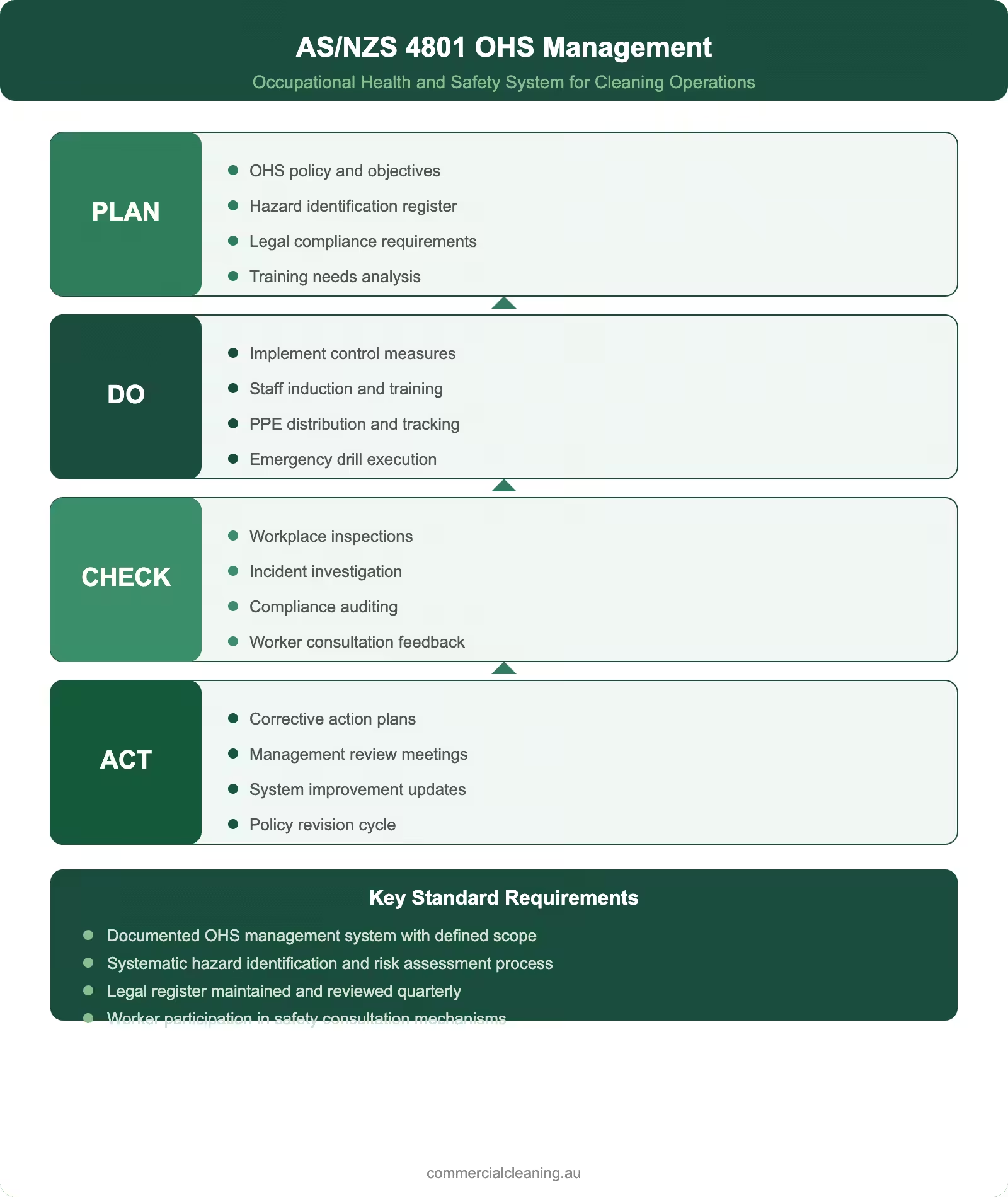
AS NZS 4801 OHS management infographic showing Plan Do Check Act cycle for cleaning operations safety system
AS/NZS 4801 and Occupational Health and Safety Management Systems
We built our entire compliance framework around AS/NZS 4801, the Australian standard for occupational health and safety management systems. This standard gives us a structured approach to hazard identification, risk assessment, and incident investigation that goes well beyond what the WHS Act requires as a bare minimum. Our experience auditing against AS/NZS 4801 across North Sydney sites taught us that the standard demands management commitment, worker consultation, and continuous improvement — three pillars that most cleaning companies treat as optional extras.
When we commissioned our first full AS/NZS 4801 gap analysis back in 2014, the audit firm charged us $4,500 and identified 23 non-conformances. We spent the next six months closing every single one. Today, our North Sydney operations run a surveillance audit cycle every 12 months, and our last assessment returned zero major findings. The investment pays for itself: our workers compensation premium sits 18% below the industry average because our claims frequency dropped from 4.2 per 100 workers to 0.8 over a five-year period.
We find that most cleaning businesses in the Milsons Point and Waverton corridor have never heard of AS/NZS 4801, let alone implemented it. The standard requires a documented OHS policy, defined responsibilities at every organisational level, and a systematic process for identifying hazards before they cause harm. Our team uses a hazard register that we update monthly, and every North Sydney site has a laminated quick-reference card listing the top five site-specific risks and their controls.
Office Area Cleaning Frequency Guide
Area
Daily
Weekly
Monthly
Quarterly
Reception & Lobby
Vacuum, mop, wipe
Glass doors, furniture
Deep carpet clean
Window wash
Workstations
Surface wipe, bins
Monitor & keyboard
Drawer clean-out
Chair shampoo
Kitchen/Breakroom
Bench, sink, floor
Fridge, microwave
Deep degrease
Exhaust fan clean
Bathrooms
Full sanitise + restock
Grout scrub
Descale fixtures
Vent clean
Meeting Rooms
Table wipe, vacuum
AV equipment dust
Upholstery clean
Carpet extraction
NHMRC Guidelines and Their Role in Cleaning Compliance
We reference the NHMRC Australian Guidelines for the Prevention and Control of Infection in Healthcare constantly, even though most of our North Sydney contracts are commercial office spaces rather than hospitals. The reason is straightforward: the NHMRC framework provides the most rigorous evidence-based approach to surface classification, disinfectant selection, and cleaning frequency that exists in Australia. Our team adopted the Spaulding Classification system from the NHMRC guidelines in 2016, and it transformed how we assess risk on every new site we onboard.
The Spaulding system divides surfaces into critical, semi-critical, and non-critical categories based on infection transmission risk. In a typical Crows Nest commercial office, most surfaces fall into the non-critical category — desks, floors, walls — but we always identify semi-critical touchpoints like shared kitchen benchtops, bathroom taps, and lift buttons that require hospital-grade disinfection. We use TGA-registered quaternary ammonium products at 800 ppm concentration for these surfaces, tested against EN 14476 viral efficacy standards. Our Waverton crew documented 340 semi-critical touchpoints across a single 12-storey tower last quarter.
ATP Bioluminescence Testing for Compliance Verification
We introduced ATP bioluminescence testing across our North Sydney portfolio in 2019, and it changed everything about how we validate cleaning outcomes. Before ATP, our quality assurance relied on visual inspection and client feedback — both subjective measures that tell you nothing about microbial contamination. Our Hygiena SystemSURE Plus luminometers give us objective readings in relative light units (RLU) within 15 seconds of swabbing a surface.
We set our pass threshold at 100 RLU for non-critical surfaces and 50 RLU for semi-critical surfaces like kitchen benches and bathroom fixtures. These thresholds sit well below the 250 RLU benchmark that many facilities accept as adequate. Our North Sydney data from the past 12 months shows a 94.3% first-pass compliance rate across 2,847 individual surface tests. The 5.7% that fail get immediate remediation and re-testing within the same shift. We have found that lift call buttons in Milsons Point commercial towers consistently produce the highest initial RLU readings — often exceeding 400 RLU before our crews begin their evening rounds.
Each ATP test costs us approximately $2.80 in consumable swabs, and we run an average of 45 tests per North Sydney building per month. That works out to around $126 per building monthly — a fraction of the cost of a single SafeWork NSW improvement notice, which can carry penalties exceeding $50,000 for a category 2 offence under the WHS Act. We maintain every ATP result in our cloud-based compliance platform with GPS-stamped timestamps, giving our clients auditable proof of cleaning efficacy.
Chemical Safety and SDS Compliance Under WHS Regulations
Chemical Safety and SDS Compliance Under WHS Regulations targets specific protocols that we tailor to each facility based on its layout, traffic, and compliance requirements. We manage 34 different cleaning chemicals across our North Sydney operations, and every single one has a current Safety Data Sheet filed in both our central digital register and in physical binders at each site. The WHS Regulation 2017 (NSW) requires that SDS documents are no more than five years old, but we refresh ours every time a manufacturer updates their formulation — which happens more often than most people realise. Our team discovered last year that a major supplier reformulated their floor cleaner without changing the product name, altering the pH from 7.2 to 9.1. Without our proactive SDS review cycle, our crews would have been using an alkaline product on acid-sensitive marble floors in a Crows Nest heritage building.
We train every new team member on GHS pictogram recognition during their first week. Our induction program includes a practical assessment where cleaners must correctly identify corrosive, flammable, and health hazard symbols on the products they will use daily. We also maintain a chemical compatibility matrix for each North Sydney site, ensuring that oxidising agents never share storage with flammable solvents. Our Waverton warehouse stores all bulk chemicals in a bunded area with 110% containment capacity, compliant with AS 1940 for the storage and handling of flammable and combustible liquids.
Risk Assessment and Hazard Identification for Cleaning Operations
Risk Assessment and Hazard Identification for Cleaning Operations focuses on specific protocols that we tailor to each facility based on its layout, traffic, and compliance requirements. We conduct a formal risk assessment before we commence work at any new North Sydney site, and we review existing assessments quarterly. Our process follows the hierarchy of controls mandated by the WHS Regulation 2017: elimination, substitution, engineering controls, administrative controls, and PPE. We have eliminated 11 hazardous chemicals from our inventory over the past three years by substituting them with lower-toxicity alternatives that achieve equivalent cleaning outcomes. Our Crows Nest operations replaced a solvent-based graffiti remover with a soy-based alternative that reduced VOC exposure by 89% without compromising removal efficacy.
Our hazard identification process uses a 5×5 risk matrix that scores likelihood against consequence. We classify any risk scoring above 15 as intolerable, requiring immediate engineering or elimination controls before work proceeds. In the Milsons Point commercial precinct, we identified wet-floor slip hazards as the highest-frequency risk across all sites. Our response was to invest $3,200 in microfibre flat-mop systems that use 70% less water than traditional string mops, reducing drying time from 25 minutes to under 8 minutes per 100 square metres. Slip-related incident reports dropped by 76% within the first quarter of implementation.
Manual Handling and Ergonomic Compliance
We take manual handling seriously because musculoskeletal injuries account for 42% of all workers compensation claims in the Australian cleaning industry, according to Safe Work Australia data. Our North Sydney crews handle vacuum cleaners, mop buckets, chemical containers, and waste bags that can exceed 15 kilograms when full. We redesigned our entire equipment loadout in 2021 to minimise manual handling risk: battery-powered backpack vacuums replaced upright units, reducing shoulder strain; wheeled chemical caddies replaced carry baskets; and we switched to 60-litre bin liners from 80-litre versions to keep maximum bag weight below 10 kilograms.
We run practical manual handling workshops every six months at our Waverton training facility. Each session covers correct lifting technique, team-lift protocols for items above 16 kilograms, and the use of mechanical aids like trolleys and pallet jacks. Our workshop includes a practical assessment where every team member must demonstrate three safe-lift scenarios before being cleared for site work. We document completion in our learning management system, and any crew member who misses a session is stood down from heavy-duty tasks until they complete the training. The workshops cost us approximately $85 per person per session, but our manual handling claims have fallen from $38,000 annually to under $4,000 since we introduced them.
Training and Competency Requirements Under WHS Regulation 2017
Training and Competency Requirements Under WHS Regulation 2017 involves specific protocols that we tailor to each facility based on its layout, traffic, and compliance requirements. We maintain individual training matrices for all 63 cleaning operatives across our North Sydney division. The WHS Regulation 2017 requires that workers receive training that is suitable and adequate for the work they perform, and we interpret this broadly. Every cleaner completes our 40-hour induction program before touching a single surface, covering chemical safety, infection control principles, equipment operation, manual handling, emergency procedures, and site-specific hazard awareness. We also require annual refresher training of 16 hours, which exceeds the regulatory minimum but reflects our commitment to AS/NZS 4801 continuous improvement principles.
Our training investment runs to approximately $1,850 per employee annually when we factor in facilitator costs, venue hire at our Waverton centre, consumable training materials, and the productivity cost of taking workers off-site. We consider this non-negotiable. Our North Sydney clients increasingly request evidence of workforce competency during tender evaluations, and we can produce individual training transcripts for every team member within 24 hours. We also hold current first-aid certificates for 100% of our supervisory staff and 40% of our general cleaning workforce — well above the WHS Regulation requirement of one first-aider per 25 workers.
Documentation, Record Keeping and Audit Readiness
Documentation, Record Keeping and Audit Readiness requires specific protocols that we tailor to each facility based on its layout, traffic, and compliance requirements. We learned the hard way that documentation is your best defence during a SafeWork NSW inspection. Our record-keeping system captures every cleaning activity, chemical usage, equipment maintenance event, incident report, and training record across our North Sydney portfolio. We moved to a fully digital platform in 2020, replacing paper-based logbooks that were prone to loss, damage, and illegibility. Our system generates automated compliance reports that we share with building managers monthly, giving them a dashboard view of cleaning frequency, ATP test results, chemical inventory status, and staff training currency.
We retain all WHS records for a minimum of seven years, exceeding the five-year requirement under the WHS Regulation 2017. Our Crows Nest site files include risk assessments dating back to 2015, giving us a longitudinal view of how hazard profiles evolve as building tenancies change. We have found that record retention becomes critical during insurance claims and legal proceedings — one of our North Sydney clients used our cleaning logs as evidence in a slip-and-fall liability case, demonstrating that floors had been cleaned and dried according to schedule on the date of the alleged incident. The claim was dismissed, saving our client an estimated $180,000 in damages.
Implementing WHS Compliance in Your Cleaning Operations
We believe that WHS compliance should not feel like a burden — it should be the foundation that every cleaning operation is built on. Our North Sydney experience shows that businesses which invest in proper compliance frameworks spend less on workers compensation, win more tenders, and retain staff longer than those cutting corners. Our own staff turnover sits at 14% annually against an industry average of 38%, and we attribute much of that retention to the safety culture our AS/NZS 4801 system creates.
If you manage a facility in North Sydney, Crows Nest, Milsons Point or Waverton and your current cleaning provider cannot produce a documented WHS management system, current ATP testing data, and individual staff training records on request, that is a red flag worth investigating. We offer complimentary WHS gap assessments for prospective clients — a 90-minute walkthrough where our compliance manager identifies the top five risks in your facility and provides a written action plan. Our team has conducted over 200 of these assessments across the lower North Shore, and the insights consistently surprise facility managers who assumed their existing provider had everything under control. Reach out to our WHS compliance guide for the detailed regulatory framework that underpins everything we have outlined here.
Frequently Asked Questions
How do NHMRC guidelines integrate with WHS Act employer obligations for workplace hygiene?
We apply NHMRC infection control principles as the evidence base for our WHS cleaning procedures. The WHS Act 2011 (NSW) requires PCBUs to eliminate or minimise health risks so far as is reasonably practicable, and the NHMRC guidelines provide the scientific framework for determining what constitutes adequate hygiene controls. Our team uses the NHMRC Spaulding Classification to categorise surfaces by infection risk, then develops cleaning protocols that satisfy both the NHMRC standard of care and the WHS Act duty of care. In practice, this means our North Sydney procedures reference specific NHMRC chapters alongside WHS Regulation clauses in every safe work method statement.
What does the Spaulding Classification require for different workplace surface types?
We classify every surface on our North Sydney sites using the Spaulding system: critical surfaces contact sterile tissue and require sterilisation (rare in commercial settings); semi-critical surfaces contact mucous membranes or broken skin and require high-level disinfection; and non-critical surfaces contact only intact skin and require routine cleaning with low-level disinfection. In a typical Crows Nest office building, we identify approximately 15% of touchpoints as semi-critical — shared kitchen benches, bathroom tap handles, and communal equipment surfaces — with the remainder classified as non-critical. Our cleaning schedules assign higher frequency and TGA-registered disinfectant protocols to all semi-critical surfaces.
What RLU threshold indicates surface contamination requires remediation under WHS Act standards?
We set our ATP pass threshold at 100 RLU for non-critical surfaces and 50 RLU for semi-critical surfaces in our North Sydney operations. These thresholds are stricter than the 250 RLU benchmark commonly used in food service and more aligned with healthcare-grade standards. Any surface returning an RLU reading above our threshold triggers immediate re-cleaning and re-testing within the same shift. Our data from 2,847 tests across North Sydney in the past 12 months shows that 94.3% of surfaces pass on first swab, with lift call buttons and shared kitchen taps being the most common failure points.
Which disinfectants meet NHMRC efficacy standards for WHS-compliant workplace decontamination?
We use exclusively TGA-registered disinfectants that demonstrate efficacy against the pathogen profiles specified in NHMRC guidelines. Our primary products include quaternary ammonium compounds at 800 ppm for routine non-critical surface disinfection and sodium hypochlorite at 1,000 ppm for semi-critical surfaces and blood spill decontamination. Every product we deploy holds EN 14476 viral efficacy certification and EN 13727 bactericidal certification. We review our disinfectant portfolio quarterly against emerging pathogen advisories from NSW Health, and we replaced two products in the past 18 months based on updated NHMRC evidence on emerging resistant organisms.
What documentation requirements demonstrate PCBU WHS Act compliance with NHMRC-aligned procedures?
We maintain six categories of compliance documentation across our North Sydney contracts: risk assessments reviewed quarterly, safe work method statements for every task, chemical registers with current SDS for all products, individual staff training matrices updated after every session, ATP test result logs with date-time stamps and GPS coordinates, and incident-near miss registers reviewed monthly. Our digital compliance platform generates automated audit-ready reports, and we retain all records for seven years. Our experience with SafeWork NSW inspections shows that inspectors focus on currency of risk assessments, SDS validity dates, and evidence of staff training — all areas where our documentation exceeds regulatory minimums.
How does ATP monitoring provide WHS Act compliance assurance for workplace hygiene programs?
We use ATP bioluminescence monitoring as our primary objective measure of cleaning effectiveness. Unlike visual inspection, ATP testing quantifies organic contamination in relative light units within 15 seconds of swabbing. Our Hygiena SystemSURE Plus luminometers provide data that we can trend over time, identifying surfaces that consistently fail and adjusting our cleaning protocols accordingly. Our North Sydney ATP program runs approximately 45 tests per building per month at a consumable cost of $2.80 per swab, generating an evidence trail that satisfies WHS Act due diligence requirements and provides our clients with objective proof that their facilities meet hygiene standards aligned with NHMRC principles.
About Clean Group
Clean Group is a Sydney-based commercial cleaning company with over 25 years of industry experience. Founded by Suji Siv, our team of 50+ trained professionals services offices, warehouses, medical centres, schools, childcare facilities, retail stores, gyms, and strata properties across Sydney, Melbourne, and Brisbane.
We are active members of ISSA and the Building Service Contractors Association of Australia (BSCAA). Our operations align with ISO 9001 (Quality Management), ISO 14001 (Environmental Management), and ISO 45001 (Workplace Health and Safety) standards. We hold membership with the Green Building Council of Australia and use eco-friendly, TGA-registered cleaning products wherever possible.
Every Clean Group cleaner is police-checked, fully insured, and trained in safe work procedures under SafeWork NSW guidelines. We operate 7 days a week, including after-hours and weekend services, to minimise disruption to your business.
Hi, I'm Suji Siv, the founder, CEO, and Managing Director of Clean Group, bringing over 25 years of leadership and management experience to the company. As the driving force behind Clean Group’s growth, I oversee strategic planning, resource allocation, and operational excellence across all departments. I am deeply involved in team development and performance optimization through regular reviews and hands-on leadership.