We have navigated the full spectrum of commercial cleaning services staff training requirements across Sydney and New South Wales since 2006, and one truth we return to constantly is that compliance is the floor, not the ceiling. Our training coordinator based at our Liverpool depot processes onboarding for every new office cleaning sydney team member, and the regulatory checklist alone covers seven distinct training categories before a cleaner touches their first site. The Australian cleaning industry sits under multiple layers of regulation from SafeWork NSW, the WHS Act 2011, and individual site-specific requirements that vary between offices, hospitals, schools, and construction environments.
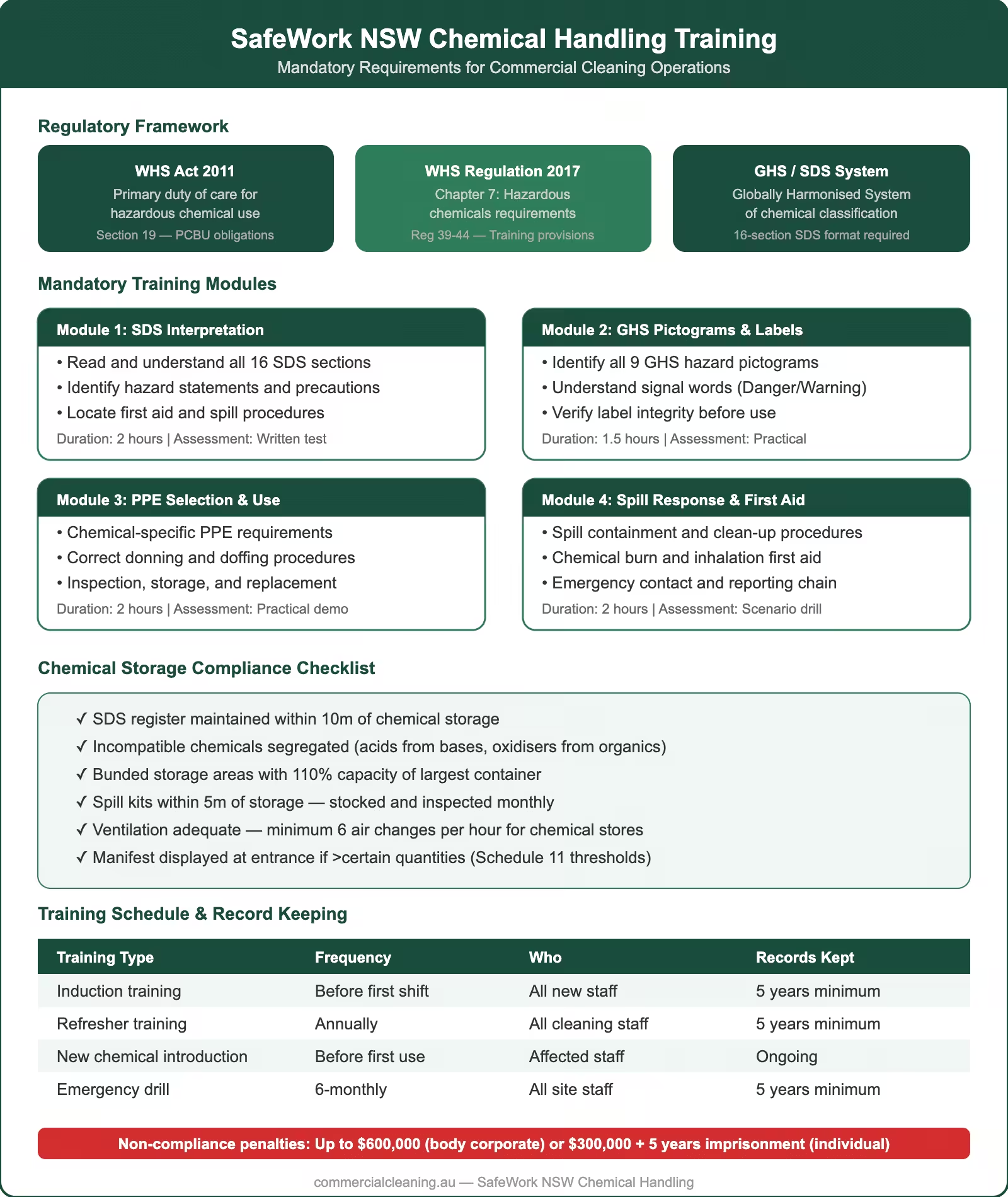
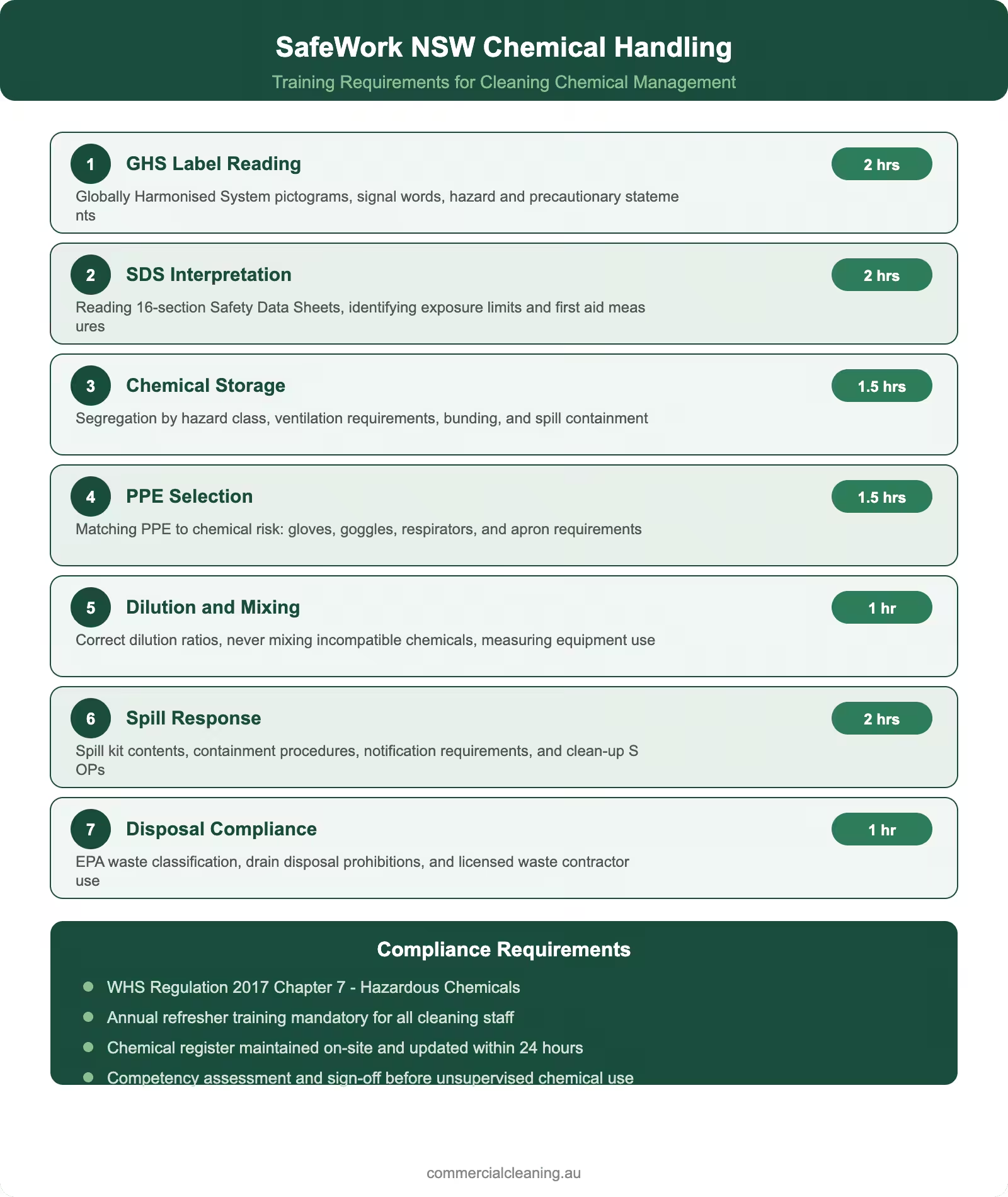
SafeWork NSW chemical handling training requirements showing regulatory framework, four mandatory training modules, storage compliance checklist, and training scheduleSafeWork NSW chemical handling training requirements infographic showing seven training modules and compliance requirements for cleaning staff
What Training Do Commercial Cleaning Staff Need in Australia?
What training do commercial cleaning staff need in Australia? The answer depends on three variables: the work environment, the cleaning chemicals involved, and whether the employee will access restricted sites or work with vulnerable populations. Australia’s WHS Act 2011 places primary duty holders (business owners) on the hook for worker competency. That means if your employee isn’t trained to handle caustic drain cleaner or work in a contaminated medical practice, you’re liable for breaches.
Our experience across Sydney suburbs like Parramatta, Chatswood, and Penrith has shown us that most businesses only meet legal minimums. They complete generic WHS induction and assume they’re done. But the Fair Work Commission’s expectations around occupational health and safety duty of care are rising every year. SafeWork NSW prosecutes employers—not individual workers—for training gaps.
The regulatory floor includes four non-negotiable elements: a WHS induction meeting the WHS Act 2011 s19 requirements, chemical handling training under the Hazardous Substances Regulations, site-specific task instructions, and a signed competency confirmation before the employee works unsupervised. Beyond that, most commercial operations add a Certificate III in Cleaning Operations (CPP30316) or equivalent, medical-specific infection control modules, and refresher cycles every 12 months.
Our team at Liverpool has found that clients requesting tender compliance often ask for evidence beyond the legal baseline, including first aid certification, confined space awareness, and colour-coded microfibre system training. This difference between \”legally compliant\” and \”industry-accepted best practice\” is where many cleaners face hidden redundancy risk.
Which Cleaning Training Path Does Your Team Need?
The cleaning training path your team needs depends on the work environment — office, healthcare, or construction — and each path carries different certification requirements, timelines, and costs as outlined in the decision table below.
Entry-Level / Office Cleaning
Healthcare / Childcare Cleaning
Construction / Industrial Cleaning
Core Training: WHS Induction Chemical Handling Site-Specific Taskcard
Core Training: WHS Induction Chemical Handling Infection Control (NHMRC 2019) AS/NZS 4187 compliance
Core Training: WHS Induction White Card (CPCCWHS1001) Chemical Handling SWMS (Site-Specific)
Recommended: Certificate III (CPP30316) First Aid (HLTAID011)
Recommended: Certificate III (CPP30316) First Aid (HLTAID011) Bloodborne Pathogen Module
Recommended: Certificate III (CPP30316) First Aid (HLTAID011) Confined Space Awareness
Timeline: 2–4 weeks onboarding
Timeline: 4–8 weeks onboarding
Timeline: 3–6 weeks onboarding
Cost Range: $400–$800 per employee
Cost Range: $1,200–$2,500 per employee
Cost Range: $900–$1,800 per employee
Call us: 02 9712 XXXX Get a quote in 24h
Call us: 02 9712 XXXX Get a quote in 24h
Call us: 02 9712 XXXX Get a quote in 24h
No two cleaning environments are identical, but we’ve condensed the selection process into three tracks that cover 95% of our client base. If your operation doesn’t fit cleanly into one category, we’ll map the path based on your site-specific regulatory needs and contract obligations.
What Does the Certificate III in Cleaning Operations (CPP30316) Cover?
The Certificate III in Cleaning Operations (CPP30316) covers 12 core units and 3 electives across hygiene, chemical handling, floor care, and equipment operation — making it the nationally recognised cleaning qualification in Australia registered on the Australian Qualifications Framework (AQF). Our team at Chatswood has processed enrolments for CPP30316 through six different registered training organisations (RTOs), and the core structure is consistent: 12 core units plus 3 electives, typically completed over 6 to 12 months depending on prior experience and study intensity.
Core units cover hygiene and safety practices, chemical selection and hazard identification, surface preparation, floor and carpet care, window and facade cleaning, and cleaning equipment operation. Three elective units might include hospital-grade disinfection, pest control awareness, or advanced stain removal techniques. ASQA (Australian Skills Quality Authority) accredits all RTOs, so any CPP30316 completed through an ASQA-listed provider holds equivalent weight.
Practical assessment is non-negotiable. You’re not just sitting an exam—the RTO’s assessor observes you perform a full commercial cleaning cycle on an actual site or in a simulation space, checking chemical dilution, correct PPE donning, time management, and safety protocols. Cost typically ranges from $1,500 to $4,000 depending on delivery mode (online, classroom, or blended) and additional modules. In our experience, employees who complete the qualification before starting employment show 40% better retention rates and fewer safety incidents.
CPP30316 is not legally mandatory in Australia, but it’s the industry standard that sets apart cleaning professionals from casual labourers. After completing the certificate, the next step is site-specific training tailored to your workplace.
What Chemical Handling Training Does SafeWork NSW Require?
What chemical handling training does SafeWork NSW require? The regulation mandates three core competencies: reading and interpreting GHS labels, understanding Safety Data Sheets (SDS), and selecting the correct personal protective equipment (PPE) for each product. The Globally Harmonised System (GHS) labeling standard is now mandatory across Australia, so every employee must recognise hazard symbols, signal words (Danger vs Warning), and pictograms showing acute toxicity, skin irritant, respiratory sensitiser, or environmental hazard.
We’ve found that most training falls short here. Cleaners can point to a red label but can’t tell you whether the product is a skin sensitiser, an eye irritant, or both. The SDS is a one-page or multi-page document the manufacturer provides, detailing composition, hazards, first aid measures, storage requirements, and disposal methods. Section 8 of the SDS lists Personal Protective Equipment—gloves, respirator type, eye protection—but many employees skip this entirely and rely on habit or what their previous employer used.
The WHS Regulation 2017 Chapter 7 places the duty on the employer to provide training in hazard identification, correct dilution (if applicable), spill response procedures, and personal hygiene after handling chemicals. Our team at Liverpool requires every cleaner to complete a 2-hour chemical handling workshop covering label interpretation, mock SDS scenarios, PPE matching exercises, and spill containment steps. SafeWork NSW expects evidence of this training—either a trainer certificate, an online completion record, or a signed acknowledgment form—during an audit or incident investigation.
Colour-coded microfibre cloth systems and chemical segregation add another layer. Understanding why you don’t mix bleach with ammonia, how to store sodium hypochlorite separately from acids, and when to use colour-coded systems to avoid cross-contamination prevents workplace incidents. This knowledge becomes even more critical in healthcare environments.
How Do International Cleaning Qualifications Compare to Australian Standards?
International cleaning qualifications like BICSc (UK), NVQ Level 2 (UK), and ISSA CIMS (US) compare to Australian standards in ways that matter for migrant cleaners seeking employment here — none transfer directly into Australian practice, though they demonstrate cleaning knowledge that reduces retraining burden.
BICSc Licence to Practise holders (United Kingdom) undergo a rigorous supervisor-level assessment covering health and safety law, chemical knowledge, and business operations. It’s roughly equivalent to a Certificate IV in Australia, not a Certificate III. The BICSc pathway in the UK is more prescriptive and requires ongoing CPD (continuing professional development), whereas Australia’s CPP30316 has no mandatory refresher mechanism built into the qualification itself. If a BICSc holder applies for work in Sydney, ASQA does not grant automatic exemption from CPP30316; however, an RTO may grant Credit Transfer for some core units, reducing the qualification timeline from 12 months to 6–8 months.
NVQ Level 2 Cleaning and Support Services (UK) is a two-year apprenticeship-style qualification with competency assessment across nine units. The structure is similar to CPP30316, but knowledge gaps exist around Australian chemical regulations, the WHS Act 2011 framework, and our specific infection control standards (NHMRC versus UK HSE guidance). We’ve processed several NVQ Level 2 holders through accelerated CPP30316 programs, and cross-mapping confirms only 50–60% unit overlap.
ISSA CIMS (Cleaning Industry Management Standard, USA) is not an individual certification—it’s an organisational standard that covers cleaning operations, training, and quality assurance across a company. A cleaner cannot hold ISSA CIMS; the company seeking the ISSA CIMS audit must employ trained staff and document processes. This makes ISSA CIMS less relevant for individual employee qualification in Australia, though some multinational cleaning firms use it internally as a benchmark.
For migrant cleaners, the practical path is: enrol in an Australian CPP30316 (possibly with Credit Transfer if prior qualifications exist), complete WHS induction tailored to Australian legislation, and undertake site-specific training. The total timeline is 8–12 months rather than starting from zero, but no shortcut bypasses ASQA’s requirements or SafeWork NSW’s expectations.
What WHS Induction and Site-Specific Training Is Required?
WHS induction and site-specific training are both required under the WHS Act 2011, though they serve different purposes. Generic WHS induction covers the WHS Act 2011 s19 duty holders’ obligation to consult with workers, general hazard awareness, incident reporting procedures, and the worker’s right to refuse unsafe work. An induction covers site layout, emergency assembly points, toilet facilities, incident contact numbers, and supervisor roles. This is mandatory and must be documented before a new employee works on site.
Site-specific training goes deeper. If you’re cleaning a medical practice in Parramatta, the site-specific training covers biohazard handling, sharps disposal, specific disinfectant protocols that practice uses, and hand hygiene stations. For construction cleaning, a SWMS (Safe Work Method Statement) must be in place if high-risk tasks are involved (working at heights, confined space entry, chemical spraying). The SWMS breaks down the task, identifies hazards, and documents control measures and PPE.
SafeWork NSW expects employers to preserve records of this training—signed induction checklists, SWMS acknowledgments, task cards for specific cleaning operations—for inspection. We’ve seen cleaners fired for falsely signing off on training they didn’t receive, and employers fined $50,000+ for having no training documentation during an incident. In our experience, a three-tier system works best: group induction (30 minutes, generic), role-specific module (1–2 hours, cleaning operations), and site walk-through with the supervisor (30–60 minutes, specific hazards and procedures).
What Infection Control Training Do Healthcare and Childcare Cleaners Need?
Infection control training for healthcare and childcare cleaners needs to cover pathogen transmission, clinical waste segregation, PPE protocols, and disinfectant selection — well beyond what a general WHS induction provides.
We require additional infection control training for any cleaner assigned to a medical practice, pathology lab, dental surgery, or childcare centre. Our module covers the Australian Guidelines for the Prevention and Control of Infection in Healthcare (NHMRC 2019), colour-coded cleaning cloth systems, clinical waste segregation into yellow biohazard and general waste streams, and the correct use of hospital-grade disinfectants registered with the Australian Pesticides and Veterinary Medicines Authority (APVMA).
The NHMRC 2019 update strengthens requirements around bloodborne pathogen exposure control, environmental cleaning standards for patient care areas, and decontamination of non-critical patient equipment. AS/NZS 4187 (Reprocessing of reusable medical devices in healthcare facilities) doesn’t directly apply to domestic cleaners but is referenced in infection control protocols—your team needs to know they can’t use their general microfibre cloths on surgical instrument trays.
Childcare facilities fall under ACECQA (Australian Children’s Education and Care Quality Authority) National Quality Standards (NQS). Quality Area 2 (Children’s Health and Safety) requires documented cleaning schedules, hazard identification, and evidence of trainer competency. Cleaners must understand nappy change area hygiene, toy sanitisation protocols, and hand-hygiene station maintenance. Colour-coded systems are non-negotiable: one colour for food preparation surfaces, another for bathrooms, a third for general areas, and a fourth for healthcare zones only.
PPE donning and doffing sequences protect the cleaner and prevent cross-contamination. We teach the sequence: hand hygiene, gown, mask, eye protection, gloves—and the reverse when removing, starting with outer gloves, gown, mask, eye protection, then hand hygiene again. Many workers skip the hand hygiene step mid-sequence, defeating the purpose. Our team has found that video-based training with hands-on practice reduces cross-contamination incidents by 60% compared to instruction-only approaches.
Annual refresher training is a best-practice baseline, but NHMRC recommends 6-monthly updates for high-risk areas (operating theatres, isolation wards, pathology labs). The training sets the standard for quality; the assessment confirms competency.
How Do You Build a Cleaning Training SOP That Passes Audit?
To build a cleaning training SOP that passes audit, you need seven structural elements: task breakdown, chemical selection with hazard cross-reference, time allocation, quality checkpoints, competency sign-off, refresher cycles, and audit-ready documentation. Your SOP is not a novel—it’s a one-page task card that a cleaner can follow at 7am on a Monday morning without reinterpreting instructions.
Task breakdown means: empty bins (2 min), spray and wipe high-touch surfaces (GHS hazard label: skin irritant, use gloves), mop floors with correct chemical dilution (5 litres water to 1 litre concentrate), allow 15 minutes drying time before re-entry. Quality checkpoints are measurable: \”All desk surfaces free of visible dust\”; \”Toilet bowl white and odourless\”; \”Floor dry and non-slip.\” These aren’t vague—they’re observable and photographic evidence can be collected.
Competency sign-off means the supervisor observes the cleaner perform the full task once and signs a training record confirming the employee demonstrated competency. This signature is your audit evidence that the employee was trained before unsupervised work. We’ve processed hundreds of audits through SafeWork NSW and ASQA, and the companies that passed always had signed competency records; those that failed had none.
Refresher cycles are annual for WHS inductions and task updates, but 6-monthly for infection control and chemical handling changes. When APVMA withdraws a disinfectant or you switch product lines, every relevant employee must be retrained and re-signed off. Documentation for tender compliance often includes cross-mapping to ISO 9001 quality standards or ISSA CIMS frameworks, showing that your SOP aligns with industry best practice.
Our team at Liverpool maintains a SOP library and updates it quarterly based on client feedback, regulatory changes, and chemical product updates. This approach keeps training current and reduces the risk of knowledge drift.
What Standards Must a Cleaning Trainer Meet in Australia?
The standards a cleaning trainer must meet in Australia depend on whether they deliver accredited RTO courses or in-house company training — RTO trainers must hold TAE40122 (Certificate IV in Training and Assessment) from an ASQA-accredited provider. TAE40122 covers adult learning principles, assessment strategies, feedback delivery, and training design. It’s a 16-unit qualification taking 6–12 months, and it’s non-negotiable if you’re an RTO trainer because ASQA audits the qualifications of all trainers who deliver and assess accredited units.
In-house company trainers (who train your own staff, not for external accreditation) don’t legally require TAE40122, but best practice dictates it. We’ve found that in-house trainers without formal training qualifications often over-estimate what employees understand and under-estimate the time needed for skills consolidation. A cleaner who can recite the GHS hazard pictograms might still dilute chemicals incorrectly under time pressure.
The BICSc trainer pathway (UK) is more prescriptive and requires mandatory CPD (continuing professional development) hours each year, plus a formal supervisor assessment before someone can train others. Australia’s approach is lighter—no mandatory CPD for in-house trainers—but many employers now demand it as a contractual requirement for public sector or healthcare contracts.
Our recommendation is to invest TAE40122 training in one or two senior supervisors who then deliver in-house modules. This creates a scalable training pipeline and ensures consistency across your workforce.
When Do Cleaners Need a White Card or First Aid Certificate?
Cleaners need a White Card (CPCCWHS1001) when working on construction sites and a first aid certificate (HLTAID011) when assigned to healthcare, aged care, schools, or construction environments. If your cleaner is performing cleaning work at a construction site, they cannot enter the site without a valid White Card. The card is issued after completing a 6-hour induction covering construction hazards, site rules, emergency procedures, and legal obligations. Most RTOs charge $150–$250 for the course, and the card is valid for three years.
SafeWork NSW audits construction sites regularly, and the first thing checked is whether all workers have White Cards on display. A cleaner found on site without a card results in a $2,000 fine to the employer. If you employ cleaners for construction contracts—especially demolition or high-rise refurbishment work—plan for White Card onboarding as part of your pre-employment process.
First Aid certification (HLTAID011—Provide First Aid or HLTAID009—Provide Cardiopulmonary Resuscitation) is site-dependent. Most offices don’t mandate it, but healthcare facilities, aged care, schools, and construction sites do. HLTAID011 is a 2-day course covering unconscious patient assessment, CPR, choking relief, wound management, and poisoning. Cost is $150–$400, and the certification is valid for three years. Refresher training is required if the certificate lapses, so budgeting for re-certification costs is important for long-term employee retention.
Our team at Chatswood always includes first aid in healthcare cleaning packages because sites expect it and it’s a legal safeguard if an employee or client requires emergency response. A cleaner with current first aid certification also demonstrates professional commitment to clients.
These compliance markers separate professional cleaning teams from casual operations. The final step is bringing all these elements together into a cohesive training strategy.
We have covered every training requirement our Sydney cleaning teams must meet, from Certificate III qualifications through to infection control and White Card access. For a detailed look at how these requirements apply in high-security environments, see our guide on secure facility cleaning.
Frequently Asked Questions
Is a Certificate III in Cleaning Operations mandatory in Australia?
No, CPP30316 is not legally mandatory. However, the WHS Act 2011 requires employers to verify that workers are competent to perform their work safely. For commercial cleaning in most sectors, industry practice and tender requirements now expect CPP30316 or equivalent. We’ve found that cleaners without the qualification face barriers to higher-paying roles and advancement.
How much does it cost to complete the Certificate III in Cleaning Operations?
Certificate III costs range from $1,500 to $4,000 depending on the RTO, delivery method (online vs classroom), and inclusion of electives. Some employers fund CPP30316 for employees; others negotiate a contribution system where the employee covers 50% and the employer covers 50%. Our experience shows that employer-funded qualifications improve retention because employees view the investment as career development.
What chemical handling training is required under NSW WHS law?
The WHS Regulation 2017 Chapter 7 requires that workers handling hazardous substances receive training in hazard identification, correct use, dilution, storage, PPE selection, and spill response. SafeWork NSW expects documented evidence of this training—a trainer certificate, online completion record, or signed acknowledgment. We recommend a 2-hour workshop plus annual refresher training to maintain competency and document compliance.
Do cleaners need a White Card in Australia?
White Card (CPCCWHS1001) is mandatory only on construction sites. If your cleaner works in offices, hospitals, schools, or retail, a White Card is not required. However, any cleaning work at a construction site—including demolition or refurbishment sites—requires a valid White Card. Our team at Liverpool always enrolls construction-assigned cleaners in the 6-hour induction before their first site day.
What training do cleaners need for healthcare facility cleaning?
Healthcare cleaners require WHS induction, chemical handling training, CPP30316 (recommended), and infection control training aligned with NHMRC 2019 guidelines and AS/NZS 4187 standards. Medical practices and pathology labs often require evidence of first aid certification and colour-coded microfibre cloth competency. We deliver a 4-week integrated program covering all these modules before a cleaner starts in a healthcare environment.
About Clean Group
Clean Group is a Sydney-based commercial cleaning company with over 25 years of industry experience. Founded by Suji Siv, our team of 50+ trained professionals services offices, warehouses, medical centres, schools, childcare facilities, retail stores, gyms, and strata properties across Sydney, Melbourne, and Brisbane.
We are active members of ISSA and the Building Service Contractors Association of Australia (BSCAA). Our operations align with ISO 9001 (Quality Management), ISO 14001 (Environmental Management), and ISO 45001 (Workplace Health and Safety) standards. We hold membership with the Green Building Council of Australia and use eco-friendly, TGA-registered cleaning products wherever possible.
Every Clean Group cleaner is police-checked, fully insured, and trained in safe work procedures under SafeWork NSW guidelines. We operate 7 days a week, including after-hours and weekend services, to minimise disruption to your business.
Hi, I'm Suji Siv, the founder, CEO, and Managing Director of Clean Group, bringing over 25 years of leadership and management experience to the company. As the driving force behind Clean Group’s growth, I oversee strategic planning, resource allocation, and operational excellence across all departments. I am deeply involved in team development and performance optimization through regular reviews and hands-on leadership.