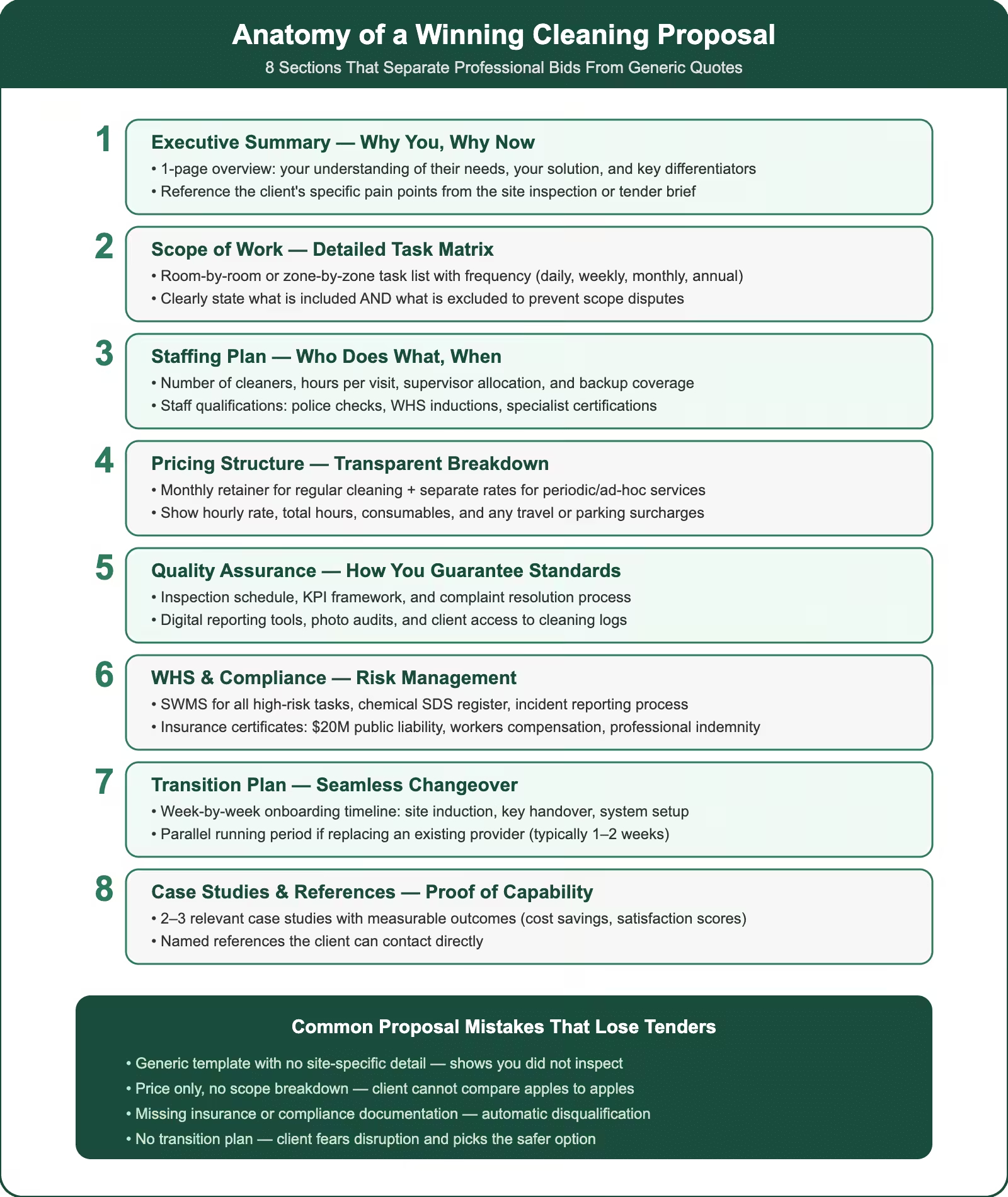
Anatomy of a winning cleaning proposal showing 8 essential sections from executive summary through case studies with common tender mistakes to avoid
What Goes Into a Winning Cleaning Proposal
When it comes to commercial cleaners, understanding the fundamentals matters. A proposal is your sales document — it converts site visits into signed contracts for commercial cleaning services.
The structure matters. Successful proposals walk the client from problem (their facility needs cleaning) through solution (your services and pricing) to reassurance (insurance, compliance, testimonials) and a clear call to action (sign here).
We’ve found that proposals exceeding five pages often lose readers’ attention. Keep critical sections front-and-centre: scope, pricing, timeline, and your team’s qualifications. Secondary details (WHS documentation, detailed product lists) go in appendices.
Our team at a Mascot office complex crafted a proposal that led with their pain point (inconsistent cleaning affecting tenant retention), showed our solution (daily deep cleans plus weekly sanitation), and closed with three client testimonials — it won the contract within two weeks.
The Site Walkthrough — Getting Your Numbers Right
The Site Walkthrough — Getting Your Numbers Right involves specific protocols that we tailor to each facility based on its layout, traffic, and compliance requirements. Never quote from memory or photos alone.
Visit the site with the client or their facility manager. Measure square metres, count high-traffic areas, identify specialist cleaning needs (glass partitions, server rooms, medical-grade surfaces), and photograph problem zones (stained carpets, grimy baseboards, dusty ventilation grilles).
Document everything in a standardised checklist: floor type (carpet, polished concrete, vinyl), wall finish, furniture density, access restrictions (security gates, after-hours only), and required cleaning frequency. This becomes the basis for your scope of work.
In our experience cleaning office buildings in Chatswood and North Sydney, clients always underestimate their actual cleaning needs. Walking the site reveals that a “simple office clean” actually involves multiple specialist tasks — window cleaning, carpet shampooing, kitchen deep-clean — each priced separately.
Pricing Your Proposal — Per Hour vs Per Square Metre
Two common pricing models dominate commercial cleaning: hourly rates and per-square-metre rates.
Hourly pricing works for variable or reactive work (post-construction cleanup, deep cleans, one-off projects). You charge $35–$65/hour depending on specialisation and location. Sydney CBD and Parramatta corporate districts command higher rates ($50–$65/hour) than regional areas ($35–$45/hour).
Per-square-metre pricing suits recurring contracts (daily office cleaning, weekly retail maintenance). Standard office cleaning runs $2.50–$4.50 per m², healthcare facilities $5.00–$7.50 per m², post-construction $4.00–$6.50 per m², and retail $3.00–$5.00 per m².
Service Type
Per Hour (AUD)
Per Sq Metre (AUD)
Best Used For
Standard office cleaning
$35–$45
$2.50–$4.50
Recurring daily/weekly contracts
Medical/healthcare
$50–$65
$5.00–$7.50
Higher compliance; TGA protocols
Post-construction
$45–$60
$4.00–$6.50
One-off; specialised debris removal
Retail/shopping centre
$38–$50
$3.00–$5.00
High-traffic; recurring cycles
High-rise windows
$60–$80+
N/A
Specialist equipment; WHS-critical
For recurring contracts, multiply your hourly rate by estimated hours per cycle, then divide by the site’s square metres to derive a per-m² price. This hybrid approach lets you scale predictably.
Insurance, WHS and Compliance Sections That Build Trust
Insurance, WHS and Compliance Sections That Build Trust includes specific protocols that we tailor to each facility based on its layout, traffic, and compliance requirements. Clients won’t sign without proof of compliance.
Your proposal must include a full-page section titled “Insurance and Compliance” featuring:
ABN and GST registration number
Public liability certificate of currency ($5–$20M coverage)
Workers compensation certificate (if you employ staff)
WHS policy summary (one-page overview of safe practices)
Safe Work Method Statement (SWMS) for tasks specific to their site
Professional facilities and government tenders (through SSROC or NSW eTendering) also request ISO 9001 (quality management), ISO 14001 (environmental), or BSCAA certification. If you hold these, feature them prominently — they differentiate you from competitors.
Our team at a Surry Hills healthcare facility included a copy of their TGA-approved disinfectant documentation and a summary of their infection-control protocols. The client’s safety officer immediately approved the proposal.
Social Proof — Testimonials and Case Studies That Close Deals
Testimonials and case studies reduce perceived risk.
Include 3–5 short quotes from past clients, ideally from similar facility types. A quote from a North Sydney office building manager (“Clean Group’s daily cleaning kept our tenant satisfaction above 95%”) matters more to a prospect office client than generic praise.
Add one or two case studies (200–300 words each) detailing a past project: the challenge (filthy post-construction site), your solution (three-phase cleanup with equipment rental), and the result (client saved $8,000 versus hiring a second contractor). Case studies should reference specific suburbs or facility types your prospect relates to.
Always ask clients for permission before including their name or facility name in testimonials. Some prefer anonymity (“Major Sydney office building”) — respect that, but the suburb/postcode still adds credibility.
Our experience cleaning retail spaces in Epping and Mascot showed that video testimonials (a 30-second clip of the facility manager praising your work) convert better than text-only quotes.
Proposal Software Compared — Better Proposals vs PandaDoc vs Proposify
Proposal Software Compared — Better Proposals vs PandaDoc vs Proposify targets specific protocols that we tailor to each facility based on its layout, traffic, and compliance requirements. Manual proposal writing (Word, Google Docs) costs time and looks amateurish.
Better Proposals ($40–$100/month) specialises in service-based quotes and proposals. It integrates with Jobber (cleaning job management software) and automatically populates pricing from past jobs. Templates include cleaning-specific sections (services, scheduling, insurance, testimonials). Exports to PDF with your branding.
PandaDoc ($25–$65/month) is a general-purpose proposal platform with deeper customisation. Supports electronic signatures, payment collection, and CRM integration. Steeper learning curve but very flexible for multi-service businesses.
Proposify ($49–$199/month) excels at design-heavy, visually stunning proposals. Ideal if you want sleek layouts with client photos and project images. Slightly overkill for pure cleaning services but effective for premium, high-touch clients.
Jobber ($400–$800/month) bundles quoting, invoicing, job scheduling, and payments. Cleaning businesses love it because it’s purpose-built — you measure a site, auto-populate your square metres, and the software calculates pricing instantly from your saved rates.
For startup cleaners, Better Proposals or Jobber offer the best ROI. As you scale, PandaDoc gives more design control.
Common Proposal Mistakes That Lose Contracts
Three mistakes sink proposals repeatedly.
Mistake 1: Vague scope. Writing “Weekly office cleaning” without detailing frequency, surface areas, or specific tasks confuses clients and invites disputes. Instead: “Weekly Monday–Friday morning cleaning, 6:00–8:30 AM, including carpet vacuuming, desk dusting, restroom sanitation to WHS standards, and rubbish removal.”
Mistake 2: Missing insurance proof. Proposing without attaching your public liability certificate of currency signals unprofessionalism or non-compliance. Government and corporate clients immediately reject incomplete proposals.
Mistake 3: Unclear pricing breakdowns. Lumping all costs into one line item (“Office cleaning: $4,500/month”) looks like you didn’t measure the site. Instead, itemise: “Daily vacuuming (2,000 m²) = $3,200/month; Weekly sanitation = $800/month; Monthly deep-clean windows = $500/month. Total: $4,500.”
In our experience at Parramatta and Epping office sites, clients also rejected proposals lacking a defined contract start date and term length (e.g., “12-month agreement, with 30-day termination clause”).
Follow-Up Strategy After Sending Your Proposal
Sending a proposal isn’t the end — it’s the beginning of a sales cycle.
Set a reminder to follow up 3 business days after sending. Call or email the decision-maker (usually the facility manager or office manager) and ask: “Did you receive the proposal? Do you have any questions?” Many proposals sit unread because busy managers forget. A polite follow-up re-triggers attention.
If they ask for revisions (pricing adjustments, expanded scope), turn around a revised proposal within 24 hours. This responsiveness signals reliability.
If they go silent after two follow-ups, assume they’ve chosen a competitor. Don’t keep chasing — it wastes energy. However, email them every 6–12 months with a brief check-in (“We’d love to serve you when your current cleaner’s contract renews”).
Our team tracked proposal conversion rates and found that proposals sent on Tuesday–Thursday convert 15% better than Monday or Friday submissions. Friday proposals often sit until the following week, losing momentum. Understanding industry trends and statistics for cleaners can inform your proposal strategy and competitive positioning.
Frequently Asked Questions
How detailed should my scope of work section be?
Detailed enough that the client can’t argue about what’s included. List every cleaning task, frequency (daily, weekly, monthly), surface types, and any exclusions. For example: “Carpet vacuuming (daily), hard-floor mopping (Tuesday/Friday), restroom sanitisation (twice daily), window cleaning (monthly), excluding external building facades and HVAC duct cleaning.” Ambiguous scopes lead to disputes. Our team adds a line: “Any work outside this scope will be quoted separately.”
Should I include payment terms in my proposal?
Yes. Specify invoicing frequency (monthly, fortnightly), payment due date (net 14, net 30), and accepted payment methods (bank transfer, credit card, cheque). Include a line like: “Invoices due within 14 days of month-end. Late payments incur 2% monthly interest per Fair Work Act guidelines.” Clear payment terms prevent cash-flow surprises.
How far in advance should I send a proposal?
Send within 24 hours of your site walkthrough while details are fresh and you’re top-of-mind. Clients often request bids from 2–3 competitors simultaneously — being first matters. Include a line like: “This proposal is valid for 14 days. To book your start date, please confirm by [date].”
Do I need electronic signature capability in my proposal?
Not for small jobs, but highly valuable for recurring contracts. Tools like Better Proposals, PandaDoc, and Proposify let clients sign digitally, which accelerates closing. For government and large commercial contracts, electronic signature (via DocuSign or Acrobat Sign) is often required. Solo startups can get by with printed signatures, but invest in e-signature software once you’re consistently bidding large contracts.
Can I include estimated profit margins in my proposal?
No — never disclose your costs or profit margins. The proposal shows your all-in price; the client doesn’t need to know your labour cost or product markup. If they ask “How much of this is profit?”, deflect professionally: “Our pricing reflects the expertise, compliance, and reliability we bring. If your budget is constrained, let’s discuss scaled-back options.”
About Clean Group
Clean Group is a leading commercial cleaning company in Sydney, providing professional cleaning services to offices, strata buildings, medical facilities, schools, gyms, and retail spaces across the greater Sydney region. With over 25 years of experience and a commitment to WHS compliance, eco-friendly practices, and consistent quality, Clean Group delivers tailored cleaning solutions backed by a 100% satisfaction guarantee.
Hi, I'm Suji Siv, the founder, CEO, and Managing Director of Clean Group, bringing over 25 years of leadership and management experience to the company. As the driving force behind Clean Group’s growth, I oversee strategic planning, resource allocation, and operational excellence across all departments. I am deeply involved in team development and performance optimization through regular reviews and hands-on leadership.