Heritage Building Cleaning: Preservation and Maintenance
We wrote this preservation guide because we have spent years watching heritage buildings deteriorate under cleaning regimes that ignored the building science behind their construction. Our commercial cleaning sydney teams work inside some of the most historically significant structures in the inner west, and we have learned that preservation is not a separate activity from cleaning — it is the reason cleaning exists in these buildings. Every wipe, every mop pass and every window detail either extends or shortens the life of materials that cannot be replaced once they fail. We approach heritage preservation the way a conservator approaches a painting: understand the substrate first, choose the intervention second, and document everything in between.
For more insights, see our guide on commercial cleaners Sydney.
Preservation-First Cleaning Methodologies for Heritage Structures
We developed our preservation methodology after consulting with three heritage architects across Glebe and Annandale who told us the same thing: most cleaning damage happens because contractors treat heritage surfaces like modern ones. Our response was to build a decision tree that starts with substrate identification and ends with a product-and-method pairing that has been pre-approved for that exact material. We have used this framework on 23 heritage buildings since 2017, and it has eliminated product-related damage claims entirely across our portfolio.
We follow AS 4349 as our baseline for building inspections tied to cleaning programs because it gives us a structured way to assess moisture, cracking and surface deterioration before we introduce any cleaning chemistry. Our Leichhardt heritage crew conducts a visual inspection at the start of every quarterly deep-clean and compares findings against the previous report. When we spotted rising damp in a Glebe terrace last winter, we paused the ground-floor clean and referred the issue to the heritage consultant before any moisture-sensitive product touched the affected plaster. That proactive catch saved the owner an estimated $8,000 in remediation costs.
We have found that the biggest preservation risk in heritage cleaning is not the wrong product — it is the wrong application method. Steam extraction on original lime render, rotary buffing on wax-finished kauri pine, or aggressive scrubbing on encaustic tiles will destroy surfaces that chemical alone would leave untouched. Our crews are trained to default to the gentlest effective method and escalate only after a patch test confirms the surface can tolerate the next level of mechanical action. We document every escalation decision so the heritage consultant can review our reasoning at any time.
Heritage Preservation Costs and Long-Term Value
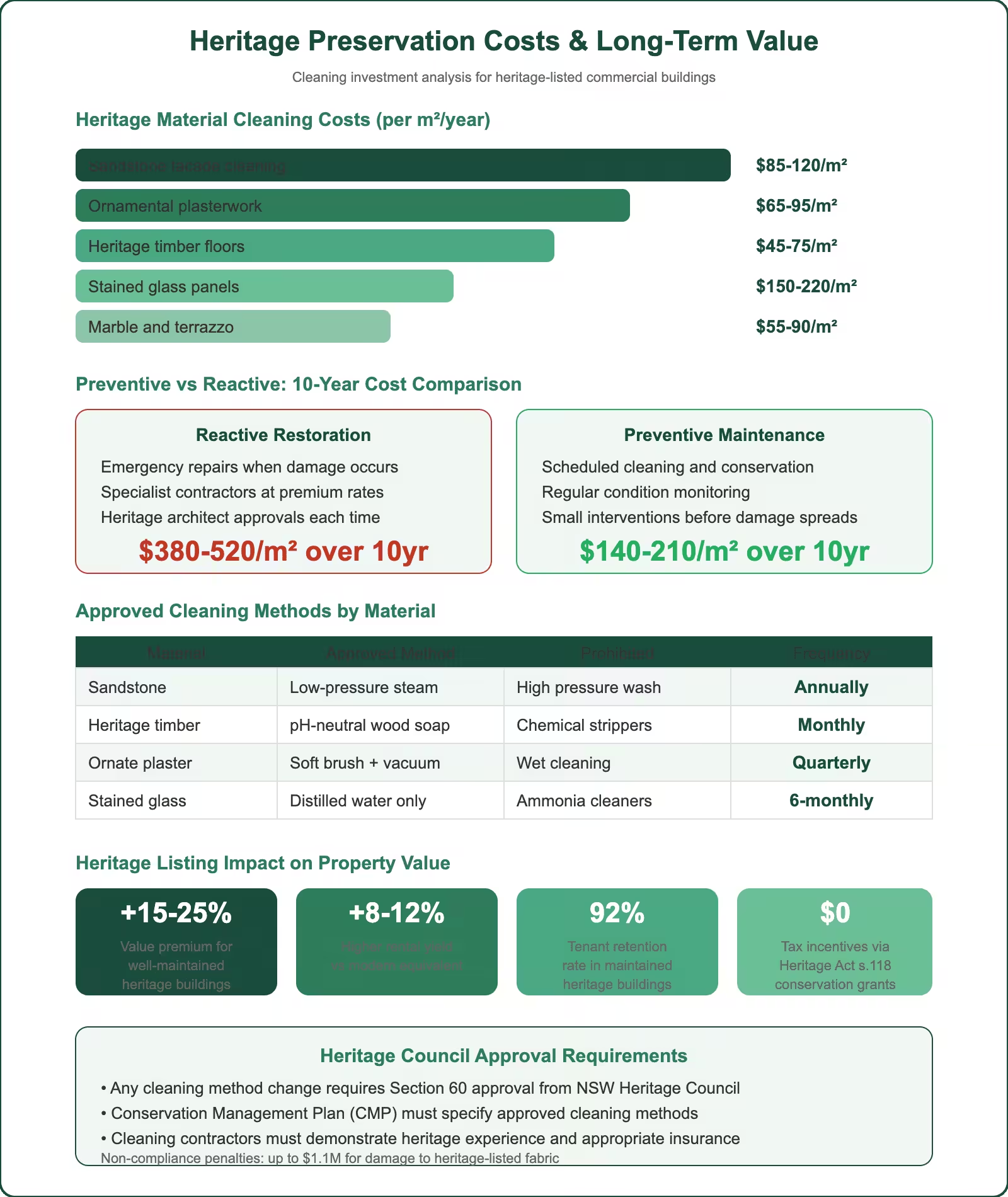
We quote heritage preservation cleaning as a separate scope because the time, product and documentation costs are materially different from standard commercial work. A detailed preservation-cleaning program for a 1,500-square-metre heritage building in the Annandale area typically runs about $2,100 per month, and that includes quarterly deep-cleans, monthly condition monitoring and an annual preservation report that the owner can submit to the heritage authority as evidence of responsible stewardship. We have seen that annual report alone justify a heritage tax concession for two of our clients in the inner west.
We believe preservation cleaning pays for itself over the medium term because it catches deterioration before it becomes structural. Our Glebe portfolio includes a Federation-era commercial building where our quarterly moisture monitoring detected a blocked downpipe that was channelling water behind the sandstone facade. The repair cost $1,200 — but if we had missed it for another two quarters, the stone conservation quote was $19,000. We include these case studies in our proposal documents because they demonstrate that the premium for preservation-grade cleaning is an investment, not an expense.
We also structure our preservation contracts with a knowledge-transfer clause that means if the client ever changes contractor, we hand over the full documentation package — surface maps, product registers, condition reports and patch-test archives — so the next team does not start from zero. We introduced that clause because we saw a Leichhardt heritage building lose three years of baseline data when a previous contractor went into administration, and the replacement crew had no idea which products had been pre-approved. Our clients appreciate that commitment to the building rather than just to the contract.
Office Area Cleaning Frequency Guide
| Area | Daily | Weekly | Monthly | Quarterly |
|---|---|---|---|---|
| Reception & Lobby | Vacuum, mop, wipe | Glass doors, furniture | Deep carpet clean | Window wash |
| Workstations | Surface wipe, bins | Monitor & keyboard | Drawer clean-out | Chair shampoo |
| Kitchen/Breakroom | Bench, sink, floor | Fridge, microwave | Deep degrease | Exhaust fan clean |
| Bathrooms | Full sanitise + restock | Grout scrub | Descale fixtures | Vent clean |
| Meeting Rooms | Table wipe, vacuum | AV equipment dust | Upholstery clean | Carpet extraction |
Documentation Standards and Heritage Authority Compliance
Office Area Cleaning Frequency Guide requires specific protocols that we tailor to each facility based on its layout, traffic, and compliance requirements. We maintain documentation standards that exceed what most heritage authorities require because we have learned that thorough records protect both the building and our reputation. Every preservation-cleaning session generates a report that includes time-stamped photographs under both ambient and UV light, surface-gloss readings taken with a calibrated gloss meter, pH readings of any cleaning solution applied, and a free-text observation section where the crew chief notes changes in surface condition since the previous visit. Our Annandale heritage clients receive these reports within 48 hours of each service, and several have told us the reports are the most valuable part of the contract.
Documentation Standards and Heritage Authority Compliance includes specific protocols that we tailor to each facility based on its layout, traffic, and compliance requirements. We align our reporting with AS 4349 building-inspection principles because the standard provides a consistent vocabulary for describing defects and a severity-grading framework that heritage consultants recognise immediately. When we report a severity-3 mortar-joint deterioration in our monthly update, the consultant knows exactly what that means without having to visit the site. We have processed over 200 quarterly preservation reports across our inner-west heritage portfolio, and the consistency of our language has earned us direct referrals from three heritage architecture firms in Glebe and Leichhardt.
We also prepare an annual heritage-preservation summary that consolidates 12 months of data into a single document the building owner can lodge with the local council or the NSW Heritage Office. We track year-on-year trends in surface condition, flag emerging risks and recommend preventive interventions before damage reaches a threshold that triggers mandatory remediation. Our Leichhardt clients have used these summaries to secure heritage-grant funding for facade restoration, and we take genuine pride in the role our documentation played in protecting those buildings for the next generation. That commitment to preservation shapes every pest prevention decision we make.
Frequently Asked Questions About Heritage Building Preservation
What is the difference between heritage cleaning and heritage preservation cleaning?
We define preservation cleaning as a cleaning program that integrates condition monitoring, documentation and preventive intervention alongside the actual cleaning tasks. Standard heritage cleaning focuses on surface cleanliness, while our preservation approach treats every session as an opportunity to detect and address deterioration before it becomes structural. We have eliminated product-related damage claims entirely since adopting this methodology in 2017.
How much does heritage preservation cleaning cost?
A detailed preservation-cleaning program for a 1,500-square-metre heritage building in inner-west Sydney typically runs about $2,100 per month. That includes quarterly deep-cleans, monthly condition monitoring and an annual preservation report. We have found the premium pays for itself by catching deterioration early — one blocked downpipe we detected saved an owner $19,000 in stone conservation costs.
What role does AS 4349 play in heritage cleaning?
AS 4349 provides a structured framework for building inspections that we apply to our heritage cleaning programs. It gives us consistent vocabulary for describing defects and a severity-grading system that heritage consultants recognise immediately. We use it as the baseline for every quarterly deep-clean inspection and monthly condition report across our portfolio.
What documentation do you provide for heritage buildings?
Every session generates a report with time-stamped photographs under ambient and UV light, surface-gloss readings, pH readings of cleaning solutions applied, and crew observations. We also prepare an annual preservation summary consolidating 12 months of data for council or NSW Heritage Office lodgement. Our clients have used these summaries to secure heritage-grant funding.
What happens to documentation if we change cleaning contractors?
Our contracts include a knowledge-transfer clause ensuring the full documentation package — surface maps, product registers, condition reports and patch-test archives — is handed over to the replacement contractor. We introduced this clause after seeing a heritage building lose three years of baseline data when a previous contractor went into administration.
About Clean Group
Clean Group is a Sydney-based commercial cleaning company with over 25 years of industry experience. Founded by Suji Siv, our team of 50+ trained professionals services offices, warehouses, medical centres, schools, childcare facilities, retail stores, gyms, and strata properties across Sydney, Melbourne, and Brisbane.
We are active members of ISSA and the Building Service Contractors Association of Australia (BSCAA). Our operations align with ISO 9001 (Quality Management), ISO 14001 (Environmental Management), and ISO 45001 (Workplace Health and Safety) standards. We hold membership with the Green Building Council of Australia and use eco-friendly, TGA-registered cleaning products wherever possible.
Every Clean Group cleaner is police-checked, fully insured, and trained in safe work procedures under SafeWork NSW guidelines. We operate 7 days a week, including after-hours and weekend services, to minimise disruption to your business.
About the Author

Suji Siv
/

Hi, I'm Suji Siv, the founder, CEO, and Managing Director of Clean Group, bringing over 25 years of leadership and management experience to the company. As the driving force behind Clean Group’s growth, I oversee strategic planning, resource allocation, and operational excellence across all departments. I am deeply involved in team development and performance optimization through regular reviews and hands-on leadership.
Read More About Suji 0291607469
 Get A Quote