Understanding what a cleaning contractor actually does — and how they differ from an employee — is necessary for any business engaging commercial cleaning services. We have operated as a cleaning contractor in Sydney for twenty-six years and the distinction between contractors and employees remains one of the most misunderstood areas in our industry. This guide explains the role from the inside, covering legal definitions, responsibilities, pricing models, and what to look for when choosing the right contractor.
Cleaning Contractor Definition Under Fair Work Law
Under Australian law, a cleaning contractor is a person or business engaged to perform cleaning services under a contract for services rather than a contract of service. The Fair Work Act 2009 and the Independent Contractors Act 2006 draw this distinction based on several factors: the degree of control over how work is performed, whether the contractor supplies their own equipment, whether they can delegate or subcontract, and whether they bear financial risk for the work.
We operate as a principal contractor, which means we hold the head contract with the building owner or facilities manager and employ our own staff under the Cleaning Services Award 2020. Some operators in Sydney work as sole-trader subcontractors, but the Australian Taxation Office has been increasingly scrutinising these arrangements. If a cleaner works set hours at a single location, uses the client’s equipment, and cannot substitute another worker, the ATO may deem that an employment relationship regardless of what the contract says. We have seen this catch out several competitors in Parramatta and the CBD.
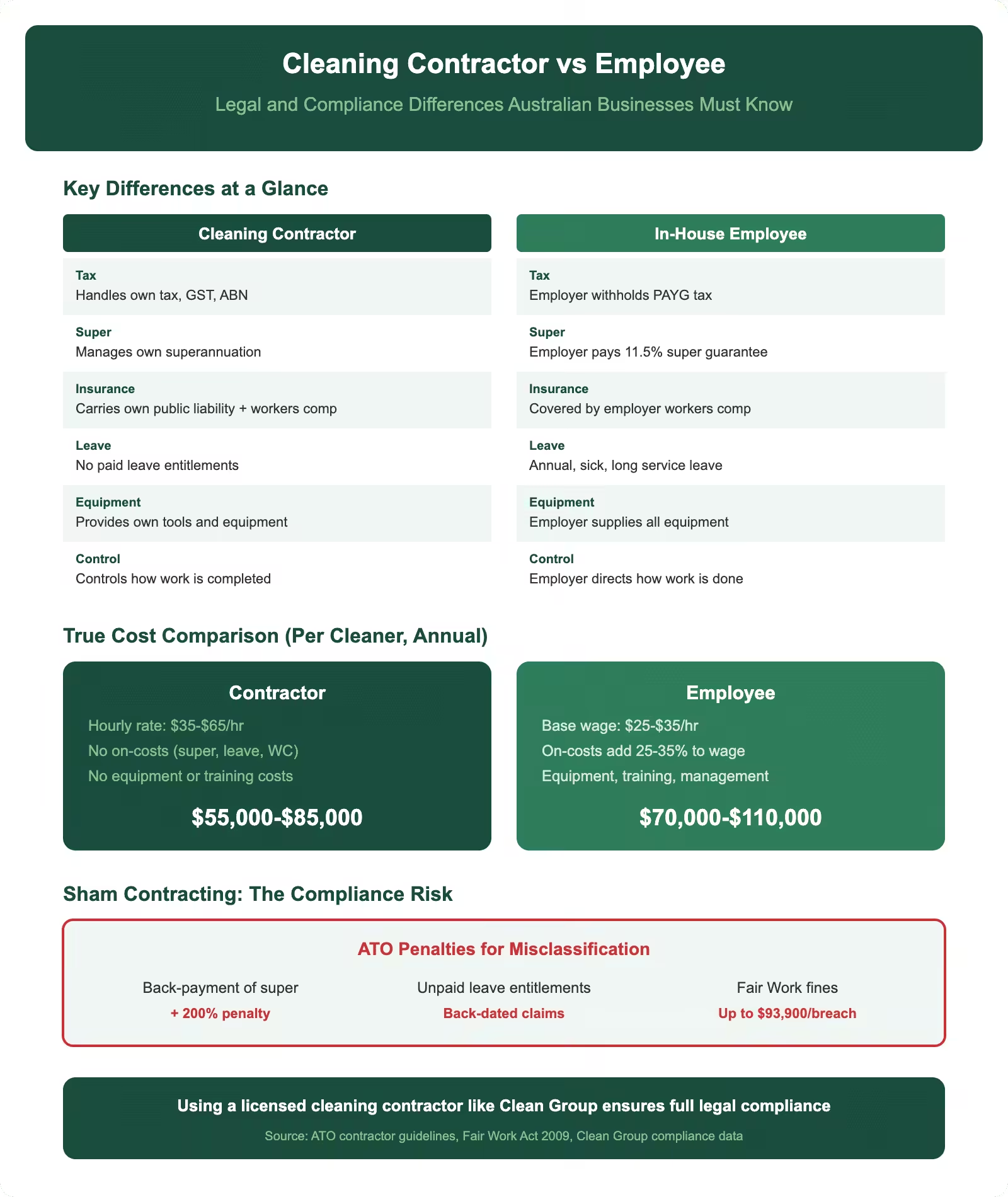
Cleaning contractor versus employee comparison infographic showing legal differences cost comparison tax super insurance obligations and sham contracting compliance risks in Australia
Contractor vs Employee: Legal and Compliance Differences
The compliance obligations differ significantly between engaging a contractor and employing staff directly. A genuine contractor handles their own superannuation, workers compensation insurance, tax withholding, and public liability cover. An employer must provide these under the Cleaning Services Award 2020, Fair Work Act, and state WHS legislation. The Cleaning Accountability Framework has pushed hard for transparency in this area because sham contracting — disguising employment as contracting to avoid on-costs — remains a systemic issue in our industry.
Our team manages all employment obligations in-house. We process superannuation fortnightly, maintain workers compensation coverage with a current premium below the industry average, and report through Single Touch Payroll. When we subcontract specialist services — high-rise window cleaning or heritage restoration work — we verify the subcontractor’s ABN, insurance certificates, and safe work method statements before they set foot on site. That due diligence protects our clients and our reputation.
Office Area Cleaning Frequency Guide
Area
Daily
Weekly
Monthly
Quarterly
Reception & Lobby
Vacuum, mop, wipe
Glass doors, furniture
Deep carpet clean
Window wash
Workstations
Surface wipe, bins
Monitor & keyboard
Drawer clean-out
Chair shampoo
Kitchen/Breakroom
Bench, sink, floor
Fridge, microwave
Deep degrease
Exhaust fan clean
Bathrooms
Full sanitise + restock
Grout scrub
Descale fixtures
Vent clean
Meeting Rooms
Table wipe, vacuum
AV equipment dust
Upholstery clean
Carpet extraction
Types of Cleaning Contractors by Sector
Cleaning contractors in Australia generally specialise by sector because each environment demands different skills, equipment, and compliance knowledge. Commercial office cleaning is the largest segment and our core business — we maintain over thirty-five sites across the Sydney CBD, North Sydney, Chatswood, and Macquarie Park. Healthcare cleaning requires knowledge of AS 4187 for infection control. Childcare cleaning operates under National Quality Framework standards. Industrial cleaning involves heavy plant and hazardous materials governed by additional WHS codes of practice.
We have deliberately built expertise across multiple sectors because it makes us a more resilient business and a more valuable partner for property groups that manage mixed portfolios. A facilities manager who oversees both a Surry Hills office tower and a Lane Cove medical centre benefits from engaging a single contractor with demonstrated capability across both environments rather than managing two separate relationships.
Contractor Responsibilities: Cleaning, Business, and Client Relations
A cleaning contractor’s responsibilities extend well beyond mopping floors. We manage rostering, staff training, chemical procurement, equipment maintenance, quality auditing, WHS compliance, and client communication — all simultaneously. Our operations team coordinates over one hundred and fifty cleaners across morning, day, and evening shifts, and every site has a dedicated supervisor responsible for daily execution and a monthly account review with the client.
The business side is equally demanding. We maintain public liability insurance of twenty million dollars, process payroll fortnightly for all staff, lodge Business Activity Statements quarterly, submit Taxable Payments Annual Reports to the ATO, and manage workers compensation claims through our insurer. These obligations are what distinguish a professional contractor from someone with a mop and an ABN. In our experience, facilities managers in Barangaroo and the CBD have become much more rigorous about verifying these credentials during the tender process.
Equipment and Supplies Contractors Typically Own
A genuine cleaning contractor invests in their own equipment, which is one of the legal indicators that distinguishes contracting from employment. Our fleet includes ride-on scrubbers, truck-mounted carpet extraction units, backpack vacuums with HEPA H13 filtration, oscillating pad machines for hard floors, high-pressure washers, and a full range of microfibre cleaning systems. Every piece of equipment has a QR-coded maintenance tag with complete service history.
Our Homebush depot manages a central consumable store that dispatches weekly to every site. We maintain standing-order agreements with three national distributors to avoid supply chain dependency. Chemical selection follows a strict protocol — every product must be TGA-listed if making antimicrobial claims, GECA-certified where available, and cross-referenced against Safety Data Sheets reviewed quarterly. We spend roughly sixty-five thousand dollars annually on equipment replacement and maintenance alone, which is a significant capital commitment that sole-trader operators often cannot sustain.
Skills and Qualifications for Cleaning Contractors
We require every cleaner to hold a minimum Certificate III in Cleaning Operations (CPP30316) and complete a site-specific induction before their first shift. Supervisors must also hold current first-aid certification and a WHS White Card. Beyond formal qualifications, the practical skills that matter most in commercial cleaning include surface identification — knowing which floor finish requires a neutral pH cleaner versus an alkaline stripper — and the ability to read and follow safe work method statements.
Our training programme runs continuously. New starters complete forty hours of induction covering chemical safety, manual handling, infection control protocols, and equipment operation. Experienced staff cycle through quarterly refresher modules aligned to AS/NZS 4801 safety management principles. We also run an internal leadership programme for senior supervisors that covers site management, client communication, and audit reporting. This investment in people is what allows us to deliver consistent quality across thirty-five diverse sites.
Contractor Pricing Models: Hourly, Per-Metre, and Fixed Contracts
Pricing in the cleaning industry follows three primary models. Hourly rates are common for casual and ad-hoc work — the Cleaning Services Award 2020 sets the base at thirty-one dollars and sixty-five cents for a Level 1 cleaner, but the true cost to a compliant contractor sits closer to forty-five dollars once on-costs are included. Per-square-metre pricing is standard for routine commercial contracts — in Sydney’s CBD, compliant rates typically range from thirty-eight to fifty-two dollars per square metre per annum for a five-night service.
We prefer fixed-price contracts with a schedule of rates for ad-hoc work because this model gives clients budget certainty while allowing flexibility. Every contract includes annual CPI-linked escalation and a transparent cost breakdown showing labour, consumables, equipment, and overhead components. We walk away from tenders where the pricing implies below-award labour rates because those arrangements inevitably fail — either the contractor cuts corners, underpays staff, or collapses entirely.
Legal Requirements for Australian Cleaning Contractors
Operating legally as a cleaning contractor in Australia requires an ABN, appropriate business registration, public liability insurance, workers compensation insurance (if employing staff), and compliance with the Cleaning Services Award 2020 for all employees. The Taxable Payments Annual Report is mandatory for businesses that pay contractors for cleaning services — a requirement many smaller operators overlook until the ATO issues a penalty notice.
We also maintain professional indemnity insurance, motor vehicle fleet insurance, and a detailed WHS management system aligned to the Work Health and Safety Act 2011 (NSW). Our compliance costs run to approximately one hundred and twenty thousand dollars annually across legal, accounting, insurance, training, and audit functions. These are not optional expenses — they are the cost of operating legitimately. The Fair Work Ombudsman has recovered tens of millions in underpayments from the cleaning sector, and we have seen competitors lose their businesses overnight when compliance failures were exposed.
Choosing the Right Cleaning Contractor
When evaluating cleaning contractors, look beyond the quote. Request evidence of their compliance framework — insurance certificates, workers compensation coverage, safety management documentation, and training records. Ask for references from buildings similar to yours in size and type. A contractor who cleans a ten-thousand-square-metre CBD office tower operates at a completely different level to one servicing residential homes, and the capabilities are not interchangeable.
Our advice is to use a weighted evaluation matrix: forty per cent methodology, twenty-five per cent price, twenty per cent experience and references, and fifteen per cent innovation and sustainability. We welcome this level of scrutiny because it rewards operators who invest in systems and people rather than those who simply submit the lowest price. For a broader view of the different service delivery models available, explore our complete guide to cleaning commercial properties.
Five Critical FAQs for Understanding Cleaning Contractors
What is the difference between a cleaning contractor and a cleaning employee?
A contractor operates under a contract for services, supplies their own equipment, bears financial risk, and can subcontract. An employee works under a contract of service with set hours, employer-supplied equipment, and entitlements under the Cleaning Services Award 2020. Misclassifying employees as contractors is a serious compliance breach.
How much does a cleaning contractor charge in Sydney?
Compliant rates for commercial cleaning in Sydney typically range from thirty-eight to fifty-two dollars per square metre per annum for routine five-night services. The Cleaning Services Award 2020 base rate is thirty-one dollars sixty-five cents per hour, but true contractor costs including on-costs sit closer to forty-five dollars.
What insurance does a cleaning contractor need?
At minimum, public liability insurance of twenty million dollars, workers compensation coverage for all employees, and an ABN. We also carry professional indemnity and motor vehicle fleet insurance across our entire operation.
What qualifications should a cleaning contractor hold?
We require Certificate III in Cleaning Operations (CPP30316) for all staff, with supervisors holding additional first-aid and WHS White Card certification. ISSA membership and CIMS certification provide additional credibility for contractors targeting institutional clients.
How do I verify a cleaning contractor’s compliance?
Request current insurance certificates, workers compensation coverage confirmation, ABN verification through the Australian Business Register, and evidence of Award compliance including pay records. The Cleaning Accountability Framework provides a useful benchmark for assessing contractor legitimacy.
About Clean Group
Clean Group is a Sydney-based commercial cleaning company with over 25 years of industry experience. Founded by Suji Siv, our team of 50+ trained professionals services offices, warehouses, medical centres, schools, childcare facilities, retail stores, gyms, and strata properties across Sydney, Melbourne, and Brisbane.
We are active members of ISSA and the Building Service Contractors Association of Australia (BSCAA). Our operations align with ISO 9001 (Quality Management), ISO 14001 (Environmental Management), and ISO 45001 (Workplace Health and Safety) standards. We hold membership with the Green Building Council of Australia and use eco-friendly, TGA-registered cleaning products wherever possible.
Every Clean Group cleaner is police-checked, fully insured, and trained in safe work procedures under SafeWork NSW guidelines. We operate 7 days a week, including after-hours and weekend services, to minimise disruption to your business.
Hi, I'm Suji Siv, the founder, CEO, and Managing Director of Clean Group, bringing over 25 years of leadership and management experience to the company. As the driving force behind Clean Group’s growth, I oversee strategic planning, resource allocation, and operational excellence across all departments. I am deeply involved in team development and performance optimization through regular reviews and hands-on leadership.
![What Is A Business Cleaning Contractor and What Do Cleaning Contractors Do? [Explained]](https://commercialcleaning.au/wp-content/uploads/2021/06/What-Is-A-Cleaning-Contractor-and-What-Do-Cleaning-Contractors-Do-Explained.avif)