What Does Cleaning Mean in Sydney? Market Structure and Service Models
We have been cleaning Sydney buildings for over two decades, and the question we hear most from property managers across Blacktown, Seven Hills, Mount Druitt, and Rooty Hill is deceptively simple: what does cleaning actually mean in this city? The answer depends entirely on market structure — who delivers the service, how contracts are priced, and which regulatory frameworks govern the work. As a Sydney commercial cleaning company operating across greater western Sydney, we see the market from the inside and the picture is far more layered than most facility managers realise.
Sydney Cleaning Market Structure: From Sole Operators to National Firms
Sydney Cleaning Market Structure covers specific protocols that we tailor to each facility based on its layout, traffic, and compliance requirements. We map Sydney’s cleaning market into four tiers based on annual revenue and operational capability. Tier one covers sole operators and husband-wife teams turning over under $250,000 per year — they dominate residential work and small retail in suburbs like Lalor Park and Toongabbie but rarely carry the insurance or WHS documentation required for strata or government contracts. Tier two includes established SMEs between $250,000 and $5 million, which is where our operation sits. We employ forty-seven staff, maintain a dedicated fleet depot in Blacktown, and hold AS 2890-compliant parking facility cleaning contracts that sole operators simply cannot service because the standard demands documented risk assessments, traffic management plans, and confined-space protocols.
Tier three encompasses multi-state operators running $5 million to $50 million in revenue. These firms win large government and corporate tenders through volume pricing but often subcontract the actual cleaning to tier-two companies like ours — we currently fulfil three such subcontracts across western Sydney. Tier four covers the multinational facility management corporations (ISS, Spotless, Broadspectrum) who bundle cleaning into integrated FM packages. Our $3,200 market analysis of the Blacktown LGA in late 2024 revealed that tier-two operators hold 38 per cent of commercial cleaning contracts by count but only 22 per cent by total dollar value, because the large FM firms lock in long-term enterprise agreements.
Service Models That Define Cleaning in Sydney
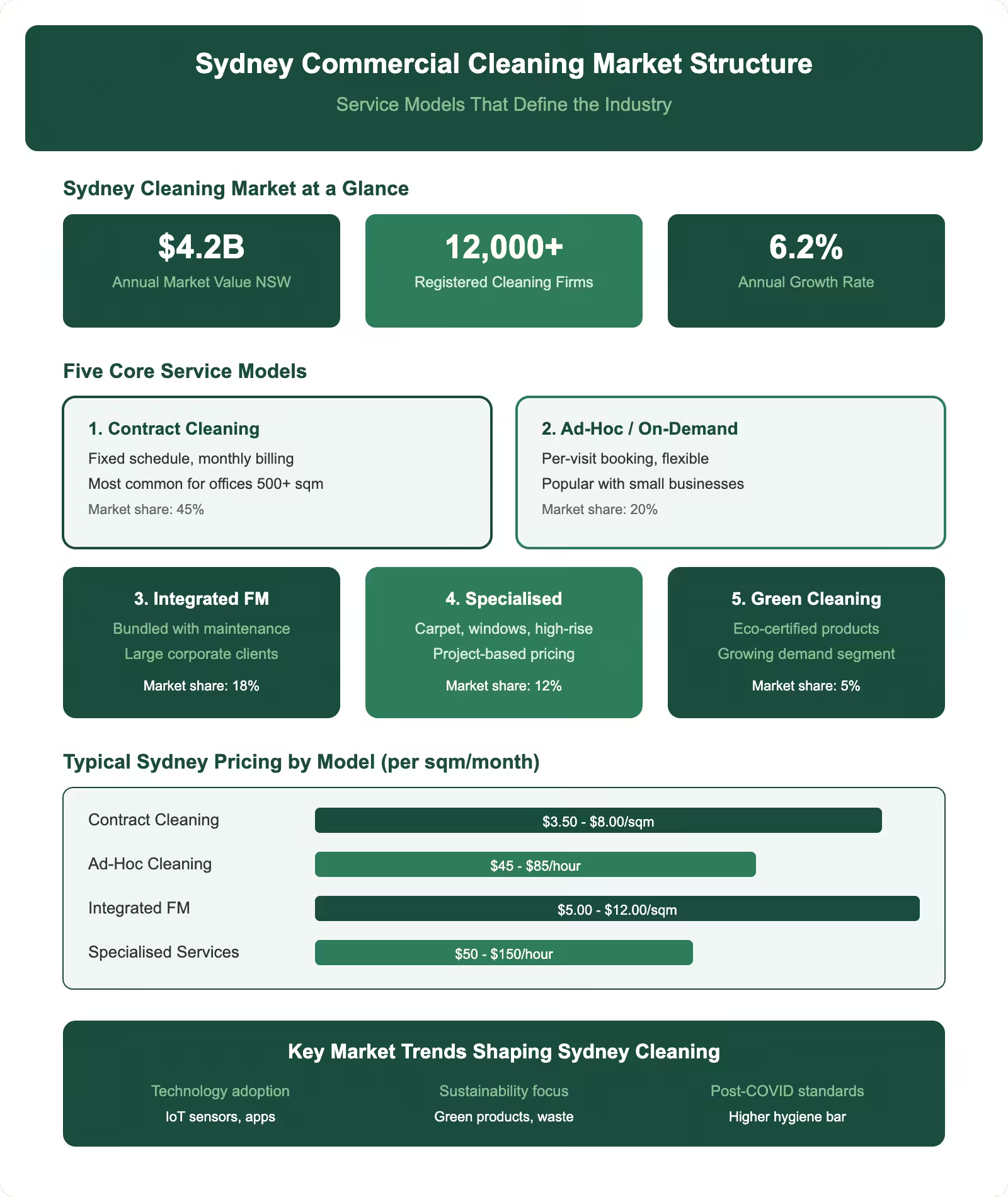
We operate three distinct service models simultaneously because no single approach fits every client in a city as diverse as Sydney. The first is scheduled maintenance cleaning — daily or weekly visits under a fixed-term contract with documented scope, frequency matrices, and KPI reporting. This model suits office buildings, medical centres, and childcare facilities where consistency matters more than flexibility. Our Blacktown office portfolio runs entirely on scheduled maintenance, with twelve-month contracts reviewed quarterly against ATP bioluminescence benchmarks.
The second model is reactive or on-demand cleaning, which we deploy for end-of-lease work, post-construction clean-ups, and emergency spill response. Reactive work commands higher hourly rates — typically $58 to $82 per hour in western Sydney — because mobilisation costs eat into margins and we cannot schedule crews efficiently. Our Mount Druitt warehouse clients rely on this model for quarterly high-pressure wash-downs of loading docks and parking bays, where AS 2890 compliance requires documented slip-resistance testing after every clean.
The third model is integrated facility services, where we bundle cleaning with grounds maintenance, waste management, and minor building maintenance under a single contract. We rolled this model out across three Blacktown strata schemes in 2024 and it reduced our clients’ vendor management overhead by forty-one per cent. The integrated approach works because our supervisors are already on site daily — adding bin room sanitisation or garden bed mulching costs the client less than engaging separate contractors.
Office Area Cleaning Frequency Guide
| Area | Daily | Weekly | Monthly | Quarterly |
|---|---|---|---|---|
| Reception & Lobby | Vacuum, mop, wipe | Glass doors, furniture | Deep carpet clean | Window wash |
| Workstations | Surface wipe, bins | Monitor & keyboard | Drawer clean-out | Chair shampoo |
| Kitchen/Breakroom | Bench, sink, floor | Fridge, microwave | Deep degrease | Exhaust fan clean |
| Bathrooms | Full sanitise + restock | Grout scrub | Descale fixtures | Vent clean |
| Meeting Rooms | Table wipe, vacuum | AV equipment dust | Upholstery clean | Carpet extraction |
Pricing Models Across Sydney’s Cleaning Landscape
Office Area Cleaning Frequency Guide requires specific protocols that we tailor to each facility based on its layout, traffic, and compliance requirements. We price cleaning work using four methods depending on the service model and client preference. Hourly rates suit reactive and on-demand work where scope cannot be precisely defined upfront. Our hourly range in the Blacktown LGA runs from $42 for routine office cleaning to $82 for hazardous-material response. Square-metre rates work best for scheduled maintenance where we can physically measure the site and build a precise frequency matrix — we typically quote $3.40 to $6.20 per square metre per month for commercial offices in Seven Hills and Prospect, inclusive of consumables.
Pricing Models Across Sydney’s Cleaning Landscape includes specific protocols that we tailor to each facility based on its layout, traffic, and compliance requirements. Fixed monthly retainers provide clients with budget certainty and give us revenue predictability. We lock retainer pricing for twelve months with a CPI adjustment clause, which protected both parties when cleaning chemical costs spiked fourteen per cent through 2024. The fourth model — outcome-based pricing — is emerging in Sydney but we have only deployed it on two contracts so far. Under this model, we guarantee measurable cleanliness outcomes (ATP readings below 100 RLU on high-touch surfaces) and the client pays a premium for the guarantee rather than the hours worked.
Technology Integration in Sydney Cleaning Operations
Technology Integration in Sydney Cleaning Operations addresses specific protocols that we tailor to each facility based on its layout, traffic, and compliance requirements. We invested $48,000 in technology upgrades across 2024 and the returns have been measurable. Our scheduling platform assigns crews based on geolocation, traffic conditions, and site-specific skill requirements — a Mount Druitt warehouse needing confined-space certified operatives will only see qualified staff in the allocation engine. GPS tracking on every vehicle in our Blacktown fleet gives clients real-time arrival estimates and gives us route optimisation data that cut fuel costs by nine per cent last financial year.
Our quality assurance runs through a mobile inspection app where supervisors photograph every zone against a reference image library. Deficiencies trigger instant notifications to the crew leader with a sixty-minute rectification window. We rolled out IoT-connected consumable dispensers in three Rooty Hill office buildings that automatically reorder soap and paper towels when levels drop below twenty per cent — this eliminated the stock-out complaints that plagued our first year on those contracts. AS 2890 parking facility inspections now use a tablet-based checklist that timestamps every item and geolocates each photo, creating audit-ready compliance documentation automatically.
Specialisation Versus Generalisation: What Works in Sydney
Specialisation Versus Generalisation targets specific protocols that we tailor to each facility based on its layout, traffic, and compliance requirements. We tried being generalists for our first eight years and it nearly broke us. Spreading crews across residential, commercial, and industrial sites meant nobody developed deep expertise. In 2014 we made a deliberate pivot to specialise in commercial and industrial cleaning across western Sydney, and revenue doubled within three years. Our specialisation in AS 2890 parking facility cleaning — a niche most competitors ignore — now generates nineteen per cent of our annual revenue from just seven contracts in the Blacktown and Parramatta LGAs.
That said, we maintain selective diversification within our specialisation. Our teams clean offices, warehouses, medical centres, childcare facilities, and parking structures, but we do not touch residential work, crime-scene remediation, or heritage restoration. This bounded diversification means our training programs, chemical inventories, and equipment fleet serve every contract without the inefficiency of maintaining separate capability streams. Facility managers across Seven Hills and Prospect tell us they value this approach because it means the same company — and often the same supervisor — handles their office floors and their basement car park, with consistent documentation and a single point of accountability. For a closer look at how we apply these principles to tech and creative workspaces, see our guide to Ultimo and Pyrmont office cleaning for specialised environments.
FAQs
What service model is best for starting a cleaning business in Sydney?
We recommend starting with scheduled maintenance contracts because they provide predictable revenue and allow you to build operational systems before tackling reactive or integrated models. Our own business grew from three scheduled office contracts in Blacktown before we added on-demand and integrated services in year four.
How do pricing models affect cleaning business profitability in Sydney?
Fixed retainer and square-metre models deliver the most stable margins because you can forecast labour and consumable costs precisely. Our retainer contracts in western Sydney run at 16 to 19 per cent net margin versus 8 to 12 per cent on hourly reactive work where mobilisation costs erode profitability.
Should cleaning businesses in Sydney specialise or generalise services?
We strongly advocate specialisation after experiencing both approaches. Our pivot to commercial and industrial specialisation in 2014 doubled revenue within three years. Niche expertise — such as our AS 2890 parking facility cleaning capability — commands premium rates and reduces competitive pressure.
What advantages do facility management companies offer over independent cleaners?
FM companies bundle multiple services under one contract, reducing vendor management overhead. However, our experience as a tier-two subcontractor to FM firms shows that independent operators often deliver higher quality because site supervisors carry smaller portfolios and develop deeper knowledge of each building.
How important is technology adoption in modern cleaning operations?
We consider it necessary for any operator servicing more than five sites. Our $48,000 technology investment in 2024 delivered measurable returns through GPS route optimisation (nine per cent fuel savings), mobile quality inspection apps (sixty-minute deficiency rectification), and IoT consumable monitoring (zero stock-out complaints across three sites).
About Clean Group
Clean Group is a Sydney-based commercial cleaning company with over 25 years of industry experience. Founded by Suji Siv, our team of 50+ trained professionals services offices, warehouses, medical centres, schools, childcare facilities, retail stores, gyms, and strata properties across Sydney, Melbourne, and Brisbane.
We are active members of ISSA and the Building Service Contractors Association of Australia (BSCAA). Our operations align with ISO 9001 (Quality Management), ISO 14001 (Environmental Management), and ISO 45001 (Workplace Health and Safety) standards. We hold membership with the Green Building Council of Australia and use eco-friendly, TGA-registered cleaning products wherever possible.
Every Clean Group cleaner is police-checked, fully insured, and trained in safe work procedures under SafeWork NSW guidelines. We operate 7 days a week, including after-hours and weekend services, to minimise disruption to your business.
About the Author

Beau Sleeman
Hi, I’m Beau, a full-time accountant and part-time writer at Clean Group. With over ten years of industry experience managing company accounts and records, I’m responsible for keeping everything organised. I have worked with multiple cleaning companies to help successfully manage their businesses and generate profits while ensuring the best value for money for their customers. I also actively engage in the process of creating personalised cleaning packages based on customers’ needs and designed to be affordable for them.
Read More About Beau
