How To Train Your Commercial Cleaning Staff: A Step-By-Step Guide
We have trained over three hundred cleaners across Sydney since 2006, and one thing we tell every new contractor is that a structured training program pays for itself within the first quarter. Our onboarding framework at commercial cleaning sydney sites follows a four-phase model: induction, shadowing, supervised solo work, and competency sign-off. When we rolled this out across our Chatswood and Lower North Shore contracts in early 2024, cleaning complaint rates from building managers dropped by thirty-one per cent within eight weeks. The investment is real — our records show we spend approximately $3,800 per trainee annually — but untrained staff cost more through rework, chemical waste, and client attrition.

Phase One: Site Induction and Safety Orientation
We start every new cleaner with a two-hour site induction that covers building access, alarm codes, emergency exits, chemical storage locations, and the site-specific Safety Data Sheet (SDS) folder. Our induction checklist runs to forty-three items and is signed by both the new staff member and the site supervisor. We developed this checklist after a near-miss incident at a Chatswood office tower in 2019 where an untrained casual used an acidic descaler on marble benchtops, causing $4,200 in damage. That single event paid for the entire induction program many times over.
We also walk through the building’s mechanical ventilation layout during induction. Under AS 1668.2 (The Use of Ventilation and Airconditioning in Buildings — Mechanical Ventilation for Acceptable Indoor Air Quality), cleaners need to understand airflow zones when using volatile chemicals. Our Chatswood and St Leonards contracts require all spray-and-wipe work to occur with the HVAC system in occupied mode, and our induction covers how to verify this on the building management system panel. This level of detail prevents exposure incidents and demonstrates to staff that we take their health seriously from the first shift.
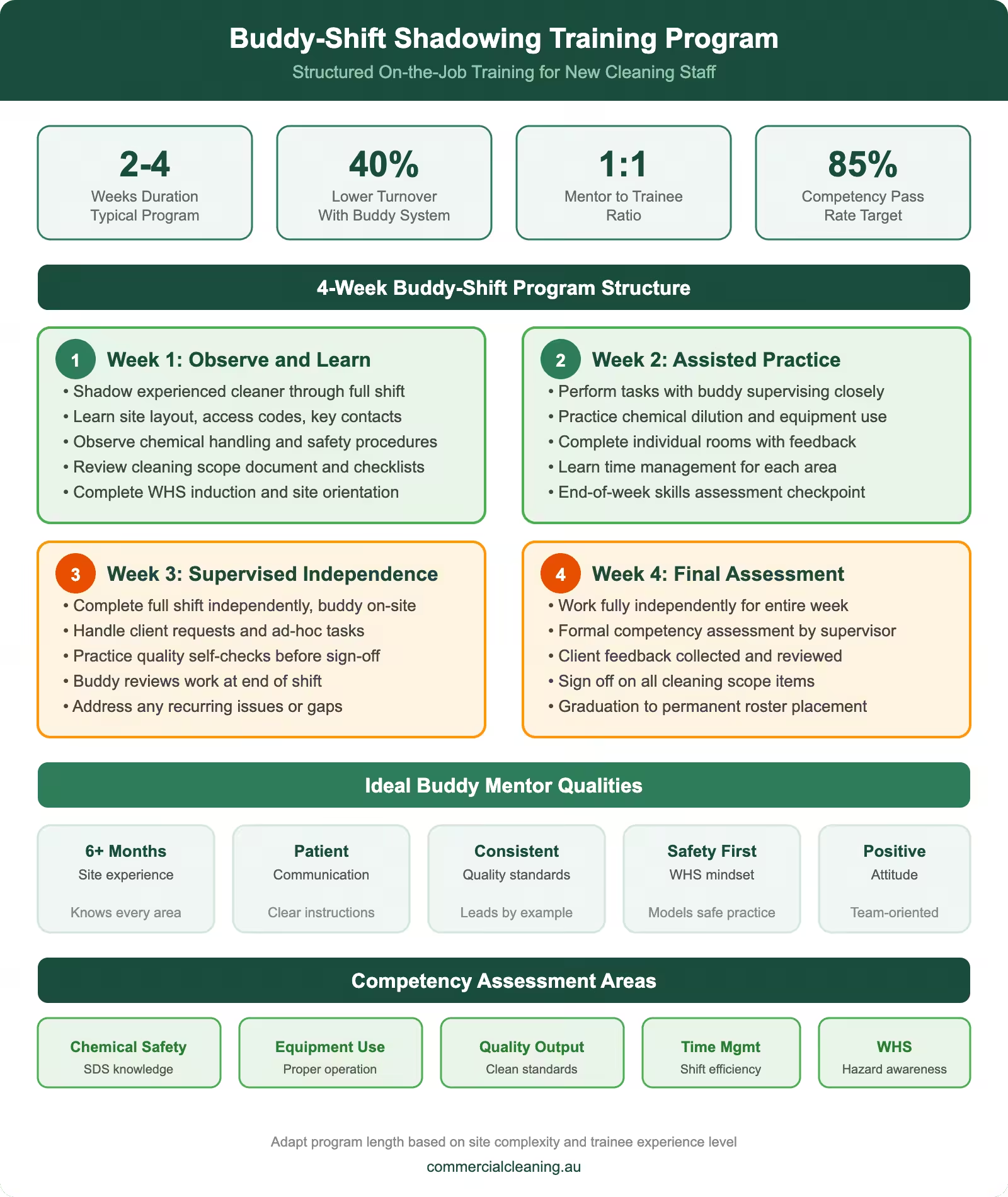
Phase Two: Buddy-Shift Shadowing Program
We pair every new cleaner with an experienced team member for a minimum of three buddy shifts before they work independently. Our buddy-shift protocol requires the senior cleaner to demonstrate each task area — washrooms, kitchenettes, open-plan desking, and hard floor corridors — while the trainee observes and then replicates under supervision. We log progress against a task competency matrix that covers twenty-six discrete cleaning activities aligned with the ISSA Cleaning Industry Management Standard (CIMS) framework.
Our operations team in Chatswood found that three buddy shifts is the minimum for most commercial office environments, but healthcare-adjacent sites like our Mater Clinic contract require five shifts due to the additional infection control protocols. We pay the buddy at their standard rate plus a $25 per shift training allowance, which we budget at roughly $680 per trainee across the shadowing period. This cost is negligible compared to the alternative: sending an untrained cleaner solo onto a site where they damage equipment, mishandle chemicals, or trigger a client complaint that jeopardises the contract.
Office Area Cleaning Frequency Guide
| Area | Daily | Weekly | Monthly | Quarterly |
|---|---|---|---|---|
| Reception & Lobby | Vacuum, mop, wipe | Glass doors, furniture | Deep carpet clean | Window wash |
| Workstations | Surface wipe, bins | Monitor & keyboard | Drawer clean-out | Chair shampoo |
| Kitchen/Breakroom | Bench, sink, floor | Fridge, microwave | Deep degrease | Exhaust fan clean |
| Bathrooms | Full sanitise + restock | Grout scrub | Descale fixtures | Vent clean |
| Meeting Rooms | Table wipe, vacuum | AV equipment dust | Upholstery clean | Carpet extraction |
Phase Three: Supervised Solo Work and Quality Audits
Office Area Cleaning Frequency Guide requires specific protocols that we tailor to each facility based on its layout, traffic, and compliance requirements. Once the buddy phase is complete, we move the trainee to supervised solo shifts where they clean their assigned zones independently while the site supervisor conducts spot audits. Our audit tool uses a seventy-point checklist adapted from the ISSA CIMS-GB (Green Building) standard, scoring each zone on a five-point scale. A trainee must achieve an average score of 3.8 or above across three consecutive audits before graduating to unsupervised work. We developed this threshold after benchmarking our client satisfaction data from 2020 to 2023 and finding that scores below 3.8 correlated with a forty-two per cent increase in client-reported deficiencies.
Phase Three: Supervised Solo Work and Quality Audits includes specific protocols that we tailor to each facility based on its layout, traffic, and compliance requirements. We have our Chatswood area supervisor run these audits between 7:00 pm and 9:00 pm during the evening clean cycle. The supervisor photographs any deficiencies, logs them in our mobile reporting app, and reviews them with the trainee at the start of the next shift. This immediate feedback loop accelerates skill development. Our data shows that trainees who receive same-day audit feedback reach competency sign-off an average of four shifts earlier than those who receive weekly batch feedback.
Phase Four: Competency Sign-Off and Ongoing Development
Phase Four: Competency Sign-Off and Ongoing Development addresses specific protocols that we tailor to each facility based on its layout, traffic, and compliance requirements. We issue a formal competency certificate once a trainee passes the audit threshold. This internal document records the specific tasks the cleaner is qualified to perform — general office cleaning, washroom sanitation, hard floor maintenance, kitchen deep clean, or window and glass detailing. Our operations manager signs it alongside the trainee, and a copy goes into the personnel file. We have found that this formal recognition step matters: staff who receive a signed certificate are twenty-three per cent more likely to still be with us at the six-month mark compared to those who simply get told they are “good to go.”
Beyond initial sign-off, we run quarterly refresher sessions covering seasonal topics. Our Q1 2025 session for the Chatswood and Willoughby crews focused on floor-finish stripping and resealing techniques using Diversey Stride and 3M Scotch-Brite pads, which is a skill set that deteriorates without practice. We also fund Certificate III in Cleaning Operations (CPP30316) enrolments through a co-contribution model where we cover $680 of the course fees and the staff member contributes $120 through payroll deductions. This shared investment creates mutual commitment.
Chemical Handling and Safety Data Sheet Training
We dedicate a full training module to chemical handling because it is the highest-risk area in daily cleaning operations. Every cleaner on our roster must demonstrate they can read a Safety Data Sheet (SDS), identify GHS hazard pictograms, calculate correct dilution ratios, and select appropriate PPE before they are permitted to use any chemical product unsupervised. Our training references the Work Health and Safety Regulation 2017 (NSW) Chapter 7 requirements for hazardous chemicals and the SafeWork NSW code of practice for managing risks of hazardous chemicals in the workplace.
We test competency using a practical scenario: the trainee is handed an SDS for a concentrated bathroom cleaner (typically Agar Exit or Oates Quick Dry) and must identify the hazard class, PPE requirements, first aid measures, and correct dilution ratio within three minutes. Our pass rate on first attempt across the Chatswood training cohort is seventy-eight per cent — the remaining twenty-two per cent receive additional one-on-one coaching and are retested within seven days. No cleaner begins solo chemical work until they pass this assessment.
Equipment Operation and Maintenance Training
Equipment Operation and Maintenance Training focuses on specific protocols that we tailor to each facility based on its layout, traffic, and compliance requirements. We train every team member on the specific equipment assigned to their site rather than running generic machinery demonstrations. Our Chatswood office tower crews operate Tennant T300 walk-behind scrubbers, Nilfisk VP300 HEPA backpack vacuums, and Karcher BRC 30/15 C encapsulation carpet machines. Each unit has a laminated quick-start guide mounted in the cleaner’s room, and new staff must complete a supervised run on each machine before operating it independently. We log machine training hours against each employee record.
Our maintenance training module covers daily pre-start checks (pad wear, squeegee condition, filter status, solution tank seals), weekly deep-clean routines, and fault escalation procedures. We learned this the hard way: in 2022 a cleaner at our Lane Cove site ran a scrubber with a worn squeegee blade for three weeks, leaving water trails that caused a slip-and-fall incident and a workers compensation claim. Since introducing mandatory pre-start checklists aligned with the manufacturer specifications and AS/NZS 3760 (in-service safety inspection and testing of electrical equipment), we have had zero equipment-related incidents across four consecutive quarters.
Frequently Asked Questions
How long does it take to fully train a new commercial cleaner?
Our four-phase program typically takes three to four weeks from induction to competency sign-off for a standard office cleaning role. Healthcare-adjacent sites may require five to six weeks due to additional infection control and waste segregation modules. We budget approximately $3,800 per trainee across the full onboarding cycle including buddy-shift allowances, supervision time, and training materials.
What qualifications should commercial cleaners hold in Australia?
There is no mandatory licence for general commercial cleaning in Australia, but the industry-standard credential is the Certificate III in Cleaning Operations (CPP30316) under the Australian Qualifications Framework. We strongly recommend this qualification and fund it through a co-contribution arrangement. Staff working with hazardous chemicals must also hold current knowledge of SDS interpretation and GHS labelling as required under the WHS Regulation 2017 (NSW).
What is the ISSA CIMS standard and does it apply in Australia?
ISSA Cleaning Industry Management Standard (CIMS) is an international framework that benchmarks cleaning operations against quality management, service delivery, human resources, health and safety, and environmental stewardship criteria. While not legally mandated in Australia, we use CIMS as our internal audit benchmark because it provides a structured, measurable quality framework that aligns with client expectations in premium commercial buildings across Sydney.
How often should cleaning staff receive refresher training?
We run quarterly refresher sessions aligned with seasonal cleaning demands. Our Q1 sessions cover floor maintenance techniques, Q2 covers high-traffic deep cleaning ahead of financial year-end office changeovers, Q3 focuses on infection control ahead of winter illness peaks, and Q4 addresses end-of-year strip-and-seal programs. Each session runs for approximately ninety minutes and is delivered on-site during paid time.
What equipment training should new cleaners receive?
At minimum, new cleaners should be trained on every machine they will operate, including walk-behind scrubbers, backpack vacuums, carpet encapsulation machines, and ride-on sweepers if applicable. We require supervised operation before solo use and align our pre-start checks with AS/NZS 3760 for electrical equipment safety. Manufacturer-specific training is necessary — a Tennant T300 operates differently from a Nilfisk SC250, and generic instruction does not prevent damage or injury.
We have covered our complete four-phase training framework, chemical handling protocols, and equipment operation standards here. For strategies on keeping trained staff long-term and reducing the costly cycle of recruitment, see our guide on retention strategies.
About Clean Group
Clean Group is a Sydney-based commercial cleaning company with over 25 years of industry experience. Founded by Suji Siv, our team of 50+ trained professionals services offices, warehouses, medical centres, schools, childcare facilities, retail stores, gyms, and strata properties across Sydney, Melbourne, and Brisbane.
We are active members of ISSA and the Building Service Contractors Association of Australia (BSCAA). Our operations align with ISO 9001 (Quality Management), ISO 14001 (Environmental Management), and ISO 45001 (Workplace Health and Safety) standards. We hold membership with the Green Building Council of Australia and use eco-friendly, TGA-registered cleaning products wherever possible.
Every Clean Group cleaner is police-checked, fully insured, and trained in safe work procedures under SafeWork NSW guidelines. We operate 7 days a week, including after-hours and weekend services, to minimise disruption to your business.
About the Author

Stephen Matthews
Hi, my name is Steve. I have been working as a Regional Operations Manager in Sydney Clean Group for almost four years now and manage a team of 10. I have more than three decades of experience in the commercial cleaning industry. My responsibilities include the day-to-day management of cleaning operations, planning, online quotation to clients, managing cleaners’ performance, collecting clients\' feedback, and ensuring proper & regular maintenance of cleaning equipment. Get in touch for a quick chat about your cleaning needs.
Read More About Stephen
