Shopping centre cleaning contracts represent one of the most complex and regulated cleaning service agreements in Australia. These are not simple janitorial contracts—they’re multi-layered facility management agreements involving risk allocation, statutory compliance, and performance measurement systems that rival many corporate service tenders. Our team at Clean Group has worked with major shopping centre operators like Scentre Group (Westfield), Vicinity Centres, and Stockland to work through these detailed requirements, and we know the tendering sector from both client and contractor perspectives.
If you’re a shopping centre manager developing a retail cleaning service agreement for facilities manager evaluating tenders, or a cleaning contractor bidding for this work, understanding the mechanics of these contracts is non-negotiable. The stakes are high: poor cleaning directly impacts tenant satisfaction and foot traffic, while non-compliance with WHS and Modern Slavery Act obligations can trigger regulatory action and reputational damage. This guide walks through the tendering process, regulatory obligations, performance metrics, and contract terms that define modern shopping centre cleaning in Australia.
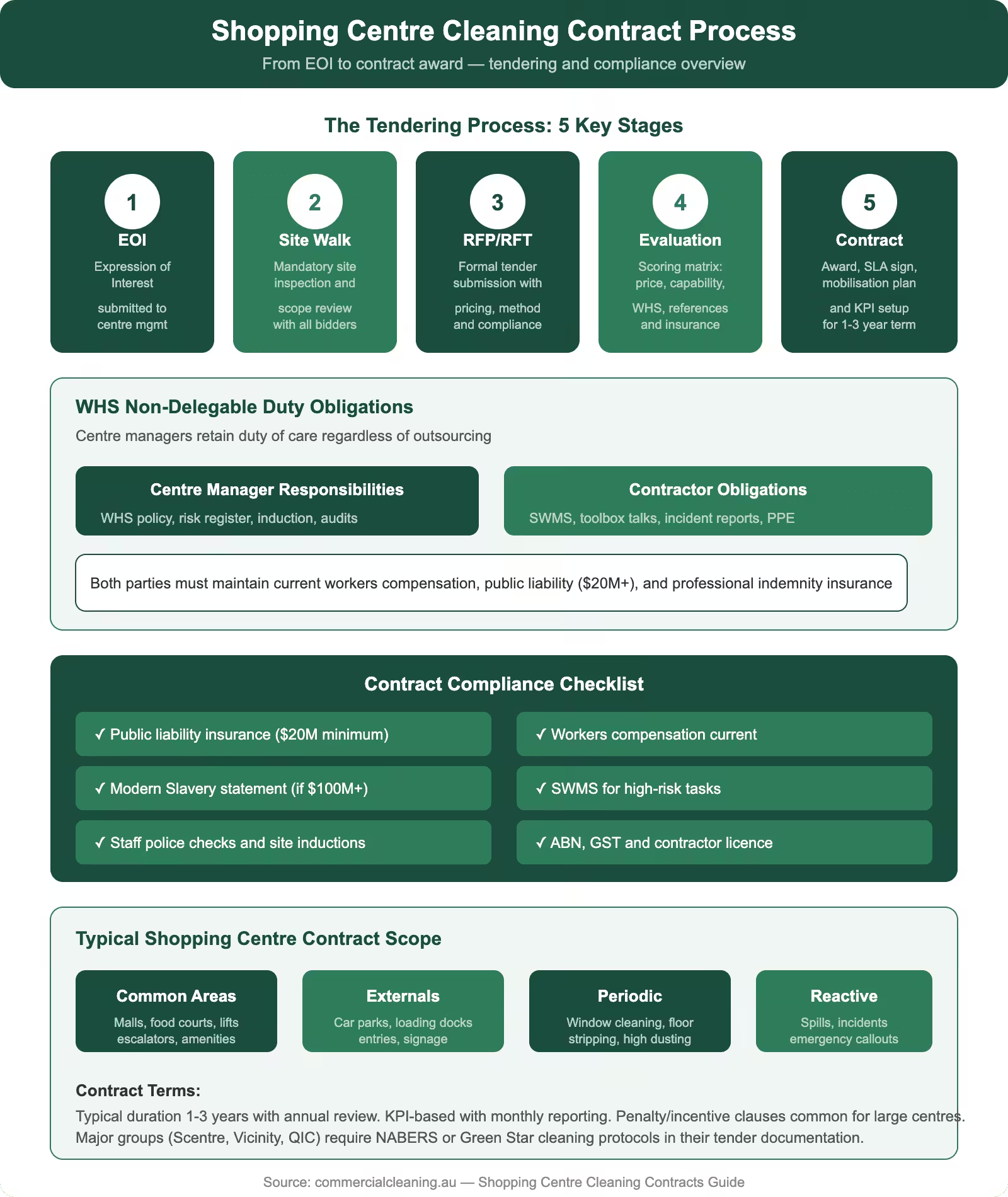
Shopping centre cleaning contract tendering process showing 5 stages from EOI to contract award with WHS compliance and scope overview
How Shopping Centre Cleaning Contracts Work in Australia
Shopping centre cleaning in Australia operates within a specific regulatory and commercial framework that differs markedly from office or strata cleaning. Most major shopping centres—including Westfield Sydney, Chatswood Chase, Macquarie Centre, Stockland Merrylands, and Westfield Bondi Junction—run cleaning through either direct facility management contracts or panel agreements with preferred contractors. The contract typically covers daily cleaning of common areas (floors, escalators, restrooms, walkways), waste management, and specialist services like high-level cleaning and deep cleaning programs.
Scentre Group, which operates Westfield centres across Australia, and Vicinity Centres have standardised their cleaning briefs in recent years, though contract terms remain highly negotiable. Stockland and QIC (which holds significant retail property assets) operate similar models, though some centres retain legacy contracts with older specifications. Lendlease, as both a major property manager and mixed-use developer, often builds cleaning requirements into their broader FM contracts. The key distinction is that shopping centre cleaning is rarely a spot-bid contract: centres typically maintain either an incumbent supplier or run a formal tender process when the contract expires or underperformance occurs.
Payment structures usually follow a fixed monthly or quarterly base fee (covering defined daily services) plus variable charges for specialist work and after-hours cleaning. This creates cash flow certainty for contractors while allowing centres to control costs for high-demand periods. A typical agreement might fix the cost of daily common-area cleaning at $85,000–$150,000 per month depending on the centre size and specification, with additional fees for deep cleans, floor stripping and sealing, external area cleaning, and event-related cleaning.
The Tendering Process: From EOI to Contract Award
Most major shopping centre operators use a formal competitive tendering process overseen by panel procurement advisors. This process typically begins with a Request for Expressions of Interest (EOI), which is often advertised on illion TenderLink or similar government/corporate procurement portals. The EOI stage is designed to shortlist serious bidders and reduce the number of full tender responses the centre must evaluate.
The EOI itself is not trivial. It requires evidence of relevant experience (usually 2+ contracts cleaning centres over 50,000 sqm), financial standing (audited financials showing positive EBITDA), and WHS credentials. Scentre Group, Vicinity Centres, and Stockland all demand that responding contractors provide references from comparable facilities, copies of current insurance certificates, and proof of SafeWork NSW compliance. Rejection at EOI stage often reflects weak financial standing or inadequate centre experience rather than price—the centre is screening for capacity and stability before inviting full tenders.
The full tender then requires a detailed response to a Cleaning Specification (usually 15–30 pages) that itemises every service, frequency, quality standard, and response protocol. This is where specificity matters: the tender will ask for unit rates on line items like “high-level external window cleaning” (quarterly), “graffiti removal” (as-needed), “heavy-duty floor stripping and sealing” (annually per zone), and “after-hours litter removal” (per event). Contractors who submit vague pricing or fail to address every line item are typically ranked lower in scoring.
Evaluation then follows a weighted scoring matrix published in the tender documents. A typical weighting might be: Price 30%, WHS and Compliance 25%, Key Personnel and Experience 20%, Innovation and Service Quality 15%, Local Knowledge and Community Benefit 10%. This is not a price-only tender. A bid that’s 10% cheaper but scores lower on compliance will often lose to a higher-priced bid with stronger WHS credentials and more experienced supervisors.
The tender process typically runs 8–12 weeks from EOI close to contract award, though some centres compress this to 6 weeks. SafeWork NSW and the Fair Work Act don’t regulate the tendering process itself, but they do regulate how the winning contractor must operate once selected—which we cover below.
WHS Non-Delegable Duty and What It Means for Centre Managers
Section 19 of the WHS Act 2011 (NSW) establishes the “non-delegable duty”—a requirement that a person in control of a workplace must verify the health and safety of workers, even if that work is contracted out. This is the single most important legal concept in shopping centre cleaning contracts, and it’s frequently misunderstood by both centre managers and contractors.
What this means in practice: If a cleaning contractor’s worker is injured at Westfield Sydney while cleaning escalators, Westfield can be prosecuted for breach of Section 19 regardless of whether the contractor was at fault. The centre cannot say “that’s the contractor’s problem”—the law makes the centre jointly liable for any worker safety failure in the cleaning contract. This fundamentally changes how centre managers must approach contractor selection and oversight.
Our team at Clean Group has worked with SafeWork NSW investigators after incidents at shopping centres, and we’ve seen the impact of non-delegable duty litigation firsthand. Centres that failed to verify a contractor’s induction procedures, Safe Work Method Statements (SWMS), or incident reporting processes have faced prosecution even when the incident was ostensibly the contractor’s responsibility. The legal standard is that the centre must take “due diligence” to verify the contractor has adequate WHS systems in place.
In practical terms, this means: (1) the tender evaluation must include a detailed WHS assessment, (2) the contract must require the contractor to maintain specific certifications and insurance, (3) the centre must conduct regular WHS audits of the contractor’s performance, and (4) the contract must include clear procedures for incident reporting and investigation. A centre that signs a cleaning contract without an associated SWMS or without confirming the contractor’s workers’ compensation insurance is inviting regulatory action.
Section 19 also means that centres cannot transfer liability to contractors by inserting indemnity clauses in the contract. The law supersedes the contract: the centre remains liable regardless of what the agreement says. The centre’s role becomes one of verification and oversight, not avoidance. This is why major operators like Scentre Group and Vicinity Centres include mandatory monthly WHS audits and incident-reporting requirements in their contracts.
Insurance, Licensing and Modern Slavery Due Diligence
Insurance, Licensing and Modern Slavery Due Diligence includes specific protocols that we tailor to each facility based on its layout, traffic, and compliance requirements. The insurance requirements for shopping centre cleaning contracts are substantial and non-negotiable. The standard requirements include:
Public Liability Insurance: Minimum $20M cover is standard for major shopping centres, though some require $50M or higher. This covers third-party injury claims (customer trips on wet floors, falls in stairwells, etc.). The policy must name the centre as an interested party and remain valid for the contract duration plus 7 years after completion.
Workers’ Compensation Insurance: Required under the Workers Compensation Act 1987 (NSW) for any contractor with employees. The contractor must provide proof of current registration with the Workers Compensation Nominal Insurer (WCNI), not just a copy of a policy.
Professional Indemnity Insurance: Required for contracts over $500,000 in value, typically set at 5–10% of contract value. This covers claims arising from the contractor’s negligence in service delivery.
Tool and Plant Insurance: Covering contractor-owned equipment used on-site, usually required only for contracts involving specialist equipment.
Verification is strict. Centres will request certificates of currency directly from insurers (not from the contractor), and they will cross-reference the policy details against the tender submission. A discrepancy—even a minor policy number change—can trigger contract suspension pending clarification. Insurance lapses are grounds for immediate termination in virtually all shopping centre cleaning contracts.
Beyond insurance, cleaning contractors must hold appropriate licences. For NSW-based centres, this includes a valid drivers’ licence (for supervisors and site managers), and increasingly a High Risk Work Licence (if using elevated platforms or boom lifts for high-level cleaning). Some centres also require security clearance through the Australian Security Intelligence Organisation (ASIO) if contractors will have after-hours access to restricted areas.
Modern Slavery Act 2018 due diligence is a newer but increasingly rigorous requirement, particularly for contracts managed by major corporates. Scentre Group and Vicinity Centres now require contractors to complete a Modern Slavery risk assessment and provide declarations that their supply chain (labour on-hire companies, equipment suppliers, subcontractors) complies with anti-slavery obligations. This includes verification that workers are paid at least Award rates per the Fair Work Act 2009, that there are no excessive working hours or conditions approaching forced labour, and that subcontractors have their own Modern Slavery policies. Failure to provide satisfactory Modern Slavery documentation can result in exclusion from tender shortlists.
Working with Children Check (WWCC) is often required for staff who may have incidental contact with children (e.g., cleaning after-hours in childcare facilities within the centre). Centres will ask for proof of current WWCC status for named supervisors and key personnel.
SLA and KPI Benchmarks for Shopping Centre Cleaning
Shopping centre cleaning contracts are managed through detailed Service Level Agreements (SLAs) and Key Performance Indicators (KPIs), which are far more specific than those in office or strata cleaning. The SLA typically defines:
KPI Metric
Typical Target
Measurement Method
Floor cleanliness (daily areas)
95% pass rate on daily visual audit
Centre staff spot-checks with photographic evidence
Restroom hygiene (hourly check areas)
100% compliance with hourly sign-off
Contractor hourly log with time-stamped photos
Defect response time
30 min for urgent (spills, hazards); 4 hrs standard
Centre raises work order; contractor logs response time
Complaint resolution rate
80% of complaints resolved within 48 hours
Formal complaint log reviewed monthly
Monthly audit score
90+ out of 100 across all zones
Centre or third-party auditor monthly walk-through
Tenant complaint rate
Max 2 per month per 50 retailers
Centre compiles tenant feedback
Staff turnover (key personnel)
Max 20% annual turnover on named supervisors
Contractor reports quarterly
These metrics are contractually binding. Missing the floor cleanliness target three months running, for example, typically triggers a remediation notice. Two remediation notices within 12 months can result in termination for breach. This is why shopping centre contracts require strict operational discipline and real-time data capture systems.
Beyond these standard KPIs, centres increasingly track sustainability metrics: waste diversion rates, water consumption per sqm, chemical use (tracking shift to eco-friendly cleaners), and carbon footprint reporting. Stockland and some Vicinity Centres locations now require contractors to document waste recycling and report on-site sustainability performance quarterly.
Our experience at Clean Group shows that the most successful contractors are those with solid systems for capturing KPI data in real time—digital cleaning logs, mobile app-based work order tracking, and photographic audit trails. Centres expect monthly KPI reports within 5 working days of month-end, not excuses or estimates.
Contract Terms: Payment Structure, Defect Notices and Exit Clauses
Contract Terms: Payment Structure, Defect Notices and Exit Clauses targets specific protocols that we tailor to each facility based on its layout, traffic, and compliance requirements. Shopping centre cleaning contracts typically run for 3–5 years, with optional renewal periods. The payment structure usually comprises a base monthly fee (covering defined daily services) plus variable charges for ad-hoc work.
A typical payment clause reads: “The Contractor shall invoice the Centre monthly for the base service fee of $[amount] plus any agreed additional work at the rates specified in Schedule A. Invoices must be submitted within 10 working days of month-end and must itemise all hours worked against agreed line items. Payment is due within 30 days of invoice date.” Payment terms of Net 30 are standard, though some large corporates (particularly QIC-managed properties) negotiate Net 45.
Defect notices are the centre’s formal mechanism for raising performance issues. When KPIs are missed, the centre issues a defect notice specifying the breach, evidence, and required corrective action. A typical defect notice might read: “Monthly audit score fell to 84/100 in July (target 90). Specific defects: floor cleanliness in food court (2 instances), graffiti on Level 3 east stairwell (1 instance, 8-hour response). Corrective action required by [date]: implement daily floor inspection checklist in food court and station staff Level 3 during peak hours.” The contractor then has a defined period (usually 7–14 days) to address the issue and provide evidence of remediation.
Accumulation of defect notices triggers escalation: first notice is a written warning; second notice within 12 months typically triggers a performance review meeting; third notice can result in termination for breach. This structure is standard across Scentre Group, Vicinity Centres, and Stockland contracts, though some negotiate more lenient escalation (e.g., fourth notice before termination).
Exit clauses define how either party can end the contract. Most contracts include:
Fixed expiry: The contract expires at the end of the agreed term (e.g., 30 June 2029). Either party can terminate by providing 90 days’ notice of non-renewal.
Termination for breach: The Centre can terminate immediately if the Contractor materially breaches the contract (e.g., failure to maintain insurance, criminal conduct by staff, systematic failure to meet KPIs) and fails to rectify within a notice period (typically 14–28 days).
Termination for convenience: Some contracts allow the Centre to terminate without cause by providing 6–12 months’ notice. This is less common in modern contracts but exists where the Centre wants contractual flexibility.
Step-down: Upon termination, the contract usually requires the Contractor to “step down” and assist the incoming contractor with handover documentation, system access, and knowledge transfer over a 2–4 week transition period. The step-down is often covered by a reduced fee (typically 50% of normal charges).
A critical clause that appears in virtually every centre contract is the “indemnity and hold harmless” provision, which requires the Contractor to indemnify the Centre against all claims arising from the Contractor’s negligence or breach of contract (subject, as noted earlier, to the limitations of Section 19 of the WHS Act). This means the Contractor’s insurance must be adequate, and the Contractor must maintain financial reserves to cover potential claims beyond insurance limits.
Evaluating Tenders: Weighted Scoring and Red Flags
Evaluating Tenders: Weighted Scoring and Red Flags focuses on specific protocols that we tailor to each facility based on its layout, traffic, and compliance requirements. As a contractor, understanding how your tender will be scored is critical. Most shopping centre tenders use the weighted matrix we described earlier: Price (30%), WHS and Compliance (25%), Key Personnel and Experience (20%), Innovation and Service Quality (15%), Local Knowledge and Community Benefit (10%). But within each category, evaluators are looking for specific markers.
WHS and Compliance: Evaluators will award maximum points only if the tender demonstrates: (1) an accredited WHS management system (AS/NZS 4801 or ISO 45001 certification), (2) evidence of zero lost-time injuries over the past 24 months (or a documented improvement plan if there have been incidents), (3) copies of current insurance certificates matching the Centre’s requirements, (4) a completed SWMS template for each major cleaning activity (escalator cleaning, high-level work, chemical handling), and (5) proof of staff training in WHS induction and emergency response. Tenders missing any of these components will score below 80% in this category.
Key Personnel and Experience: The Centre expects named supervisors and site managers with documented shopping centre experience. A tender proposing a “suitable person TBN [to be named]” will score poorly. Instead, provide CVs showing 2+ years at comparable centres. Chatswood Chase and Macquarie Centre contracts particularly value supervisors with experience at similar high-traffic centres. Lendlease-managed contracts often request references that can be checked directly with the Centre.
Innovation and Service Quality: This is where contractors differentiate. Rather than offering standard cleaning, highlight: real-time monitoring systems (e.g., IoT sensors tracking floor moisture or waste fill levels), reporting dashboards that give the Centre transparency on KPI performance in real time, or sustainability innovations (e.g., waterless floor cleaning systems, compostable waste liners). Some contractors propose pilot programs (e.g., “monthly customer satisfaction surveys on cleaning quality”) to demonstrate client focus. These initiatives often score 10–15% higher than generic “we will meet all contractual requirements” statements.
Local Knowledge: This category rewards contractors who have existing relationships with Sydney shopping centres and can demonstrate understanding of local tenant demographics, peak trading times, and specific local challenges. A contractor who proposes enhanced cleaning around Christmas trading periods or who has worked with Stockland Merrylands previously will score higher than a national contractor making generic promises.
Red flags for evaluators include:
Vague or incomplete insurance details (e.g., “public liability insurance on request” rather than a certificate of currency attached).
Turnover of supervisory staff—if your previous centre contract involved three supervisor changes in two years, the Centre will question your ability to retain staff.
Pricing that’s significantly below market without a documented reason (e.g., “we can reduce cost by using in-house training programs” is reasonable; a 30% undercut with no explanation suggests the contractor will cut corners or go insolvent).
No reference to Modern Slavery due diligence or WHS systems—these are expected inclusions now.
Generic responses copied from another tender—Centres often cross-check tenders and will immediately downgrade a proposal that doesn’t address the specific centre’s requirements.
Contractors who’ve been terminated from previous centre contracts in the past 5 years will face substantial scoring penalties, and some Centres will exclude them entirely.
Our team at Clean Group has successfully secured major centre contracts at Westfield Sydney and Stockland Merrylands by scoring above 90 in WHS/Compliance (through ISO 45001 certification), above 85 in Key Personnel (by providing named supervisors with 5+ years’ centre experience), and above 80 in Innovation (by proposing a real-time KPI dashboard and a pilot customer satisfaction program). Price competitiveness matters, but a tender scoring in the top quartile on compliance and experience will often win even if it’s not the lowest-priced offer.
Frequently Asked Questions
What happens if a cleaning contractor is injured at a shopping centre? Who’s liable?
Under Section 19 of the WHS Act 2011, both the shopping centre and the contractor can be liable. The centre, as the “person in control of the workplace,” has a non-delegable duty to verify the contractor’s worker is safe. If a cleaner falls from scaffolding during high-level window cleaning, SafeWork NSW will investigate both the contractor’s procedures and the centre’s oversight. The contractor will face liability for breach of their own WHS obligations; the centre can face liability for failing to verify the contractor had adequate safety systems. The contractor’s workers’ compensation insurer will cover the injured worker’s medical and income-replacement costs, but both the centre and contractor may face regulator prosecution. This is why centres invest heavily in verifying contractor WHS systems before award.
Can a contractor subcontract parts of the cleaning work?
This depends entirely on the contract terms. Most major centre contracts allow subcontracting only with prior written approval from the Centre, and only if the subcontractor meets the same insurance, WHS, and compliance standards as the primary contractor. Some contracts prohibit subcontracting altogether for core daily cleaning (to maintain continuity) but allow it for specialist services like floor sealing or high-level cleaning, where the primary contractor may not have those skills. Scentre Group typically allows subcontracting for ad-hoc services but requires the contractor to retain responsibility for the subcontractor’s performance. If the subcontractor breaches contract terms, the primary contractor remains liable to the Centre. This means contractors must carefully vet subcontractors and maintain oversight of their work.
How are shopping centre cleaning KPIs typically enforced?
KPIs are enforced through a formal defect notice process. When a monthly audit reveals that the contractor has scored 84/100 instead of the required 90/100, the Centre issues a defect notice detailing the shortfalls and requiring corrective action within 7–14 days. The contractor must then provide evidence of remediation (e.g., photos, updated procedures, supervisor retraining logs). Repeated defects escalate: first notice is a warning; second notice triggers a formal performance review meeting; third notice within 12 months can result in termination for breach. Some Centres also tie financial penalties to KPI shortfalls—for example, 1–2% reduction in monthly fees for each point below the target score. This creates financial incentive to maintain performance, not just avoid termination.
What’s the difference between a panel agreement and a fixed-term contract?
A panel agreement is an arrangement where the Centre maintains a roster of approved contractors who are pre-vetted for WHS, insurance, and compliance, but work is assigned on an as-needed basis. Panel members might receive a small monthly retainer ($2,000–$5,000) to maintain availability, and then invoice for actual work performed. Fixed-term contracts are exclusive arrangements where one contractor is named as the primary service provider for a defined period (e.g., 3 years). Fixed-term contracts provide revenue certainty for contractors but require dedicated staff and resources. Centres prefer fixed-term contracts for core daily cleaning (to maintain continuity) but may use panel agreements for specialist or ad-hoc services. Some Centres (particularly Stockland and Vicinity Centres) use a hybrid model: fixed contract for daily cleaning plus a panel of subcontractors for deep cleaning, external services, and emergency response.
What should a contractor do if a Centre issues a defect notice they disagree with?
The contract should include a dispute resolution procedure. Typically, the contractor has 5–7 working days to formally dispute the defect notice, providing evidence (photos, witness statements, audit records) explaining why the claim is incorrect. This triggers a meeting between the Centre’s facilities manager and the contractor’s account manager to review the evidence. If still unresolved, some contracts allow escalation to senior management or, in rare cases, independent mediation. However, disputes are best avoided through transparent KPI tracking: if the contractor and Centre have aligned on measurement methods and real-time reporting, disputes over whether a target was met become rare. Our team at Clean Group avoids disputes by providing the Centre with daily cleaning logs and weekly KPI reports; when both parties are seeing the same data, disagreements are rare.
Are shopping centre cleaning contracts affected by the Fair Work Act 2009?
Yes, absolutely. The contractor must verify all cleaning staff are paid at least the Award minimum wage (typically the Cleaning Services Award 2010, which sets minimum hourly rates around $25–$28 depending on classification). Failure to pay Award rates exposes the contractor to enforcement action by the Fair Work Ombudsman and potential penalties of $5,000–$20,000 per underpaid worker. Some major Centres (particularly those managed by QIC or Lendlease) now request detailed payroll documentation from contractors during the tender process to verify Award compliance. The Centre can also face reputational risk if it’s found to be contracting with an underpaying contractor, which is why Modern Slavery due diligence is becoming standard. We keep all our staff paid above Award rates and can provide payroll evidence to any centre requiring it.
What happens at the end of a shopping centre cleaning contract?
The contract concludes with a “step-down” phase, typically 2–4 weeks, where the outgoing contractor assists the incoming contractor (and centre staff) with handover. This includes providing access to all cleaning manuals, equipment inventories, supplier contact lists, spare parts locations, and procedural documentation. The outgoing contractor also conducts joint walk-throughs with the incoming contractor to point out site-specific issues (e.g., “this escalator needs gentler cleaning to avoid damage,” “this floor requires weekly sealing in winter due to moisture”). The step-down period is usually invoiced at 50% of the normal monthly fee, and the outgoing contractor must be available for 2–4 hours per week during this phase. Professional step-downs leave the new contractor in a strong position to maintain service levels, which is why centres value contractors who cooperate during exit, even when the contract is ending due to performance issues.
Can a shopping centre terminate a contractor for failure to maintain Modern Slavery compliance?
Yes. The Modern Slavery Act 2018 imposes obligations on entities with annual revenue over $100 million (which includes all major shopping centre operators) to conduct due diligence on their supply chains and report on slavery risks. If a contractor fails to provide Modern Slavery documentation or if a contractor is found to be employing workers at below Award rates or under exploitative conditions, the Centre faces regulatory and reputational risk and can terminate the contract immediately for breach of compliance obligations. We’ve seen this happen: a contractor who hired labour on-hire workers but failed to verify those workers were paid properly triggered a Modern Slavery audit, which the Centre then required the contractor to remediate or face termination. Make sure your supply chain (labour hire, chemical suppliers, equipment providers) is also Modern Slavery compliant and documented.
About Clean Group
Clean Group is a leading commercial cleaning company in Sydney, providing professional cleaning services to offices, strata buildings, medical facilities, schools, gyms, and retail spaces across the greater Sydney region. With over 25 years of experience and a commitment to WHS compliance, eco-friendly practices, and consistent quality, Clean Group delivers tailored cleaning solutions backed by a 100% satisfaction guarantee.
For specialised event space cleaning requirements, we also offer flexible panel and one-off service agreements to meet temporary retail and event needs.
Hi, I'm Suji Siv, the founder, CEO, and Managing Director of Clean Group, bringing over 25 years of leadership and management experience to the company. As the driving force behind Clean Group’s growth, I oversee strategic planning, resource allocation, and operational excellence across all departments. I am deeply involved in team development and performance optimization through regular reviews and hands-on leadership.