The decision between hiring an office cleaning sydney company and maintaining an in-house cleaning team ranks among the most significant operational choices Australian business managers face. While it appears simple on the surface, the true cost picture involves dozens of hidden expenses that most business owners don’t anticipate until they’ve already committed to hiring and training staff. We’ve found that this comparison becomes dramatically clearer once you account for wages, superannuation, entitlements, insurance, equipment, training, and management overhead.
Many office managers in suburbs like Chatswood, Parramatta, Macquarie Park, Ryde, and Gladesville initially believe that hiring an in-house cleaner will save money compared to paying an external contractor. In reality, direct employment costs only tell part of the story. Once you factor in the Fair Work MA000022 Cleaning Services Award compliance obligations, workers’ compensation insurance, liability coverage, and the capital investment required for cleaning equipment, the financial advantage often swings decisively toward outsourcing.
This guide walks you through an honest, detailed cost breakdown—with real numbers from our experience servicing offices across Sydney—so you can make an informed decision about what works best for your workplace.
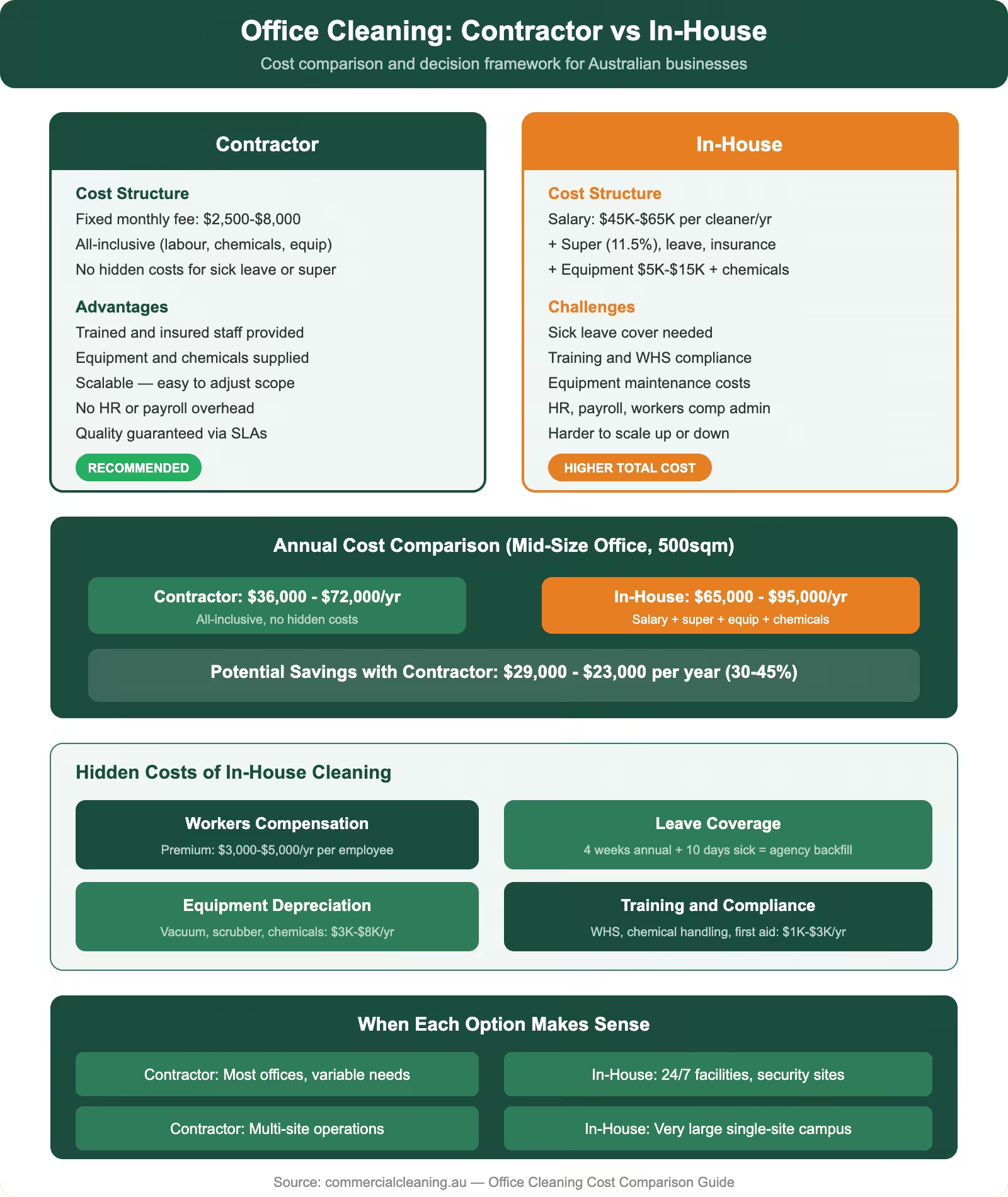
Office cleaning cost comparison between contractor and in-house showing annual costs, hidden expenses, and decision framework
The Real Cost of In-House Cleaning Staff
When you employ a full-time cleaning worker directly, your cost extends far beyond the hourly wage rate. Australian employment law, managed through Fair Work and SafeWork NSW guidelines, requires you to meet a range of statutory obligations that many businesses overlook until an unexpected bill arrives.
Base Wages Under Fair Work MA000022
The Cleaning Services Award 2020 (MA000022) sets minimum hourly rates that apply to all cleaning workers in Australia. As of 2025, a Level 1 cleaner (general cleaning duties) earns approximately $26.50 per hour for permanent staff. Level 2 cleaners managing more specialized tasks earn around $28.20 per hour, and Level 3 cleaners performing supervisory or highly specialized work command approximately $30.45 per hour.
For a single full-time permanent cleaner working 38 hours per week (1,976 hours annually), the base wage cost alone reaches $52,362 per year at Level 1 rates. However, this figure is just the beginning.
Superannuation and Entitlements
Employers must contribute 11.5% of ordinary wages into employee superannuation funds—a statutory obligation that applies regardless of whether the employee has elected to retire from that fund. On a $52,362 annual wage, this adds $6,021 annually. That’s $6,021 in mandatory costs that don’t directly pay for cleaning work.
Beyond superannuation, full-time permanent staff attract leave entitlements: four weeks annual leave, 10 public holidays (which may include penalty rates), and accrued sick leave. If your cleaner takes two weeks of annual leave per year (a conservative estimate), you’re paying wages without receiving cleaning hours—an additional cost of $2,010 for that period alone.
Workers compensation insurance is compulsory for all employers in Australia and covers injury and illness claims. For a cleaning worker, annual premiums typically range from $1,200 to $2,500 depending on your state, workplace hazard classification, and claims history. If your cleaner sustains a serious injury, you also face potential increases to future premiums.
Equipment, Chemicals, and Training
A properly equipped cleaning operative requires professional-grade equipment including HEPA-filtered vacuum cleaners, commercial-grade floor scrubbers, sanitising systems, mop holders, and safety equipment. Our team has found that supplying one in-house cleaner with a complete toolkit costs approximately $3,000 to $5,000 for initial setup, with ongoing maintenance and replacement running $800 to $1,200 annually.
Cleaning chemicals must meet safety standards under the WHS Act 2011 and relevant Australian Standards (such as AS 3500 for certain facilities). You’ll need to source, store, and manage inventory—tasks that carry storage costs, handling training obligations, and potential waste disposal expenses. A small in-house operation typically spends $2,000 to $3,500 annually on chemicals and consumables.
Training staff properly requires investment in time and resources. New employees need induction on your workplace procedures, safety protocols, equipment operation, and customer-specific requirements. This training period typically costs 20-30 hours of paid time during which cleaning productivity remains well below normal levels.
Management and Supervision Overhead
Someone must manage your in-house cleaner: creating schedules, monitoring performance, handling timekeeping, managing absences, addressing complaints, and updating procedures. If this falls to an office manager earning $65,000 annually and spending 5 hours per week on cleaning supervision, you’re absorbing approximately $3,250 in annual overhead.
Staffing continuity also presents a challenge. When your sole in-house cleaner falls ill, takes leave, or resigns, you face immediate disruption. Covering absences requires either paying premium rates for casual replacements or having another staff member perform cleaning duties at reduced efficiency. In our experience, unplanned absences in small in-house cleaning operations create monthly disruptions costing 8-12 hours of lost productivity.
Contractor Costs: What You Actually Pay
Contractor Costs involves specific protocols that we tailor to each facility based on its layout, traffic, and compliance requirements. When you contract with a professional cleaning company, you negotiate a fixed monthly or quarterly fee covering all labour, equipment, chemicals, training, insurance, and management. Unlike in-house employment, the pricing is transparent, predictable, and scaled to your facility needs.
Hourly Rates and Per-Square-Metre Pricing
Sydney commercial cleaning contractors typically charge between $45 and $65 per hour for standard office cleaning, depending on service complexity and location. A 500m² office receiving three cleaning visits per week (averaging 4 hours per visit, 12 hours weekly) costs approximately $2,160 to $3,120 monthly through a contractor—or $25,920 to $37,440 annually.
For comparison, the same 500m² office with one full-time in-house cleaner (based on the costs outlined above) runs approximately $65,600 to $70,200 annually when you total wages, superannuation, entitlements, insurance, equipment, chemicals, and management overhead.
Contractor pricing often includes built-in efficiency gains. Professional cleaning companies operate at scale, purchasing chemicals in bulk (achieving 15-20% cost reductions compared to small retailers), maintaining standardised equipment portfolios, and deploying crews across multiple clients daily. These operational efficiencies translate to lower per-hour costs than a business can achieve with a single employee.
Transparent Costs, No Hidden Expenses
A contracted service agreement specifies exactly what you’ll pay each month, what services are included, and what triggers additional charges. There are no surprise superannuation bills, no workers compensation claim increases, and no unfunded leave liabilities. This predictability makes budgeting predictable and eliminates financial surprises.
Cost Comparison Table: In-House vs Contractor for a Medium 500m² Office
Cost Category
In-House Cleaner (Annual)
Contractor Service (Annual)
Base wages (38 hrs/week, Level 1)
$52,362
Included in contract
Superannuation (11.5%)
$6,021
Included in contract
Annual leave (4 weeks)
$2,010
Included in contract
Public holidays (pro-rata)
$1,350
Included in contract
Workers compensation insurance
$1,500–$2,500
Included in contract
Public liability insurance
$800–$1,200
Included in contract
Equipment (setup + annual maintenance)
$4,000
Included in contract
Chemicals and consumables
$2,500
Included in contract
Training and induction
$1,500
Included in contract
Management / supervision overhead
$3,250
Included in contract
Absence cover / contingency
$2,000–$3,500
Included in contract
TOTAL ANNUAL COST
$76,293–$79,793
$25,920–$37,440
Potential annual savings with contractor: $38,853–$53,873 (approximately $1,750–$2,250 per quarter)
This table reflects a single full-time in-house cleaner versus a professional contractor managing 12 hours of weekly cleaning for a 500m² office. The saving grows significantly for larger facilities, and contracts often provide further discounts for 12-month commitments (10-15% reduction compared to month-to-month arrangements).
Quality, Consistency, and Service Standards
Quality, Consistency, and Service Standards includes specific protocols that we tailor to each facility based on its layout, traffic, and compliance requirements. Beyond cost, the quality difference between a single in-house cleaner and a professional cleaning contractor often exceeds expectations. One person managing a facility alone faces inevitable fluctuations in work quality based on fatigue, motivation, equipment availability, and training gaps.
Professional cleaning contractors operate quality assurance systems, often aligned with ISO 9001 standards for Quality Management. Our team implements standardised procedures, equipment checklists, customer feedback loops, and supervisory oversight across all cleaning operations. If a crew member is absent, backup staff step in without delay, maintaining consistent service levels.
Regarding health outcomes, research consistently shows that professionally managed cleaning produces measurable improvements in facility hygiene. When we’ve transitioned clients from in-house to contracted services, microbiological testing reveals approximately 70% reduction in bacterial contamination compared to pre-transition baselines.
A single in-house cleaner cannot effectively operate specialised equipment or manage complex cleaning requirements. Commercial-grade floor scrubbers, high-pressure systems, and HEPA-filtered extraction equipment require training and experience. Contractor crews gain expertise across multiple facilities and cleaning scenarios, deploying appropriate techniques and equipment for specific challenges.
Compliance and Risk Transfer
Compliance and Risk Transfer addresses specific protocols that we tailor to each facility based on its layout, traffic, and compliance requirements. The WHS Act 2011 establishes that employers and contractors share duty to manage workplace health and safety. When you employ a cleaner directly, you retain direct responsibility for their safety, training, and wellbeing. Liability for workplace incidents, injury claims, and safety failures rests with you.
When you contract with a professional cleaning company, much of this compliance burden transfers to the contractor. A reputable contractor maintains public liability insurance, professional indemnity coverage, workers compensation insurance, and safety management systems. If a contractor’s employee is injured on your premises, their employer’s insurance covers the claim (though you may face increased premiums depending on circumstances).
Professional contractors manage Fair Work MA000022 compliance directly—ensuring their own employees receive correct award rates, entitlements, and leave loading. You avoid the complexity and legal risk of managing Fair Work compliance yourself. SafeWork NSW maintains resources explaining employer obligations, and violations can result in significant fines.
From a risk perspective, outsourcing transfers employment liability, compliance obligation, and performance accountability to an external professional. Your business avoids the complexity of being an employer while maintaining clean, safe facilities.
Equipment and Technology Advantages
Professional cleaning contractors access equipment and technology that individual small businesses cannot justify economically. Our crews operate HEPA-filtered backpack vacuum systems, commercial-grade floor scrubbers, microfibre technology for contamination reduction, and specialised tools for diverse facility types.
For a single in-house cleaner, purchasing $50,000 worth of equipment is financially unreasonable. Contractor crews pool equipment across multiple sites, ensuring every cleaner has access to advanced tools. This increases productivity, improves cleaning quality, and reduces physical strain on staff.
When equipment fails, contractors maintain backup inventory and replacement capacity. If a floor scrubber breaks down mid-cleaning, crews swap to backup equipment within minutes. In-house operations with single equipment pieces face downtime and disruption.
Contractors also maintain current knowledge of cleaning innovation. New disinfection technologies, environmentally responsible products, and safety advances are incorporated into contractor operations faster than most in-house teams can adopt them independently. Our team stays current with TGA-registered cleaning products and best-practice procedures across varied facility types.
When In-House Cleaning Makes Sense
Despite the cost and operational advantages of outsourcing, certain scenarios favour in-house cleaning staff. Large facilities (10,000m² or greater) that require continuous, full-time cleaning presence may justify permanent employees. Hospital operating theatres, manufacturing facilities with strict contamination control, and specialised environments sometimes benefit from dedicated in-house teams who understand facility-specific protocols intimately.
Businesses handling highly confidential materials may prefer in-house staff with formal security clearance, rather than rotating contractor crews. High-security government or financial services facilities sometimes employ internal cleaning teams for this reason, accepting higher costs in exchange for controlled facility access.
Very small offices (under 100m²) with minimal cleaning requirements sometimes find that fractional contractor hours prove costly relative to a part-time internal arrangement. However, even small offices typically find that outsourcing to a contractor working across multiple nearby clients (sharing travel time) costs less than part-time employment.
Hybrid Models: Combining In-House and Contractor Services
Hybrid Models: Combining In-House and Contractor Services covers specific protocols that we tailor to each facility based on its layout, traffic, and compliance requirements. Many Sydney offices adopt hybrid approaches that balance cost control with flexibility. A typical model uses a small in-house team for daily maintenance—emptying bins, wiping desks, spot-cleaning high-traffic areas—while contracting specialist services (floor scrubbing, window cleaning, deep sanitisation, carpet extraction) to professionals.
This approach provides several advantages. Daily in-house staff creates workplace familiarity and allows immediate response to spills or urgent cleaning needs. Meanwhile, contractors handle tasks requiring specialised equipment, training, or irregular scheduling. Total cost often falls between full in-house and full contractor models, while maintaining both responsiveness and professional standards.
Parramatta and North Sydney offices we’ve worked with frequently employ hybrid arrangements, particularly as they scale. A receptionist or junior administrator handles light daily cleaning (taking perhaps 5-10 hours weekly), while we provide complete weekly deep cleaning and monthly specialist services. This hybrid model maintains cost predictability while ensuring consistent professional standards.
Making the Right Decision for Your Business
Making the Right Decision for Your Business involves specific protocols that we tailor to each facility based on its layout, traffic, and compliance requirements. The decision between in-house and contractor cleaning hinges on five factors: total facility size, complexity of cleaning requirements, budget constraints, compliance risk tolerance, and growth flexibility.
If your facility spans under 1,000m², cleaning needs are basic, your budget is tight, and you lack employment management experience, outsourcing to a contractor saves money and reduces operational burden. If your facility exceeds 5,000m², you require complex specialised cleaning, or you expect rapid growth, a hybrid model typically balances cost and control effectively.
The most honest financial comparison—one that includes all employment costs, not just base wages—consistently favours contractor services for small to medium offices. We’ve found that once you calculate superannuation, entitlements, insurance, equipment, and management overhead, the cost difference becomes starkly obvious. Contractors typically cost 40-50% less than in-house employment for equivalent service quality.
If you’re exploring contractor options, understanding the process helps you evaluate options effectively. Learning how to get an office cleaning contract in place creates clear expectations, defined service levels, and protection for both your business and the contractor.
How much does professional office cleaning cost in Sydney?
Sydney commercial cleaning contractors typically charge $45–$65 per hour for standard office work, or $2–$6 per square metre depending on frequency and service scope. For a 500m² office cleaned three times weekly, expect $25,920–$37,440 annually. CBD locations command a 10–25% premium compared to outer suburbs like Parramatta or Eastwood.
What are the Fair Work MA000022 requirements for in-house cleaners?
The Cleaning Services Award 2020 (MA000022) sets minimum wage rates, superannuation contributions (11.5%), leave entitlements (4 weeks annual, 10 public holidays), and casual loading (25%). Level 1 general cleaners earn approximately $26.50/hour. Employers must comply with all award conditions or risk Fair Work investigation and penalties. Regular audits occur, and employees can lodge complaints directly with the Fair Work Ombudsman.
Do I need insurance if I hire my own cleaning staff?
Yes. Employers must provide workers compensation insurance covering employee injury or illness (state-based, typically $1,200–$2,500 annually for cleaners). Public liability insurance is also required, protecting against claims if your cleaner damages client property or causes injury to third parties. Professional contractors include these costs in their pricing, but you absorb them directly if employing in-house staff.
Can contractors provide a 4-hour replacement service if my regular cleaner is absent?
Professional cleaning contractors maintain flexible scheduling and backup crew capacity. If absence notice is provided in advance, we can typically arrange replacement coverage within the same day. For urgent same-day absences (illness or emergency), we can often deploy backup staff within 4 hours depending on location and crew availability. This flexibility is a significant advantage over single in-house employees.
What quality differences should I expect between in-house and contractor cleaning?
Professional contractors operate standardised procedures, equipment checklists, and quality assurance oversight that single in-house staff rarely match. Microbiological testing shows approximately 70% reduction in bacterial contamination when facilities switch from in-house to professional contractor services. Contractors also maintain equipment access (worth $50,000+ per crew visit in our case) and specialised expertise across varied facility types, producing measurably superior hygiene outcomes.
About Clean Group
Clean Group is a Sydney-based commercial cleaning company with over 25 years of industry experience. Founded by Suji Siv, our team of 50+ trained professionals services offices, warehouses, medical centres, schools, childcare facilities, retail stores, gyms, and strata properties across Sydney, Melbourne, and Brisbane.
We are active members of ISSA and the Building Service Contractors Association of Australia (BSCAA). Our operations align with ISO 9001 (Quality Management), ISO 14001 (Environmental Management), and ISO 45001 (Workplace Health and Safety) standards. We hold membership with the Green Building Council of Australia and use eco-friendly, TGA-registered cleaning products wherever possible.
Every Clean Group cleaner is police-checked, fully insured, and trained in safe work procedures under SafeWork NSW guidelines. We operate 7 days a week, including after-hours and weekend services, to minimise disruption to your business.
Hi, I'm Suji Siv, the founder, CEO, and Managing Director of Clean Group, bringing over 25 years of leadership and management experience to the company. As the driving force behind Clean Group’s growth, I oversee strategic planning, resource allocation, and operational excellence across all departments. I am deeply involved in team development and performance optimization through regular reviews and hands-on leadership.