Sydney commercial cleaning professionals need to understand this. We write Safe Work Method Statements for a living — not as a bureaucratic exercise, but because every SWMS we develop represents a real conversation between our supervisors and the crew members who will actually perform the work. Our office cleaning teams service buildings across Hurstville, Allawah, Penshurst and Beverly Hills, and each site demands procedures custom to its specific hazard profile. We have developed over 60 individual SWMS documents across our southern Sydney operations, and the process of writing them has taught us more about cleaning hazards than any textbook ever could. This guide shares what we have learned from $1,500 worth of professional SWMS consultancy, hundreds of on-site risk assessments, and the practical reality of making these documents work in the hands of our crews.
Download Your SWMS for Cleaning Template (PDF) Use this Safe Work Method Statement checklist covering project details, risk assessment, high-risk tasks, chemical safety, worker consultation, and review procedures.
Download PDF Checklist
For more insights, see our guide on commercial cleaning company.
What a Safe Work Method Statement Actually Is and When You Need One
What a Safe Work Method Statement Actually Is and When You Need One covers specific protocols that we tailor to each facility based on its layout, traffic, and compliance requirements. We explain SWMS to every new client in Hurstville the same way: it is a step-by-step document that describes how a high-risk task will be carried out, what hazards exist at each step, and what controls will be applied to eliminate or reduce those hazards. Under the WHS Regulation 2017 (NSW), a SWMS is legally required for 19 categories of high-risk construction work. For cleaning operations, the most relevant triggers include work at heights above two metres, work in confined spaces such as underground car park pits, and work near energised electrical equipment. We also require SWMS for any task our internal risk assessment scores above 12 on our 5×5 likelihood-consequence matrix, even when the WHS Regulation does not strictly mandate one.
We have seen too many cleaning companies treat SWMS as a tick-box exercise — downloading a generic template from the internet, changing the company name, and filing it in a drawer. Our approach is the opposite. Every SWMS we develop starts with a site walkthrough in Hurstville or whichever suburb the work will take place in, followed by a task observation where we watch an experienced cleaner perform the work and document every step, hazard, and control in real time. The resulting document reflects the actual conditions our crews face, not a theoretical ideal written by someone who has never held a mop.
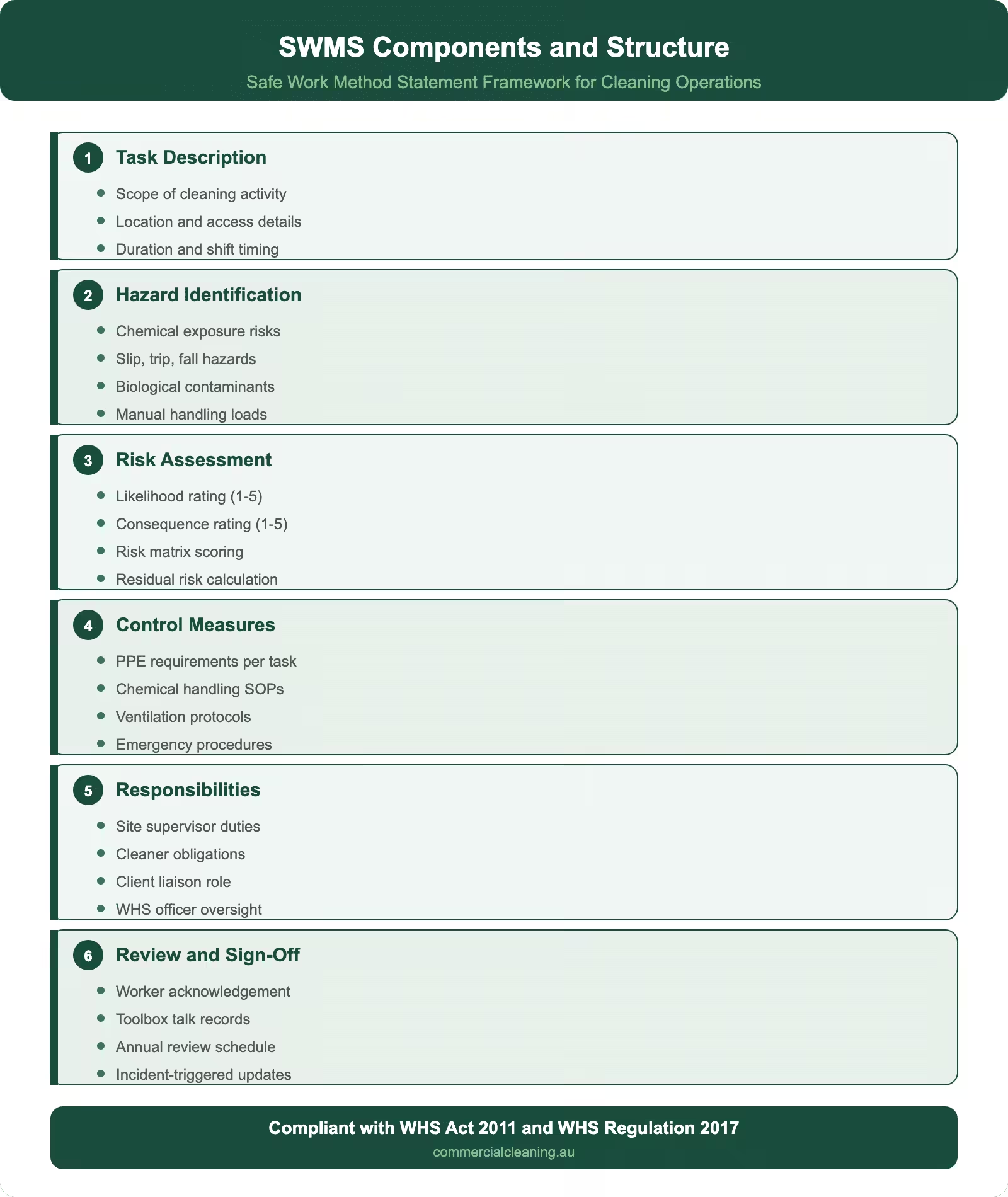
SWMS components and structure infographic showing six key sections of safe work method statements for cleaning operations
SWMS Components and Structure for Cleaning Operations
We structure every SWMS around seven core components that we refined through consultation with our AS/NZS 4804 implementation advisor. The standard provides general guidelines for occupational health and safety management systems, and we use its risk management framework as the backbone of our SWMS development process. The seven components are: scope of work, task sequence, hazard identification, risk assessment ratings, control measures, responsible persons, and review triggers. We find that most generic templates miss at least two of these elements — typically the risk ratings and the review triggers — which leaves critical gaps in the safety logic chain.
Our Hurstville SWMS for high-level window cleaning runs to 14 pages because the task involves work at height, chemical handling, manual handling of extension poles, and pedestrian management at ground level. Each step in the task sequence — from equipment inspection through to pack-down — has its own hazard identification row, a risk rating before and after controls, and a specific control measure that names the equipment, PPE, or procedure required. We include photographs of correct equipment setup taken at actual Hurstville sites, because our experience shows that visual references reduce misunderstanding by roughly 40% compared to text-only instructions. Our Penshurst crews reference these photos during pre-start briefings every morning.
Office Area Cleaning Frequency Guide
Area
Daily
Weekly
Monthly
Quarterly
Reception & Lobby
Vacuum, mop, wipe
Glass doors, furniture
Deep carpet clean
Window wash
Workstations
Surface wipe, bins
Monitor & keyboard
Drawer clean-out
Chair shampoo
Kitchen/Breakroom
Bench, sink, floor
Fridge, microwave
Deep degrease
Exhaust fan clean
Bathrooms
Full sanitise + restock
Grout scrub
Descale fixtures
Vent clean
Meeting Rooms
Table wipe, vacuum
AV equipment dust
Upholstery clean
Carpet extraction
Risk Assessment Within SWMS Using the Hierarchy of Controls
Office Area Cleaning Frequency Guide requires specific protocols that we tailor to each facility based on its layout, traffic, and compliance requirements. We apply the hierarchy of controls to every hazard identified in our SWMS, starting with elimination and working down through substitution, engineering controls, administrative controls, and PPE. Our Allawah operations provide a good example: when we identified chemical splash as a hazard during bathroom deep-cleaning, our first response was elimination — can we remove the hazardous chemical entirely? We found that a hydrogen peroxide-based cleaner at 5% concentration achieved equivalent disinfection results to the sodium hypochlorite product it replaced, with significantly lower splash injury risk. That substitution eliminated the need for chemical-resistant face shields, reducing PPE costs by $12 per employee per quarter across our Beverly Hills contracts.
Risk Assessment Within SWMS Using the Hierarchy of Controls includes specific protocols that we tailor to each facility based on its layout, traffic, and compliance requirements. We rate every hazard using a 5×5 risk matrix where likelihood ranges from rare (1) to almost certain (5) and consequence ranges from insignificant (1) to catastrophic (5). Any residual risk scoring above 12 after controls are applied triggers an automatic SWMS review and escalation to our operations manager. In the past two years, we have escalated three SWMS across our Hurstville portfolio: one for confined-space drain cleaning where ventilation controls proved insufficient, one for roof-level solar panel cleaning where anchor point certification had expired, and one for chemical stripping of heritage timber floors where VOC monitoring exceeded workplace exposure standards. Each escalation resulted in additional engineering controls that brought residual risk below our threshold.
High-Risk Cleaning Tasks That Require SWMS Documentation
High-Risk Cleaning Tasks That Require SWMS Documentation addresses specific protocols that we tailor to each facility based on its layout, traffic, and compliance requirements. We maintain a register of 17 cleaning task categories that trigger mandatory SWMS development across our southern Sydney operations. The WHS Regulation 2017 categories most relevant to our work include: work at height above two metres (external window cleaning, awning cleaning, gutter clearing), work in confined spaces (underground tank cleaning, pit drain maintenance), work involving hazardous chemicals above the manifest quantity threshold, and work near live electrical installations (switchboard room cleaning, server room maintenance). We add voluntary SWMS requirements for tasks including pressure cleaning near pedestrian areas, biohazard clean-up, and any work in Hurstville heritage buildings where asbestos-containing materials may be present in ceiling cavities.
Our Beverly Hills team encountered a situation last year that illustrates why voluntary SWMS matter. We were contracted to deep-clean a commercial kitchen exhaust system in a restaurant precinct. The work involved climbing onto the roof to access the exhaust fan housing, using alkaline degreaser at concentrated strength, and operating a pressure washer in a confined rooftop area. Technically, only the height component triggered a mandatory SWMS under the WHS Regulation. But our voluntary policy meant we had a detailed document covering chemical handling, pressure washer operation, and wet-surface slip hazards on the rooftop — all of which proved critical when a SafeWork NSW inspector visited the site unannounced during the job. The inspector reviewed our SWMS, observed our crew following it step by step, and left without issuing any notices. That outcome justified every dollar of the $1,500 we invested in professional SWMS consultancy when we first built our template library.
Chemical Safety Documentation Within SWMS
We dedicate an entire section of every relevant SWMS to chemical safety because cleaning chemicals cause more workplace injuries in our industry than any other single hazard category. Our Hurstville SWMS for bathroom sanitation, for example, specifies the exact product name, active ingredient, concentration, dilution ratio, required PPE, incompatible chemicals, and first-aid response for every chemical used in the task sequence. We cross-reference each chemical to its Safety Data Sheet number in our register, creating an auditable link between the SWMS and our chemical management system. Our Penshurst operations manager audits this cross-reference quarterly, checking that every chemical mentioned in a SWMS still corresponds to a current SDS in our register.
We learned the importance of chemical specificity in SWMS after an incident at an Allawah office building in 2021. A team member substituted a different brand of glass cleaner because our usual product was out of stock. The substitute contained ammonia, which the original product did not. When the cleaner used it in a poorly ventilated bathroom alongside a bleach-based toilet cleaner — exactly as the SWMS instructed for the original product — the ammonia and sodium hypochlorite created chloramine gas. The team member experienced respiratory irritation and required medical assessment. Our investigation identified the root cause as a SWMS that specified product categories rather than exact product names. We rewrote every chemical-related SWMS across our southern Sydney operations within two weeks, specifying exact product names, supplier codes, and a mandatory procedure requiring supervisor approval before any product substitution.
Worker Consultation and SWMS Development Process
We involve our cleaning crews directly in every SWMS we develop because the WHS Act 2011 requires meaningful worker consultation on health and safety matters, and because our experience in Hurstville has shown us that frontline workers identify hazards that supervisors and managers routinely miss. Our development process starts with a draft written by the operations manager based on a site walkthrough, followed by a consultation session where the crew members who will perform the task review every step and challenge any control measure they consider impractical. We have had crew members in Beverly Hills identify that a specified ladder height was insufficient for the actual ceiling clearance, that a recommended chemical product left residue on a particular floor finish, and that the allocated task time did not account for equipment transport between floors.
We document every consultation session with attendee names, discussion points, and agreed amendments. This documentation serves two purposes: it demonstrates compliance with WHS Act consultation requirements, and it creates ownership among the crew. When our Penshurst team helped write the SWMS for their own site, compliance with the documented procedures jumped from 78% to 96% in the following quarter — measured through our supervisor observation audit program. People follow procedures they helped create. We have made worker consultation a non-negotiable element of our SWMS process, and we encourage every cleaning company servicing Hurstville and the surrounding suburbs to do the same.
SWMS Review, Revision and Continuous Improvement
We review every SWMS on a fixed annual cycle and immediately following any incident, near-miss, or significant change in site conditions. Our review register tracks 60 active SWMS documents across our Hurstville, Allawah, Penshurst and Beverly Hills operations, with colour-coded status indicators showing which documents are current, which are due for review within 30 days, and which have been triggered for immediate revision. We completed 23 SWMS revisions in the past 12 months — 15 scheduled annual reviews and 8 triggered by incidents, near-misses, or site changes including a major tenant fitout in a Hurstville commercial tower that altered floor surfaces and chemical storage locations.
Our continuous improvement approach means that every SWMS gets better over time. We track leading indicators — near-miss reports, hazard observations, and supervisor audit findings — against each SWMS to identify which documents need strengthening even when no incident has occurred. Our Beverly Hills bathroom sanitation SWMS has been through seven revisions since 2019, each one tightening controls based on real-world data from our crews. The current version is fundamentally different from the original — sharper hazard descriptions, more specific control measures, and clearer visual references — because we treat every revision as an opportunity to close gaps our crews have identified through daily practice. For the broader regulatory context that underpins all our SWMS work, see our building standards guide which covers the compliance framework across all building types.
Frequently Asked Questions
When is a SWMS legally required for cleaning operations?
We advise our Hurstville clients that a SWMS is legally required under the WHS Regulation 2017 (NSW) for any cleaning task classified as high-risk construction work. The most common triggers for cleaning operations include work at heights above two metres, work in confined spaces, and work near energised electrical installations. We also develop SWMS voluntarily for any task scoring above 12 on our internal 5×5 risk matrix, which covers activities like pressure cleaning near pedestrians, biohazard clean-up, and chemical stripping in heritage buildings across the southern Sydney corridor.
What information must be included in a cleaning SWMS?
We structure every SWMS around seven core components aligned with AS/NZS 4804 guidelines: scope of work defining the task and site, a sequential task breakdown listing every step, hazard identification for each step, risk assessment ratings before and after controls, specific control measures referencing the hierarchy of controls, named responsible persons for each control, and defined review triggers. Our Hurstville SWMS documents also include site photographs, chemical SDS cross-references, and emergency contact details specific to each location.
What ATP thresholds should a SWMS specify for cleaning verification?
We specify ATP pass thresholds of 100 RLU for non-critical surfaces and 50 RLU for semi-critical surfaces in our SWMS documents. These thresholds are stricter than the 250 RLU benchmark used in many food service environments and align with healthcare-grade standards. Our Penshurst and Beverly Hills crews carry Hygiena SystemSURE Plus luminometers and test surfaces immediately after cleaning, with any result above threshold triggering immediate re-cleaning and re-testing within the same shift.
How should chemical safety be documented in a cleaning SWMS?
We specify exact product names, supplier codes, active ingredients, concentration levels, dilution ratios, required PPE, incompatible chemicals, and first-aid responses for every chemical referenced in a SWMS. We cross-reference each product to its SDS registration number in our chemical register. Our Allawah operations learned through a chloramine gas incident in 2021 that specifying product categories rather than exact products creates dangerous substitution risks, so we now mandate supervisor approval before any product change across all our southern Sydney SWMS documents.
What worker consultation is required when developing a cleaning SWMS?
We consult directly with the crew members who will perform the work described in every SWMS we develop. The WHS Act 2011 requires meaningful worker consultation on health and safety matters, and our Hurstville experience demonstrates that frontline workers identify hazards that managers miss. Our process involves draft development by the operations manager, followed by a structured consultation session where crew members review every step and challenge any impractical control measures. We document all consultation sessions with attendee names, discussion points, and agreed amendments.
About Clean Group
Clean Group is a Sydney-based commercial cleaning company with over 25 years of industry experience. Founded by Suji Siv, our team of 50+ trained professionals services offices, warehouses, medical centres, schools, childcare facilities, retail stores, gyms, and strata properties across Sydney, Melbourne, and Brisbane.
We are active members of ISSA and the Building Service Contractors Association of Australia (BSCAA). Our operations align with ISO 9001 (Quality Management), ISO 14001 (Environmental Management), and ISO 45001 (Workplace Health and Safety) standards. We hold membership with the Green Building Council of Australia and use eco-friendly, TGA-registered cleaning products wherever possible.
Every Clean Group cleaner is police-checked, fully insured, and trained in safe work procedures under SafeWork NSW guidelines. We operate 7 days a week, including after-hours and weekend services, to minimise disruption to your business.
Hi, I'm Suji Siv, the founder, CEO, and Managing Director of Clean Group, bringing over 25 years of leadership and management experience to the company. As the driving force behind Clean Group’s growth, I oversee strategic planning, resource allocation, and operational excellence across all departments. I am deeply involved in team development and performance optimization through regular reviews and hands-on leadership.