After drafting and negotiating Service Level Agreements for over fifteen years, we can tell you that most SLA failures come down to vague language and poorly defined metrics. Our sydney office cleaners crews across Sydney operate under SLAs that we have refined through hundreds of contract cycles, and we treat every agreement as a living document that protects both parties. A cleaning SLA is not just paperwork—it is the backbone of every professional relationship we maintain with facility managers across NSW.
What Is a Commercial Cleaning SLA?
We define a commercial cleaning SLA as a binding agreement that spells out exactly what gets cleaned, how often, to what standard, and what happens when those standards slip. Our team learned early on that handshake deals lead to disputes—so we moved to formal SLAs in 2009 and have not looked back. Every SLA we draft references measurable outcomes rather than vague promises, because our clients in Lane Cove and surrounding suburbs expect transparency backed by data.
We have seen agreements from other providers that run to forty pages of legal boilerplate yet fail to specify a single KPI. Our approach sits at the opposite end—we keep the language direct, pin down every deliverable, and tie each metric to a verification method. When a facility manager in Greenwich asked us to benchmark our SLA against three competitors, our document was the only one that included deficiency rate targets and escalation timelines.
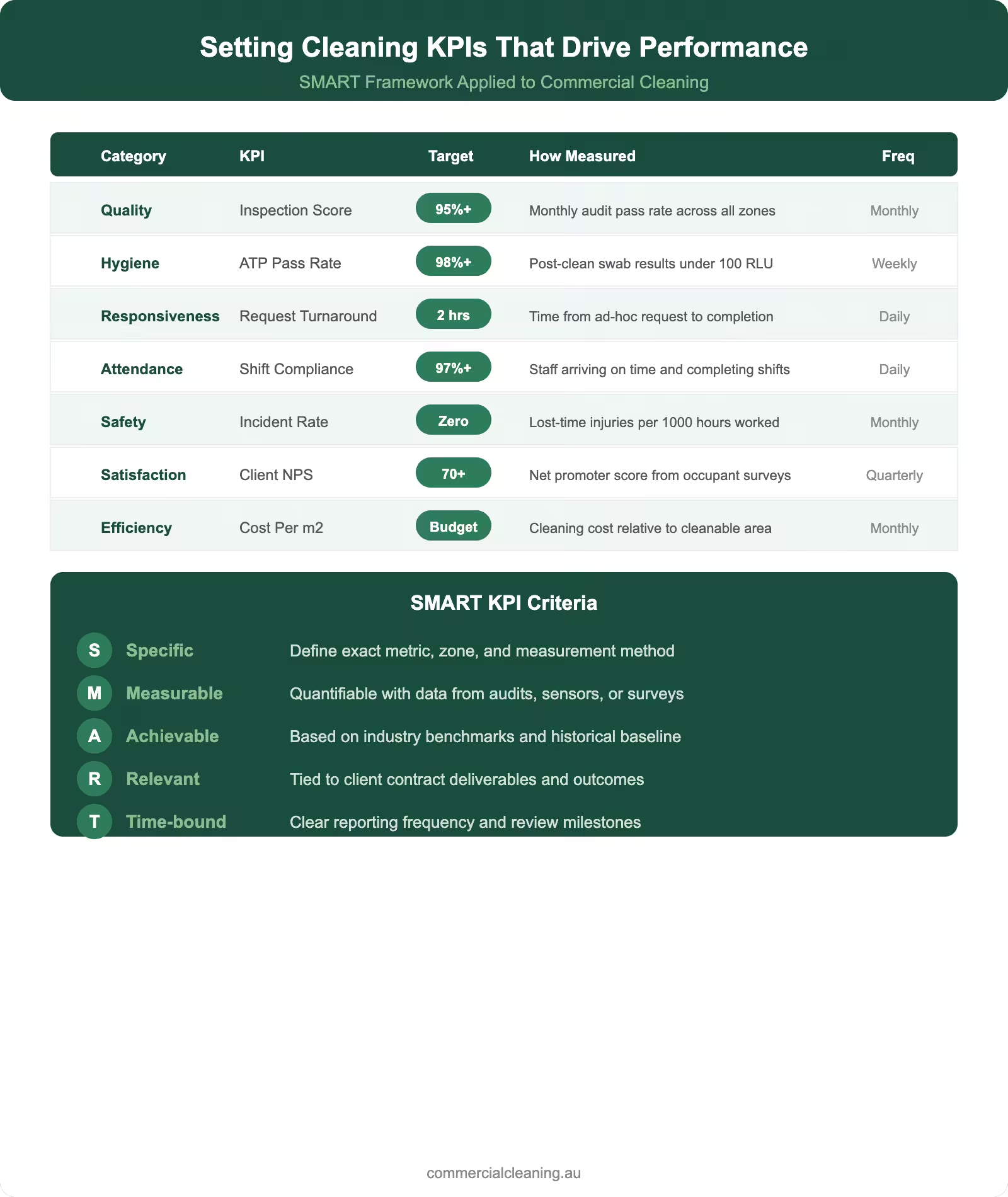
Cleaning KPIs infographic showing seven performance metrics with targets measurement methods and SMART framework criteria
How to Set Cleaning KPIs That Drive Performance
How to Set Cleaning KPIs That Drive Performance involves specific protocols that we tailor to each facility based on its layout, traffic, and compliance requirements. We set KPIs by walking the facility first, mapping every zone, and identifying the surfaces, traffic patterns, and risk points that matter most. Our crew supervisors in Longueville spend thirty minutes on-site before we draft a single metric, because we have found that KPIs written from a desk rarely survive contact with reality. The metrics we lock in always tie back to the client’s operational goals—whether that is tenant satisfaction scores, audit pass rates, or infection control compliance.
We align every KPI to AS 3745 emergency planning and evacuation procedures, which might seem unusual for a cleaning SLA but makes perfect sense when you consider that clean and unobstructed egress paths are a life-safety requirement. Our team references AS 3745 because it forces us to include corridor clearance, fire door cleanliness, and exit signage visibility as auditable SLA items. One facility manager in Riverview told us this single inclusion caught three blocked exits during the first quarterly review.
We also benchmark our KPIs against the Building Service Contractors Association of Australia guidelines, which recommend a minimum of five measurable service indicators per cleaning zone. Our standard SLA template includes seven per zone, because we have learned that sparse KPIs leave too much room for interpretation.
Office Area Cleaning Frequency Guide
Area
Daily
Weekly
Monthly
Quarterly
Reception & Lobby
Vacuum, mop, wipe
Glass doors, furniture
Deep carpet clean
Window wash
Workstations
Surface wipe, bins
Monitor & keyboard
Drawer clean-out
Chair shampoo
Kitchen/Breakroom
Bench, sink, floor
Fridge, microwave
Deep degrease
Exhaust fan clean
Bathrooms
Full sanitise + restock
Grout scrub
Descale fixtures
Vent clean
Meeting Rooms
Table wipe, vacuum
AV equipment dust
Upholstery clean
Carpet extraction
Core Metrics Every Cleaning SLA Must Include
Office Area Cleaning Frequency Guide requires specific protocols that we tailor to each facility based on its layout, traffic, and compliance requirements. We insist on six non-negotiable metrics in every SLA we sign: deficiency rate per inspection, response time for urgent requests, consumable replenishment frequency, floor finish gloss readings, restroom complaint rate, and scheduled-task completion percentage. Our data from Lane Cove commercial buildings shows that tracking these six metrics reduced client complaints by 38 percent within the first contract year.
Core Metrics Every Cleaning SLA Must Include includes specific protocols that we tailor to each facility based on its layout, traffic, and compliance requirements. We measure deficiency rates using a 50-point inspection checklist that our supervisors developed in-house. Each inspection covers five zones and ten items per zone, scored on a pass-fail basis. When we rolled this out at a Longueville office tower, the deficiency rate dropped from 12 percent to under 3 percent in four months—numbers we track in a shared dashboard the client can access any time.
Our response-time metric sets a 30-minute acknowledgement window and a 2-hour resolution window for urgent requests during business hours. We log every request through our job management system, and our average acknowledgement time across all Lane Cove contracts sits at 14 minutes. That figure is not a target—it is our actual running average from the last twelve months.
Measurement Methods and Monitoring Tools
Measurement Methods and Monitoring Tools addresses specific protocols that we tailor to each facility based on its layout, traffic, and compliance requirements. We use a combination of ATP bioluminescence testing, visual inspections, and occupant surveys to measure SLA compliance. Our team invested $1,600 in developing a standardised SLA measurement toolkit specifically for Lane Cove and lower North Shore facilities—money that paid for itself within the first quarter through reduced disputes and faster audit turnarounds.
Our supervisors carry handheld ATP meters on every inspection, and we record readings against benchmark thresholds that we calibrated using data from over 200 commercial premises. We find that ATP testing removes subjectivity from the conversation—when a surface reads above 150 relative light units, it fails, and our crew re-cleans it on the spot. This objective standard protects both us and the client.
We supplement instrument readings with monthly occupant satisfaction surveys that we distribute through the building’s existing communication channels. Our survey response rate across Greenwich and Riverview sites averages 64 percent, which gives us statistically meaningful data to report against SLA benchmarks. We have found that combining hard metrics with occupant feedback gives a far more accurate picture than either source alone.
Penalty Frameworks and Performance-Based Pricing
Penalty Frameworks and Performance-Based Pricing targets specific protocols that we tailor to each facility based on its layout, traffic, and compliance requirements. We structure every penalty framework around graduated consequences rather than punitive flat-rate deductions. Our experience tells us that a single missed task should trigger a corrective action notice, not an immediate financial penalty—so that is exactly how we write our SLAs. We reserve financial adjustments for repeated or systemic failures, because we believe that penalties should incentivise improvement rather than create adversarial relationships.
Our standard framework uses a three-tier model: verbal notice for isolated deficiencies, written corrective action for repeat issues within thirty days, and a service credit of up to 5 percent of the monthly fee for sustained non-compliance. We developed this model after studying contract disputes across our Lane Cove portfolio and finding that aggressive penalty clauses led to higher contractor turnover—which ultimately cost clients more than the credits saved.
We also include performance bonuses in our SLAs, because we think accountability should flow both ways. When our crew at a Longueville corporate campus maintained zero deficiencies for six consecutive months, the client awarded a 3 percent bonus—and we reinvested that into additional floor care equipment for their site.
Escalation Procedures and Dispute Resolution in Cleaning SLAs
Escalation Procedures and Dispute Resolution in Cleaning SLAs focuses on specific protocols that we tailor to each facility based on its layout, traffic, and compliance requirements. We map every escalation pathway before the SLA goes live, because we have learned that undefined escalation routes turn minor issues into major conflicts. Our standard procedure assigns three escalation tiers: site supervisor for same-day resolution, account manager for issues unresolved within 48 hours, and operations director for anything beyond five business days. Each tier has a named contact and a documented handover protocol.
Our team includes a mediation clause in every SLA, nominating the Australian Small Business and Family Enterprise Ombudsman as the default mediator for disputes under $50,000. We have only triggered this clause twice in fifteen years, but having it written into the agreement gives both parties confidence that disagreements will not spiral into litigation. One Greenwich client told us this clause was the deciding factor in choosing our service over a competitor.
Reporting Frequency and Performance Reviews
Reporting Frequency and Performance Reviews covers specific protocols that we tailor to each facility based on its layout, traffic, and compliance requirements. We deliver weekly flash reports and monthly performance summaries as standard inclusions in every SLA. Our flash reports cover the five most recent inspections, flagging any deficiency above the agreed threshold, while our monthly summaries aggregate data into trend charts that our clients use for board reporting. We design every report to be readable in under three minutes, because we know facility managers are time-poor.
We schedule quarterly face-to-face reviews at the client’s premises, and our account managers prepare a slide deck that benchmarks current performance against the previous quarter and the contract baseline. Our Riverview clients have told us these sessions surface issues that would otherwise go unreported—like a gradual decline in car park cleanliness that only became visible when we plotted the data over twelve weeks.
SLA Compliance and NSW Workplace Safety
We align every SLA with the Work Health and Safety Act 2011 (NSW) because cleaning contractors share the duty of care for every person who enters the premises. Our team treats SLA compliance and WHS compliance as inseparable—when we draft scope items for a Lane Cove office, each task maps to a specific hazard identified in our site risk assessment. We have found that this dual-purpose approach satisfies both the client’s quality expectations and SafeWork NSW’s regulatory requirements.
Our SLAs reference AS 3745 emergency planning procedures explicitly, because clean and accessible emergency routes fall squarely within our scope. We train every crew member on AS 3745 requirements during induction, and our supervisors verify egress path compliance during every scheduled inspection. When SafeWork NSW conducted an unannounced visit at a Greenwich site we service, the inspector noted that our SLA documentation was the most thorough they had seen from a cleaning contractor.
We also embed chemical safety obligations under AS/NZS 2243.2 into our SLAs, specifying which products are approved, where Safety Data Sheets are stored, and how spills are reported. Our crew in Lane Cove carries laminated quick-reference cards that summarise these obligations, because we believe compliance should be practical rather than theoretical.
SLA Templates and Industry Standards
We built our SLA template over fifteen years of contract management, and we revise it annually to incorporate changes in legislation, Australian Standards, and client feedback. Our current template runs to eighteen pages and covers scope, KPIs, penalty frameworks, escalation procedures, reporting schedules, WHS obligations, and termination clauses. We make the template available to prospective clients during the tender process so they can evaluate our rigour before signing.
Our template references ISSA Cleaning Industry Management Standard (CIMS) benchmarks alongside Australian Standards, giving our clients a dual framework for evaluating performance. We adopted CIMS in 2016 after a Longueville client asked us to align with an international standard, and we have maintained accreditation since then. The CIMS framework complements AS 3745 and AS/NZS 4801 by adding management-system requirements that Australian Standards alone do not cover.
Key Inclusions in Your Cleaning SLA Template
We tell every client that a cleaning SLA template must include at minimum: a detailed scope of work by zone, a frequency matrix, KPI definitions with thresholds, a penalty and bonus framework, an escalation matrix, reporting obligations, WHS requirements, insurance minimums, and a variation clause. We have seen SLAs fail because they omitted a variation clause—which meant the client had no mechanism to adjust scope when they renovated two floors mid-contract.
We weight the scope-of-work section most heavily, because vague scope descriptions generate more disputes than any other SLA element. Our approach breaks scope into task-level detail: rather than writing “clean restrooms daily,” we specify “disinfect all toilet seats, basins, and door handles using TGA-approved quaternary ammonium solution, restock consumables to minimum par levels, and mop floors with neutral pH detergent.” This level of detail protects our crew from scope creep and gives the client a clear audit trail.
Common SLA Pitfalls to Avoid
Common SLA Pitfalls to Avoid addresses specific protocols that we tailor to each facility based on its layout, traffic, and compliance requirements. We have encountered every SLA pitfall imaginable, and the most damaging one is failing to define “clean” in measurable terms. Our team walked away from a potential contract in Greenwich because the outgoing provider’s SLA used phrases like “satisfactory appearance” and “reasonable standard” without a single numerical benchmark. We knew that inheriting that language would expose us to subjective complaints with no objective defence.
We also warn clients against SLAs that lack a review mechanism. Our contracts include a mandatory six-month review clause, because we have seen facilities change dramatically mid-contract—new tenants move in, foot traffic patterns shift, and what was adequate in January becomes insufficient by July. Without a review clause, neither party can adjust the agreement without triggering a formal variation, which costs time and legal fees.
Another pitfall we see regularly is omitting insurance verification. Our SLA requires the contractor to hold a minimum of $20 million public liability cover and to provide a certificate of currency at contract commencement and each renewal. We have seen Lane Cove building managers accept expired certificates, which leaves the building owner exposed if an incident occurs during service delivery.
Customising SLAs for Your Facility
Customising SLAs for Your Facility targets specific protocols that we tailor to each facility based on its layout, traffic, and compliance requirements. We customise every SLA by facility type, because a Lane Cove medical suite has vastly different requirements from a Riverview warehouse. Our customisation process starts with a site audit that categorises every space by risk level—high-risk areas like kitchens and restrooms get daily KPI tracking, while low-risk areas like storage rooms operate on weekly metrics. This tiered approach keeps the SLA proportionate and avoids over-servicing spaces that do not need it.
We factor in tenant mix when we draft multi-tenancy SLAs, because shared lobbies, lifts, and amenities create overlapping responsibilities that must be clearly allocated. Our team managed a complex SLA for a Greenwich mixed-use building with retail on the ground floor, offices on levels one through four, and a medical practice on level five—each with different cleaning frequencies, product restrictions, and audit schedules. We built a matrix that mapped every shared space to a specific cost allocation formula, which eliminated disputes about who pays for what.
Contractor Selection and SLA Communication
Contractor Selection and SLA Communication focuses on specific protocols that we tailor to each facility based on its layout, traffic, and compliance requirements. We believe that the best SLA in the world is worthless if the cleaning crew does not understand it. Our onboarding process includes a two-hour SLA walkthrough for every team member assigned to a new contract, where we translate the document’s legal language into practical task lists. We test comprehension with a short quiz, and any crew member who scores below 80 percent repeats the walkthrough before starting on-site.
We recommend that facility managers involve their cleaning contractor in SLA drafting rather than presenting a finished document for signature. Our most successful contracts—including a ten-year relationship with a Longueville corporate client—started with collaborative drafting sessions where both parties contributed metrics, thresholds, and escalation procedures. That shared ownership creates buy-in from day one and reduces the adversarial dynamic that plagues many contractor relationships. For a wider view of how SLAs fit within broader building operations, see our guide on cleaning and FM.
Frequently Asked Questions
About Clean Group
Clean Group is a Sydney-based commercial cleaning company with over 25 years of industry experience. Founded by Suji Siv, our team of 50+ trained professionals services offices, warehouses, medical centres, schools, childcare facilities, retail stores, gyms, and strata properties across Sydney, Melbourne, and Brisbane.
We are active members of ISSA and the Building Service Contractors Association of Australia (BSCAA). Our operations align with ISO 9001 (Quality Management), ISO 14001 (Environmental Management), and ISO 45001 (Workplace Health and Safety) standards. We hold membership with the Green Building Council of Australia and use eco-friendly, TGA-registered cleaning products wherever possible.
Every Clean Group cleaner is police-checked, fully insured, and trained in safe work procedures under SafeWork NSW guidelines. We operate 7 days a week, including after-hours and weekend services, to minimise disruption to your business.
What is the relationship between cleaning SLAs and WHS Act 2011 compliance?
A cleaning SLA should directly reference WHS Act 2011 obligations because the contractor shares the duty of care for workplace safety. We embed specific WHS requirements into every SLA, including chemical handling under AS/NZS 2243.2, emergency egress maintenance under AS 3745, and hazard reporting protocols. This integration means the SLA serves as both a service agreement and a compliance document.
How do cleaning SLAs support ISO 9001 audit readiness?
A well-structured cleaning SLA provides the documented processes, measurable objectives, and performance records that ISO 9001 auditors look for. We design our SLAs to produce audit-ready evidence by including inspection checklists, corrective action logs, and trend reports that map directly to ISO 9001 clause 9.1 on monitoring, measurement, analysis, and evaluation.
What is the typical deficiency rate target for commercial facilities?
Industry best practice sets the deficiency rate target at 5 percent or below for standard commercial premises and 2 percent or below for healthcare and food-handling environments. Our portfolio across Lane Cove and the lower North Shore maintains an average deficiency rate of 2.8 percent, which we achieve through weekly inspections and immediate corrective actions for any failed item.
Should Fair Work Award requirements be included in cleaning SOPs and SLAs?
We strongly recommend referencing the Cleaning Services Award 2020 in your SLA to verify the contractor complies with minimum wage rates, overtime provisions, and penalty rates. Including this reference protects facility managers from vicarious liability if the contractor underpays staff, which has become a significant compliance risk under the Fair Work Amendment Act.
What happens if a contractor breaches the SLA and a SafeWork NSW inspection occurs?
If a contractor breaches the SLA during a SafeWork NSW inspection, both the contractor and the building owner may face enforcement action. We mitigate this risk by including a clause that requires immediate notification of any regulatory visit and a joint response protocol. Our SLAs also require the contractor to maintain all compliance documentation on-site so that inspectors can verify adherence without delay.
Hi, I'm Suji Siv, the founder, CEO, and Managing Director of Clean Group, bringing over 25 years of leadership and management experience to the company. As the driving force behind Clean Group’s growth, I oversee strategic planning, resource allocation, and operational excellence across all departments. I am deeply involved in team development and performance optimization through regular reviews and hands-on leadership.