We have sourced, tested, and stocked commercial cleaning products for over fifteen years, and the difference between retail-grade and professional-grade formulations is something our team sees reflected in cleaning results every single day. Our clients often ask us where to buy the right products and whether the commercial versions are worth the higher shelf price. We wrote this guide because navigating the Australian cleaning supplies market requires knowing which distributors carry genuinely professional products versus repackaged consumer formulations with inflated price tags. Every recommendation below comes from products we have purchased, tested on live sites, and either kept in our inventory or rejected based on real-world performance.
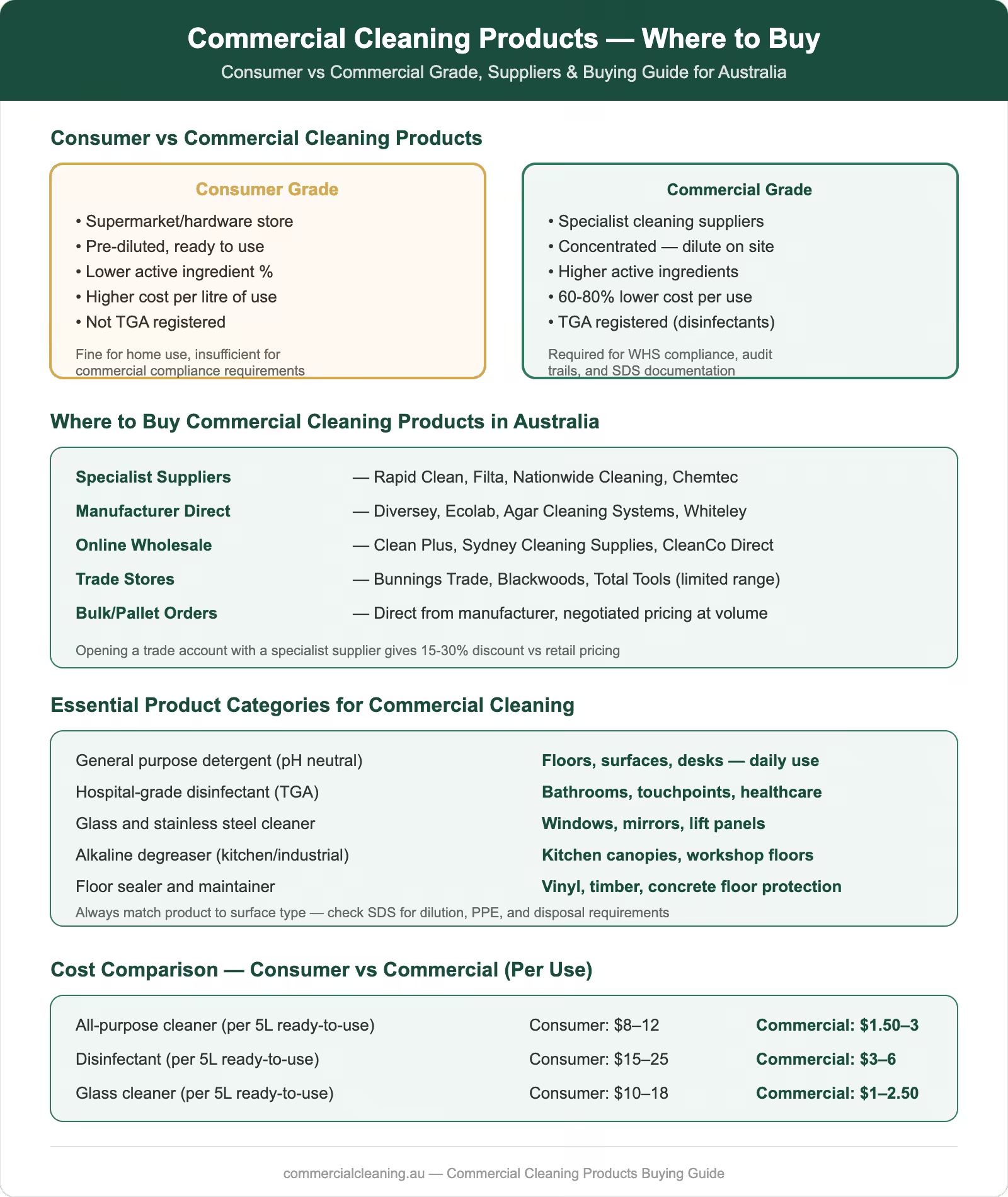
Commercial cleaning products buying guide showing consumer vs commercial comparison, Australian suppliers, essential product categories, and cost comparison per use
Understanding the Difference Between Consumer and Commercial Cleaning Products
We draw a clear line between consumer cleaning products sold in supermarkets and the commercial-grade formulations we use on our contracts. Our team has tested both side by side on identical surfaces, and the differences are measurable: commercial concentrates typically deliver three to five times more active cleaning agent per litre when diluted according to the Safety Data Sheet, which means our cleaners use less product per shift and achieve better results. We have found that consumer products often contain more fragrance, more colourant, and less actual surfactant than their commercial equivalents, because they are formulated to appeal to shoppers rather than to clean efficiently under commercial soil loads.
We also value the consistency of commercial formulations. Our team relies on products that perform identically from batch to batch because our cleaning procedures are calibrated to specific dilution ratios, contact times, and pH levels. We have experienced batch variation with some budget commercial brands where the product worked perfectly one month and failed to remove soil the next — we traced the issue to a reformulation that the manufacturer had not communicated. We now only purchase from distributors who provide batch-specific SDS documents and who notify us of any formulation changes before they ship. Our supervisors at sites in Ingleburn learned to check SDS dates on every delivery after one batch change caused streaking on a polished concrete floor that took an entire shift to correct.
Where to Buy Commercial Cleaning Products in Australia
We purchase our cleaning products through three channels: specialist janitorial distributors, manufacturer-direct accounts, and industry buying groups. Our team has found that specialist distributors offer the best combination of product range, technical support, and delivery reliability for day-to-day purchasing. We maintain accounts with distributors who carry the brands we have standardised on, and we negotiate volume pricing that keeps our per-litre cost competitive. We avoid purchasing cleaning chemicals from general hardware chains because their commercial range is limited and their staff typically cannot provide the technical SDS guidance we need for WHS compliance.
We also buy directly from manufacturers when we need specialised products that distributors do not carry or when we require custom dilution packaging. Our team has manufacturer-direct accounts for our floor finish systems, carpet extraction chemicals, and healthcare-grade disinfectants because these products require technical support that only the manufacturer can provide. We follow AS 1216 class labelling requirements for dangerous goods when receiving and storing chemical shipments, and we verify that every delivery arrives with current SDS documentation and correct hazard labels. We learned to inspect deliveries carefully after a shipment to our Minto warehouse arrived with unlabelled containers that turned out to be an alkaline degreaser mislabelled as a neutral floor cleaner — using it as labelled would have stripped the coating from every vinyl floor on our schedule that week.
Commercial Cleaning Product Comparison
Product Type
Active Ingredient
Kill Time
Best For
TGA Listed
Quaternary Ammonium
Benzalkonium chloride
10 min
General surfaces
Yes
Sodium Hypochlorite
Bleach 0.1%
1 min
Bathrooms, blood spills
Yes
Hydrogen Peroxide
H₂O₂ 3–6%
5 min
Multi-surface, eco
Yes
Isopropyl Alcohol
IPA 70%
30 sec
Electronics, glass
No
Peracetic Acid
PAA 0.2%
5 min
Food-grade surfaces
Yes
Evaluating Product Quality and Making Cost-Effective Purchasing Decisions
Commercial Cleaning Product Comparison requires specific protocols that we tailor to each facility based on its layout, traffic, and compliance requirements. We evaluate every new product through a structured trial process before adding it to our approved product list. Our team tests new products on a controlled section of floor or surface at a low-risk site, measures the result against our existing product, and compares the cost per square metre cleaned rather than the cost per litre purchased. We have found that the cheapest concentrate often turns out to be the most expensive option when diluted to the same cleaning strength, because low-cost formulations frequently require stronger dilution ratios that consume more product per clean. We calculate true cost by dividing the purchase price by the number of ready-to-use litres each concentrate produces at its recommended dilution ratio.
Evaluating Product Quality and Making Cost-Effective Purchasing Decisions includes specific protocols that we tailor to each facility based on its layout, traffic, and compliance requirements. Our team also factors in secondary costs that do not appear on the invoice. We consider rinse requirements — products that leave residue need additional rinsing passes that consume labour and water. We consider surface compatibility — a product that cleans well but slowly degrades a floor coating creates hidden replacement costs. We consider fragrance and VOC levels — strong fragrances trigger complaints in enclosed offices and may violate indoor air quality standards. We have rejected products that performed well in cleaning trials but failed on secondary criteria, because our experience has taught us that total cost of ownership matters more than purchase price. One particular all-purpose cleaner we trialled at a site near Leumeah cleaned beautifully but left a tacky residue that attracted soil within hours, costing us $1,870 in additional labour to re-clean and switch products across the affected areas.
Building a WHS-Compliant Product Inventory
We maintain a WHS-compliant chemical register for every product in our inventory, and we consider this register as important as the products themselves. Our team records the product name, manufacturer, SDS version number, hazard classification, storage requirements, and approved uses for every chemical we stock. We update this register whenever we add a new product, receive a reformulated batch, or discontinue an item. We have found that maintaining a current register is not just a legal obligation — it is a practical tool that prevents our cleaners from using incompatible products and helps us respond quickly when a client asks for specific chemical safety information.
We store our products according to the segregation requirements on their SDS documents, keeping oxidisers away from flammables, acids away from bases, and corrosives in bunded containment. Our team conducts monthly stock audits to check for expired products, damaged containers, and storage compliance, and we train every cleaner in basic chemical safety during their induction. We believe that a well-managed product inventory is the foundation of safe, consistent commercial cleaning, and our investment in inventory management has prevented every chemical incident that poor storage could have caused. Our detailed approach to bulk purchasing and cost management continues in our wholesale cleaning supplies bulk buying guide.
Frequently Asked Questions
What is the difference between consumer and commercial cleaning products?
We have found that commercial concentrates deliver three to five times more active cleaning agent per litre than consumer products when diluted correctly. Our team tests both regularly, and commercial formulations consistently outperform consumer products in removing commercial soil loads while providing batch-to-batch consistency that calibrated cleaning procedures require.
Where should Australian businesses buy commercial cleaning products?
We recommend specialist janitorial distributors for the best combination of product range, technical support, and delivery reliability. Our team also maintains manufacturer-direct accounts for specialised products like floor finish systems and healthcare-grade disinfectants that require technical support only the manufacturer can provide.
How do you evaluate whether a cleaning product is cost-effective?
We calculate cost per square metre cleaned rather than cost per litre purchased. Our team divides the purchase price by the number of ready-to-use litres each concentrate produces at its recommended dilution ratio. We also factor in secondary costs like rinse requirements, surface compatibility, and VOC levels.
What WHS documentation is required for commercial cleaning chemicals?
We maintain a chemical register listing every product with its SDS version number, hazard classification, storage requirements, and approved uses. Our team updates this register whenever products are added, reformulated, or discontinued. We follow AS 1216 class labelling requirements for all dangerous goods in our inventory.
How should commercial cleaning products be stored safely?
We store products according to SDS segregation requirements: oxidisers away from flammables, acids away from bases, and corrosives in bunded containment. Our team conducts monthly stock audits checking for expired products, damaged containers, and storage compliance to prevent chemical incidents.
Why is batch consistency important in commercial cleaning products?
We rely on consistent formulations because our cleaning procedures are calibrated to specific dilution ratios, contact times, and pH levels. Our team has experienced batch variations that caused cleaning failures, so we now only purchase from distributors who provide batch-specific SDS documents and communicate any formulation changes before shipping.
Should businesses buy cleaning products from hardware stores?
We avoid purchasing cleaning chemicals from general hardware chains because their commercial range is limited and their staff typically cannot provide the technical SDS guidance needed for WHS compliance. Our team sources from specialist janitorial distributors who carry professional-grade products with full technical support.
How do you prevent using the wrong cleaning product on a surface?
We maintain an approved product list that maps each product to its compatible surfaces, and every site has a product-surface matching chart. Our team trains cleaners during induction on reading SDS pH values and hazard pictograms, and we use colour-coded labelling systems to prevent mix-ups during busy shifts.
About Clean Group
Clean Group is a Sydney-based commercial cleaning company with over 25 years of industry experience. Founded by Suji Siv, our team of 50+ trained professionals services offices, warehouses, medical centres, schools, childcare facilities, retail stores, gyms, and strata properties across Sydney, Melbourne, and Brisbane.
We are active members of ISSA and the Building Service Contractors Association of Australia (BSCAA). Our operations align with ISO 9001 (Quality Management), ISO 14001 (Environmental Management), and ISO 45001 (Workplace Health and Safety) standards. We hold membership with the Green Building Council of Australia and use eco-friendly, TGA-registered cleaning products wherever possible.
Every Clean Group cleaner is police-checked, fully insured, and trained in safe work procedures under SafeWork NSW guidelines. We operate 7 days a week, including after-hours and weekend services, to minimise disruption to your business.
Hi, I'm Suji Siv, the founder, CEO, and Managing Director of Clean Group, bringing over 25 years of leadership and management experience to the company. As the driving force behind Clean Group’s growth, I oversee strategic planning, resource allocation, and operational excellence across all departments. I am deeply involved in team development and performance optimization through regular reviews and hands-on leadership.