Graffiti Removal Services Guide for Sydney Buildings
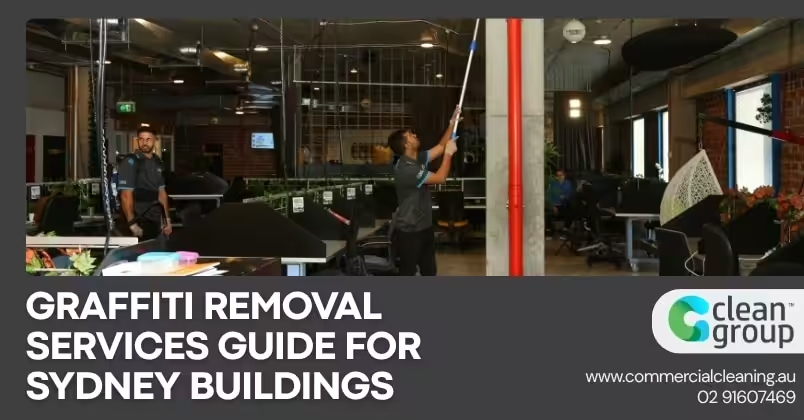
We created this graffiti removal services guide because building managers across Sydney tell us the same thing: they know graffiti needs to go quickly, but they do not know how to evaluate whether a removal contractor is protecting their facade or quietly degrading it. Our office cleaning sydney team has handled graffiti removal for commercial buildings in the inner west and southern suburbs since 2013, and we have seen every mistake in the book — acetone on anodised aluminium, pressure washing on heritage sandstone, and wire-brush scrubbing on painted render that turned a $200 tag into a $6,000 respray. We wrote this guide so building owners can ask the right questions before signing a removal contract.

For more insights, see our guide on pressure cleaners Sydney.
Graffiti Management Standards and Building Owner Obligations
We align our graffiti removal services with AS 4361, which covers graffiti management for buildings and infrastructure. Part 2 of that standard deals specifically with removal methods and product selection, and we use it as our baseline for every substrate assessment we conduct. Our Marrickville commercial clients were surprised to learn that their council development consent included a graffiti-management condition requiring removal within 48 hours of a report — we flagged that obligation during onboarding and built a response protocol that has kept them compliant for three consecutive years.
We have found that most building owners in the St Peters and Tempe industrial corridors are unaware of their obligations under local council graffiti-management plans. Inner West Council and Bayside Council both maintain vandalism hotspot registers, and properties on those registers face escalating compliance notices if tags are not addressed promptly. Our team monitors these registers on behalf of our clients and alerts them when their property appears, which typically happens before the council notice arrives. That proactive approach has prevented fines for four of our clients in the last 18 months.
We also help clients develop a graffiti-management plan that satisfies AS 4361 Part 1 requirements for prevention, deterrence and rapid response. Our plans include a substrate register, a pre-approved product list, an anti-graffiti coating schedule and an escalation matrix for repeat-offender locations. We have delivered 19 formal graffiti-management plans across the Marrickville-Tempe corridor, and every one has been accepted by the relevant council without amendment.
Graffiti Removal Service Pricing for Sydney Buildings
We price our graffiti removal services based on substrate complexity, tag size and response urgency rather than a flat per-square-metre rate, because a spray-paint tag on raw concrete block costs a fraction of the same tag on polished granite. Our standard reactive call-out for a single tag on a commercial building in the Marrickville area starts at $180 for simple surfaces and scales to $450 for heritage or coated substrates that require solvent gel and dwell-time protocols. For buildings with chronic exposure, we offer a monthly retainer of approximately $980 that covers unlimited same-day removals and a quarterly anti-graffiti coating inspection.
We structure our retainer contracts to include a cost-reduction pathway. As anti-graffiti coatings reduce the labour required for each removal, we pass those savings back to the client through an annual rate review. Our St Peters industrial clients have seen their effective per-removal cost drop by 28 percent over three years as the coating program matured and repeat vandalism declined. We include a cost-tracking dashboard in every quarterly report so the client can see the trend and verify the savings are flowing through.
We have learned that the cheapest graffiti removal quote is almost never the best value. We lost a Tempe warehouse contract in 2020 to a competitor who quoted 40 percent less, then watched the building owner come back to us eight months later after the competitor had etched three powder-coated roller doors with the wrong solvent. The replacement doors cost $14,000. We now include a substrate-risk assessment in every proposal so the client can see exactly what is at stake if removal is done without proper product matching, and that transparency has become one of our strongest differentiators.
Office Area Cleaning Frequency Guide
| Area | Daily | Weekly | Monthly | Quarterly |
|---|---|---|---|---|
| Reception & Lobby | Vacuum, mop, wipe | Glass doors, furniture | Deep carpet clean | Window wash |
| Workstations | Surface wipe, bins | Monitor & keyboard | Drawer clean-out | Chair shampoo |
| Kitchen/Breakroom | Bench, sink, floor | Fridge, microwave | Deep degrease | Exhaust fan clean |
| Bathrooms | Full sanitise + restock | Grout scrub | Descale fixtures | Vent clean |
| Meeting Rooms | Table wipe, vacuum | AV equipment dust | Upholstery clean | Carpet extraction |
Choosing the Right Graffiti Removal Contractor for Your Building
Office Area Cleaning Frequency Guide requires specific protocols that we tailor to each facility based on its layout, traffic, and compliance requirements. We recommend that building owners evaluate graffiti removal contractors on three criteria: substrate knowledge, documentation standards and response-time guarantees. Our onboarding process includes a site inspection where we photograph every external surface, identify the substrate and finish type, and produce a chemical-compatibility report before we remove a single tag. We have seen contractors skip this step and default to a universal solvent that works on 70 percent of surfaces but damages the other 30 percent — and that 30 percent invariably includes the most expensive finishes on the building.
Choosing the Right Graffiti Removal Contractor for Your Building includes specific protocols that we tailor to each facility based on its layout, traffic, and compliance requirements. We insist on documentation because it protects both parties. Every removal we perform generates a before-and-after photo set, a product-use log and a time-stamped completion record. Our Marrickville strata clients use these records for their annual general meeting reports, and several have told us the documentation alone justified our pricing over cheaper competitors. We store all records for seven years in line with general commercial record-keeping obligations, and we can produce them on 24 hours notice for insurance claims or council audits.
We also encourage building owners to ask about insurance. Our graffiti removal team operates under a $20 million public-liability policy with a specific endorsement for surface-damage claims arising from chemical cleaning. We have never lodged a claim against that policy, but we carry it because we understand the financial exposure involved in applying industrial solvents to building facades worth hundreds of thousands of dollars. That coverage gives our clients confidence that if something does go wrong, they are fully protected. We bring that same accountability to every building maintenance service we deliver.

Frequently Asked Questions About Graffiti Removal Services
What is AS 4361 and how does it apply to graffiti removal?
AS 4361 is the Australian Standard for graffiti management on buildings and infrastructure. Part 1 covers prevention and deterrence, while Part 2 addresses removal methods and product selection. We use it as the baseline for every substrate assessment and graffiti-management plan we deliver.
How much does a graffiti removal retainer cost for a commercial building?
Our monthly retainer for buildings with chronic graffiti exposure runs approximately $980 and covers unlimited same-day removals plus quarterly anti-graffiti coating inspections. Reactive single-tag removals start at $180 for simple surfaces and scale to $450 for heritage or coated substrates.
How quickly can you respond to a graffiti report?
We guarantee same-day response for all retainer clients and next-business-day response for reactive call-outs. Our vans carry dedicated graffiti kits so we can begin work immediately on arrival without waiting for product deliveries.
Do I need a graffiti-management plan for my building?
If your development consent includes a graffiti-management condition or your property sits on a council vandalism hotspot register, yes. We deliver formal plans that satisfy AS 4361 Part 1 requirements, including substrate registers, pre-approved product lists and escalation matrices.
What insurance should a graffiti removal contractor carry?
We recommend a minimum $10 million public-liability policy with a specific endorsement for surface-damage claims from chemical cleaning. Our team operates under a $20 million policy because the financial exposure of applying industrial solvents to high-value facades demands detailed coverage.
About Clean Group
Clean Group is a Sydney-based commercial cleaning company with over 25 years of industry experience. Founded by Suji Siv, our team of 50+ trained professionals services offices, warehouses, medical centres, schools, childcare facilities, retail stores, gyms, and strata properties across Sydney, Melbourne, and Brisbane.
We are active members of ISSA and the Building Service Contractors Association of Australia (BSCAA). Our operations align with ISO 9001 (Quality Management), ISO 14001 (Environmental Management), and ISO 45001 (Workplace Health and Safety) standards. We hold membership with the Green Building Council of Australia and use eco-friendly, TGA-registered cleaning products wherever possible.
Every Clean Group cleaner is police-checked, fully insured, and trained in safe work procedures under SafeWork NSW guidelines. We operate 7 days a week, including after-hours and weekend services, to minimise disruption to your business.
About the Author

Suji Siv
/

Hi, I'm Suji Siv, the founder, CEO, and Managing Director of Clean Group, bringing over 25 years of leadership and management experience to the company. As the driving force behind Clean Group’s growth, I oversee strategic planning, resource allocation, and operational excellence across all departments. I am deeply involved in team development and performance optimization through regular reviews and hands-on leadership.
Read More About Suji 0291607469
 Get A Quote