Business Facade Cleaning: Pressure Washing Safety & Methods Guide
We have pressure-cleaned business facades across Sydney for over fifteen years, and the transformation a thorough clean delivers still surprises building owners who have watched their property darken gradually without realising how much grime has accumulated. Our team provides professional commercial pressure cleaning services in Sydney that restore facades to near-original condition while protecting the substrate from the damage that incorrect pressure or chemical selection can cause.
For more insights, see our guide on commercial pressure cleaners.
Why Your Business Facade Needs Professional Cleaning
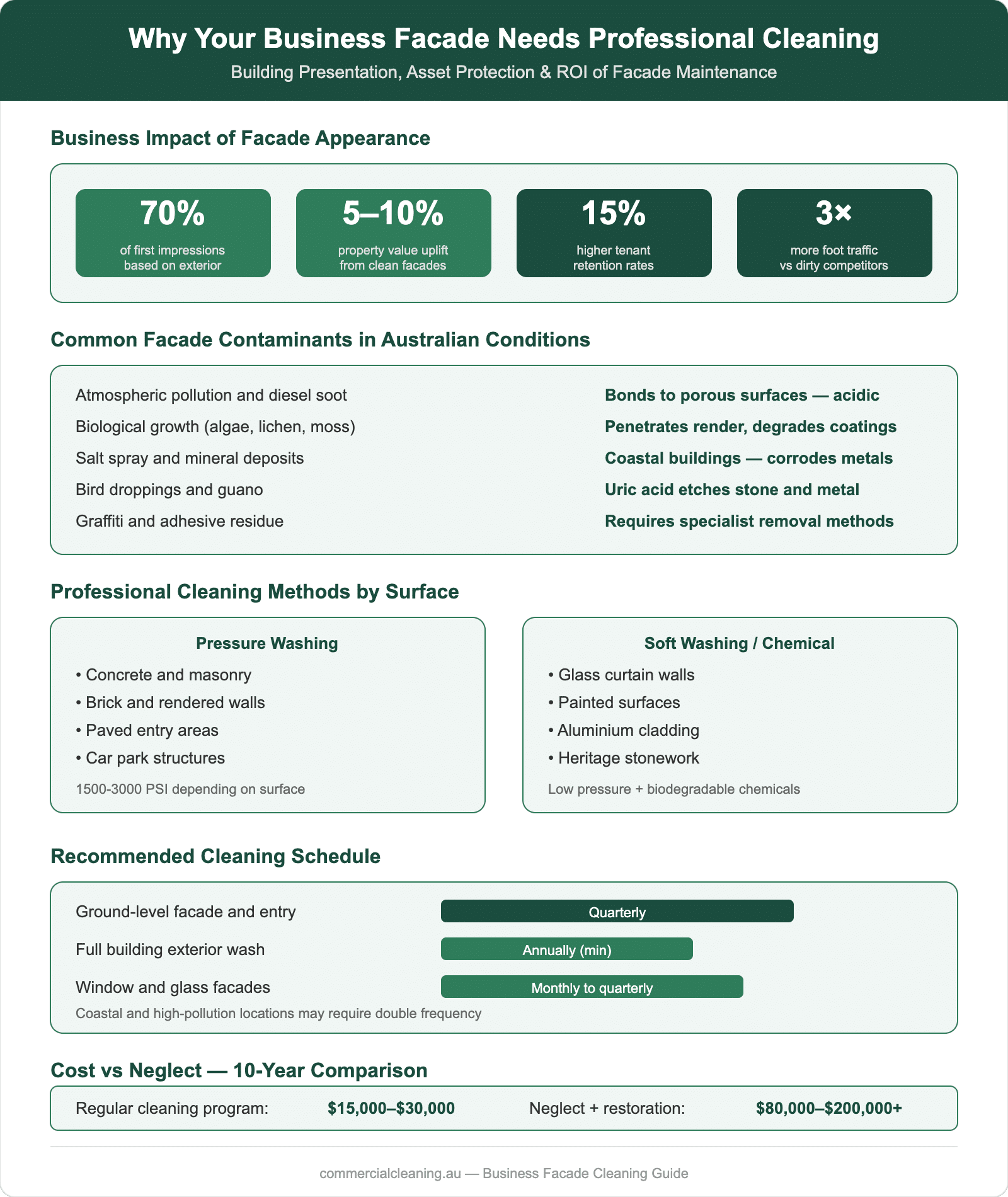
Why Your Business Facade Needs Professional Cleaning covers specific protocols that we tailor to each facility based on its layout, traffic, and compliance requirements. Sydney’s coastal environment deposits salt spray, airborne pollution, organic growth, and fine dust on every exterior surface continuously. In Chatswood and St Leonards, where commercial buildings sit close to major arterial roads, we see diesel soot and brake dust creating a grey-black film on rendered and painted surfaces within twelve months of the last clean. Left untreated, that film bonds to the substrate and becomes progressively harder to remove. Algae and lichen colonise damp-facing walls within two to three years, and their root structures penetrate porous renders, creating micro-cracks that allow water ingress and accelerate spalling.
Professional facade cleaning is not just cosmetic—it is preventive maintenance. AS 4312, the Australian Standard for atmospheric corrosion protection of metal substrates by coated surface treatments, sets benchmarks for how protective coatings perform in different exposure environments. When we clean a facade, we are effectively resetting the surface condition so existing coatings can continue performing their protective function. A building in Artarmon with a well-maintained paint system can go eight to ten years between full repaints, but the same building left uncleaned will need repainting in five because biological growth and pollutant deposits degrade the coating from the outside in.
Pressure Settings and Substrate Protection
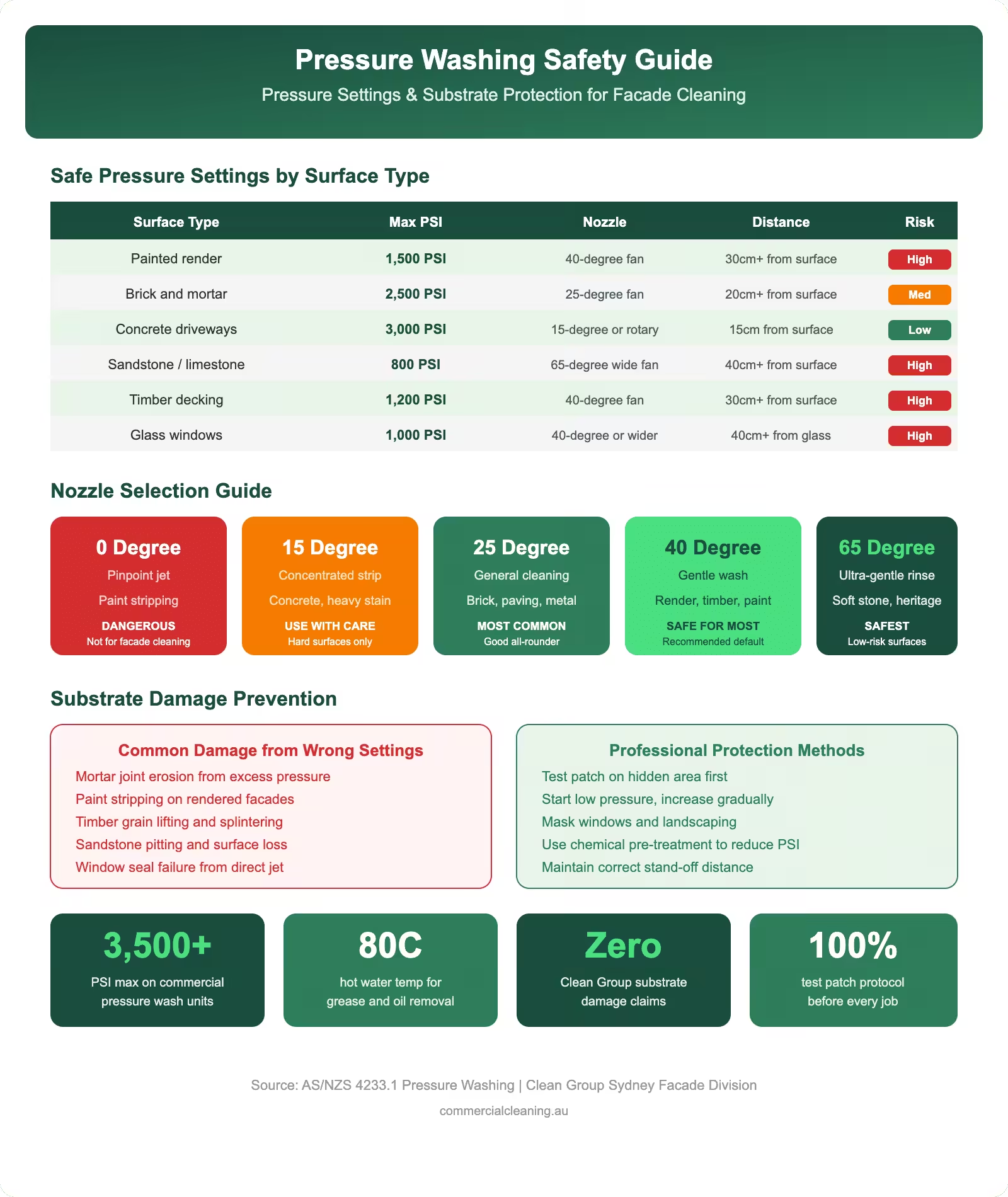
Pressure Settings and Substrate Protection involves specific protocols that we tailor to each facility based on its layout, traffic, and compliance requirements. The single biggest mistake in facade cleaning is using too much pressure. We have been called to repair jobs in Chatswood where another operator blasted acrylic render off a commercial building because they ran a 4000 PSI unit at close range on a surface that should have been cleaned at 1500 PSI with a wide fan tip. Our crews select pressure, flow rate, nozzle angle, and stand-off distance based on the specific substrate—brick, render, painted concrete, natural stone, glass curtain wall, aluminium composite panel, or timber cladding. Each material has a damage threshold, and we stay well below it while still delivering enough mechanical energy to lift the soil.
For softer substrates like aged lime render and sandstone, we use a soft-wash approach that relies on chemical action rather than pressure. A low-concentration sodium hypochlorite solution or a surfactant-based biocide is applied at low pressure, given a dwell time to break down organic growth, and then rinsed off gently. This method kills algae, lichen, and moss at the root without disturbing the substrate surface. We have soft-washed heritage-listed sandstone facades in St Leonards that were so delicate the strata manager had been told by two previous contractors that pressure cleaning was not possible. Our team cleaned the entire facade without a single mark on the stone.
Office Area Cleaning Frequency Guide
| Area | Daily | Weekly | Monthly | Quarterly |
|---|---|---|---|---|
| Reception & Lobby | Vacuum, mop, wipe | Glass doors, furniture | Deep carpet clean | Window wash |
| Workstations | Surface wipe, bins | Monitor & keyboard | Drawer clean-out | Chair shampoo |
| Kitchen/Breakroom | Bench, sink, floor | Fridge, microwave | Deep degrease | Exhaust fan clean |
| Bathrooms | Full sanitise + restock | Grout scrub | Descale fixtures | Vent clean |
| Meeting Rooms | Table wipe, vacuum | AV equipment dust | Upholstery clean | Carpet extraction |
Chemical Pre-Treatment for Stubborn Contamination
Office Area Cleaning Frequency Guide requires specific protocols that we tailor to each facility based on its layout, traffic, and compliance requirements. Not every facade responds to pressure and water alone. Carbon staining from exhaust vents, rust runs from corroding fixings, and graffiti all require targeted chemical treatments before the pressure wash stage. We carry a range of professional-grade chemicals including acidic cleaners for efflorescence and rust, alkaline degreasers for carbon and cooking oil deposits, and solvent-based graffiti removers matched to the paint type and substrate. In Artarmon commercial strips, where restaurant exhaust fans deposit cooking grease on adjacent building facades, we apply a heated alkaline pre-treatment that emulsifies the grease layer before we rinse it away with warm water at moderate pressure.
Chemical Pre-Treatment for Stubborn Contamination includes specific protocols that we tailor to each facility based on its layout, traffic, and compliance requirements. Every chemical we use on a facade is tested on an inconspicuous area first. Our crews apply a small patch, wait the full dwell time, rinse, and inspect the result before scaling up to the full facade. This precaution takes ten minutes and has saved us from chemical-related damage incidents on every project. We also capture all chemical runoff with ground-level bunding and vacuum recovery where required by the local council’s stormwater protection regulations—a compliance step that many operators ignore but one that can result in significant fines for the building owner if contaminated water enters the stormwater system.
Access Solutions for Multi-Storey Facades
Access Solutions for Multi-Storey Facades addresses specific protocols that we tailor to each facility based on its layout, traffic, and compliance requirements. Cleaning a ground-floor shopfront and cleaning a twelve-storey office tower are fundamentally different operations. We deploy the access method that matches the building height, facade geometry, and site constraints—elevated work platforms for low-rise buildings up to four storeys, rope access technicians for towers and buildings with limited ground-level clearance, and scaffolding for projects that require sustained access over multiple days. Our rope access team holds current IRATA certifications and our EWP operators carry the relevant high-risk work licences. We have cleaned facades up to thirty-two storeys in Chatswood using dual-line rope access without a single safety incident across more than nine hundred individual descents on that project.
Traffic and pedestrian management around the work zone is planned before we arrive on site. In busy commercial areas like St Leonards, where shop awnings overhang busy footpaths, we erect temporary barriers and signage to redirect foot traffic during the wash phase when water and chemical runoff are flowing down the facade. We coordinate with the building manager and neighbouring tenants to close windows, retract awnings, and cover outdoor merchandise before we begin. This preparation takes time, but it prevents the complaints, insurance claims, and tenant disputes that result from water damage to neighbouring premises during a poorly planned facade clean.
What Business Facade Cleaning Costs in Sydney
We quote facade cleaning on a per-square-metre basis with the rate varying according to the substrate type, contamination severity, access method, and any chemical pre-treatments required. A straightforward pressure wash of a three-storey painted render facade in Artarmon with ground-level EWP access costs significantly less per square metre than a soft-wash of a heritage sandstone building in St Leonards requiring rope access and chemical runoff containment. Across the commercial facade projects we have completed in Chatswood, St Leonards, and Artarmon over the past twelve months, our average project value sits around $3,550 for a mid-sized commercial building of between five hundred and eight hundred square metres of facade area.
Strata and building managers who schedule annual facade cleaning benefit from consistency pricing—the first clean after years of neglect is always the most intensive and expensive, but subsequent annual cleans run faster because the contamination has not had time to bond deeply to the substrate. We have clients in Chatswood who have been on annual cleaning programs for over six years, and their per-clean cost has dropped by more than twenty per cent compared to the initial service because the surfaces now respond to a single pass rather than multiple treatments.
For building owners who need the facade substrate itself assessed and cleaned rather than just the surface grime removed, our team also provides specialist building facade cleaning that addresses structural contamination, coating failures, and substrate-specific restoration requirements.

Frequently Asked Questions
Will pressure cleaning damage my building’s render or paint?
Not when done correctly. We select pressure settings, nozzle types, and stand-off distances based on the specific substrate material. Softer surfaces like aged render and sandstone receive soft-wash treatments that rely on chemical action rather than mechanical pressure to avoid any surface damage.
How often should a commercial facade be cleaned?
We recommend annual cleaning for most commercial buildings in Sydney. Properties near major roads or in coastal areas may benefit from six-monthly cleaning due to accelerated contamination from diesel soot, salt spray, and biological growth.
Do you handle stormwater runoff compliance?
Yes. We capture chemical runoff with ground-level bunding and vacuum recovery where required by local council stormwater protection regulations. All waste water is disposed of through licensed contractors with documentation provided to the building manager.
Can you clean glass curtain walls and aluminium panels?
We clean all facade types including glass curtain walls, aluminium composite panels, zinc cladding, and steel framing. Each material gets a substrate-specific treatment to remove contamination without affecting coatings, anodising, or sealant joints.
What access methods do you use for tall buildings?
We deploy elevated work platforms for buildings up to four storeys, IRATA-certified rope access technicians for towers and restricted-access sites, and scaffolding for projects requiring sustained multi-day access. The method is matched to building height, facade geometry, and site constraints.
How long does a facade clean take?
A mid-sized commercial building of five hundred to eight hundred square metres typically takes one to two days depending on contamination severity and access complexity. Simpler low-rise facades can be completed in a single day.
Do you remove graffiti as part of facade cleaning?
Yes. We carry solvent-based graffiti removers matched to the paint type and substrate. Graffiti removal is included as part of the facade clean or available as a standalone service. We can also apply anti-graffiti coatings after cleaning to make future removal easier and faster.
Will the cleaning affect neighbouring tenants or pedestrians?
We coordinate with the building manager and neighbours before starting, erect barriers and signage to redirect foot traffic, close windows, retract awnings, and cover outdoor merchandise. This preparation prevents water damage complaints and ensures the work proceeds safely.
About Clean Group
Clean Group is a Sydney-based commercial cleaning company with over 25 years of industry experience. Founded by Suji Siv, our team of 50+ trained professionals services offices, warehouses, medical centres, schools, childcare facilities, retail stores, gyms, and strata properties across Sydney, Melbourne, and Brisbane.
We are active members of ISSA and the Building Service Contractors Association of Australia (BSCAA). Our operations align with ISO 9001 (Quality Management), ISO 14001 (Environmental Management), and ISO 45001 (Workplace Health and Safety) standards. We hold membership with the Green Building Council of Australia and use eco-friendly, TGA-registered cleaning products wherever possible.
Every Clean Group cleaner is police-checked, fully insured, and trained in safe work procedures under SafeWork NSW guidelines. We operate 7 days a week, including after-hours and weekend services, to minimise disruption to your business.
About the Author

Beau Sleeman
Hi, I’m Beau, a full-time accountant and part-time writer at Clean Group. With over ten years of industry experience managing company accounts and records, I’m responsible for keeping everything organised. I have worked with multiple cleaning companies to help successfully manage their businesses and generate profits while ensuring the best value for money for their customers. I also actively engage in the process of creating personalised cleaning packages based on customers’ needs and designed to be affordable for them.
Read More About Beau 0291607469
 Get A Quote