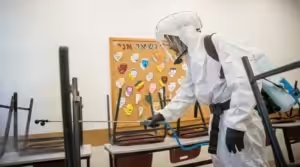
We have built our reputation as childcare cleaners on a simple principle — every childcare centre deserves cleaning that is designed specifically for the unique challenges of early childhood environments, not adapted from a generic commercial cleaning template. Our team has developed detailed hygiene programmes for centres across Blacktown, Seven Hills, and Lalor Park, and we have seen the measurable difference that purpose-built childcare centre cleaning makes to infection rates, parent confidence, and regulatory compliance. We recently completed a full programme implementation at a seventy-place centre in Blacktown that had been struggling with recurring gastroenteritis outbreaks under their previous contractor, and within two terms of our structured approach, their illness notification rate dropped to the lowest in their operating history.
Why Purpose-Built Childcare Cleaning Matters
Our approach to childcare centre cleaning treats every surface, fixture, and piece of equipment as a potential vector for pathogen transmission between children whose developing immune systems offer limited protection against environmental contamination. We have cleaned hundreds of early childhood facilities and we know from direct experience that the contamination patterns in childcare centres are fundamentally different from any other commercial environment. We deal with nappy change contamination, food handling in non-commercial kitchen settings, mouthed toys returning to shared play spaces, and bodily fluid incidents that occur multiple times daily. We designed our cleaning systems to address each of these challenges with specific, evidence-based interventions rather than relying on general-purpose cleaning to cover all bases.
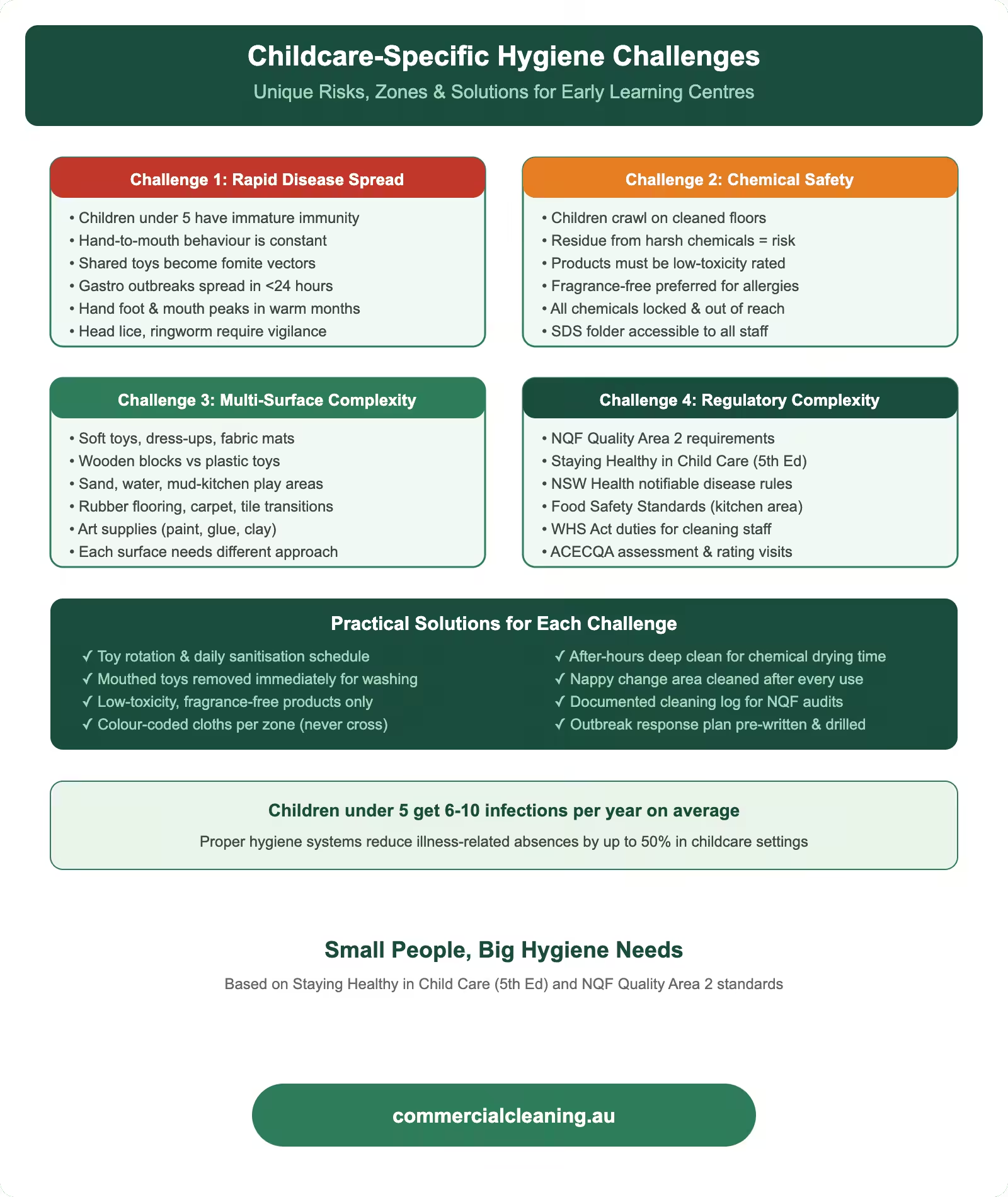
Childcare-specific hygiene challenges covering disease spread, chemical safety, multi-surface complexity, and regulatory requirements with practical solutions
What Australian Regulations Require for Childcare Cleaning
Every licensed early childhood education and care service in Australia operates under the National Quality Framework (NQF), administered by ACECQA. Quality Area 2 of the NQF covers children’s health and safety and is the primary assessment dimension relevant to cleaning and hygiene. Assessors review whether your centre’s cleaning practices meaningfully support infection control, safe food handling, and a hygienic sleep and play environment — not just whether floors look clean on inspection day. We align every cleaning programme to the indicators in Quality Area 2 so that the work we do contributes directly to your next assessment and rating cycle.
The authoritative reference for infection-control practice in Australian childcare is Staying Healthy: Preventing Infectious Diseases in Early Childhood Education and Care Services (NHMRC, 5th edition). It is the document your nominated supervisor, your assessors, and your local public-health unit all reference when a notifiable illness outbreak occurs. We train every cleaner allocated to a childcare centre on the specific hygiene procedures in Staying Healthy, including the contact times and product-class requirements for outbreak-grade disinfection. On top of Staying Healthy, we layer Work Health and Safety Act 2011 obligations around chemical handling, the APVMA registration status of every sanitiser we use, and the centre’s own documented risk management plan.
Hygiene Challenges Unique to Early Childhood Settings
A commercial cleaning template built for office buildings does not transfer to a childcare centre, and the reason is straightforward: the contamination sources are different, the tolerances are tighter, and the regulatory exposure is higher. A cleaner walking into an office encounters desks, keyboards, kitchenette surfaces, and bathrooms. A cleaner walking into a childcare centre encounters all of those plus six categories of early-childhood-specific hygiene challenges that every centre faces every day.
Mouthed objects returning to shared spaces. Infants and toddlers explore by mouth. Toys, puzzle pieces, and even book corners cycle between mouths and shared play areas dozens of times per day.
Nappy change and toileting contamination. Enteric pathogens including rotavirus, norovirus, and shigella are endemic in childcare settings. A nappy change area that is not disinfected to the correct contact time after every use becomes a transmission hub within hours.
Food preparation in non-commercial kitchens. Most centres prepare meals in a kitchenette that is not regulated as a commercial food premises, yet the food safety expectation from parents and FSANZ is identical.
Bodily fluid incidents multiple times per day. Toileting accidents, vomiting, nosebleeds, and grazes are routine. Our cleaners carry dedicated spill kits with absorbent, chlorine granules, and PPE for every room.
Shared sleep surfaces. Cots, stretchers, and sleep mats accumulate skin flora, saliva, and respiratory droplets. Linen needs daily change and mattresses need weekly deep sanitisation.
Outdoor play surfaces. Sand, soft-fall rubber, and hard play surfaces all harbour their own contamination profiles, from bird droppings to spilled milk to shoe-transported soil pathogens.
Room-by-Room Cleaning Protocols We Follow
Nappy Change Area
After every nappy change, the mat surface is wiped to remove visible soiling, then disinfected with a TGA-listed hospital-grade disinfectant rated against norovirus and rotavirus, with the full manufacturer-specified contact time observed before the surface is wiped clean. We use single-use paper towels for the wipe-down and a colour-coded microfibre (red) that is never taken outside the nappy change zone. Hand-wash basin taps, bin lids, and door handles in the nappy change corridor are on the same post-change disinfection cycle, because those are the secondary contact points that transfer pathogens out of the change area.
Sleep Room and Cot Area
Linen is changed daily for cots and every sleep session for stretcher beds. Mattresses and sleep mats are sanitised weekly with a TGA-listed disinfectant and dried completely before the room is reset. Cot frames, rails, and any surface a child’s hand or face contacts is wiped daily. We inspect ventilation grilles every visit because poor air movement in a sleep room concentrates respiratory droplets and is a contributor to RSV and influenza transmission within groups.
Food Prep and Kitchenette
The kitchenette is cleaned to food-safety standards — separate colour-coded chopping boards, sanitiser-sink at the correct concentration, fridge temperature checked and logged at every visit, utensils hot-water sanitised at the correct temperature. We complete a food-safety surface swab on request for any centre that wants documentary evidence for their next assessment cycle.
Play Spaces and Classroom
All high-touch surfaces — tables, chair backs, light switches, door handles, book corners — are disinfected at the start and end of each day. Hard toys are rotated out of service at the end of each session and batch-sanitised in a dedicated container with a TGA-listed disinfectant at the correct dwell time. Any mouthed toy is pulled immediately, bagged, and cycled through the sanitisation station before it returns to the floor. Soft toys rotate on a documented weekly wash schedule.
Bathroom and Toileting
Bathrooms in use are checked and touchpoint-cleaned every two hours during operating hours, with a full sanitising clean at the end of each session. We use low-fragrance, pH-neutral products — many children in this age group have asthma or chemical sensitivities, and strong phenolic or bleach odours in an occupied bathroom are a workplace-health issue for staff as well as a comfort issue for children.
Outdoor Play Area
Hard surfaces are pressure-washed weekly. Soft-fall rubber is inspected for tears and surface-cleaned with a gentle sanitiser that does not degrade the rubber matrix. Sandpits are raked daily, sifted weekly, and topped up or replaced on a documented cycle. Fences, gates, and outdoor play equipment are cleaned on the same monthly cycle as indoor play equipment.
Chemical Safety in Childcare Centres
Every product we use in a childcare centre is chosen with three constraints: it must carry a TGA listing or APVMA registration for its intended sanitiser or disinfectant use, it must have a current Safety Data Sheet on file at the centre, and it must be suitable for use around children with respiratory sensitivity. That rules out many of the strong phenolic, quaternary-ammonium, and solvent-based products that a generic commercial cleaner might default to. We maintain the SDS library at the centre on our portal and keep a physical copy in the chemical store as required. Where we can, we schedule disinfectant application for non-occupied hours, and where an in-occupancy application is necessary — bodily fluid spill, for example — we use only products rated for use in occupied areas, with full PPE.
Daily, Weekly, Monthly and Quarterly Cleaning Schedule
Daily: nappy change surface after each use, bathroom touchpoint check every two hours, end-of-day floor clean across all rooms, linen change for cots and stretchers, mouthed-toy sanitisation cycle, kitchen sanitiser-sink refresh, bin empty and liner replace, hand-wash basin and tap disinfection.
Weekly: mattress and sleep-mat sanitisation, soft toy wash cycle, outdoor equipment wash, under-furniture vacuum, fridge clean-out and temperature log audit, chemical store check.
Monthly: HVAC filter inspection and replacement where needed, full sleep room deep clean, curtain and blind clean, playground equipment structural and hygiene inspection, SDS library audit.
Quarterly: hot-water carpet extraction in all carpeted rooms, hard-floor strip and reseal where needed, full windows internal and external, storage room and staff room deep clean, chemical inventory vs SDS reconciliation.
Infection Outbreak Response
When a centre identifies two or more cases of a notifiable illness within a short window — gastroenteritis, hand-foot-and-mouth, RSV, influenza — the cleaning regime immediately shifts to an outbreak protocol. Contact times double. Touchpoint frequency doubles. Any product that does not carry a claim against the specific pathogen is replaced with one that does. For gastro outbreaks, we move to a chlorine-based disinfectant at the concentration Staying Healthy recommends and observe the full contact time on every surface a symptomatic child may have contacted. For enveloped respiratory viruses, we focus on air handling, tissue disposal, and high-frequency touchpoint cycles. We document every outbreak-response clean so that your nominated supervisor has the record ready for NSW Health or the equivalent state public-health unit if they request it.
Frequently Asked Questions
How often should a childcare centre be deep-cleaned?
We recommend a full deep clean quarterly, with weekly targeted deep work on sleep rooms, bathrooms, and the nappy change area. Daily cleaning covers infection control; the quarterly cycle resets the baseline on carpets, hard floors, windows, HVAC, and storage areas.
Can cleaners work during operating hours?
Bathroom touchpoint checks, spill response, and nappy change disinfection happen during operating hours. Heavier work — floors, carpets, chemical-intensive disinfection — is scheduled for after-hours so that children are not exposed to strong product odours or wet surfaces.
What products are safe for use around children?
We default to TGA-listed disinfectants with low fragrance profiles, pH-neutral general cleaners, and APVMA-registered sanitisers for food-contact surfaces. Every product has an SDS on file at the centre and is chosen with paediatric asthma incidence in mind.
Do cleaners need a Working with Children Check?
Every cleaner we allocate to a childcare centre holds a current NSW Working with Children Check. We verify and record the WWCC number for every team member and make the register available to your approved provider at any time.
How do I verify cleaners are following NSW regulations?
We provide a shared cleaning log with every sign-in, task checklist, and chemical use documented. That log, together with the SDS library and the WWCC register, is the documentary trail your assessor or the Department will ask for. We will also sit with your nominated supervisor on request to walk through the log and explain any entry.
What happens if a gastro outbreak starts?
We activate outbreak protocol within the same day. Chlorine-based disinfection replaces general sanitiser on every high-risk surface. Cleaning frequency on toilets, nappy change areas, and high-touch points doubles. We stay on outbreak protocol until your nominated supervisor and, where applicable, the local public-health unit clear the centre.
What records should cleaners keep?
At minimum: a daily sign-in and task log, chemical use and SDS register, WWCC register for every cleaner on site, incident and outbreak-response records, and quarterly deep-clean sign-off. We provide all of this as standard.
What’s the difference between routine cleaning and childcare cleaning?
Routine commercial cleaning targets a clean visual finish. Childcare cleaning targets an infection-control outcome. The products are different, the contact times are different, the frequencies are higher, and the documentation requirement is continuous. Treating them as interchangeable is the single most common reason centres fail their Quality Area 2 assessment on hygiene.
Our next guide offers practical insights into the facility-wide hygiene approaches that prevent cross-contamination and build infection control excellence across every room in your centre. Explore our facility hygiene guide for actionable strategies that complement your daily cleaning protocols.
Hi, I'm Suji Siv, the founder, CEO, and Managing Director of Clean Group, bringing over 25 years of leadership and management experience to the company. As the driving force behind Clean Group’s growth, I oversee strategic planning, resource allocation, and operational excellence across all departments. I am deeply involved in team development and performance optimization through regular reviews and hands-on leadership.