We sanitise over 1,200 commercial surfaces every week across the Hills District, and the number-one question our Castle Hill clients ask is straightforward: what is sanitising, and how is it different from just cleaning? The distinction matters because getting it wrong exposes your business to health code violations, WorkSafe notices, and — in food service — potential prosecution under the Food Act 2003. As commercial cleaners Sydney operators with two decades of hands-on experience, we break down exactly what sanitising means in an Australian regulatory context and why your facility almost certainly needs a documented sanitisation program.
Sanitisation Defined: The NHMRC and Spaulding Framework
We follow the National Health and Medical Research Council (NHMRC) definition, which classifies sanitisation as reducing microbial contamination to a level considered safe by public health standards — typically a 99.9 per cent (3-log) reduction in vegetative bacteria on non-critical surfaces. This sits between cleaning (physical removal of visible soil) and disinfection (destruction of specific pathogens including mycobacteria and viruses). Our crews in Castle Hill, Baulkham Hills, Kellyville, and Glenhaven apply this three-tier hierarchy on every job because each tier demands different chemicals, contact times, and validation methods.
The Spaulding Classification System — developed by Dr Earle Spaulding in 1968 and adopted by the NHMRC — categorises surfaces into critical, semi-critical, and non-critical based on infection risk. Non-critical surfaces (floors, walls, benchtops, furniture) require sanitisation rather than sterilisation. Semi-critical surfaces (respiratory equipment, endoscope sheaths) require high-level disinfection. We deal almost exclusively with non-critical surfaces in our commercial contracts, which means sanitisation is our bread and butter. Our supervisors carry laminated Spaulding reference cards because misclassifying a surface leads to either overkill (wasting expensive hospital-grade disinfectant on a desk) or underkill (using a general-purpose cleaner on a food contact surface that needs sanitisation).
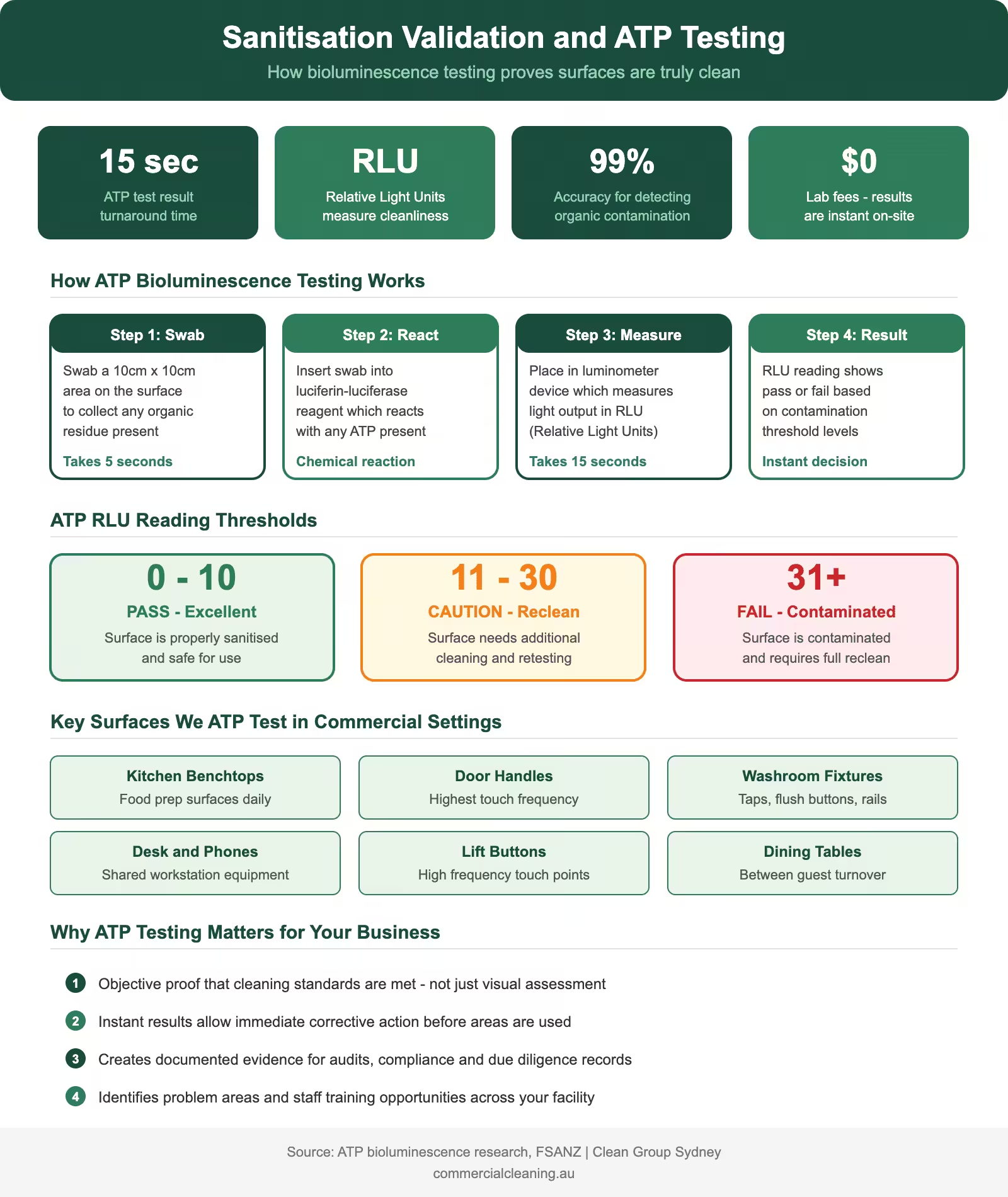
ATP bioluminescence sanitisation testing infographic showing how it works RLU thresholds key test surfaces and benefits for commercial cleaning validation
ATP Bioluminescence Testing: How We Validate Sanitisation
ATP Bioluminescence Testing involves specific protocols that we tailor to each facility based on its layout, traffic, and compliance requirements. We invested in Hygiena SystemSURE Plus luminometers in 2019 and they transformed our quality assurance program. ATP (adenosine triphosphate) bioluminescence testing measures organic residue on surfaces in relative light units (RLU). Our benchmark for non-critical commercial surfaces is below 100 RLU post-sanitisation — the ISSA standard for “clean” in commercial environments. Food contact surfaces in our Castle Hill restaurant and cafe contracts must hit below 30 RLU, which aligns with Food Standards Australia New Zealand (FSANZ) guidance.
We test a minimum of ten randomly selected surfaces per site visit on sanitisation contracts. Our data from 2024 shows a 97.3 per cent first-pass compliance rate across our Hills District portfolio, meaning fewer than three surfaces per hundred require re-sanitisation. That number was 89 per cent in 2020 before we standardised chemical dilution ratios and implemented the $680 sanitisation kit we now deploy at every Castle Hill site — the kit includes pre-measured sachets of quaternary ammonium compound (QUAT), colour-coded microfibre cloths conforming to AS/NZS 4146 (Laundry practice), and a calibrated spray bottle system that eliminates guesswork from dilution.
Office Area Cleaning Frequency Guide
Area
Daily
Weekly
Monthly
Quarterly
Reception & Lobby
Vacuum, mop, wipe
Glass doors, furniture
Deep carpet clean
Window wash
Workstations
Surface wipe, bins
Monitor & keyboard
Drawer clean-out
Chair shampoo
Kitchen/Breakroom
Bench, sink, floor
Fridge, microwave
Deep degrease
Exhaust fan clean
Bathrooms
Full sanitise + restock
Grout scrub
Descale fixtures
Vent clean
Meeting Rooms
Table wipe, vacuum
AV equipment dust
Upholstery clean
Carpet extraction
Employer Obligations Under the WHS Act 2011
Office Area Cleaning Frequency Guide requires specific protocols that we tailor to each facility based on its layout, traffic, and compliance requirements. We remind every client in the Hills District that the Work Health and Safety Act 2011 (NSW) places a primary duty of care on persons conducting a business or undertaking (PCBUs) to confirm, so far as is reasonably practicable, that workers and visitors are not exposed to health risks. For sanitisation, this translates into three actionable obligations: maintain documented cleaning and sanitisation schedules, provide Safety Data Sheets (SDS) for every chemical on site, and verify workers are trained in correct chemical handling under the Globally Harmonized System (GHS).
Employer Obligations Under the WHS Act 2011 includes specific protocols that we tailor to each facility based on its layout, traffic, and compliance requirements. Our Kellyville and Baulkham Hills contracts include a compliance pack that covers all three obligations. We write the sanitisation schedule, supply the SDS folder, and deliver on-site GHS training to our own crews and client staff who handle any shared chemicals. SafeWork NSW conducted an unannounced inspection at one of our Castle Hill strata sites in March 2024 — the inspector reviewed our chemical register, dilution log, and ATP testing records and issued zero improvement notices. That outcome was not luck; it was the direct result of our AS/NZS 4146-aligned laundry and textile hygiene protocols that extend to how we wash, store, and rotate microfibre cloths used in sanitisation.
Chemical Sanitisers: What We Use and Why
Chemical Sanitisers addresses specific protocols that we tailor to each facility based on its layout, traffic, and compliance requirements. We stock three classes of sanitiser across our Hills District operations. Quaternary ammonium compounds (QUATs) are our workhorse for non-critical surfaces in offices, retail, and strata common areas — they are low-toxicity, non-corrosive, and effective at ambient temperature with a sixty-second contact time. Sodium hypochlorite (bleach) at 1,000 ppm available chlorine is our go-to for food contact surfaces in Castle Hill commercial kitchens, aligning with FSANZ Standard 3.2.2. For healthcare-adjacent environments like GP waiting rooms in Glenhaven, we use a hydrogen peroxide-based accelerated disinfectant that doubles as a sanitiser at lower concentrations.
Every chemical we deploy holds a current Australian Industrial Chemicals Introduction Scheme (AICIS) registration and a Therapeutic Goods Administration (TGA) listing where claims of pathogen kill are made. We abandoned two products in 2023 after their manufacturers failed to renew TGA registration — our chemical review process catches these lapses quarterly because using an unregistered disinfectant on a commercial site would void our professional indemnity insurance and expose the client to regulatory risk.
Sanitisation Versus Disinfection: When Each Applies
Sanitisation Versus Disinfection targets specific protocols that we tailor to each facility based on its layout, traffic, and compliance requirements. We explain this distinction to every new client during onboarding because the terminology confusion costs money. Sanitisation reduces bacteria to safe levels on non-critical surfaces — think desks, door handles, reception counters, lift buttons, and bathroom vanities. Disinfection destroys or irreversibly inactivates specific pathogens including Mycobacterium tuberculosis, norovirus, and Clostridioides difficile spores, and is required for semi-critical surfaces or during outbreak response. Our standard commercial contracts in Castle Hill and Baulkham Hills operate at the sanitisation level. We escalate to disinfection only when a client reports confirmed illness, when we service medical consulting rooms, or when public health orders mandate it (as occurred during the 2020–2022 pandemic response).
The cost difference is significant. Our sanitisation service for a 500-square-metre Castle Hill office runs $185 per visit. Upgrading the same space to hospital-grade disinfection costs $340 per visit because we switch to accelerated hydrogen peroxide, extend contact times to ten minutes, and add post-disinfection ATP validation on every high-touch surface. Facility managers in the Hills District who understand this distinction avoid paying disinfection prices for sanitisation-level work — and that is exactly why we created our $680 sanitisation kit as a standalone product for clients who want to supplement our scheduled visits with their own interim sanitisation between our weekly cleans. The kit follows AS/NZS 4146 colour-coding for laundry separation, and if your facility needs a broader view of cleaning types, our guide to essential cleaning industry terminology maps every category against Australian standards.
FAQs
What is the difference between sanitisation and disinfection under NHMRC guidelines?
Sanitisation achieves a 99.9 per cent (3-log) reduction in vegetative bacteria on non-critical surfaces, while disinfection destroys specific pathogens including mycobacteria and viruses on semi-critical surfaces. We apply sanitisation to standard commercial environments and reserve disinfection for medical settings or confirmed illness events in the Hills District.
How does ATP bioluminescence testing validate sanitisation effectiveness?
We swab surfaces with a Hygiena SystemSURE Plus luminometer that measures organic residue in relative light units (RLU). Our benchmark is below 100 RLU for general commercial surfaces and below 30 RLU for food contact surfaces. Our 2024 data across Castle Hill and Baulkham Hills sites shows a 97.3 per cent first-pass compliance rate.
What are employer obligations for sanitisation under the WHS Act 2011?
The Act requires PCBUs to maintain documented sanitisation schedules, provide Safety Data Sheets for every chemical on site, and train workers in chemical handling under GHS. Our compliance pack covers all three obligations and has passed SafeWork NSW inspection without improvement notices.
How does the Spaulding Classification determine sanitisation requirements?
The Spaulding system categorises surfaces by infection risk: non-critical (floors, desks, handles) need sanitisation, semi-critical (respiratory equipment) need high-level disinfection, and critical (surgical instruments) need sterilisation. We clean non-critical surfaces in commercial settings and carry laminated Spaulding reference cards for correct classification.
What chemical sanitisers are approved for use in Australian food service?
We use sodium hypochlorite at 1,000 ppm for food contact surfaces in Castle Hill kitchens, aligning with FSANZ Standard 3.2.2. All our sanitisers hold AICIS registration and TGA listing where pathogen-kill claims are made. We review registrations quarterly and dropped two products in 2023 after manufacturers failed TGA renewal.
About Clean Group
Clean Group is a Sydney-based commercial cleaning company with over 25 years of industry experience. Founded by Suji Siv, our team of 50+ trained professionals services offices, warehouses, medical centres, schools, childcare facilities, retail stores, gyms, and strata properties across Sydney, Melbourne, and Brisbane.
We are active members of ISSA and the Building Service Contractors Association of Australia (BSCAA). Our operations align with ISO 9001 (Quality Management), ISO 14001 (Environmental Management), and ISO 45001 (Workplace Health and Safety) standards. We hold membership with the Green Building Council of Australia and use eco-friendly, TGA-registered cleaning products wherever possible.
Every Clean Group cleaner is police-checked, fully insured, and trained in safe work procedures under SafeWork NSW guidelines. We operate 7 days a week, including after-hours and weekend services, to minimise disruption to your business.
Hi, I'm Suji Siv, the founder, CEO, and Managing Director of Clean Group, bringing over 25 years of leadership and management experience to the company. As the driving force behind Clean Group’s growth, I oversee strategic planning, resource allocation, and operational excellence across all departments. I am deeply involved in team development and performance optimization through regular reviews and hands-on leadership.