When we first started servicing commercial properties across Waterloo and the surrounding suburbs, one of the biggest barriers we noticed between our team and our clients was language. Facility managers would request a “deep clean” expecting one outcome, while our commercial cleaning team understood the term to mean something entirely different. Over the years, we have built this glossary from real conversations, real misunderstandings, and real lessons learned on the job. Every term below reflects how the professional cleaning industry actually uses these words in Australia, not textbook definitions copied from overseas sources.
General Cleaning Terminology Every Business Should Know
We find that most disputes between cleaning contractors and clients stem from undefined expectations around basic terminology. When a contract says “regular cleaning,” does that mean daily vacuuming, weekly mopping, or fortnightly dusting? Our team learned to define every term explicitly after a Waterloo strata manager cancelled our contract in 2018 because their interpretation of “periodic maintenance” differed from ours by about three weeks. That experience cost us $780 in project review fees to overhaul our entire glossary documentation and client onboarding materials, but it was the best investment we ever made in communication clarity.
Abrasive cleaning refers to any method that uses friction or gritty materials to remove stubborn deposits from surfaces. We use abrasive techniques on concrete warehouse floors, tiled kitchen splashbacks, and grout lines where chemical cleaning alone cannot penetrate built-up grime. Our team selects abrasive pads rated by grit level — typically between 200 and 800 grit for commercial applications — because using the wrong grade can permanently scratch polished surfaces. We ruined a marble reception counter in Zetland during our second year of operation by using a pad that was far too coarse, and that mistake taught us to always test abrasive products on a hidden section first.
Biohazard cleaning covers any situation involving blood, bodily fluids, chemical spills, or pathogen-contaminated materials. We carry dedicated biohazard kits in every van because these situations arise without warning — a Rosebery warehouse client once called us at 6am after an employee injury left blood contamination across a loading dock. Our biohazard protocols align with AS/NZS 4360 risk management framework principles, which require us to assess the severity of contamination, isolate the area, don appropriate personal protective equipment, and decontaminate using hospital-grade disinfectants before any standard cleaning resumes.
Cross-contamination describes the transfer of bacteria, allergens, or chemicals from one surface or area to another through shared cleaning equipment. We eliminate cross-contamination risk by colour-coding our microfibre cloths and mop heads — red for bathrooms, blue for general surfaces, green for kitchen and food areas, and yellow for high-touch points like door handles and light switches. This system costs more in inventory management, but we have seen it reduce post-clean bacterial swab failures by over 80 percent across our Waterloo and Redfern commercial client portfolio.
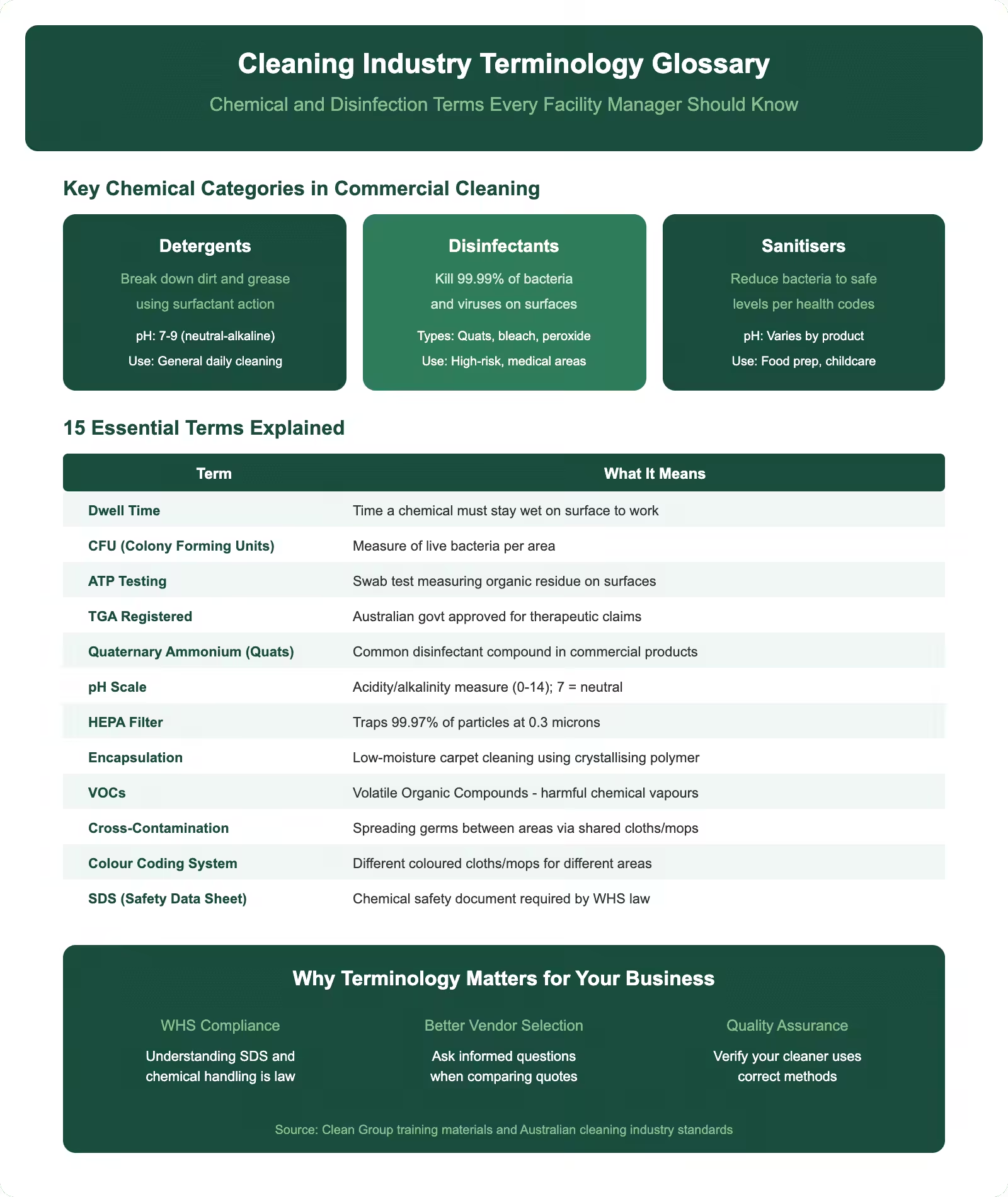
Cleaning industry terminology glossary infographic showing chemical categories essential terms definitions and why understanding cleaning terms matters for facility managers
Chemical and Disinfection Terms Used in Professional Cleaning
Chemical and Disinfection Terms Used in Professional Cleaning involves specific protocols that we tailor to each facility based on its layout, traffic, and compliance requirements. Understanding chemical terminology is not optional in our industry — it is a safety requirement. We train every new team member on chemical classifications during their first week because misusing products can cause surface damage, toxic fume exposure, or ineffective disinfection that puts building occupants at risk. Our chemical training program references Safety Data Sheets for every product we stock, and we review these sheets quarterly because manufacturers reformulate products more often than most people realise.
Bactericidal means a product kills bacteria on contact, while bacteriostatic means it merely inhibits bacterial growth without destroying existing colonies. We only use bactericidal products in high-risk environments like medical waiting rooms, childcare centres, and food preparation areas because bacteriostatic agents leave live bacteria on surfaces that can resume multiplying once the chemical evaporates. Our clients in Zetland and Rosebery food service venues specifically request bactericidal verification certificates, which we supply monthly as part of our compliance reporting.
Dwell time is the minimum period a disinfectant must remain wet on a surface to achieve its claimed kill rate. We consider dwell time the single most misunderstood concept in commercial cleaning because most cleaning staff wipe surfaces dry within seconds of applying product, which renders the disinfectant almost useless. Our standard operating procedure requires our team to apply disinfectant, move to the next task, and return to wipe the treated surface only after the specified dwell time — typically four to ten minutes depending on the product. We time this with countdown timers on our mobile devices rather than relying on guesswork.
Quaternary ammonium compounds, which we abbreviate as quats, are the workhorse disinfectants of commercial cleaning. We use quats across roughly 70 percent of our commercial sites because they offer broad-spectrum antimicrobial action, low toxicity to humans, and compatibility with most surface materials. However, quats lose effectiveness in the presence of organic soil, which is why our pre-clean step — removing visible dirt before applying disinfectant — is not a shortcut we ever skip. We also rotate between quat-based and hydrogen peroxide-based disinfectants every six months to prevent microbial resistance buildup, a practice we adopted after attending an infection control seminar in 2021.
Office Area Cleaning Frequency Guide
Area
Daily
Weekly
Monthly
Quarterly
Reception & Lobby
Vacuum, mop, wipe
Glass doors, furniture
Deep carpet clean
Window wash
Workstations
Surface wipe, bins
Monitor & keyboard
Drawer clean-out
Chair shampoo
Kitchen/Breakroom
Bench, sink, floor
Fridge, microwave
Deep degrease
Exhaust fan clean
Bathrooms
Full sanitise + restock
Grout scrub
Descale fixtures
Vent clean
Meeting Rooms
Table wipe, vacuum
AV equipment dust
Upholstery clean
Carpet extraction
Equipment and Methodology Terms for Commercial Cleaning
Office Area Cleaning Frequency Guide requires specific protocols that we tailor to each facility based on its layout, traffic, and compliance requirements. Our equipment glossary has grown considerably since we started this business because the commercial cleaning industry adopts new technology faster than most people expect. We invested in robotic floor scrubbers for our larger Waterloo warehouse clients three years ago, and the terminology around autonomous cleaning machines alone could fill a separate guide. For this glossary, we focus on the equipment terms that facility managers encounter most frequently when reviewing cleaning proposals and service agreements.
Equipment and Methodology Terms for Commercial Cleaning includes specific protocols that we tailor to each facility based on its layout, traffic, and compliance requirements. Encapsulation cleaning is a low-moisture carpet maintenance method where we apply a crystallising polymer solution that surrounds and encapsulates soil particles. As the solution dries, it forms brittle crystals that release from carpet fibres during subsequent vacuuming. We use encapsulation as our primary interim carpet maintenance method across Rosebery and Zetland commercial tenancies because it dries within 30 minutes, allows immediate foot traffic, and extends the interval between hot water extraction cleans by up to four months. Our encapsulation machine covers roughly 400 square metres per hour, making it three times faster than traditional carpet shampooing for routine maintenance.
High-pressure cleaning uses water delivered at pressures between 2,000 and 4,000 PSI to blast away grime, grease, moss, and biological growth from hard surfaces. We deploy high-pressure units on car park decks, loading docks, building facades, and bin storage areas across our commercial portfolio. Our team adjusts pressure settings based on surface material — concrete tolerates 3,500 PSI comfortably, but painted surfaces and timber decking require us to drop below 1,500 PSI to prevent damage. We also use heated high-pressure units for grease removal in restaurant loading areas because hot water at 80 degrees Celsius breaks down animal fats roughly four times faster than cold water at the same pressure.
Microfibre technology refers to synthetic cloths and mops made from fibres split to approximately one-hundredth the diameter of a human hair. We transitioned our entire operation to microfibre over a decade ago because the capillary action of split fibres captures and holds bacteria rather than spreading them across surfaces. Each microfibre cloth in our inventory is rated for at least 500 wash cycles before fibre degradation reduces its effectiveness. We launder our microfibre inventory at 70 degrees Celsius maximum because higher temperatures melt the polyester component and destroy the split-fibre structure that makes microfibre effective in the first place.
Industry Standards and Compliance Terminology
Industry Standards and Compliance Terminology addresses specific protocols that we tailor to each facility based on its layout, traffic, and compliance requirements. We reference Australian Standards constantly in our work because they provide the benchmarks that separate professional cleaning from amateur efforts. Our team maintains current access to Standards Australia publications relevant to our operations, and we incorporate standard references into our site-specific cleaning plans so that clients understand exactly which benchmarks we are meeting. Compliance terminology often confuses business owners who have never dealt with regulatory audits, so we break down the most important terms here.
AS/NZS 4360 is the Australian and New Zealand standard for risk management, and it underpins how we assess every new commercial cleaning contract. Before we quote a job, our operations manager conducts a risk assessment that identifies hazards specific to that site — chemical storage areas, elevated work platforms, confined spaces, slip-prone surfaces, and biological risks. We document these assessments using the AS/NZS 4360 framework of risk identification, analysis, evaluation, and treatment, which gives our clients a defensible record if WorkSafe ever questions their cleaning contractor selection process. We updated our risk assessment templates in 2023 to incorporate the latest ISO 31000 alignment changes that AS/NZS 4360 now references.
TGA registration applies to any disinfectant product that claims to kill specific pathogens in Australia. The Therapeutic Goods Administration maintains an Australian Register of Therapeutic Goods, and we verify that every disinfectant in our inventory carries a valid ARTG number before we approve it for use on client sites. We rejected three cheaper disinfectant brands last year because their Australian distributors could not produce valid TGA registration numbers, despite marketing claims of hospital-grade efficacy. Our clients in Waterloo medical practices and Zetland childcare centres particularly value this verification step because it protects them from liability if a cleaning product fails to perform as claimed.
Work Health and Safety compliance in our industry means adhering to the WHS Act 2011 and its associated regulations, which cover everything from chemical handling and personal protective equipment to manual handling and working at heights. We conduct annual WHS audits on our own operations and provide copies of our audit reports to clients upon request. Our Rosebery and Redfern clients receive these reports proactively as part of our quarterly compliance summaries, which also include training completion records, incident logs, and chemical inventory documentation that demonstrates our commitment to transparent operations. For practical guidance on tackling mineral buildup in your facility, read our guide to removing limescale from fixtures effectively.
Frequently Asked Questions
What is ATP testing and why is it important in commercial cleaning?
ATP testing measures organic residue concentration through bioluminescence, giving us objective proof that surfaces are genuinely clean rather than just visually tidy. We use ATP swabs after completing high-risk area cleans because readings below 30 RLU confirm the surface is ready for disinfectant application. Our team adopted ATP testing across all Waterloo and Zetland medical clients after finding that visual inspections alone missed contamination on approximately one in five surfaces.
Why do cleaning companies use colour-coded microfibre systems?
Colour-coded microfibre prevents cross-contamination by ensuring cloths used in bathrooms never touch kitchen surfaces or desks. We assign red to bathrooms, blue to general areas, green to kitchens, and yellow to high-touch points. This system is not optional for our team — it is a fundamental infection control measure that we enforce on every single site.
What does dwell time mean and why does it matter?
Dwell time is the minimum period a disinfectant must stay wet on a surface to achieve its stated kill rate. If a cleaner sprays and wipes immediately, the disinfectant has not had time to work. We train our staff to apply product, move to another task, and return to wipe only after the required four to ten minutes have elapsed.
How often should a business update its cleaning terminology and standards documentation?
We recommend reviewing cleaning documentation at least annually or whenever Australian Standards are updated, new chemicals are introduced, or site usage changes. Our glossary documentation undergoes a formal review every six months, and we update client-facing materials within 30 days of any relevant regulatory change.
What is the difference between sanitising and disinfecting?
Sanitising reduces bacteria to safe levels as defined by public health standards, while disinfecting eliminates virtually all pathogens including viruses and fungi. We sanitise food contact surfaces and disinfect high-touch points and bathroom fixtures because each method targets different risk profiles. Using the wrong method in the wrong area either wastes resources or leaves dangerous pathogens behind.
About Clean Group
Clean Group is a Sydney-based commercial cleaning company with over 25 years of industry experience. Founded by Suji Siv, our team of 50+ trained professionals services offices, warehouses, medical centres, schools, childcare facilities, retail stores, gyms, and strata properties across Sydney, Melbourne, and Brisbane.
We are active members of ISSA and the Building Service Contractors Association of Australia (BSCAA). Our operations align with ISO 9001 (Quality Management), ISO 14001 (Environmental Management), and ISO 45001 (Workplace Health and Safety) standards. We hold membership with the Green Building Council of Australia and use eco-friendly, TGA-registered cleaning products wherever possible.
Every Clean Group cleaner is police-checked, fully insured, and trained in safe work procedures under SafeWork NSW guidelines. We operate 7 days a week, including after-hours and weekend services, to minimise disruption to your business.
Hi, I'm Suji Siv, the founder, CEO, and Managing Director of Clean Group, bringing over 25 years of leadership and management experience to the company. As the driving force behind Clean Group’s growth, I oversee strategic planning, resource allocation, and operational excellence across all departments. I am deeply involved in team development and performance optimization through regular reviews and hands-on leadership.