Complete Guide to Business Cleaning Chemicals in Sydney
We have managed cleaning chemical inventories across hundreds of commercial sites in Sydney for over two decades, and we can tell you that understanding your chemicals is just as important as owning the right cleaning machines. Our team has seen businesses waste thousands of dollars on products they did not need, damage surfaces with incorrectly diluted solutions and expose their staff to unnecessary health risks — all because they lacked a clear guide to what each chemical does and when to use it. We wrote this guide to share the practical knowledge we have built through years of hands-on testing, supplier relationships and real-world application across office, retail, medical and industrial environments in suburbs like Cronulla, Miranda and Caringbah.
For more insights, see our guide on cleaning supplies.
Understanding Chemical Categories for Commercial Cleaning
We classify our chemical inventory into five core categories: general-purpose detergents, disinfectants, degreasers, specialty surface cleaners and sanitisers. Our team has found that most commercial cleaning tasks can be handled with just two or three products from these categories, yet we regularly encounter businesses using ten or more overlapping products because nobody took the time to rationalise their supply cupboard. We simplified our own chemical range in 2019 and reduced our annual purchasing cost by 28 percent without sacrificing cleaning results on any of our contracts. We believe every business should start by auditing what they actually use versus what sits on the shelf untouched, because our experience shows that chemical bloat is one of the most common and easily fixable inefficiencies in commercial cleaning operations.
General-Purpose Detergents and When to Use Them
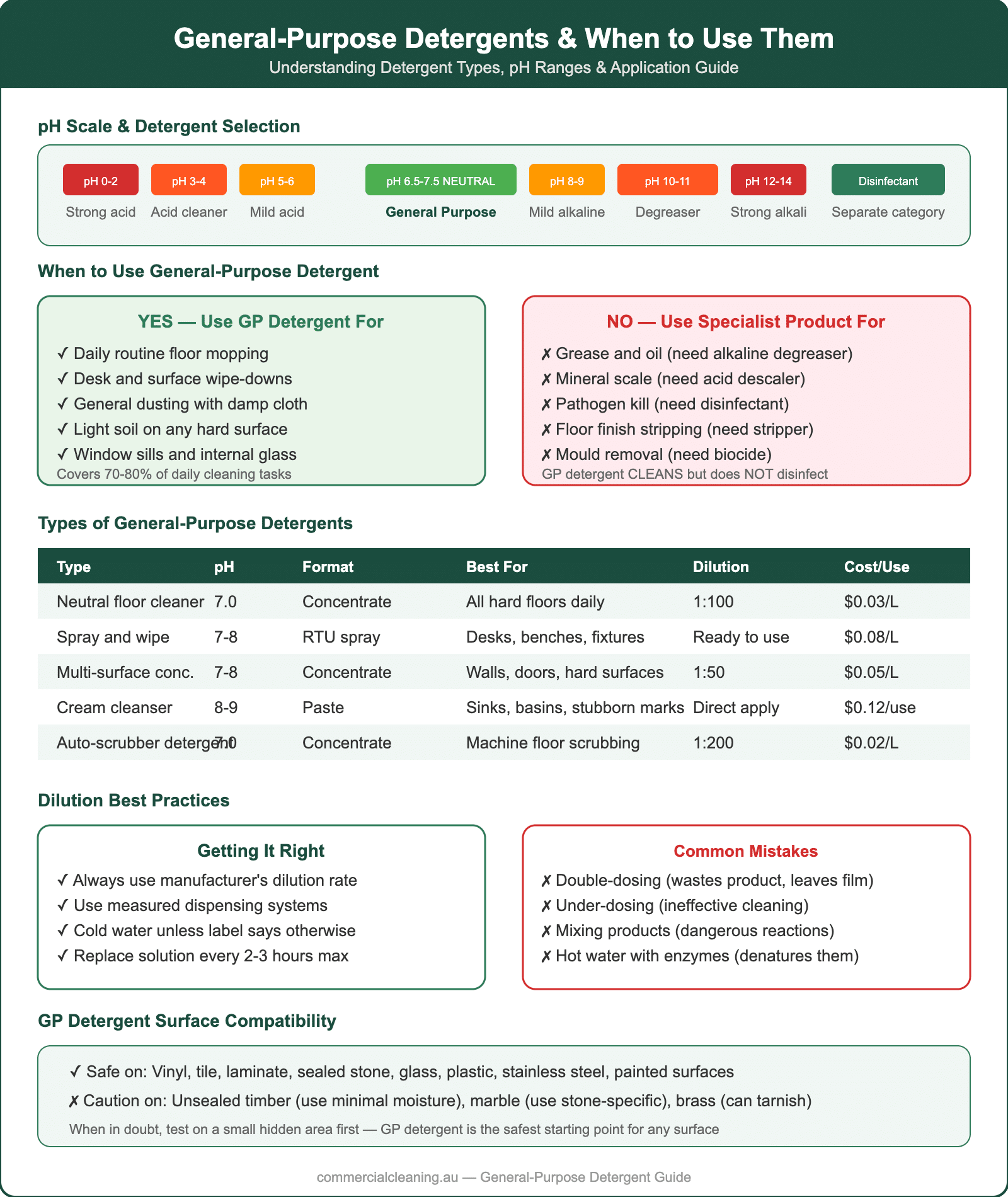
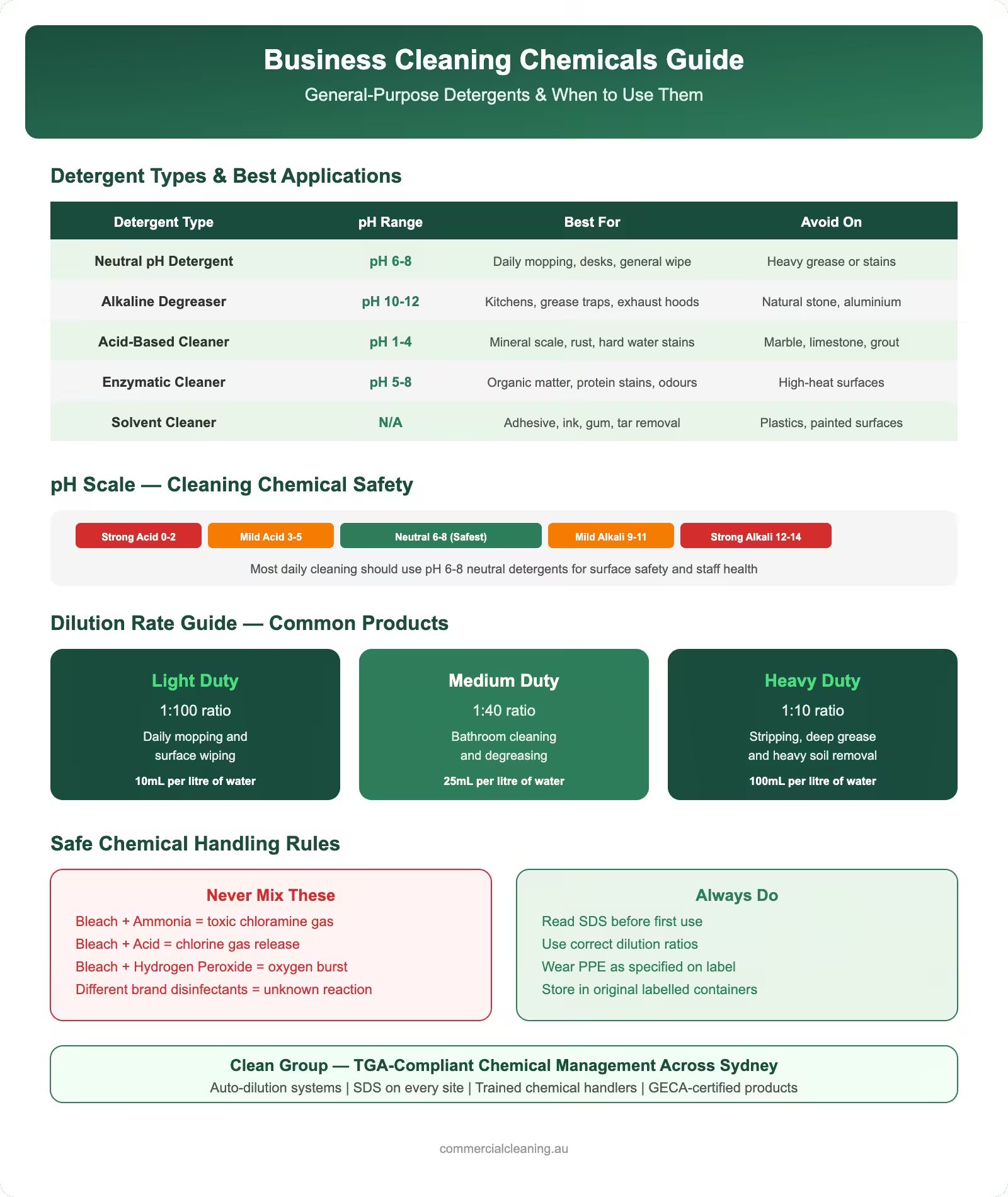
We use pH-neutral general-purpose detergents as our default cleaning solution for around 70 percent of routine tasks. Our team applies them to hard floors, benchtops, desks, internal glass and most painted surfaces because they clean effectively without leaving residue or damaging protective coatings. We have tested alkaline, acidic and neutral formulations side by side on identical surfaces, and our results consistently show that neutral detergents deliver the best balance of cleaning power and surface safety for everyday maintenance cleaning. Our crews in the Cronulla and Miranda commercial precincts use a single concentrated neutral detergent diluted through proportioning dispensers, which ensures consistent strength across every spray bottle and mop bucket on site. We have found this approach eliminates the guesswork that leads to over-concentration — a problem we used to see constantly when staff were free-pouring from bulk containers.
Commercial Cleaning Product Comparison
| Product Type | Active Ingredient | Kill Time | Best For | TGA Listed |
|---|---|---|---|---|
| Quaternary Ammonium | Benzalkonium chloride | 10 min | General surfaces | Yes |
| Sodium Hypochlorite | Bleach 0.1% | 1 min | Bathrooms, blood spills | Yes |
| Hydrogen Peroxide | H₂O₂ 3–6% | 5 min | Multi-surface, eco | Yes |
| Isopropyl Alcohol | IPA 70% | 30 sec | Electronics, glass | No |
| Peracetic Acid | PAA 0.2% | 5 min | Food-grade surfaces | Yes |
Disinfectants and Infection Control Chemicals
Commercial Cleaning Product Comparison requires specific protocols that we tailor to each facility based on its layout, traffic, and compliance requirements. We take disinfectant selection very seriously because we service medical centres, childcare facilities and aged-care environments where pathogen control is non-negotiable. Our team uses hospital-grade disinfectants listed on the Australian Register of Therapeutic Goods for all infection-control cleaning, and we never substitute with general-purpose products regardless of what their labels claim. We have invested considerable time understanding contact times, spectrum of kill and residual activity, because a disinfectant that is wiped off before its stated contact time has elapsed provides little meaningful protection. Our standard protocol requires a minimum four-minute wet contact time on high-touch surfaces, and we train every team member to apply disinfectant and move to the next task before returning to wipe — a technique that maximises both efficacy and labour efficiency.
Degreasers for Kitchen and Industrial Applications
Disinfectants and Infection Control Chemicals includes specific protocols that we tailor to each facility based on its layout, traffic, and compliance requirements. We stock both solvent-based and alkaline degreasers because different grease types respond to different chemical actions. Our team uses alkaline degreasers for commercial kitchen hoods, exhaust systems and food preparation surfaces where animal and vegetable fats are the primary soil. We reserve solvent-based products for industrial settings around Caringbah where petroleum-based greases and mechanical lubricants require a different approach. Under AS 2022, which covers the storage and handling of anhydrous ammonia, we follow strict protocols for any ammonia-based degreasing products — ensuring adequate ventilation, appropriate PPE and correct storage separation from incompatible chemicals. We spent approximately $2,610 upgrading our chemical storage systems last year to confirm full compliance with hazardous substance requirements across all our contracts, and we consider that investment necessary for protecting our team and our clients’ premises.
Specialty Surface Cleaners and Stain Removers
Degreasers for Kitchen and Industrial Applications addresses specific protocols that we tailor to each facility based on its layout, traffic, and compliance requirements. We keep a targeted range of specialty products for surfaces that general-purpose detergents cannot handle safely or effectively. Our inventory includes acid-based bathroom cleaners for mineral scale and soap scum, enzyme-based carpet spotters for protein stains, and solvent-based adhesive removers for tape residue and sticker marks. We have learned through expensive mistakes that using the wrong product on a specialty surface can cause permanent damage — our team once applied an alkaline cleaner to a natural marble reception desk in Miranda and etched the surface beyond repair, costing us a $4,200 restoration bill. That experience taught us to always test specialty chemicals on an inconspicuous area before full application, and we now maintain a surface compatibility chart that every cleaner carries on their phone for quick reference.
Safe Chemical Storage and Handling Practices
Specialty Surface Cleaners and Stain Removers targets specific protocols that we tailor to each facility based on its layout, traffic, and compliance requirements. We store all cleaning chemicals in dedicated locked cabinets with appropriate ventilation, spill containment and safety data sheets accessible within arm’s reach. Our team follows a strict protocol for chemical segregation — acids separated from alkalis, oxidisers separated from flammables, and all products stored in their original labelled containers with no decanting into unmarked bottles. We conduct monthly chemical inventory audits across all our sites in Cronulla, Miranda and Caringbah to check for expired products, damaged containers and any storage compliance issues. We have found that disciplined chemical management both protects our staff but also reduces waste from expired stock — our spoilage rate has dropped below 2 percent since we implemented formal inventory rotation procedures five years ago.
We believe that understanding your cleaning chemicals thoroughly is the foundation of safe, effective and cost-efficient commercial cleaning. Our team continues to evaluate new formulations and delivery systems as they enter the Australian market, and we encourage every facility manager to work with their cleaning partner to build a chemical program that matches their specific environment. We also recommend reviewing your cleaning suppliers regularly to verify you are getting the best combination of product quality, technical support and value for your specific needs.
Frequently Asked Questions
What cleaning chemicals does a commercial office need?
We find that most offices can operate effectively with just three products: a pH-neutral general-purpose detergent for daily surfaces, a hospital-grade disinfectant for bathrooms and high-touch points, and a glass cleaner. Our experience shows this simplified approach covers around 90 percent of routine office cleaning tasks.
How should cleaning chemicals be stored in a commercial building?
We store all chemicals in dedicated locked cabinets with ventilation, spill containment and accessible safety data sheets. We separate acids from alkalis and oxidisers from flammables, and we never allow decanting into unmarked containers on any of our sites.
What is the difference between a cleaner and a disinfectant?
We explain it to our clients this way: a cleaner removes visible soil and grime, while a disinfectant kills microorganisms. Our team always cleans a surface before disinfecting because organic matter can inactivate disinfectant chemicals, making the kill step ineffective.
How much do commercial cleaning chemicals cost per month?
We spent approximately $2,610 upgrading our chemical storage systems and our monthly chemical spend varies between $800 and $2,000 depending on the number and type of contracts. We reduced our annual purchasing cost by 28 percent after rationalising our chemical range in 2019.
Are green or eco-friendly cleaning chemicals effective for commercial use?
We have tested multiple eco-certified product ranges and found that current formulations perform comparably to traditional chemicals for most general cleaning tasks. We still use conventional hospital-grade disinfectants where infection control standards demand them, because eco alternatives have not yet matched the pathogen kill spectrum required in healthcare settings.
What safety standards apply to cleaning chemical handling in Australia?
We follow workplace health and safety regulations including the correct use of safety data sheets, appropriate PPE for each chemical category, and storage requirements under relevant standards including AS 2022 for ammonia-based products. Our team receives chemical safety training annually with refresher sessions every quarter.
How do you prevent cleaning chemicals from damaging surfaces?
We always test specialty chemicals on an inconspicuous area before full application, and our cleaners carry a surface compatibility chart for quick reference. Our team learned this lesson after an alkaline cleaner etched a natural marble surface beyond repair on one of our early contracts.
How often should a business review its cleaning chemical program?
We recommend a formal review every six months, checking for product overlap, expired stock, dilution accuracy and any new formulations that might improve results or reduce cost. Our own monthly audits catch issues early and have kept our chemical spoilage rate below 2 percent.
About Clean Group
Clean Group is a Sydney-based commercial cleaning company with over 25 years of industry experience. Founded by Suji Siv, our team of 50+ trained professionals services offices, warehouses, medical centres, schools, childcare facilities, retail stores, gyms, and strata properties across Sydney, Melbourne, and Brisbane.
We are active members of ISSA and the Building Service Contractors Association of Australia (BSCAA). Our operations align with ISO 9001 (Quality Management), ISO 14001 (Environmental Management), and ISO 45001 (Workplace Health and Safety) standards. We hold membership with the Green Building Council of Australia and use eco-friendly, TGA-registered cleaning products wherever possible.
Every Clean Group cleaner is police-checked, fully insured, and trained in safe work procedures under SafeWork NSW guidelines. We operate 7 days a week, including after-hours and weekend services, to minimise disruption to your business.
About the Author

Suji Siv
/

Hi, I'm Suji Siv, the founder, CEO, and Managing Director of Clean Group, bringing over 25 years of leadership and management experience to the company. As the driving force behind Clean Group’s growth, I oversee strategic planning, resource allocation, and operational excellence across all departments. I am deeply involved in team development and performance optimization through regular reviews and hands-on leadership.
Read More About Suji 0291607469
 Get A Quote