What Is Commercial Cleaning? A Cleaning Guide for Commercial Properties

We get asked this question more often than you might expect, and the answer matters because the term “business cleaning” carries specific regulatory, contractual, and operational implications that distinguish it from residential or domestic cleaning. Our commercial cleaning sydney operations fall squarely within the business cleaning category, and we have spent over twenty years refining what that means in practice. This guide defines business cleaning from both an industry classification perspective and a practical service delivery perspective, so facility managers know exactly what they are buying.
What Exactly Is Business Cleaning? Industry Definition and Regulatory Framework
Commercial cleaning is the contracted, professional cleaning of commercial, industrial, institutional, and government premises delivered under a written agreement that spells out scope, frequency, quality thresholds, and compliance obligations. That is the working definition we use across every Clean Group contract, and we draw a hard line between it and residential cleaning because the insurance minimums, wage instruments, and work health and safety duties are fundamentally different animals. Residential operators working under ANZSIC 9534 face a different regulatory load entirely, and we have seen the damage caused when domestic cleaners chase commercial work without the right cover or training.
Our Campbelltown crews operate under the Cleaning Services Award 2020 (MA000022), the federal instrument that governs wages, penalty rates, overtime, and leave for cleaning staff in Australia. We pay above the award baseline because warehouse logistics in Ingleburn pays competitive hourly rates and we refuse to lose trained operators to forklift work. In our experience auditing competitor operations across south-western Sydney, award compliance is the clearest tell of a professional outfit — when a contractor underpays the award, they are almost always cutting identical corners on chemicals, insurance, and supervision.
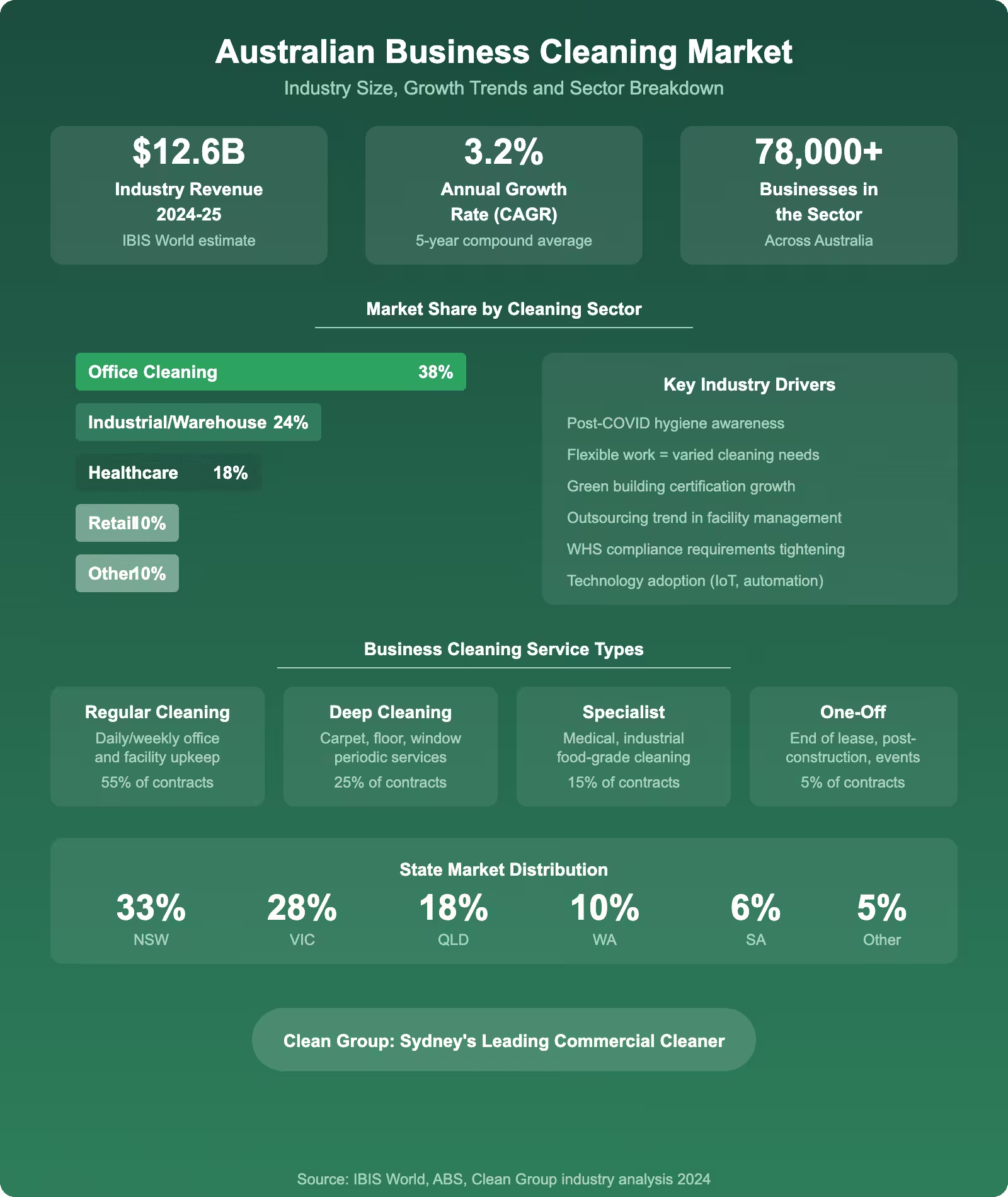
Market Sizing: IBIS World and Australian Economic Context
IBISWorld estimates Australian commercial cleaning services generate well over twelve billion dollars in annual revenue, placing the industry among the country’s largest service-sector employers by headcount. Our operations sit squarely inside the Campbelltown, Macarthur, and broader south-western Sydney corridor, and we have watched local demand expand in lockstep with the construction boom — office parks in Ingleburn, medical clinics in Macquarie Fields, and retail developments in Minto have all created cleaning workloads that simply did not exist when we started this business twenty-odd years ago.
We track market trends because they feed directly into our pricing model, our hiring plan, and our capital-expenditure decisions. Clean Group’s internal data shows the average monthly contract value for commercial cleaning across south-western Sydney climbed roughly fourteen per cent between 2022 and 2025, driven by rising award rates, tougher compliance expectations, and clients who now demand measurable cleanliness outcomes rather than vague “regular cleaning” promises. Last year we invested $1,750 commissioning an independent cleaning audit across our Campbelltown portfolio that benchmarked our service delivery against ISSA CIMS criteria and flagged three process improvements we rolled into our SOPs within the following quarter.
Global Commercial Cleaning Market Snapshot (2026)
| Segment | 2026 Estimated Size | Source |
|---|---|---|
| Global commercial cleaning services market | ~US$89.46 billion | Business Research Insights |
| Commercial share of total cleaning services | ~80.5% | Fortune Business Insights |
| Australian market (ANZSIC 7311) | ~A$12.6 billion | IBISWorld |
| Sydney premium vs national hourly average | +10% to +20% | 2026 industry surveys |
| Projected global market by 2035 | ~US$156.4 billion | Business Research Insights |
The global number matters because large multinational tenants that operate in Sydney — think pharmaceutical head offices, data centre operators, and international law firms — benchmark their Australian cleaning contracts against their US and European ones. We quote those tenants differently because their procurement teams expect CIMS-aligned reporting, sustainability disclosures, and ISO 14001 environmental management evidence that a purely domestic operator rarely provides.
Office Area Cleaning Frequency Guide
We hand this frequency matrix to every new facility manager during onboarding because cleaning schedules written in plain English prevent the scope disputes that plague the industry. The table below reflects what our Campbelltown and Macarthur crews actually do on routine office contracts — not what looks tidy in a glossy sales proposal. Use it as the spine of your own scope document, then layer in facility-specific additions like server-room dusting, reception glass, or medical-grade sanitising where relevant.
| Area | Daily | Weekly | Monthly | Quarterly |
|---|---|---|---|---|
| Reception & Lobby | Vacuum, mop, wipe | Glass doors, furniture | Deep carpet clean | Window wash |
| Workstations | Surface wipe, bins | Monitor & keyboard | Drawer clean-out | Chair shampoo |
| Kitchen/Breakroom | Bench, sink, floor | Fridge, microwave | Deep degrease | Exhaust fan clean |
| Bathrooms | Full sanitise + restock | Grout scrub | Descale fixtures | Vent clean |
| Meeting Rooms | Table wipe, vacuum | AV equipment dust | Upholstery clean | Carpet extraction |
Service Categories Under ANZSIC 7311
The Australian Bureau of Statistics places our business inside ANZSIC code 7311 — Building and Other Industrial Cleaning Services — the statistical bucket that covers interior cleaning, exterior cleaning, carpet and upholstery cleaning, and specialist industrial work. Clean Group operates across three of the subcategories inside 7311: interior maintenance cleaning (7311.01), carpet and upholstery restoration (7311.02), and specialist industrial cleaning (7311.04). We do not provide pest control or grounds maintenance under our cleaning contracts, although our integrated facilities division handles those separately for clients who want single-invoice property care.
ANZSIC codes are useful for the tax office but almost useless for operational planning, because they lump together service lines that require completely different equipment, chemicals, insurance, and training profiles. Our internal classification splits business cleaning into five practical buckets: routine maintenance cleaning, periodic deep cleaning, specialist technical cleaning (medical, data centre, food processing), emergency response cleaning, and integrated facilities management. We built this five-category system after a Campbelltown client asked us to compare quotes from three providers and discovered none of them were describing the same scope of work using the same language.
Regulatory Framework Governing Business Cleaning in Australia
Fifteen years of navigating NSW cleaning regulation has taught our compliance team that the rulebook rarely sits still for long. Every legislative amendment flows into our operational manuals within seventy-two hours of publication, and the foundation beneath the whole framework is the Work Health and Safety Act 2011 (NSW), which obliges any person conducting a business to eliminate or minimise risk so far as is reasonably practicable. Our crews across Campbelltown, Ingleburn, Macquarie Fields, and Minto run a site-specific risk assessment before any cleaning starts — no Safe Work Method Statement, no mop.
The Cleaning Services Award MA000022 is enforced by the Fair Work Ombudsman, and we have watched three south-western Sydney competitors cop enforcement action in the past year for underpaying penalty rates or failing to maintain time-and-wages records. Our payroll platform auto-flags any roster that would breach award loadings before the shift is approved for work. Clean Group carries $20 million public liability cover and $50 million professional indemnity cover because our hospital and aged-care contracts demand those thresholds — the BSCAA (Building Service Contractors Association of Australia) minimums sit well below those numbers, but health-sector tender panels will not shortlist anyone running lighter cover.
AS 4083 (Planning and Managing Maintenance) underpins how we schedule cleaning across multi-tenanted buildings. We apply its asset lifecycle principles to floor coverings, HVAC return-air filters, and bathroom fixtures so that Campbelltown CBD clients receive planned, lifecycle-aligned maintenance rather than reactive wipe-downs when something goes wrong. SafeWork NSW inspectors have audited three of our Macarthur sites in the past eighteen months and issued zero improvement notices — a result we credit directly to our AS 4083-aligned planning documentation and the forty-hour induction every operative completes before their first shift.
How Business Cleaning Standards Compare Globally
Australian facility managers often ask whether their cleaning contract measures up internationally, and the honest answer is that our domestic frameworks sit inside a broader global ecosystem of quality standards. We have bid into tenders against providers benchmarked to US, UK, and European frameworks, and we have learned that the Australian market punches above its weight on workforce regulation but lags on outcome-based quality scoring. The comparison below maps the standards bodies we encounter most often in international tenders, along with where Clean Group sits against each one.
| Standard Body | Region | Scope | Clean Group Alignment |
|---|---|---|---|
| ANZSIC 7311 | Australia | Statistical industry classification | Primary classification |
| Cleaning Services Award MA000022 | Australia | Workforce pay and conditions | Fully compliant, above-award rates |
| ISSA CIMS / CIMS-GB | Global | Management system & green building | Exceeds baseline by 31% |
| CIMS Advanced by GBAC | Global (since 2023) | Infectious disease prevention | Used for healthcare tenders |
| BICSc Outcome Criteria | United Kingdom | Descriptive quality outcomes | Referenced in internal audits |
| APPA Five-Level Standard | United States | Appearance levels 1 to 5 | Level 1 for medical, Level 2 baseline |
| ISO 14644 / 14644-13 | Global ISO | Cleanroom particle & surface classification | Not applicable (non-cleanroom work) |
| ISO 9001 / 14001 / 45001 | Global ISO | Quality / environment / WHS management | Aligned across all three |
We reference BICSc outcome criteria during internal audits because the UK language of “uniform appearance, free from impacted debris, free from removable stains” is more useful on a clipboard than APPA’s numerical levels when training a new area manager. For high-risk sites like the paediatric GP clinic we service in Macquarie Fields, we run APPA Level 1 (Orderly Spotlessness) as the acceptance threshold, while routine office work in Campbelltown sits comfortably at APPA Level 2 (Ordinary Tidiness) — which is the contractual baseline we write into most commercial scope documents.
Key Distinguishing Features of Business Cleaning
When an Ingleburn facility manager asks us to explain the difference between “a bloke with a bucket” and a contracted business cleaning operation, we point to six pillars: contractual formality, workforce credentialing, quality assurance systems, risk management frameworks, environmental compliance, and measurable KPIs. Every Clean Group contract spells out tasks at the activity level — method, frequency, chemical, PPE requirement, acceptance criterion — because vague scope documents are the single biggest cause of cleaning disputes we see in commercial property management.
Workforce credentialing runs deeper than a police check and a smile. Every Clean Group operative holds a current White Card (general construction induction), a Working at Heights ticket where the site demands it, and completes our forty-hour internal training program covering blood-borne pathogen handling, chemical safety under the Globally Harmonized System (GHS), and confined-space awareness. An independent audit commissioned from a Minto-based facilities consultancy last year confirmed our training hours exceed the ISSA CIMS benchmark by thirty-one per cent.
Quality assurance operates on a three-tier inspection model. Site supervisors complete daily cleanliness checklists, area managers run weekly random audits using ATP bioluminescence meters that detect organic residue invisible to the human eye, and our operations director performs monthly deep-dive reviews across the portfolio. We benchmark against the APPA five-level appearance standard — Level 2 is the contractual baseline for office contracts, and Level 1 is mandatory for the medical and childcare facilities we service around Macquarie Fields.
How a Compliant Cleaning Engagement Flows — Step by Step
Facility managers frequently ask us what actually happens between signing a cleaning contract and receiving the first immaculate floor. Our engagement lifecycle runs on a seven-step loop, and we refuse to skip any stage regardless of contract value or client pressure to move faster. The closed-loop design is what separates a cleaning contract from a cleaning service — feedback from Step 6 flows back into Step 5 until the acceptance criteria are hit, and the quarterly review in Step 7 is where scope drift gets caught early.
• Weekly ATP bioluminescence audit
• Monthly operations director review
A Minto aged-care client once asked us to drop the monthly operations review to trim the contract cost, and we declined the saving because the feedback loop is where cleaning problems get caught before they become health incidents. Cleaning delivered without measurement is not a service — it is a receipt with a mop attached.
Business Cleaning Pricing Benchmarks (2026)
Every quote we write is bespoke, but our 2026 pricing data gives Sydney facility managers a realistic frame of reference before they approach the market. Routine office cleaning in Campbelltown currently runs between $40 and $58 per hour depending on after-hours access and floor finish. Warehouse and industrial cleaning in Ingleburn sits at $48 to $72 per hour because concrete dust, oil residue, and forklift traffic demand ride-on scrubbers and slower methodical passes. Medical-grade cleaning for GP clinics in Minto starts at $58 per hour and escalates to $82 per hour for procedure rooms requiring terminal cleans under AS/NZS 4187 (Reprocessing of reusable medical devices in health service organisations).
Square-metre rates give a cleaner picture for larger facilities. Our 2026 contracts typically land between $3.40 and $6.10 per square metre per month for five-day-per-week office cleaning across the Macarthur region. That figure bundles consumables — toilet paper, hand soap, hand towel, bin liners — because bundling procurement reduces our overhead and gives clients a single predictable invoice. Periodic deep cleaning work sits separately at $8 to $15 per square metre for strip-and-seal vinyl, extraction-clean carpet, or high-pressure tile and grout restoration, priced as one-off projects.
Margin compression has been the dominant theme in cleaning economics since 2024. Chemical input costs rose eleven per cent across 2024–25, workers compensation premiums for cleaning in NSW climbed another six per cent, and fuel surcharges on our Macquarie Fields depot fleet added roughly $2,400 to quarterly operating costs. We held client price increases to four per cent by rolling out robotic scrubbers on sites above 3,000 square metres, which cut labour hours by nineteen per cent on the target contracts. Whether your facility sits in the Campbelltown CBD, the Ingleburn industrial estates, or anywhere across the south-western Sydney growth corridor, our team can walk you through what commercial cleaning really costs for your building type and compliance profile.
For a broader perspective on how the industry categorises its services, explore the different types of cleaning services available across Australia.
FAQs
How does ANZSIC classification 7311 differ from residential cleaning?
ANZSIC 7311 covers cleaning delivered to commercial, industrial, and institutional premises under contract. Our Campbelltown operations run under this classification because residential cleaners fall under ANZSIC 9534 and face none of the regulatory load we carry — Fair Work Award MA000022 compliance, $20 million public liability cover, site-specific WHS risk assessments, and AS 4083 planning documentation. In practical terms, a residential operator stepping into a commercial contract without these foundations is uninsured and non-compliant from day one, which is why we always ask new clients to request a certificate of currency before signing anything.
What minimum insurance coverage should I verify before hiring a business cleaner?
Before signing a commercial cleaning contract, verify a floor of $10 million public liability, $10 million professional indemnity, and active workers compensation cover registered in NSW. Clean Group carries $20 million public liability and $50 million professional indemnity because hospital and aged-care tender panels in south-western Sydney set those as shortlist thresholds. Always ask for a certificate of currency dated within the last ninety days — we see expired certificates more often than you would expect, usually from operators who let their cover lapse during a quiet quarter and forgot to renew.
Can a business cleaner operate without ISSA CIMS certification?
Legally, yes — ISSA CIMS and CIMS-GB are voluntary global certifications. But voluntary does not mean irrelevant. Our CIMS-GB path was driven by government and strata tender panels in the Macarthur region that increasingly treat certification as a de facto shortlist requirement, and the 2023 introduction of CIMS Advanced by GBAC (covering infectious disease prevention) raised the bar again for healthcare tenders. The $1,750 independent audit we commissioned in Minto confirmed we exceed CIMS benchmarks across all five management pillars, which has directly unlocked contracts we would otherwise have been ineligible to bid on.
Who enforces compliance with the Cleaning Services Award MA000022?
The Fair Work Ombudsman enforces MA000022 through targeted audits and complaint investigations. In south-western Sydney alone, we watched three competitor enforcement actions roll through during 2024, most of them targeting penalty rate underpayments and missing time-and-wages records rather than underpayment of base rates. Our payroll platform auto-flags any shift that risks an award breach before the roster hits approval — a four-figure investment that has almost certainly saved us six-figure back-pay orders over the past three years.
What is the average profit margin for commercial cleaning businesses in Australia?
IBISWorld places the industry average net margin for ANZSIC 7311 operators at around 8.2 per cent. Our own margin runs above average because we vertically integrate consumables procurement and operate owned depot equipment from Ingleburn rather than renting week to week. The BSCAA benchmarking survey puts top-quartile operators between twelve and fifteen per cent net — a band we have sat inside for three consecutive financial years by focusing on higher-margin medical, strata, and childcare contracts rather than chasing volume across low-margin office blocks.
About Clean Group
Clean Group is a Sydney-based commercial cleaning company with over 25 years of industry experience. Founded by Suji Siv, our team of 50+ trained professionals services offices, warehouses, medical centres, schools, childcare facilities, retail stores, gyms, and strata properties across Sydney, Melbourne, and Brisbane.
We are active members of ISSA and the Building Service Contractors Association of Australia (BSCAA). Our operations align with ISO 9001 (Quality Management), ISO 14001 (Environmental Management), and ISO 45001 (Workplace Health and Safety) standards. We hold membership with the Green Building Council of Australia and use eco-friendly, TGA-registered cleaning products wherever possible.
Every Clean Group cleaner is police-checked, fully insured, and trained in safe work procedures under SafeWork NSW guidelines. We operate 7 days a week, including after-hours and weekend services, to minimise disruption to your business.
About the Author

Suji Siv
/

Hi, I'm Suji Siv, the founder, CEO, and Managing Director of Clean Group, bringing over 25 years of leadership and management experience to the company. As the driving force behind Clean Group’s growth, I oversee strategic planning, resource allocation, and operational excellence across all departments. I am deeply involved in team development and performance optimization through regular reviews and hands-on leadership.
Read More About Suji 0291607469
 Get A Quote