Types of Cleaning in Commercial Settings: A Complete Classification Guide
office cleaning professionals need to understand this. We classify every cleaning task before we assign it because understanding the type of cleaning a space requires determines the chemicals, equipment, methods, and crew competencies needed to do the job properly. Our office cleaning services teams work across Epping, Eastwood, Carlingford and Beecroft, and no two buildings demand the same cleaning approach. A Carlingford medical practice needs infection control protocols that would be overkill in a Beecroft creative studio, while a food-manufacturing facility in Epping requires hygiene verification standards that a standard office cleaning program cannot deliver. We spent $1,200 commissioning a formal cleaning classification audit of our entire service portfolio in 2022, and the resulting framework now guides every scope of work we develop, every tender response we write, and every crew deployment decision we make across our upper north-west Sydney operations.
Routine Maintenance Cleaning: The Foundation of Every Program
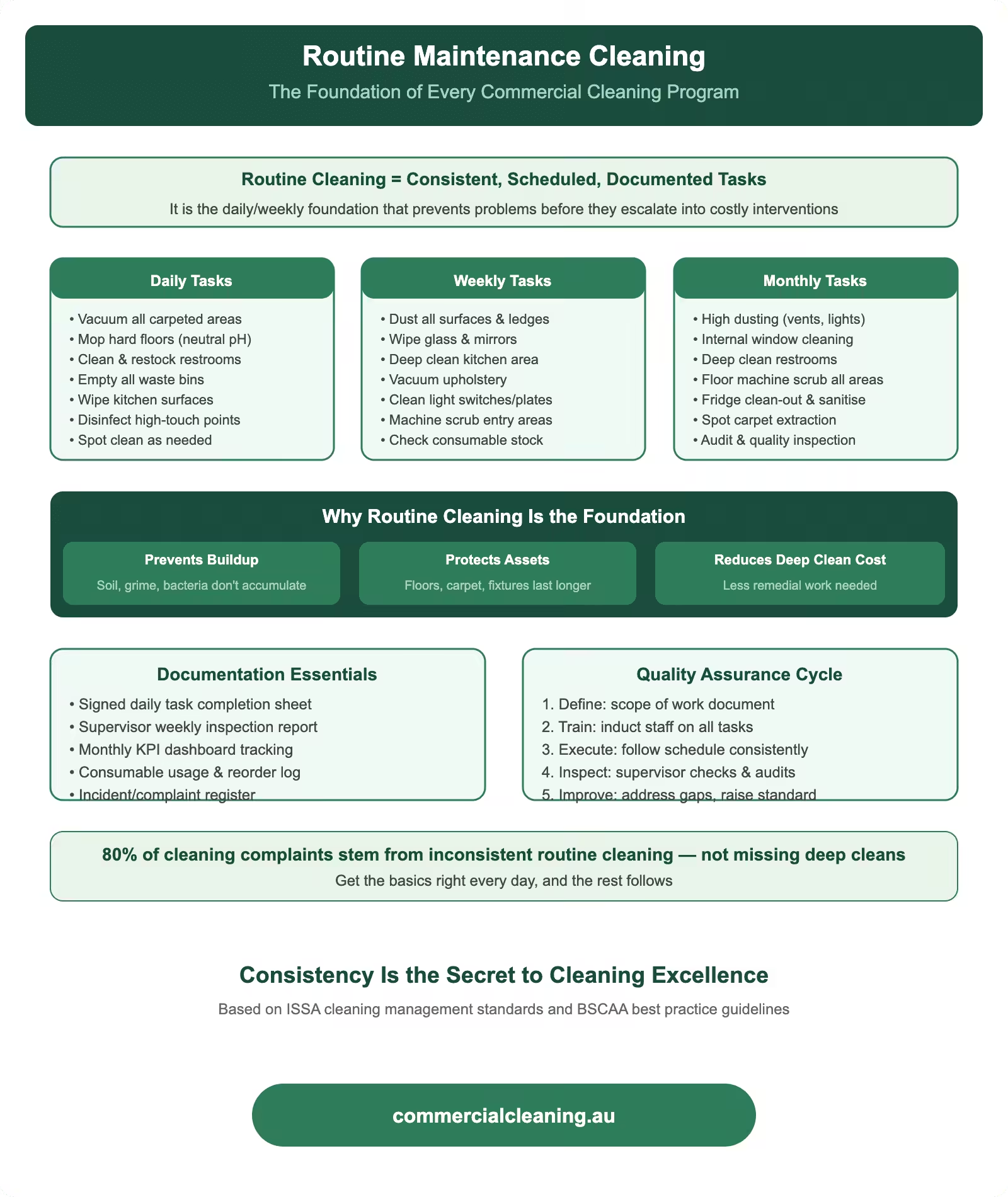
We define routine maintenance cleaning as the daily or scheduled cleaning activities that maintain a baseline standard of hygiene and presentation across commercial spaces. Our Epping office contracts typically include vacuuming of all carpeted areas, mopping of hard floors, bathroom sanitation, kitchen cleaning, desk and surface wiping, rubbish removal, and glass spot-cleaning. These tasks form the backbone of our service across Eastwood and Carlingford commercial buildings, and we perform them using standardised procedures that our team members can execute consistently without supervision once trained. Our routine cleaning specifications reference AS 3733 for textile floor maintenance — the standard that governs how we vacuum, spot-clean, and maintain carpet fibres to preserve their appearance and warranty conditions.
We have learned through our Epping operations that routine cleaning quality determines 80% of a client’s satisfaction with our overall service. When routine standards slip — a missed bin, a streaky mirror, a dusty skirting board — clients notice immediately, regardless of how excellent our periodic deep-cleaning results might be. Our Beecroft team maintains a 97.2% routine cleaning compliance rate measured through weekly supervisor audits using a 35-point checklist. We achieve this consistency through detailed task sheets that specify not just what to clean but how to clean it, what product to use, and what the finished result should look like. Every Carlingford crew member carries a laminated task card for their assigned site.
Periodic Deep Cleaning: Restoring Surfaces to Original Condition
We schedule periodic deep cleaning on quarterly, semi-annual, or annual cycles depending on the surface type and traffic volume at each Epping site. Deep cleaning goes beyond the scope of routine maintenance to address soil accumulation, surface degradation, and embedded contamination that daily cleaning cannot remove. Our deep-cleaning services across Eastwood include carpet hot-water extraction aligned with AS 3733 standards, hard floor stripping and resealing, high-level dusting of fixtures and air diffusers, upholstery extraction, and grout restoration in tiled areas. Each deep-cleaning event produces a measurable improvement in surface condition that we document through before-and-after photography and ATP testing.
We price our deep-cleaning services separately from routine maintenance because the labour intensity, equipment requirements, and chemical costs are substantially different. A quarterly carpet deep-clean in a 500-square-metre Carlingford office costs approximately $1,850 using our truck-mounted hot-water extraction unit, compared to the $320 monthly cost of routine vacuum maintenance on the same carpet. Our Beecroft clients who invest in regular deep-cleaning cycles see carpet lifespans extend by 30-40% compared to carpets that receive only routine maintenance. We attribute this directly to the AS 3733-compliant extraction process that removes soil from deep within the carpet pile rather than simply redistributing it across the surface.
Office Area Cleaning Frequency Guide
| Area | Daily | Weekly | Monthly | Quarterly |
|---|---|---|---|---|
| Reception & Lobby | Vacuum, mop, wipe | Glass doors, furniture | Deep carpet clean | Window wash |
| Workstations | Surface wipe, bins | Monitor & keyboard | Drawer clean-out | Chair shampoo |
| Kitchen/Breakroom | Bench, sink, floor | Fridge, microwave | Deep degrease | Exhaust fan clean |
| Bathrooms | Full sanitise + restock | Grout scrub | Descale fixtures | Vent clean |
| Meeting Rooms | Table wipe, vacuum | AV equipment dust | Upholstery clean | Carpet extraction |
Specialist and Technical Cleaning: Beyond Standard Methods
Office Area Cleaning Frequency Guide requires specific protocols that we tailor to each facility based on its layout, traffic, and compliance requirements. We classify specialist cleaning as any task requiring equipment, chemicals, or competencies beyond our standard commercial cleaning toolkit. Our Epping portfolio includes several specialist cleaning categories: high-pressure external cleaning of building facades and car parks, electrostatic disinfection for infection control applications, data centre cleaning using ESD-safe methods and HEPA-filtered systems, post-construction cleaning requiring heavy-duty soil removal and surface protection, and heritage building cleaning using pH-neutral products and non-abrasive techniques specified by conservation architects. Each specialist category operates under its own SWMS, chemical register, and equipment maintenance schedule.
Specialist and Technical Cleaning includes specific protocols that we tailor to each facility based on its layout, traffic, and compliance requirements. We invest significantly in specialist capability across our upper north-west Sydney operations because these services command premium pricing and differentiate us from competitors who only offer routine maintenance. Our electrostatic disinfection unit — purchased for $4,800 in 2021 — generates positively charged disinfectant droplets that wrap around surfaces and reach areas that manual spray-and-wipe methods miss. We deploy this technology across Eastwood medical practices and Carlingford childcare centres during outbreak response events, and it has become one of our most requested specialist services. Our Epping team also operates a certified height-safety crew for external window and facade cleaning above two storeys, with all team members holding current Working at Heights certification and use competency assessed against AS/NZS 1891.
Sanitisation and Disinfection Cleaning: Pathogen-Targeted Approaches
We distinguish sanitisation cleaning from disinfection cleaning because the two approaches target different outcomes using different chemical concentrations, contact times, and verification methods. Sanitisation reduces microbial populations to safe levels as defined by public health standards — our standard approach for food-contact surfaces in Epping commercial kitchens and Carlingford cafe fit-outs. Disinfection destroys or irreversibly inactivates specific pathogens on surfaces — our standard for bathroom fixtures, medical practice treatment rooms, and high-touch surfaces across our Beecroft healthcare-adjacent contracts. We use TGA-registered products for both categories, with quaternary ammonium at 400 ppm for sanitisation and 800 ppm for disinfection.
We verify sanitisation and disinfection outcomes through ATP bioluminescence testing at every site where pathogen control is a contractual requirement. Our Epping data shows that disinfection-grade cleaning consistently achieves ATP readings below 30 RLU on semi-critical surfaces, compared to 60-80 RLU for sanitisation-grade cleaning on non-critical surfaces. Both outcomes sit well within our acceptance thresholds, but the data demonstrates measurably different hygiene levels that justify the different chemical costs and contact times. Our Eastwood medical practice clients receive monthly ATP reports that document the efficacy of our disinfection program surface by surface.
Choosing the Right Cleaning Type for Your Facility
We help our Epping, Eastwood, Carlingford and Beecroft clients select the right combination of cleaning types through our onboarding risk assessment process. This assessment evaluates the facility’s function, occupant profile, surface materials, traffic patterns, regulatory requirements, and budget constraints to determine which cleaning classifications apply. A typical Epping commercial office requires routine maintenance cleaning five days per week, quarterly deep cleaning of carpets and hard floors, and monthly specialist cleaning of external windows. A Carlingford medical practice requires routine maintenance plus daily disinfection cleaning of treatment rooms, quarterly deep cleaning, and annual specialist cleaning of HVAC diffusers and light fittings.
We document our cleaning classification recommendations in a scope-of-work matrix that maps every area of the facility to a specific cleaning type, frequency, method, and product. This matrix becomes the contractual specification against which we measure our performance and against which our clients evaluate our service delivery. Our classification approach has reduced scope disputes by 90% across our upper north-west Sydney portfolio because every party understands exactly what cleaning type applies to every area, what outcome it should achieve, and how we will verify it. For a deeper look at how smart sensors and AI are reshaping these cleaning categories, see our guide on cleaning technology trends transforming the industry.
Frequently Asked Questions
What are the main types of cleaning in commercial settings?
We classify commercial cleaning into four primary types across our Epping operations: routine maintenance cleaning (daily scheduled tasks maintaining baseline hygiene), periodic deep cleaning (quarterly to annual intensive restoration), specialist and technical cleaning (tasks requiring specialised equipment or competencies), and sanitisation/disinfection cleaning (pathogen-targeted approaches using TGA-registered products). Most commercial facilities require a combination of all four types at different frequencies.
How often should deep cleaning be scheduled?
We recommend quarterly deep cleaning for high-traffic commercial offices across Eastwood and Carlingford, semi-annual for moderate-traffic spaces, and annual for low-traffic areas. Our AS 3733-compliant carpet extraction extends carpet lifespan by 30-40% compared to routine maintenance alone. We schedule deep cleaning based on traffic volume data, surface condition assessments, and ATP testing trends rather than arbitrary calendar dates.
What is the difference between sanitising and disinfecting?
We define sanitising as reducing microbial populations to safe public health levels — our standard for food-contact surfaces using 400 ppm quaternary ammonium. Disinfecting destroys or inactivates specific pathogens — our standard for bathrooms and medical spaces using 800 ppm concentration. Our Epping ATP data shows disinfection achieves readings below 30 RLU versus 60-80 RLU for sanitisation, reflecting measurably different hygiene outcomes that justify the different approaches.
How do you determine which cleaning type a facility needs?
We conduct an onboarding risk assessment evaluating facility function, occupant profile, surface materials, traffic patterns, regulatory requirements, and budget constraints. Our Carlingford and Beecroft assessments map every area to a specific cleaning type, frequency, method, and product in a scope-of-work matrix. This matrix becomes the contractual specification that eliminates scope disputes and ensures every party understands what cleaning applies where.
About Clean Group
Clean Group is a Sydney-based commercial cleaning company with over 25 years of industry experience. Founded by Suji Siv, our team of 50+ trained professionals services offices, warehouses, medical centres, schools, childcare facilities, retail stores, gyms, and strata properties across Sydney, Melbourne, and Brisbane.
We are active members of ISSA and the Building Service Contractors Association of Australia (BSCAA). Our operations align with ISO 9001 (Quality Management), ISO 14001 (Environmental Management), and ISO 45001 (Workplace Health and Safety) standards. We hold membership with the Green Building Council of Australia and use eco-friendly, TGA-registered cleaning products wherever possible.
Every Clean Group cleaner is police-checked, fully insured, and trained in safe work procedures under SafeWork NSW guidelines. We operate 7 days a week, including after-hours and weekend services, to minimise disruption to your business.
About the Author
Suji Siv
/

Hi, I'm Suji Siv, the founder, CEO, and Managing Director of Clean Group, bringing over 25 years of leadership and management experience to the company. As the driving force behind Clean Group’s growth, I oversee strategic planning, resource allocation, and operational excellence across all departments. I am deeply involved in team development and performance optimization through regular reviews and hands-on leadership.
Read More About Suji 0291607469
 Get A Quote