We have pressure-cleaned commercial sites across western Sydney since the early days of our business, and the scope has grown from simple footpath washes to full-site programs covering facades, hardscapes, loading docks, bin areas, and everything in between. Our team provides detailed commercial pressure cleaning services in Sydney designed for property managers, facility operators, and business owners who need their entire site cleaned to a consistent standard under a single contract.
Planning a Pressure Cleaning Program for Commercial Sites
Planning a Pressure Cleaning Program for Commercial Sites covers specific protocols that we tailor to each facility based on its layout, traffic, and compliance requirements. A commercial site is not a single surface—it is a collection of different substrates, contamination types, and access challenges that each need a custom approach. We start every new site engagement with a walk-through where we map every zone, identify the substrate materials, catalogue the contamination present, and note access constraints like overhead power lines, underground services, and pedestrian traffic patterns. In Penrith commercial precincts, where sites often include a mix of concrete driveways, paved courtyards, rendered walls, metal roller doors, and timber fencing, this mapping exercise is necessary because using the wrong pressure or chemical on any one of those surfaces will cause damage.
Our site plan divides the property into cleaning zones and assigns each zone a method, pressure setting, chemical treatment, and frequency based on its specific requirements. High-traffic zones like building entries and loading docks get cleaned more frequently than low-traffic areas like rear boundary fences. AS 1379, the Australian Standard for the specification of natural building stones, guides our approach to cleaning any natural stone elements on site—sandstone retaining walls, bluestone pavers, and granite thresholds all have different porosity and hardness characteristics that dictate the maximum safe pressure and the chemical families we can use without causing discolouration or surface erosion.
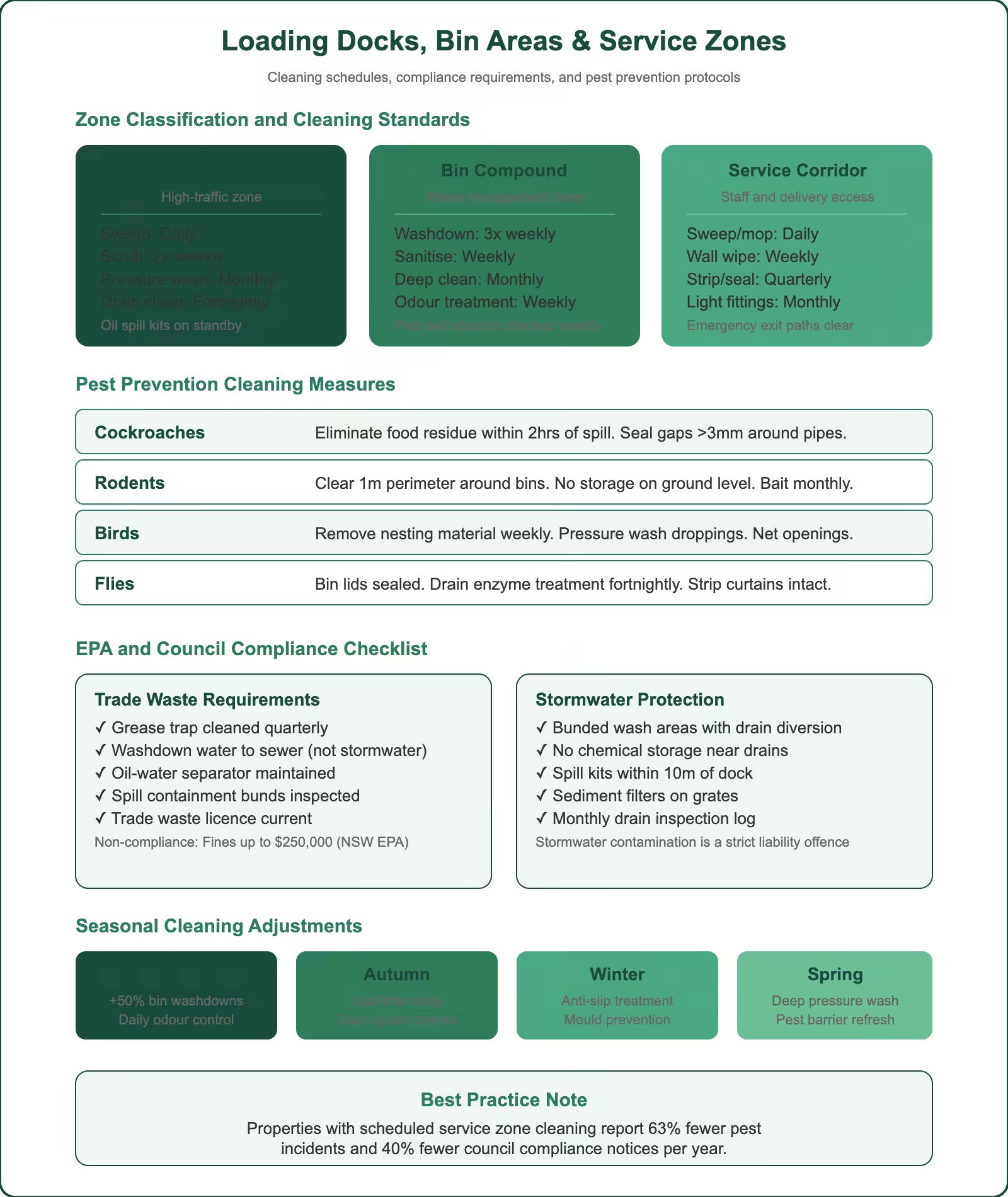
Loading dock bin area and service zone cleaning guide showing zone classifications, pest prevention measures, EPA compliance checklist, and seasonal adjustments
Loading Docks, Bin Areas, and Service Zones
Loading Docks, Bin Areas, and Service Zones involves specific protocols that we tailor to each facility based on its layout, traffic, and compliance requirements. The back-of-house areas on a commercial site are usually the dirtiest and the most neglected. Loading docks accumulate diesel drips, hydraulic fluid, pallet splinters, and food waste residue from deliveries. Bin enclosures develop biofilm, odour, and pest attraction from decomposing organic matter. Service yards collect leaf litter, cigarette butts, and airborne debris that settles in sheltered corners. We treat these zones as priority areas because they represent the highest hygiene and pest risk on the property, and because council health inspectors focus on them during routine inspections of food-related businesses.
Our cleaning approach for service zones combines hot-water pressure washing with degreasing chemicals for oil-contaminated surfaces and sanitising agents for organic waste residues. In Emu Plains industrial sites, where loading docks serve food distribution warehouses, we run the hot-water unit at 80 °C to achieve thermal sanitisation on concrete floors that standard cold-water cleaning cannot deliver. Bin enclosures get a full wash, sanitise, and deodorise treatment that eliminates odour sources rather than masking them. We have reduced pest callout frequencies by over forty per cent for three Penrith retail clients simply by implementing a monthly bin area pressure-cleaning program that removed the food residue cockroaches and rodents were feeding on.
Pressure Cleaning PSI Guide by Surface
Surface
Recommended PSI
Nozzle
Chemical Needed
Risk if Too High
Concrete Driveway
3,000–4,000
15° or turbo
Degreaser for oil stains
Etching (minimal)
Timber Deck
1,000–1,500
25° or 40°
Timber brightener
Splintering, grain damage
Brick Wall
1,500–2,500
25°
Mould remover
Mortar erosion
Painted Surface
800–1,200
40°
Mild detergent
Paint stripping
Roof Tiles
2,000–3,000
15°
Anti-moss treatment
Tile cracking
Footpaths, Entries, and Public-Facing Hardscapes
Pressure Cleaning PSI Guide by Surface requires specific protocols that we tailor to each facility based on its layout, traffic, and compliance requirements. The areas customers and visitors see first deserve the most attention. We clean building entries, pedestrian footpaths, outdoor dining areas, and forecourts using surface cleaner attachments that deliver a uniform finish without the striping pattern a handheld lance creates. For paved areas in Glenmore Park commercial centres, where interlocking concrete pavers accumulate moss and weed growth in the joints, we combine pressure washing with a post-clean application of a residual herbicide that inhibits regrowth for up to six months.
Footpaths, Entries, and Public-Facing Hardscapes includes specific protocols that we tailor to each facility based on its layout, traffic, and compliance requirements. Outdoor dining areas present a particular challenge because food and beverage spills create sticky residues that attract ants and wasps and become slip hazards when wet. We clean these areas with a food-safe degreaser followed by a hot-water pressure rinse that removes both the visible contamination and the invisible residue film. Our crews in Penrith have cleaned outdoor dining precincts at four am to have the area dry and ready for morning trade—a scheduling commitment that reflects our understanding of how hospitality businesses operate and why a clean outdoor area at opening time directly affects customer perception and revenue.
Safety and Site Management During Cleaning
Pressure cleaning on an active commercial site introduces water, chemicals, noise, and high-pressure equipment into an environment where workers, customers, and vehicles are moving. We manage these risks with a site-specific safety plan that covers exclusion zones around the pressure unit, wet-floor signage and barriers on cleaned surfaces, hearing protection for our operators in enclosed areas, and traffic management for any work that encroaches on vehicle access routes. In Emu Plains, where several of our clients operate warehouse sites with forklift traffic, we coordinate our cleaning schedule with the warehouse supervisor to confirm no forklift movements occur in the zone we are washing—a precaution that prevents the most serious injury risk on any industrial pressure cleaning job.
Our operators wear full PPE including steel-cap boots, safety glasses, hearing protection, and high-visibility clothing. Chemical handling follows GHS protocols with safety data sheets accessible on the operator’s tablet device at all times. We carry spill containment kits on every vehicle and our team leaders are trained in first-aid response specific to pressure-related injuries including high-pressure injection wounds, which are a medical emergency that requires immediate hospital treatment even when the external wound appears minor. We have maintained a zero lost-time-injury record across our commercial pressure cleaning division for over four consecutive years.
What Commercial Site Pressure Cleaning Costs in Sydney
We price full-site pressure cleaning programs on a scope-and-frequency basis with a fixed monthly or quarterly fee that covers all agreed zones, chemicals, wastewater management, and reporting. A small retail site in Glenmore Park with a forecourt, footpath, and bin area costs significantly less than a large industrial complex in Penrith with loading docks, a five-hundred-bay car park, and perimeter fencing. Across the commercial site programs we manage in Penrith, Emu Plains, and Glenmore Park, our average quarterly site-cleaning program sits around $3,610 for a mid-sized commercial property of between two thousand and four thousand square metres of total hardscape area.
Annual contracts include a cleaning schedule that maps every zone to a frequency—monthly for high-traffic and high-contamination areas, quarterly for moderate zones, and six-monthly for low-priority surfaces. We review the schedule after each clean and adjust frequencies based on actual contamination rates rather than guesswork. Clients who started on a standard quarterly program have sometimes moved high-traffic zones to monthly after we showed them the data on how quickly contamination returned between visits, and conversely, some low-use areas have been moved to annual cleaning because the data showed they stayed clean far longer than the original estimate.
For building owners who want to understand the full range of pressure washing applications beyond ground-level hardscapes, our team has prepared a detailed pressure washing guide for Sydney buildings that covers facades, roofs, and elevated structures alongside the ground-level work described here.
Frequently Asked Questions
Can you clean an entire commercial site in one visit? Yes, for most mid-sized sites. We bring sufficient equipment and crew to complete the full scope in a single mobilisation. Larger sites may be staged across two visits to manage traffic flow and drying times between zones.
Do you clean during business hours or after hours? We schedule around the client’s operations. Most retail and hospitality sites prefer early-morning or overnight cleaning. Industrial and warehouse sites can often accommodate daytime work with zone-based scheduling that keeps active areas clear of our equipment.
How do you handle different surface types on the same site? Our site plan maps every substrate and assigns custom pressure settings, nozzle types, and chemicals to each zone. Operators switch configurations as they move between zones so every surface receives the correct treatment without risk of damage.
What happens to the wastewater? All wash water is captured using bunding and vacuum recovery, stored in our on-board tank, and disposed of through a licensed liquid waste facility. Disposal certificates are provided for the property manager’s environmental compliance records.
Can you remove graffiti during the site clean? Yes. We carry solvent-based graffiti removers for common paint types and can treat tagged surfaces as part of the overall site program. Anti-graffiti coatings can be applied after removal to make future incidents faster and cheaper to address.
Do you provide before-and-after documentation? Every site clean is documented with timestamped photographs of each zone before and after cleaning. These are compiled into a digital report delivered to the property manager within forty-eight hours of the service.
How do you manage noise on sensitive sites? We use sound-attenuated pressure units for work near residential boundaries, hospitals, and schools. Cleaning schedules are adjusted to avoid noise-sensitive periods, and we comply with local council noise regulations for every job.
Can you include roof and gutter cleaning in the site program? Roof and gutter cleaning can be added to any commercial site program. We access roofs via ladder, EWP, or rope access depending on the building configuration, and clear gutters, downpipes, and roof surfaces as part of the same mobilisation.
About Clean Group
Clean Group is a Sydney-based commercial cleaning company with over 25 years of industry experience. Founded by Suji Siv, our team of 50+ trained professionals services offices, warehouses, medical centres, schools, childcare facilities, retail stores, gyms, and strata properties across Sydney, Melbourne, and Brisbane.
We are active members of ISSA and the Building Service Contractors Association of Australia (BSCAA). Our operations align with ISO 9001 (Quality Management), ISO 14001 (Environmental Management), and ISO 45001 (Workplace Health and Safety) standards. We hold membership with the Green Building Council of Australia and use eco-friendly, TGA-registered cleaning products wherever possible.
Every Clean Group cleaner is police-checked, fully insured, and trained in safe work procedures under SafeWork NSW guidelines. We operate 7 days a week, including after-hours and weekend services, to minimise disruption to your business.
Hi, I'm Suji Siv, the founder, CEO, and Managing Director of Clean Group, bringing over 25 years of leadership and management experience to the company. As the driving force behind Clean Group’s growth, I oversee strategic planning, resource allocation, and operational excellence across all departments. I am deeply involved in team development and performance optimization through regular reviews and hands-on leadership.