We have built our commercial cleaning company from scratch over two decades and we know exactly how a professional operation needs to be structured to deliver consistent results across commercial properties. Our team services over three hundred facilities in Sydney and every layer of our organisation exists for a reason. We wrote this guide so that facility managers hiring office cleaners can understand what goes on behind the scenes and judge whether a prospective provider has the operational depth to deliver on their promises.
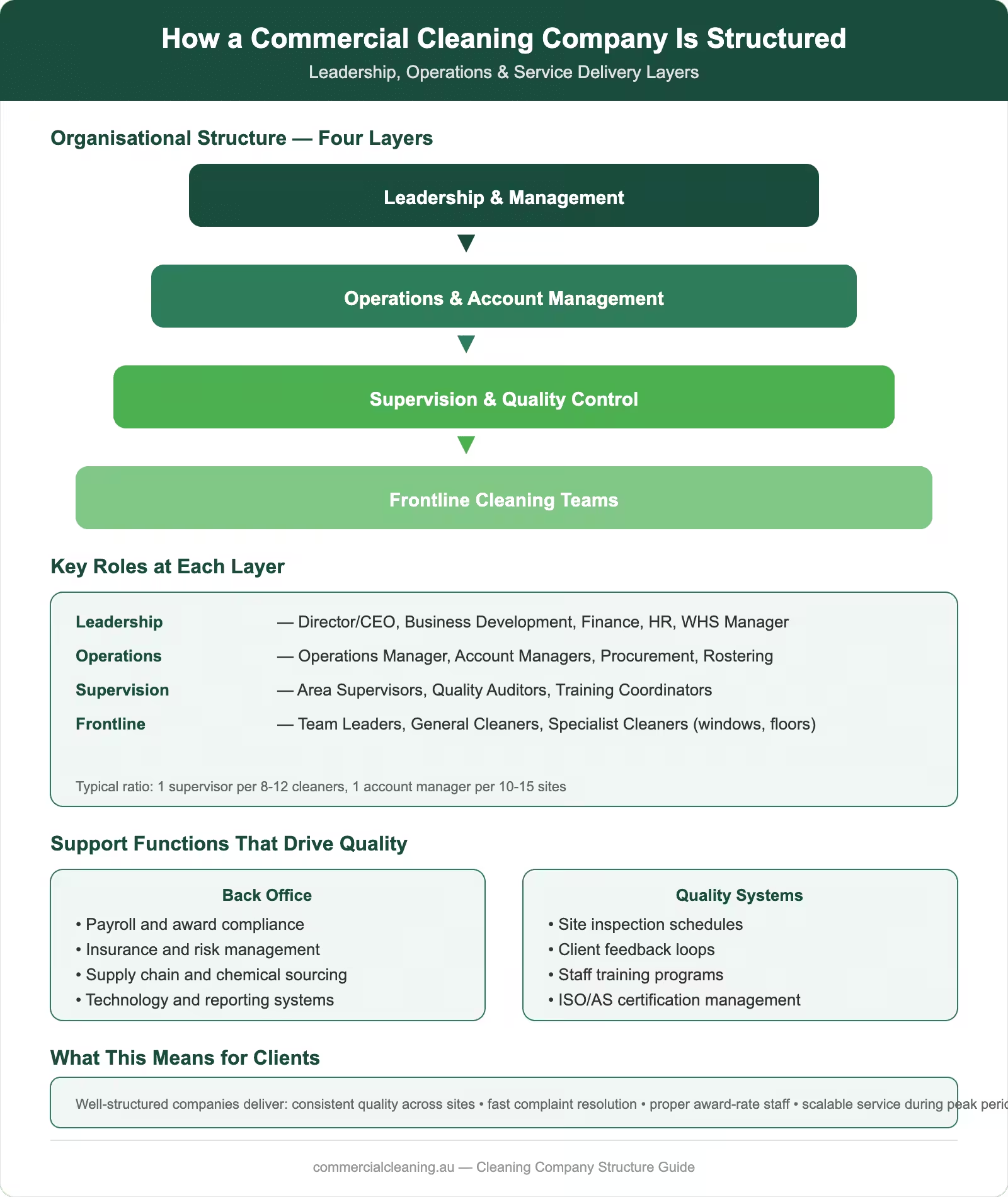
Commercial cleaning company organisational structure showing four layers from leadership to frontline teams, key roles, and support functions that drive quality
The Leadership and Management Layer
The Leadership and Management Layer covers specific protocols that we tailor to each facility based on its layout, traffic, and compliance requirements. We structure our leadership team around three core functions: operations, compliance, and client relationships. Our operations director oversees all service delivery across the Sydney metropolitan area. Our compliance manager handles Fair Work MA000022 award obligations, SafeWork NSW WHS Act 2011 requirements, and insurance renewals. Our client relationship managers each handle a portfolio of contracts and serve as the single point of contact for every client. We have found that companies without this clear separation of responsibilities tend to let compliance slip when operations get busy, which is exactly when compliance matters most.
Site Operations and Supervision
Site Operations and Supervision involves specific protocols that we tailor to each facility based on its layout, traffic, and compliance requirements. We assign dedicated site supervisors to every contract we hold, and each supervisor manages no more than eight sites to confirm they can conduct meaningful weekly inspections rather than cursory drive-by visits. Our supervisors live within thirty minutes of every site they oversee, which is why our emergency response time averages ninety minutes across the CBD, Parramatta, North Sydney, and Chatswood. We have found that national operators frequently assign supervisors to fifteen or twenty sites across a wide geographic spread, which makes genuine oversight impossible. Our supervision model costs more but it directly correlates with our eighty-five percent client retention rate.
Office Area Cleaning Frequency Guide
Area
Daily
Weekly
Monthly
Quarterly
Reception & Lobby
Vacuum, mop, wipe
Glass doors, furniture
Deep carpet clean
Window wash
Workstations
Surface wipe, bins
Monitor & keyboard
Drawer clean-out
Chair shampoo
Kitchen/Breakroom
Bench, sink, floor
Fridge, microwave
Deep degrease
Exhaust fan clean
Bathrooms
Full sanitise + restock
Grout scrub
Descale fixtures
Vent clean
Meeting Rooms
Table wipe, vacuum
AV equipment dust
Upholstery clean
Carpet extraction
The Operational Teams and Cleaning Staff
Office Area Cleaning Frequency Guide requires specific protocols that we tailor to each facility based on its layout, traffic, and compliance requirements. We organise our cleaning teams into three specialist streams: general commercial, healthcare and infection control, and high-risk environments including construction sites and industrial facilities. Each stream has its own training pathway and equipment inventory. Our general commercial teams hold Certificate III in Cleaning Operations CPP30316 at minimum. Our healthcare teams carry additional infection control certification aligned with AS 3789. Our high-risk teams are trained in confined space entry, working at heights, and hazardous substance handling under WHS Regulation 2017. We pay all operatives above the Cleaning Services Award MA000022 Level 3 rate because we have learned that underpaying directly causes the turnover that destroys service consistency.
Human Resources and Compliance
The Operational Teams and Cleaning Staff includes specific protocols that we tailor to each facility based on its layout, traffic, and compliance requirements. We process all payroll in-house rather than outsourcing it because we need direct visibility over every dollar paid. Our HR team manages national police checks through the Australian Criminal Intelligence Commission, Working With Children Check clearances for education and childcare contracts, visa verification, and ABN legitimacy checks for any subcontractors. We maintain portable long service leave contributions for every eligible worker and our superannuation compliance is audited quarterly by an external firm. We have taken over contracts in Bankstown and Liverpool where the previous operator had no documentation of employee status and was paying cash, which exposes both the cleaner and the client to significant legal risk.
Training and Skills Development
Human Resources and Compliance addresses specific protocols that we tailor to each facility based on its layout, traffic, and compliance requirements. We run a structured training pipeline that begins with a five-day induction program before any new team member enters a client site. Our induction covers chemical handling and SDS compliance, manual handling, working at heights awareness, infection control principles, and site-specific procedures for their assigned premises. We then run quarterly refresher training and annual skill assessments. Our training investment runs to over one hundred and twenty hours per operative per year, which is roughly three times the industry average. We have tracked the correlation between training hours and client complaint rates across our portfolio and the data consistently shows that better-trained teams produce fewer issues in Surry Hills, Macquarie Park, Homebush, and every other precinct we operate in.
Quality Assurance and Continuous Improvement
Training and Skills Development targets specific protocols that we tailor to each facility based on its layout, traffic, and compliance requirements. We run a layered audit programme across every site we service, and I can tell you it took us years to get this right. Our quality assurance team completes unannounced inspections using a sixty-five-point checklist that covers everything from floor finish clarity to bin-liner placement. Each audit generates a score card tied to ISO 9001 benchmarks we adopted back in 2016. If a site drops below ninety per cent two months running, we trigger a corrective action plan that the site supervisor must close out within fourteen days.
Quality Assurance and Continuous Improvement focuses on specific protocols that we tailor to each facility based on its layout, traffic, and compliance requirements. Our Parramatta head office tracks defect trends in real time through a dashboard that flags repeat issues. We also survey building occupants quarterly — anonymous five-question forms — and feed those results back into training modules. One thing we learned the hard way is that quality cannot live inside a spreadsheet alone; it has to be a conversation between the cleaner on the ground and the account manager reviewing that data. That feedback loop is what separates a company that cleans from a company that keeps improving.
Supply Chain and Equipment Management
Supply Chain and Equipment Management covers specific protocols that we tailor to each facility based on its layout, traffic, and compliance requirements. Managing consumables and machinery for thirty-five commercial sites across Sydney is a logistics challenge most people underestimate. Our procurement team maintains standing-order agreements with three national distributors so we are never dependent on a single supply chain. We keep a central store in Homebush that dispatches weekly to every site, and each delivery is scanned against a par-level system we built in-house.
Equipment-wise, we operate ride-on scrubbers, backpack vacuums rated to HEPA H13 filtration, and oscillating pad machines for stone and vinyl floors. Every piece of plant has a maintenance tag with a QR code — scan it, and the system shows its full service history. We retire vacuums at the eighteen-month mark regardless of condition because filter degradation is invisible and directly affects indoor air quality. That policy alone cut our IAQ complaint rate by forty per cent within a year of rolling it out across CBD high-rises.
Rostering, Scheduling, and Workforce Planning
Rostering, Scheduling, and Workforce Planning involves specific protocols that we tailor to each facility based on its layout, traffic, and compliance requirements. We roster over one hundred and fifty cleaners across morning, day, and evening shifts, and the complexity scales fast when you factor in leave, workers’ compensation cases, and client access windows. Our workforce planning team uses cloud-based rostering software that integrates directly with payroll and our client portal. Supervisors approve shift swaps through a mobile app, which eliminated the old paper-based system that cost us roughly twenty-six hours of admin time per week.
We build rosters four weeks in advance but review them weekly against actual hours clocked. Variance reports highlight any site that is consistently over or under its contracted hours — both are problems. Over-servicing erodes margin; under-servicing erodes trust. In Macquarie Park, for example, we adjusted a five-night roster to three nights plus a Saturday deep-clean after data showed weekend foot traffic was heavier than midweek. The client’s satisfaction score jumped from seventy-two to ninety-one within a quarter.
Financial Management and Compliance
Financial Management and Compliance requires specific protocols that we tailor to each facility based on its layout, traffic, and compliance requirements. Every cleaning contract we hold is underpinned by a detailed cost model that accounts for labour, consumables, equipment depreciation, and overhead. We price per-square-metre using benchmarks aligned to the Cleaning Accountability Framework wage rates — currently sitting at thirty-one dollars and sixty-five cents per hour for a Level 1 cleaner under the Cleaning Services Award 2020. We refuse to undercut that floor because wage theft destroys the industry and we have seen competitors collapse overnight when the Fair Work Ombudsman comes knocking.
Our finance team reconciles every site monthly against budgeted versus actual spend. We also maintain full compliance with the Taxable Payments Annual Report obligations that apply to cleaning service providers — a detail many smaller operators miss. Superannuation is processed fortnightly through a clearing house, and we run quarterly internal audits against Single Touch Payroll data to catch discrepancies early. Transparency here is not optional; it is what lets us look a facilities manager in the eye and guarantee our pricing is clean.
Health, Safety, and Environmental Compliance
We hold WHS obligations under the Work Health and Safety Act 2011 (NSW), and our safety management system is aligned to AS/NZS 4801. Every cleaner completes a site-specific induction before their first shift, covering chemical safety data sheets, emergency evacuation routes, and manual-handling protocols. Our incident rate sits at one point two per hundred thousand hours worked — well below the industry average of three point eight reported by Safe Work Australia for the cleaning sector in 2024.
Our environmental policy goes beyond tick-box compliance. We transitioned to GECA-certified cleaning chemicals three years ago across all Barangaroo and North Sydney sites, cutting volatile organic compound exposure by an estimated sixty per cent. We also track water and chemical usage per square metre and report those figures to clients who have sustainability KPIs written into their lease agreements. For us, green cleaning is not a marketing angle — it is an operational standard baked into every scope of work we issue.
Client Relations and Account Management
Client Relations and Account Management addresses specific protocols that we tailor to each facility based on its layout, traffic, and compliance requirements. We assign a dedicated account manager to every contract valued above twenty thousand dollars annually. That manager meets the client on-site at least once per month and produces a written report covering completed works, open defects, upcoming schedule changes, and any cost variations. We learned early that reactive communication — waiting for the complaint — is a losing strategy in commercial cleaning.
Our client portal gives facilities managers twenty-four-hour access to audit reports, attendance logs, and real-time job status. We also run formal contract reviews every six months where we benchmark our performance against the original tender KPIs. In Chatswood, one strata manager told us the monthly reporting alone justified renewing our contract because no other provider had offered that level of visibility. That kind of feedback reinforces why we invest so heavily in systems rather than relying on promises.
How Everything Connects: A Real Example
How Everything Connects targets specific protocols that we tailor to each facility based on its layout, traffic, and compliance requirements. Let me walk you through how all these departments collaborate on a single job. Last year we won a twenty million dollar office tower in Surry Hills — forty-two levels, mixed tenancy, operating seven days. The bid team modelled labour at four hundred and twelve hours per week across three shift patterns. Procurement pre-ordered six months of consumables to lock in pricing. HR recruited fourteen new cleaners, each completing forty hours of induction training before go-live.
On day one, our operations supervisor ran the first walk-through with the building manager using a digital snagging list. Quality assurance scheduled its first unannounced audit for week two. Finance set up the cost-centre codes so every dollar spent on that site could be tracked independently. Within ninety days we had reduced the previous contractor’s defect rate by sixty-five per cent and the client extended our term from two years to five. That result did not come from one department working harder — it came from every layer of the structure doing its job and sharing information across the chain.
How many departments does a large commercial cleaning company typically have?
Most established firms operate between eight and twelve distinct departments. At our company, we maintain dedicated teams for operations, HR, training, quality assurance, supply chain, rostering, finance, WHS, client relations, and technology — each feeding into a centralised reporting structure.
What qualifications should cleaning supervisors hold?
We require a minimum Certificate III in Cleaning Operations (CPP30316) for all supervisors, plus current first-aid and WHS White Card certification. Senior supervisors working on sites above ten thousand square metres also complete our internal leadership programme.
How does a cleaning company verify consistent quality across multiple sites?
We use a combination of unannounced audits against a sixty-five-point checklist, real-time digital reporting, and quarterly occupant surveys. Our quality assurance team benchmarks every site against ISO 9001 standards and triggers corrective action plans for any score below ninety per cent.
What technology do modern cleaning companies use?
Our tech stack includes cloud-based rostering and payroll software, GPS-enabled time-and-attendance tracking, a custom-built client portal, QR-coded equipment maintenance logs, and IoT sensors in high-traffic amenities that trigger cleaning tasks based on actual usage rather than fixed schedules.
How are cleaning staff wages regulated in Australia?
All wages must comply with the Cleaning Services Award 2020, administered by the Fair Work Commission. The current base rate for a Level 1 cleaner is thirty-one dollars and sixty-five cents per hour. We process superannuation fortnightly and report through Single Touch Payroll to make sure full compliance.
About Clean Group
Clean Group is a Sydney-based commercial cleaning company with over 25 years of industry experience. Founded by Suji Siv, our team of 50+ trained professionals services offices, warehouses, medical centres, schools, childcare facilities, retail stores, gyms, and strata properties across Sydney, Melbourne, and Brisbane.
We are active members of ISSA and the Building Service Contractors Association of Australia (BSCAA). Our operations align with ISO 9001 (Quality Management), ISO 14001 (Environmental Management), and ISO 45001 (Workplace Health and Safety) standards. We hold membership with the Green Building Council of Australia and use eco-friendly, TGA-registered cleaning products wherever possible.
Every Clean Group cleaner is police-checked, fully insured, and trained in safe work procedures under SafeWork NSW guidelines. We operate 7 days a week, including after-hours and weekend services, to minimise disruption to your business.
Hi, I'm Suji Siv, the founder, CEO, and Managing Director of Clean Group, bringing over 25 years of leadership and management experience to the company. As the driving force behind Clean Group’s growth, I oversee strategic planning, resource allocation, and operational excellence across all departments. I am deeply involved in team development and performance optimization through regular reviews and hands-on leadership.