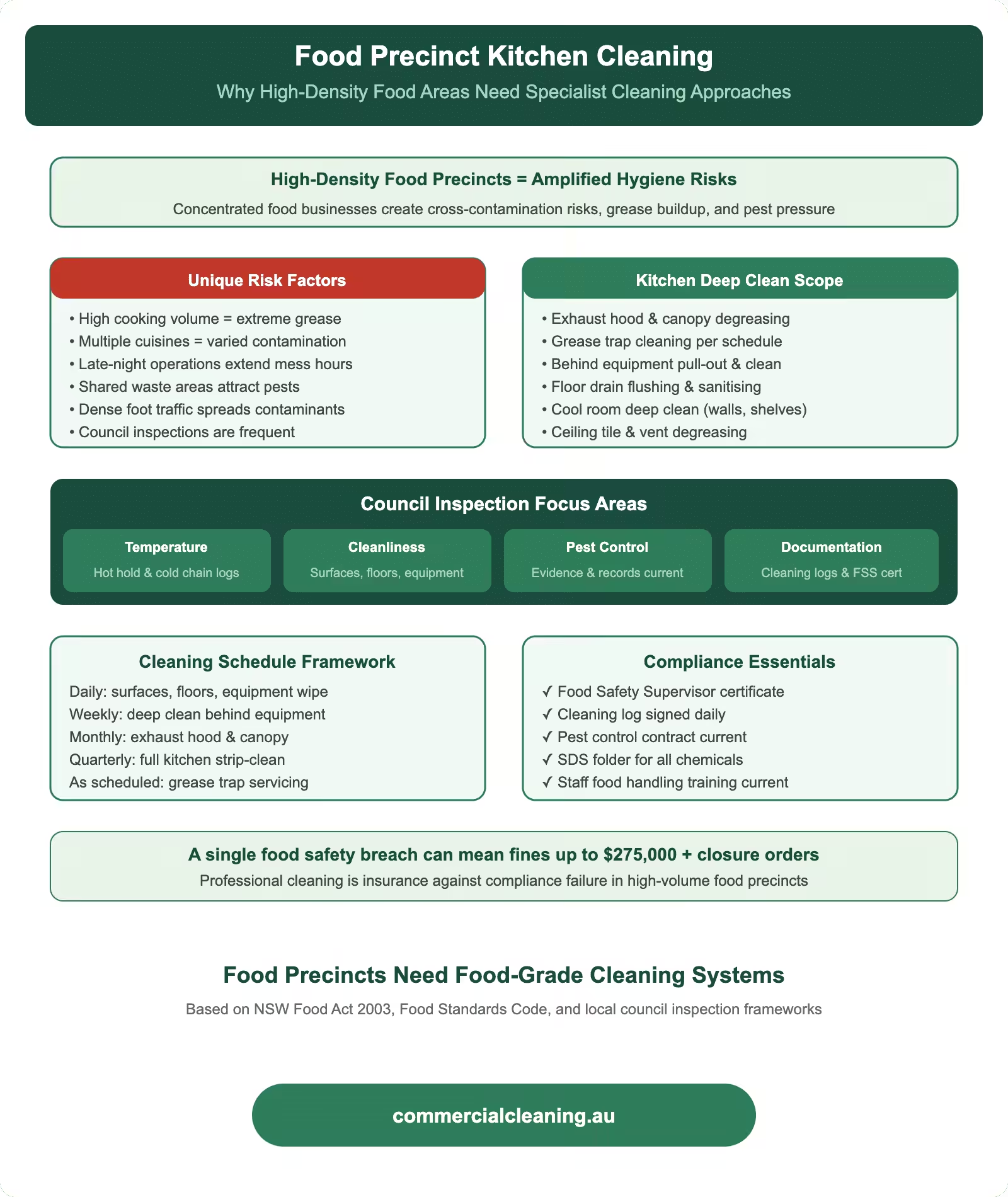
Food precinct kitchen cleaning showing unique risk factors, deep clean scope, council inspection focus areas, cleaning schedule framework, and compliance essentials
Haymarket’s Food Business environment — Why Kitchen Cleaning Here Is Different
Haymarket’s Food Business environment — Why Kitchen Cleaning Here Is Different covers specific protocols that we tailor to each facility based on its layout, traffic, and compliance requirements. Haymarket and Chinatown represent Sydney’s most vibrant and densest food precinct, stretching from Paddy’s Markets to Dixon Street and beyond. Unlike standard suburban commercial kitchens, the food businesses here operate under unique conditions: multi-story buildings packed with independent traders, shared exhaust systems serving dozens of kitchen operations, and intense high-heat cooking methods that create grease accumulation at rates far above typical café or restaurant standards. Our team at Clean Group has worked across dozens of these mixed-use food court complexes, and we’ve learned that a one-size-fits-all kitchen cleaning approach simply doesn’t work for this precinct. Our Sydney commercial cleaning services team understands that Haymarket’s multicultural food businesses demand specialised protocols tailored to wok cooking, night markets, and the complex Food Safety Supervision Certificate requirements set by the NSW Food Authority.
The businesses in this area aren’t just restaurants. You’ll find Chinese noodle houses with three woks running simultaneously, Vietnamese pho vendors, Korean BBQ grills, dumpling makers, and itinerant night market stallholders who trade only on weekends. Each operation generates different types of grease, smoke, and cooking residue. A Chinese restaurant with high-powered wok burners creates fat-laden steam that travels horizontally through ductwork; a charcoal grill produces carbon and particulate matter; a dumpling steamer generates water vapour and starch residue. When these operations share the same exhaust riser on Thomas Street or Ultimo Road, the interaction between different cooking emissions can cause blockages faster than in single-tenant buildings.
We’ve also noticed that many Haymarket traders operate under significant time pressure. Night markets, extended trading hours, and minimal floor space mean that kitchen downtime is costly. Cleaning must fit into tight windows—often just before opening or very late at night. This requires scheduling flexibility, trained crews who can work efficiently without disrupting service, and clear communication across multiple languages so that kitchen staff understand cleaning protocols and don’t inadvertently block access to exhaust vents or grease traps.
High-Heat Wok Cooking Grease Management Protocols
Wok cooking at high heat is the signature of Haymarket’s food culture, but it’s also the biggest driver of kitchen grease buildup. A traditional wok burner operates at temperatures that cause oil molecules to aerosolise and travel further through ductwork than conventional pan cooking. Over a 12-hour trading day, a busy noodle house can deposit kilograms of grease-laden vapour into the exhaust system. Our team has measured grease accumulation in some Haymarket ductwork at twice the rate of suburban kitchens, which directly impacts cleaning frequency and protocol selection.
High-heat wok cooking grease has specific properties. It cools and solidifies rapidly inside ductwork, creating a tar-like buildup that’s harder to remove than the lighter grease from lower-heat cooking. On top of that, wok chefs often use peanut oil or lard, which have different melting points and oxidation rates compared to vegetable oil. When we service a Dixon Street food court, we factor in these material differences when selecting cleaning agents and mechanical removal methods. We don’t use generic degreasers; we apply heat-resistant alkaline solutions designed for high-polymer grease, sometimes combined with manual scraping and steam cleaning, depending on accumulation thickness.
The FSANZ (Food Standards Australia New Zealand) guidance on kitchen ventilation systems doesn’t distinguish between wok and non-wok kitchens, but the reality is that NSW Food Authority inspectors in Haymarket expect to see evidence of more frequent cleaning schedules for high-heat operations. Our crews document grease removal with before/after photos, maintaining records that satisfy both health inspectors and landlord insurance requirements. We’ve found that kitchens with documented cleaning logs experience fewer compliance warnings and faster approval from the local council’s public health officers.
Cooking Type
Grease Accumulation Rate
Recommended Cleaning Interval
High-heat wok cooking (3+ burners)
2–3 kg per week
Weekly or twice-weekly
Medium-heat griddle/grill
0.8–1.5 kg per week
Fortnightly
Low-heat steamer/dumpling station
0.2–0.5 kg per week
Monthly
One challenge we face regularly on Sussex Street and in the Paddy’s Markets precinct is that grease-laden vapour doesn’t just cling to ductwork; it also condenses on kitchen walls, light fittings, and even door frames. Wok chefs often work in confined spaces where heat and steam create extremely humid environments. Standard wall cleaning becomes part of our protocol—not as a luxury add-on, but as a health and safety requirement. Grease buildup on walls becomes a fire hazard, and NSW Food Authority inspectors flag it immediately.
We’ve also implemented a practice of inspecting grease trap capacity during our visits. Many Haymarket kitchens, especially in older buildings on Dixon Street, have undersized grease traps designed for lower-volume operations. High-heat wok cooking can overwhelm these systems, leading to backups that force temporary kitchen shutdowns. Our team alerts business owners when grease trap capacity looks inadequate, giving them time to arrange upgrades before an inspection failure forces their hand.
Multi-Tenant Shared Kitchen and Food Court Exhaust Cleaning
Food courts and shared kitchen complexes are the backbone of Haymarket’s food economy. A single building might house 15–20 independent food vendors, each with a separate kitchen bench or stall, all drawing exhaust through one or two shared risers. This creates a logistical and technical challenge that single-restaurant operators simply don’t face. When tenant A (a wok vendor) and tenant B (a charcoal grill operator) share the same vertical ductwork, their emissions mix, creating unpredictable grease and char accumulation patterns.
Shared exhaust systems in Haymarket food courts demand coordination across multiple business owners. Our team must schedule cleaning to suit a window when no kitchen is operating—often after 11 PM or before 5 AM. We’ve worked with building management companies on Thomas Street to schedule deep cleans when the entire complex is closed, confirming that no individual tenant loses revenue and that the full riser can be properly flushed and cleaned. Unlike a single-tenant restaurant where we might isolate one hood and ductwork section, a shared system requires access to multiple dampers, balancing adjustments, and potential ductwork recalibration after cleaning to confirm that air pressure remains balanced across all tenant spaces.
The NSW Food Authority has specific guidance on shared kitchen infrastructure, particularly regarding cleaning responsibility and documentation. Our team clarifies with building management whether cleaning costs are borne collectively or invoiced per tenant. We then provide a single compliance document that covers the entire riser, protecting all tenants against individual liability. This is a significant point of confusion in Haymarket, where many buildings lack clear maintenance contracts. We’ve seen disputes where one tenant’s failure to maintain the exhaust system resulted in health violations affecting all neighbours—a situation that proper shared-system documentation prevents.
Multi-tenant exhaust systems also require AS 1851 certification, which is the Australian Standard for the cleaning and maintenance of ventilation ducts. Our team is trained and equipped to meet this standard, providing certificates of compliance that satisfy both building insurance and council health inspectors. When a Haymarket food court undergoes an inspection, the presence of an AS 1851 certificate dramatically accelerates sign-off and demonstrates professional management to potential tenants and investors.
NSW Food Authority Requirements for Haymarket Food Businesses
The NSW Food Authority sets specific standards for food business kitchens, and Haymarket venues fall under close scrutiny due to the density and diversity of operations. One of the most relevant requirements is the Food Safety Supervisor Certification, which mandates that at least one person in each food business must understand contamination risks, cleaning protocols, and pest control. Our team works with food businesses to align our cleaning schedule with their food safety supervisor’s understanding of FSANZ-recommended intervals and NSW Food Authority expectations.
A critical requirement is documentation of cleaning procedures. The NSW Food Authority doesn’t just want to see clean ductwork; it wants to see records demonstrating a maintenance schedule, cleaning dates, methods used, and any issues identified and rectified. Our invoices and compliance certificates serve as that documentation. When we service a kitchen on Dixon Street or Ultimo Road, we leave detailed records that the business can present to health inspectors, establishing a trail of professional maintenance that protects them against compliance violations.
The NSW Food Authority also emphasises HACCP (Hazard Analysis and Critical Control Points) principles in kitchen design and cleaning. For Haymarket’s shared kitchen environments, we’ve found that educating business owners on HACCP-aligned cleaning helps them understand why certain areas require priority attention. For instance, the area where condensation drips from ductwork above food preparation benches is a critical control point; it must be cleaned more frequently to prevent contamination of ready-to-eat foods. Our team identifies these high-risk zones during inspections and recommends enhanced cleaning protocols specific to each kitchen’s layout and food type.
One area where Haymarket kitchens often fall short is pest control integration with cleaning schedules. Grease buildup attracts pests, and inadequate cleaning can mask pest activity until an inspection fails. Our cleaning protocols include checks for signs of pests—droppings, gnaw marks, or evidence of nesting—which we report to building management. This early warning system has prevented several Haymarket food courts from escalating pest infestations that might have closed them temporarily.
Bilingual Cleaning Signage and Crew Communication
Bilingual Cleaning Signage and Crew Communication addresses specific protocols that we tailor to each facility based on its layout, traffic, and compliance requirements. Haymarket and Chinatown are linguistically diverse precincts where English may not be the primary language of many kitchen staff. When our team arrives to clean a food court, we need to communicate clearly with staff about access to equipment, whether the kitchen can continue operating during cleaning, and which areas will be restricted. Poor communication leads to missed areas, wasted time, and frustration on both sides.
We’ve invested in bilingual signage and briefing sheets in Cantonese and Mandarin, which we provide to building management and individual kitchen operators. These sheets outline the cleaning scope, expected duration, and any precautions kitchen staff should take—such as not using certain equipment during hood cleaning. For night market operators or short-term vendors at Paddy’s Markets, we provide simplified visual guides showing which areas will be off-limits and when they can resume normal operations.
Our crews are trained to use hand signals, visual demonstrations, and simple English to verify that kitchen staff understand the cleaning plan. We’ve also hired multilingual team members for key Haymarket accounts, confirming that detailed conversations about maintenance history, recurring issues, and safety concerns can happen in the customer’s preferred language. This isn’t just a courtesy; it’s an operational necessity. A misunderstanding about whether grease traps should be accessed by our team versus a plumber can delay a cleaning by hours.
We’ve also learned that different cultural backgrounds approach cleaning differently. Some kitchen staff expect us to inform them step-by-step; others prefer to be left alone to work. By establishing clear communication protocols upfront, we avoid conflicts and build trust. On Sussex Street and Dixon Street, where turnover among kitchen staff is high, we brief the person on duty at each visit, treating each day as a potential fresh start with different personnel.
Night Market and Extended Trading Hour Cleaning Schedules
Haymarket thrives on night markets, extended trading hours, and irregular schedules. Some food vendors operate only on Friday and Saturday nights at Paddy’s Markets; others run round-the-clock dimsum services. This variability makes scheduling our cleaning service a complex negotiation. A traditional restaurant with fixed 10 AM–10 PM hours is simple; a night market stall that operates 6 PM–midnight requires a completely different approach.
We’ve developed flexible scheduling options tailored to Haymarket’s trading patterns. For permanent food courts, we offer late-night deep cleaning after 11 PM when all tenants have closed. For night market operators, we arrange bi-weekly or monthly deep cleans during their off-hours, often coordinating with the night market management to schedule across multiple vendors at once. For extended-hours venues, we work within narrow windows—late morning before lunch service, or very early morning after the last service closes.
The challenge with night market cleaning is that weather, customer demand, and vendor attendance are unpredictable. A vendor who normally finishes at midnight might pack up at 10 PM on a slow night, or stay until 1 AM on a busy weekend. Our team maintains flexibility to accommodate these variations, and we’ve found that building goodwill with night market operators is worth the scheduling hassle. Many have become regular clients precisely because we’re willing to work on their terms.
Extended trading hours also mean that our crews sometimes encounter active cooking while performing exhaust cleaning. We coordinate carefully to confirm that hood cleaning never disrupts active service and that kitchen staff understand that certain equipment must be shut down during cleaning. For Haymarket venues where staff speak limited English, our bilingual signage and pre-visit briefings become necessary to prevent accidents.
Exhaust Hood, Canopy, and Ductwork Cleaning Frequency for High-Volume Kitchens
The frequency of exhaust cleaning directly correlates to cooking volume and heat intensity. The National Fire Protection Association (NFPA) and AS 1851 both recommend cleaning frequency based on grease accumulation rates, with high-volume wok kitchens requiring more frequent servicing than lower-volume operations. A Haymarket noodle house doing 200+ meals per day will accumulate grease far faster than a suburban café doing 50 meals per day.
Our recommendation for high-volume wok kitchens in Haymarket is weekly or twice-weekly cleaning of hoods and filters, with monthly deep cleaning of ductwork and annual full system descaling. This might seem expensive to a new business owner, but we explain the cost-benefit: frequent cleaning prevents emergency shutdowns due to fire code violations, extends equipment lifespan, and keeps insurance premiums stable. A business that allows grease to build up to dangerous levels will eventually face a NSW Food Authority closure order, which costs far more than preventive cleaning.
Haymarket’s shared food court systems often operate at even higher accumulation rates because they’re serving multiple high-heat kitchens simultaneously. We’ve recommended quarterly or even monthly full-system cleaning for some Ultimo Road and Thomas Street food courts where the combination of wok, charcoal grill, and steamer operations creates exponential grease buildup. Building management is usually receptive once we explain the insurance and liability implications of under-maintenance.
One factor unique to Haymarket is the age of many buildings and their exhaust systems. Older ductwork on Dixon Street may have internal rust, dents, or corrosion that traps grease more easily than smooth, modern ductwork. In these cases, we sometimes recommend more frequent cleaning or even ductwork replacement if restoration isn’t cost-effective. Our team can assess whether a system is maintainable or approaching the end of its service life.
We also monitor seasonal variation. Winter in Sydney brings cooler air and less air conditioning, which can reduce the velocity of air through ductwork and cause grease to settle more readily. Summer cooking volumes often increase in Haymarket due to extended outdoor night market activity. Our recommendations adjust seasonally, and we encourage clients to discuss quarterly reviews to fine-tune cleaning frequency based on actual performance.
For hospitality venues in nearby Darlinghurst and Surry Hills, see our guide on Darlinghurst hospitality cleaning for industry-specific protocols and compliance standards.
Frequently Asked Questions
How do I know if my Haymarket kitchen’s exhaust system needs cleaning?
Several warning signs indicate that cleaning is overdue: reduced suction in the hood (smoke backing into the kitchen), visible grease buildup on the hood exterior, a burning smell from the ductwork, or audible rattling as air moves through blockages. If your NSW Food Authority inspection report mentions ventilation deficiencies, cleaning should be scheduled immediately. We recommend a visual inspection by a professional at least quarterly if you operate high-heat wok cooking.
What’s the difference between filter cleaning and ductwork cleaning?
Hood filters trap larger grease particles and can be cleaned or replaced relatively quickly—sometimes by kitchen staff themselves. Ductwork cleaning addresses grease and particulate buildup deeper in the system, inside the ducts and in the exhaust riser. Both are necessary. Dirty filters reduce system efficiency, while dirty ductwork is a fire hazard and a health code violation. We typically recommend weekly filter cleaning/replacement and monthly to quarterly ductwork cleaning for high-volume Haymarket kitchens.
Can multiple food businesses share one exhaust system safely?
Yes, but it requires proper design, regular cleaning, and clear maintenance documentation. Shared systems in Haymarket food courts work well when there’s a centralised maintenance schedule, AS 1851 certification, and clear responsibility for cleaning costs. The building owner or management company should have a contract specifying how often the shared system is cleaned and who pays. Without this, disputes and neglect often follow.
How does bilingual communication affect cleaning quality?
Clear communication confirms that our team understands the kitchen layout, any equipment restrictions, and operational constraints. When there’s a language barrier, we use visual demonstrations, signage in the kitchen staff’s language, and simplified instructions. This prevents missed areas, reduces downtime, and builds trust. For Haymarket venues with multilingual staff, we’ve found that spending time on communication upfront actually saves time and prevents callbacks.
What happens if my food business fails an exhaust system inspection?
The NSW Food Authority will issue a non-compliance notice and typically allow 7–30 days for rectification depending on the severity. During this period, you must hire a professional cleaning service (like our team) to bring the system into compliance, obtain an AS 1851 certificate, and request a follow-up inspection. Failure to comply can result in temporary closure. The best approach is preventive scheduling so you never reach that point.
About Clean Group
Clean Group is a leading commercial cleaning company in Sydney, providing professional cleaning services to offices, strata buildings, medical facilities, schools, gyms, and retail spaces across the greater Sydney region. With over 25 years of experience and a commitment to WHS compliance, eco-friendly practices, and consistent quality, Clean Group delivers tailored cleaning solutions backed by a 100% satisfaction guarantee.
Hi, I'm Suji Siv, the founder, CEO, and Managing Director of Clean Group, bringing over 25 years of leadership and management experience to the company. As the driving force behind Clean Group’s growth, I oversee strategic planning, resource allocation, and operational excellence across all departments. I am deeply involved in team development and performance optimization through regular reviews and hands-on leadership.