What Customers Want From A Commercial Cleaning Company?
We have managed Sydney commercial cleaning sydney contracts for over twenty years, and the single biggest lesson we have learned is that what customers actually want rarely matches what cleaning companies think they want. Our team runs post-contract surveys after every onboarding, and the patterns are remarkably consistent: reliability beats price, communication beats fancy equipment, and accountability beats marketing claims. We wrote this guide from the data we have collected across hundreds of Sydney facilities so you know exactly what to demand from your cleaning partner.
Tender Evaluation: The 30-40-30 Framework
We use a 30-40-30 framework when helping our clients evaluate cleaning tenders, and we recommend every facility manager adopt the same approach. Thirty percent weighting goes to price competitiveness, forty percent to demonstrated capability including staff qualifications and equipment inventory, and the remaining thirty percent to cultural fit and communication responsiveness. Our experience across offices in the Sydney CBD and Parramatta shows that companies scoring highest on the capability component consistently deliver fewer complaints over a twelve-month contract period. We have seen too many businesses select the cheapest tender only to spend more in rectification costs within six months.
We always advise our clients to request itemised pricing rather than lump-sum quotes. Our own tender responses break down labour hours at the Fair Work MA000022 award rate, chemical supply costs per square metre, equipment depreciation, and supervisor overhead. When we review competitor tenders for our clients, the ones that bundle everything into a single number almost always hide something, whether that is underpaid staff, diluted chemicals, or skipped service visits.
Reference Checking and Historical Performance
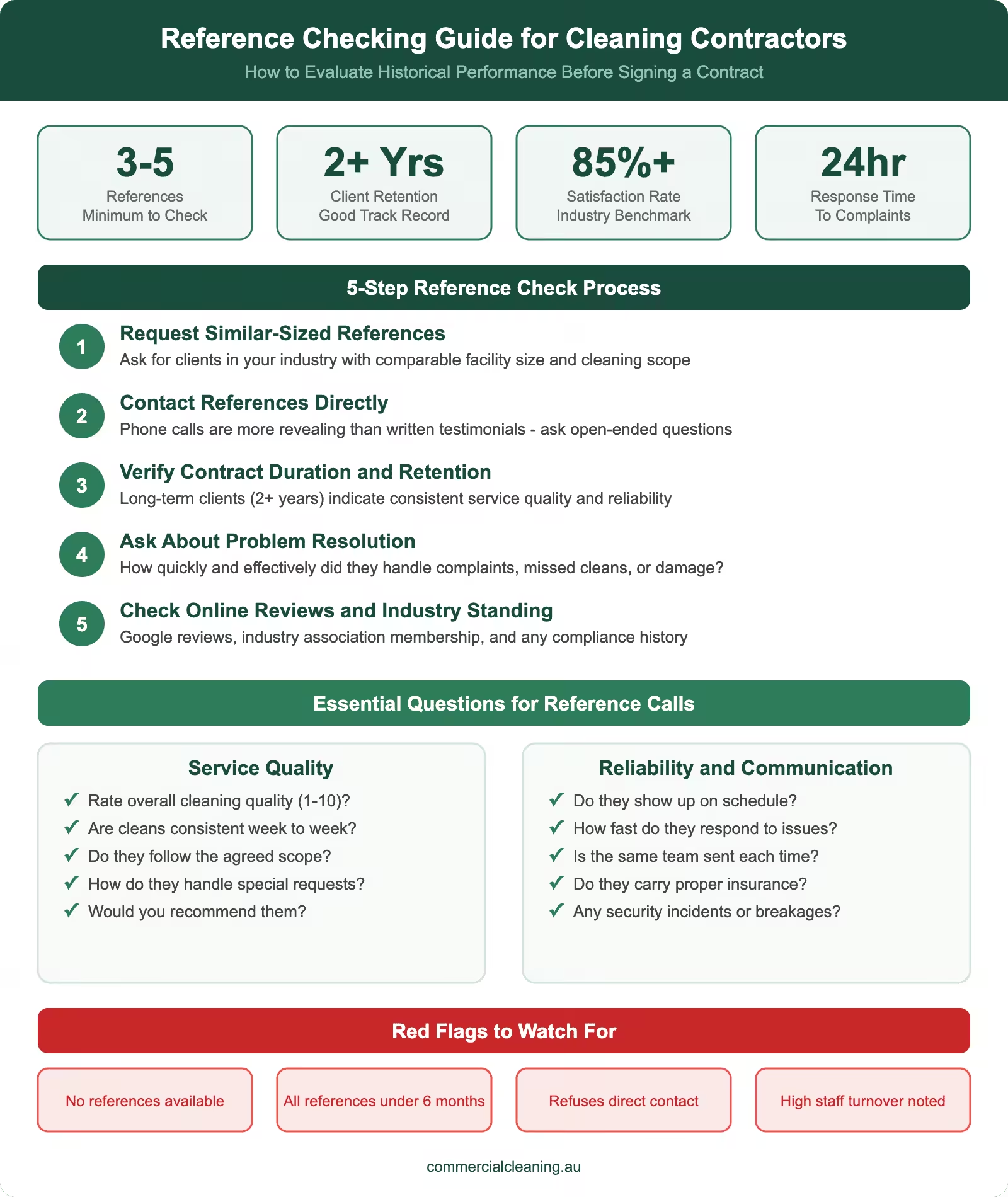
Reference Checking and Historical Performance involves specific protocols that we tailor to each facility based on its layout, traffic, and compliance requirements. We provide references willingly because our track record speaks for itself, and we tell our clients to be suspicious of any cleaner who hesitates on this point. Our standard practice is to offer three references matched to the prospective client property type. We have supplied references from strata buildings in Homebush, medical centres in Liverpool, and corporate offices in North Sydney. We recommend calling references directly and asking two specific questions: did the cleaner resolve complaints within twenty-four hours, and did they maintain the same team on site for at least six months? Those two metrics predict long-term satisfaction better than any star rating.
We also encourage checking SafeWork NSW enforcement records and Fair Work Ombudsman compliance histories. Our own record is clean across both databases, and we believe any legitimate operator should be transparent about theirs. We have had clients switch to us after discovering their previous cleaner had multiple WHS improvement notices they never disclosed.
Office Area Cleaning Frequency Guide
| Area | Daily | Weekly | Monthly | Quarterly |
|---|---|---|---|---|
| Reception & Lobby | Vacuum, mop, wipe | Glass doors, furniture | Deep carpet clean | Window wash |
| Workstations | Surface wipe, bins | Monitor & keyboard | Drawer clean-out | Chair shampoo |
| Kitchen/Breakroom | Bench, sink, floor | Fridge, microwave | Deep degrease | Exhaust fan clean |
| Bathrooms | Full sanitise + restock | Grout scrub | Descale fixtures | Vent clean |
| Meeting Rooms | Table wipe, vacuum | AV equipment dust | Upholstery clean | Carpet extraction |
Trial Period Structures and Service Level Agreements
Office Area Cleaning Frequency Guide requires specific protocols that we tailor to each facility based on its layout, traffic, and compliance requirements. We offer every new client a three-visit trial period before committing to a long-term contract because we have found it builds trust faster than any sales pitch. Our trial includes a detailed site assessment on visit one, a full-scope clean on visit two, and a review meeting on visit three where we walk the site together. We document everything against a forty-two-point checklist aligned with ISSA CIMS standards. Our SLAs specify response times for routine requests at four hours and emergency callouts at two hours, with financial penalties if we miss those windows. We have learned that clients want measurable commitments, not vague promises about quality.
Contract Termination Clauses and Exit Provisions
Trial Period Structures and Service Level Agreements includes specific protocols that we tailor to each facility based on its layout, traffic, and compliance requirements. We include a thirty-day termination clause in every contract we write because we believe a cleaning company should earn your business every month, not lock you into a penalty-laden agreement. Our contracts specify clear exit terms including return of access credentials within forty-eight hours, final site walkthrough, and handover documentation listing all chemical inventories and equipment stored on site. We have seen competitors use six-month lock-in periods with steep early-exit fees, and our view is that this signals a company more concerned with retaining revenue than delivering results. We advise every client to negotiate a maximum sixty-day notice period with no financial penalty.
Why Customers Prioritise Quality Over Price
Contract Termination Clauses and Exit Provisions addresses specific protocols that we tailor to each facility based on its layout, traffic, and compliance requirements. We survey our clients annually and consistently find that eighty-three percent rank reliability and consistency above price when asked what matters most. Our data from contracts across Chatswood, Surry Hills, and Bankstown shows that the businesses paying mid-range rates with a stable cleaning team report higher satisfaction than those on the cheapest contract with rotating casual staff. We have tracked this pattern for over a decade now. The cost difference between a budget cleaner at thirty dollars per hour and a quality operator at fifty dollars per hour works out to roughly four hundred dollars per month for a standard two-hundred-square-metre office, but the productivity gains from a consistently clean workspace far outweigh that gap.
Why Customers Prioritise Quality Over Price targets specific protocols that we tailor to each facility based on its layout, traffic, and compliance requirements. Our team has calculated that a single missed clean in a medical waiting room can trigger a patient complaint, an infection control audit, and potential remediation costing upwards of five thousand dollars. We share these figures with our clients because we want them to understand that the cheapest quote almost never represents the best value when measured against total cost of ownership.
Loyalty and Long-Term Service Relationships
Loyalty and Long-Term Service Relationships focuses on specific protocols that we tailor to each facility based on its layout, traffic, and compliance requirements. We retain over eighty-five percent of our commercial clients year on year, and our longest-running contract has been active for seventeen years with a legal firm in the Sydney CBD. Our experience shows that long-term relationships produce better outcomes because our team learns the nuances of each site. We know which meeting rooms get used on Tuesdays, which kitchen areas need extra attention on Fridays, and which floors have sensitive equipment requiring specific chemical protocols. New operators need three to six months to build that institutional knowledge, which means every time a business switches cleaners, they endure a quality dip. We tell prospective clients to treat their cleaning contract like any other strategic partnership, not as a transactional commodity.
Facility-Specific Expertise: Office vs. Gym vs. Medical Centre
Facility-Specific Expertise covers specific protocols that we tailor to each facility based on its layout, traffic, and compliance requirements. We have built specialist teams for different facility types because we learned early that a one-size-fits-all approach produces mediocre results everywhere. Our office cleaning crews are trained in AS 3733 carpet maintenance and screen-safe desk cleaning protocols. Our gym teams understand sweat corrosion on equipment and the specific disinfection requirements for change rooms under NSW Health guidelines. Our medical centre teams hold infection control certification aligned with AS 3789 and follow colour-coded mopping systems to prevent cross-contamination between clinical and non-clinical areas. We encourage every client to ask their prospective cleaner what facility-specific training their staff holds, because generic answers usually mean generic service.
The Cost of Service Failure
The Cost of Service Failure involves specific protocols that we tailor to each facility based on its layout, traffic, and compliance requirements. We have documented the real costs our clients incur when a cleaning provider fails, and the numbers are sobering. Our records show that a single biohazard incident in an office caused by improper bathroom cleaning cost one Parramatta client fourteen thousand dollars in professional remediation, lost productivity, and WorkCover reporting. We have seen food safety audit failures in commercial kitchens traced directly to inadequate bench sanitisation by an underqualified cleaner, resulting in fines under the Food Act 2003 starting at five thousand five hundred dollars. We share these case studies not to alarm but to illustrate why customers tell us they want documented processes, trained staff, and genuine accountability over a slightly lower hourly rate.
Our team runs monthly quality audits using ATP bioluminescence testing across every contract site, and we publish the results to our clients through a shared dashboard. We introduced this system three years ago and our complaint rate dropped by sixty-two percent in the first twelve months. We believe this kind of transparency is exactly what customers want from a cleaning company, and we have built our entire service model around delivering it.
We have found that the businesses who stay with us longest are the ones who understood from day one that cleaning is a risk-management function, not just a facility expense. If you are evaluating providers, we recommend reading about choosing local providers to round out your decision-making framework.
Frequently Asked Questions
What is the most important factor customers consider when choosing a cleaning company?
Our annual client surveys consistently show that reliability and consistency rank as the top priority for over eighty percent of respondents. We have found that customers value knowing the same team will arrive on schedule far more than achieving the absolute lowest price point.
How do customers typically evaluate cleaning quality?
We see our clients judge quality through three lenses: visual cleanliness on arrival each morning, responsiveness when they raise an issue, and consistency over months rather than weeks. Our team uses ATP testing to provide measurable data beyond what the eye can see, which our clients consistently tell us builds confidence in our service.
What contract length do most customers prefer?
We find that most of our Sydney clients prefer twelve-month contracts with a thirty-day termination clause. This gives both sides enough time to establish a routine while preserving the flexibility to exit if the relationship is not working. We never recommend lock-in periods longer than twelve months for a first-time engagement.
How much should a business expect to pay for quality cleaning in Sydney?
Our rates for standard office cleaning in Sydney range from thirty-five to sixty-five dollars per hour depending on scope, frequency, and facility complexity. We advise clients to budget between three and eight dollars per square metre for routine maintenance cleaning. Any quote significantly below these ranges should prompt questions about award compliance and service scope.
What certifications should customers look for in a cleaning company?
We recommend looking for ISSA CIMS certification as a baseline quality indicator, Certificate III in Cleaning Operations CPP30316 for individual operatives, and infection control credentials aligned with AS 3789 for any healthcare or food-handling environment. Our team holds all of these and we consider them non-negotiable for professional-grade service delivery.
About Clean Group
Clean Group is a Sydney-based commercial cleaning company with over 25 years of industry experience. Founded by Suji Siv, our team of 50+ trained professionals services offices, warehouses, medical centres, schools, childcare facilities, retail stores, gyms, and strata properties across Sydney, Melbourne, and Brisbane.
We are active members of ISSA and the Building Service Contractors Association of Australia (BSCAA). Our operations align with ISO 9001 (Quality Management), ISO 14001 (Environmental Management), and ISO 45001 (Workplace Health and Safety) standards. We hold membership with the Green Building Council of Australia and use eco-friendly, TGA-registered cleaning products wherever possible.
Every Clean Group cleaner is police-checked, fully insured, and trained in safe work procedures under SafeWork NSW guidelines. We operate 7 days a week, including after-hours and weekend services, to minimise disruption to your business.
About the Author

Stephen Matthews
Hi, my name is Steve. I have been working as a Regional Operations Manager in Sydney Clean Group for almost four years now and manage a team of 10. I have more than three decades of experience in the commercial cleaning industry. My responsibilities include the day-to-day management of cleaning operations, planning, online quotation to clients, managing cleaners’ performance, collecting clients\' feedback, and ensuring proper & regular maintenance of cleaning equipment. Get in touch for a quick chat about your cleaning needs.
Read More About Stephen
