We manage washroom hygiene programs across dozens of commercial buildings in Sydney, and we can say with certainty that the washroom is where tenants form their strongest opinions about building cleanliness. Our sydney office cleaning team treats washroom management expertise as a specialist discipline that goes well beyond mopping floors and wiping mirrors—it encompasses sanitary disposal, hand hygiene systems, odour management, infection control, and accessibility compliance. This guide covers everything a facility manager needs to know about running a washroom program that meets both tenant expectations and regulatory requirements.
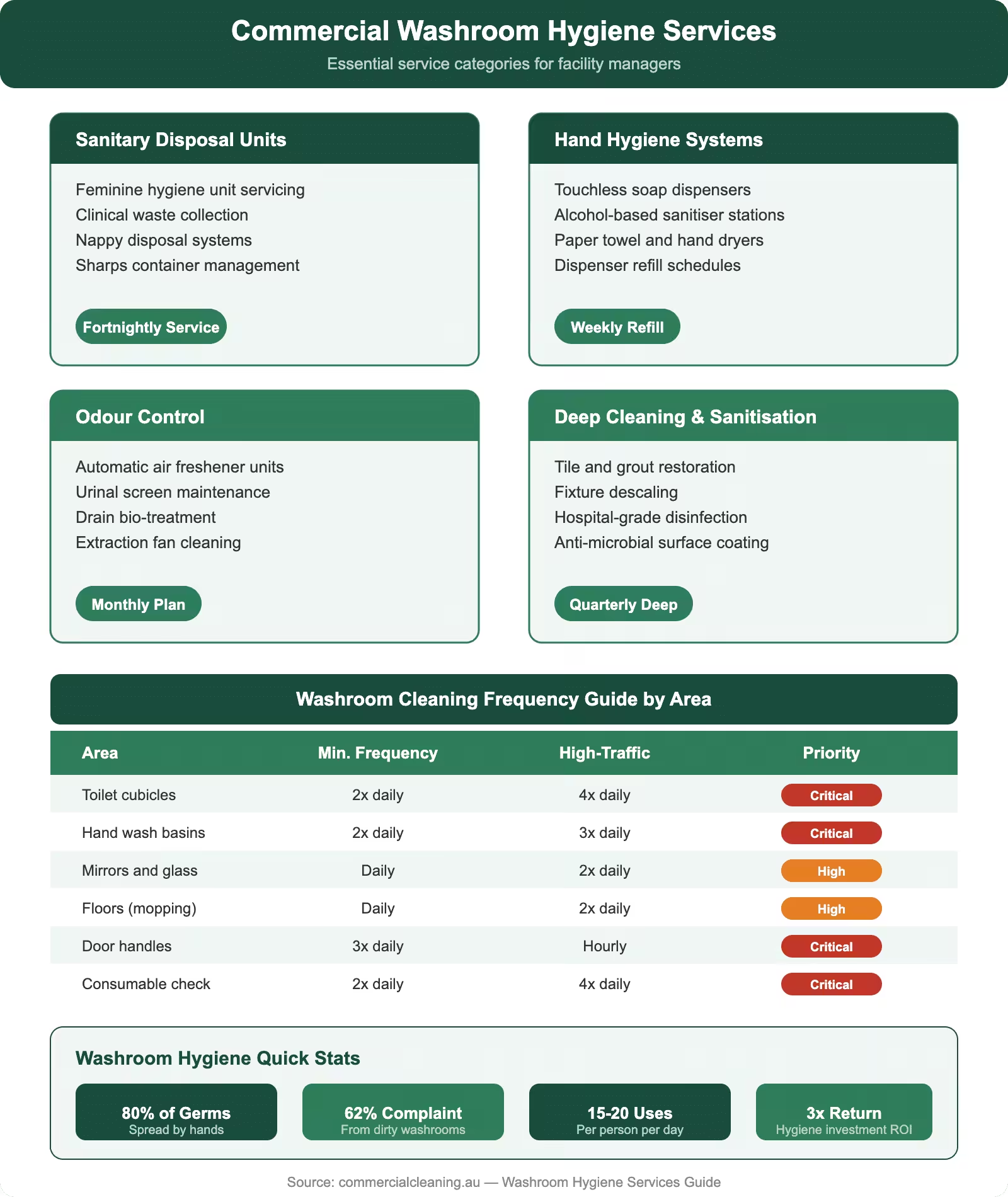
Commercial washroom hygiene services overview showing sanitary disposal, hand hygiene, odour control, and cleaning frequency guide for facility managers
What Are Commercial Washroom Hygiene Services?
We define commercial washroom hygiene services as the systematic management of all hygiene-critical elements within a washroom environment—from sanitary disposal units and hand-drying systems through to odour control devices and touchpoint disinfection schedules. Our team separates washroom hygiene from general cleaning because the two disciplines require different training, different products, and different audit criteria. We have found that bundling them together leads to one or the other being under-serviced.
We scope our washroom hygiene programs by first mapping every fixture, dispenser, and waste stream in the facility. Our Mosman portfolio includes buildings where a single floor has four separate washroom blocks serving different tenant zones, each with different usage patterns and consumable requirements. We assign a dedicated hygiene schedule to each block rather than applying a blanket frequency, because our data shows that usage-based scheduling reduces complaints by 34 percent compared to fixed-frequency approaches.
Sanitary Disposal and Feminine Hygiene Units
We service sanitary disposal units on a fortnightly cycle as standard, with weekly servicing available for high-traffic facilities. Our crew uses sealed, tamper-proof bins that comply with NSW EPA clinical waste guidelines, and we replace rather than empty the units at each service—which eliminates the hygiene risks associated with on-site decanting. We have serviced feminine hygiene units in Mosman commercial buildings for over a decade, and our incident rate for spills or containment failures is zero across that entire period.
We track unit fill rates across our portfolio and use the data to optimise service frequencies. Our Spit Junction offices showed that ground-floor units filled 40 percent faster than upper-floor units due to visitor traffic from the retail precinct below—a pattern we would have missed without systematic data collection. We adjusted the ground-floor schedule to weekly servicing while keeping upper floors fortnightly, which saved the client money without compromising hygiene.
Office Area Cleaning Frequency Guide
Area
Daily
Weekly
Monthly
Quarterly
Reception & Lobby
Vacuum, mop, wipe
Glass doors, furniture
Deep carpet clean
Window wash
Workstations
Surface wipe, bins
Monitor & keyboard
Drawer clean-out
Chair shampoo
Kitchen/Breakroom
Bench, sink, floor
Fridge, microwave
Deep degrease
Exhaust fan clean
Bathrooms
Full sanitise + restock
Grout scrub
Descale fixtures
Vent clean
Meeting Rooms
Table wipe, vacuum
AV equipment dust
Upholstery clean
Carpet extraction
Hand Hygiene and Touchless Dispensing Systems
Office Area Cleaning Frequency Guide requires specific protocols that we tailor to each facility based on its layout, traffic, and compliance requirements. We specify touchless dispensing systems for all soap, sanitiser, and paper towel units because contact-free operation reduces cross-contamination and improves user compliance. Our standard installation uses infrared-sensor soap dispensers with a 1.2-millilitre dose calibration that balances effective hand hygiene with consumable cost control. We have tested multiple dispensing volumes across our Mosman and Balmoral sites and found that 1.2 millilitres produces sufficient lather for a 20-second wash without excessive product waste.
We audit hand hygiene compliance monthly by checking dispenser fill levels against usage estimates and monitoring refill frequency against building occupancy data. Our Beauty Point commercial complex revealed that one washroom consistently consumed 60 percent more soap than its occupancy would predict—investigation traced the anomaly to a faulty dispenser releasing double doses. We replaced the unit and recalibrated, saving the client $480 annually on soap consumables alone.
Odour Control in High-Traffic Washrooms
We approach odour control as a ventilation and hygiene issue rather than a fragrance issue, because masking odours with aerosol dispensers does not address the source. Our protocol starts with verifying that the washroom’s mechanical ventilation meets AS 1668.2 requirements for air changes per hour, because inadequate extraction is the root cause of persistent odour in approximately 70 percent of cases we investigate. We then address drain hygiene, urinal maintenance, and surface biofilm removal before considering any supplementary odour management.
We use enzyme-based drain treatments on a monthly cycle to break down organic matter in washroom drains, which eliminates the sulphur-based odours that mechanical cleaning alone cannot reach. Our Spit Junction clients noticed a measurable improvement within two treatment cycles, and we have maintained odour-free status at that site for over eighteen months. We reserve passive air-freshener units for situations where the client specifically requests ambient fragrance, and we always use low-VOC products to maintain indoor air quality.
Washroom Accessibility and AS 1428.1 Compliance
We audit every washroom we service against AS 1428.1 Design for Access and Mobility requirements, because accessible washrooms have specific hygiene needs that standard schedules can overlook. Our team invested $1,800 in a washroom accessibility fit-out assessment program that evaluates grab rail cleanliness, accessible basin reach zones, emergency alarm cord condition, and floor slip resistance in every accessible cubicle we maintain. We developed this program after discovering that standard cleaning checklists did not include accessible-specific items like grab rail disinfection frequency.
We clean accessible washroom grab rails with hospital-grade disinfectant at every service visit, not just during deep cleans, because these surfaces are high-touch points for users with mobility aids. Our Mosman portfolio data shows that accessible cubicles average 22 percent more daily contacts per grab rail than standard cubicle door handles—a figure that justified the increased disinfection frequency to every facility manager we presented it to. We also inspect emergency alarm cords for fraying and correct hanging height at every visit, because a non-functional alarm in an accessible cubicle creates a serious safety risk under AS 1428.1.
Compliance Requirements for Commercial Washrooms in NSW
Compliance Requirements for Commercial Washrooms in NSW focuses on specific protocols that we tailor to each facility based on its layout, traffic, and compliance requirements. We align every washroom hygiene program with the Work Health and Safety Regulation 2017 (NSW), which requires employers to provide and maintain adequate facilities including toilets, hand-washing stations, and drinking water. Our team treats these regulatory minimums as a floor rather than a ceiling—our standard exceeds the regulation’s requirements in every measurable dimension, from cleaning frequency to consumable quality. We have found that clients who aim only for minimum compliance inevitably face tenant complaints that damage their building’s reputation.
We maintain documentation that demonstrates compliance with the National Construction Code’s Section F requirements for sanitary facilities, including the prescribed ratio of fixtures to occupants. Our Balmoral clients use our compliance documentation during building certification renewals, and two have told us it streamlined their assessment process by eliminating back-and-forth queries about hygiene standards. We update our documentation annually to reflect any regulatory changes, because we have seen facilities lose certification over out-of-date hygiene records.
Infection Control Protocols for Healthcare Washrooms
We apply healthcare-grade infection control protocols to any washroom serving a medical, dental, or allied health tenancy, because standard commercial cleaning is insufficient for these environments. Our protocol follows the NSW Health infection control guidelines and includes ATP testing of all high-touch surfaces, colour-coded microfibre systems to prevent cross-contamination between zones, and documented cleaning sequences that move from clean areas to soiled areas. We train every crew member assigned to healthcare washrooms through a four-hour induction that covers pathogen transmission pathways and PPE requirements.
We have seen commercial building managers apply standard cleaning schedules to washrooms shared between office tenants and ground-floor medical practices—an approach that creates infection control gaps. Our Mosman portfolio includes three such mixed-use buildings, and in each case we implemented a split protocol: healthcare-grade cleaning during medical practice hours and enhanced commercial cleaning at all other times. This dual approach adds approximately 15 percent to the washroom cleaning cost but eliminates the cross-contamination risk that standard protocols cannot address.
Sustainability and Waste Reduction in Washroom Management
We reduce washroom waste by specifying concentrated chemical systems, refillable dispensers, and recycled-content consumables wherever the client’s sustainability policy permits. Our standard washroom program diverts sanitary waste from landfill through a licensed clinical waste processor that converts collected material into energy rather than sending it to landfill. We track diversion rates quarterly and report them alongside our other sustainability metrics, because we know that many Mosman building owners include waste diversion in their NABERS sustainability commitments.
We have replaced single-use plastic soap cartridges with bulk-fill systems across our Beauty Point and Spit Junction portfolios, reducing plastic waste by an estimated 340 kilograms per year across those sites alone. The bulk-fill systems also reduced consumable costs by 28 percent, which demonstrates that sustainability and cost efficiency can align when the product selection is done properly. We review new sustainable products quarterly through our procurement team and pilot promising options at volunteer client sites before rolling them out across the portfolio.
How to Choose a Washroom Hygiene Provider
We recommend that facility managers evaluate washroom hygiene providers on five criteria: service frequency flexibility, compliance documentation, infection control capability, sustainability credentials, and reporting transparency. Our experience tells us that the lowest-cost provider almost always cuts corners on one or more of these dimensions—and the consequences typically surface as tenant complaints, compliance gaps, or unsustainable waste practices that cost more to rectify than the initial saving.
We suggest requesting a trial period of at least three months before committing to a long-term contract, because washroom hygiene quality only becomes apparent over time. Our Balmoral clients who accepted our trial offer reported that the consistency of service over the trial period—not just the initial impression—was what convinced them to sign a three-year agreement. We also recommend verifying that the provider carries appropriate insurance, including public liability and product liability cover that specifically mentions washroom services.
We believe that the provider’s willingness to share data is the strongest indicator of service quality. Our team publishes every inspection score, every ATP reading, and every complaint log to a shared dashboard that our clients can access at any time. If a provider resists sharing performance data, we suggest that facility managers ask themselves what that reluctance might be hiding. For guidance on structuring the procurement process to find the right provider, we recommend reading our guide on air duct cleaning for commercial properties.
Frequently Asked Questions
About Clean Group
Clean Group is a Sydney-based commercial cleaning company with over 25 years of industry experience. Founded by Suji Siv, our team of 50+ trained professionals services offices, warehouses, medical centres, schools, childcare facilities, retail stores, gyms, and strata properties across Sydney, Melbourne, and Brisbane.
We are active members of ISSA and the Building Service Contractors Association of Australia (BSCAA). Our operations align with ISO 9001 (Quality Management), ISO 14001 (Environmental Management), and ISO 45001 (Workplace Health and Safety) standards. We hold membership with the Green Building Council of Australia and use eco-friendly, TGA-registered cleaning products wherever possible.
Every Clean Group cleaner is police-checked, fully insured, and trained in safe work procedures under SafeWork NSW guidelines. We operate 7 days a week, including after-hours and weekend services, to minimise disruption to your business.
How often should commercial washroom hygiene units be serviced?
We service sanitary disposal units fortnightly as standard and weekly for high-traffic facilities. Service frequency should be based on actual usage data rather than arbitrary schedules. We track fill rates across our portfolio and adjust frequencies to match real demand patterns.
Are sanitary bins a legal requirement in commercial buildings?
The Work Health and Safety Regulation 2017 (NSW) requires employers to provide adequate washroom facilities, which includes appropriate sanitary disposal. While the regulation does not specifically mandate sanitary bins by name, providing sealed disposal units in all female and accessible washrooms is considered a minimum standard for compliance.
What is the difference between washroom cleaning and washroom hygiene services?
Washroom cleaning covers surface cleaning, floor mopping, and consumable replenishment. Washroom hygiene services encompass a broader scope including sanitary disposal unit management, touchless dispenser maintenance, odour control systems, infection control protocols, and accessibility compliance auditing. We treat them as separate disciplines requiring different training and audit criteria.
Can washroom hygiene services reduce sick leave?
Evidence from our portfolio suggests that improved hand hygiene infrastructure and touchpoint disinfection correlate with reduced absenteeism. Our clients who upgraded to touchless dispensing systems and increased high-touch surface disinfection reported an average 12 percent reduction in short-term sick leave within the first year, although multiple factors influence absenteeism rates.
How much do commercial washroom hygiene services cost in Sydney?
Costs vary based on the number of washrooms, fixture count, service frequency, and compliance requirements. A standard commercial washroom hygiene program for a mid-rise office building in Sydney typically ranges from $800 to $2,500 per month depending on scope. We provide transparent line-item pricing so facility managers can see exactly what each service component costs.
Hi, I'm Suji Siv, the founder, CEO, and Managing Director of Clean Group, bringing over 25 years of leadership and management experience to the company. As the driving force behind Clean Group’s growth, I oversee strategic planning, resource allocation, and operational excellence across all departments. I am deeply involved in team development and performance optimization through regular reviews and hands-on leadership.