How to Spot Quality in a Commercial Cleaner

11 Signs of a Good Cleaner: Professional Quality Indicators
11 Signs of a Good Cleaner covers specific protocols that we tailor to each facility based on its layout, traffic, and compliance requirements. We have hired, trained, supervised, and evaluated commercial cleaners for over fifteen years, and the qualities that separate a genuinely good cleaner from an average one are consistent regardless of the environment they work in. Our office cleaning services recruitment process identifies these qualities early because we learned through costly experience that technical skills can be taught but the fundamental attributes of a good cleaner are either present or they are not. We developed our quality indicator framework after analysing performance data across our cleaning teams in Matraville and surrounding suburbs, where the diversity of client environments gave us a detailed view of what makes certain cleaners consistently outperform their peers.
We wrote this guide for facility managers who need to evaluate cleaning providers and for cleaning business operators who want to benchmark their staff against professional standards. Our eleven indicators come from direct operational observation rather than theoretical ideals, and each one correlates with measurable quality outcomes in our performance data. We believe that understanding these signs helps everyone in the commercial cleaning supply chain make better decisions about the people responsible for maintaining workplace hygiene and presentation.
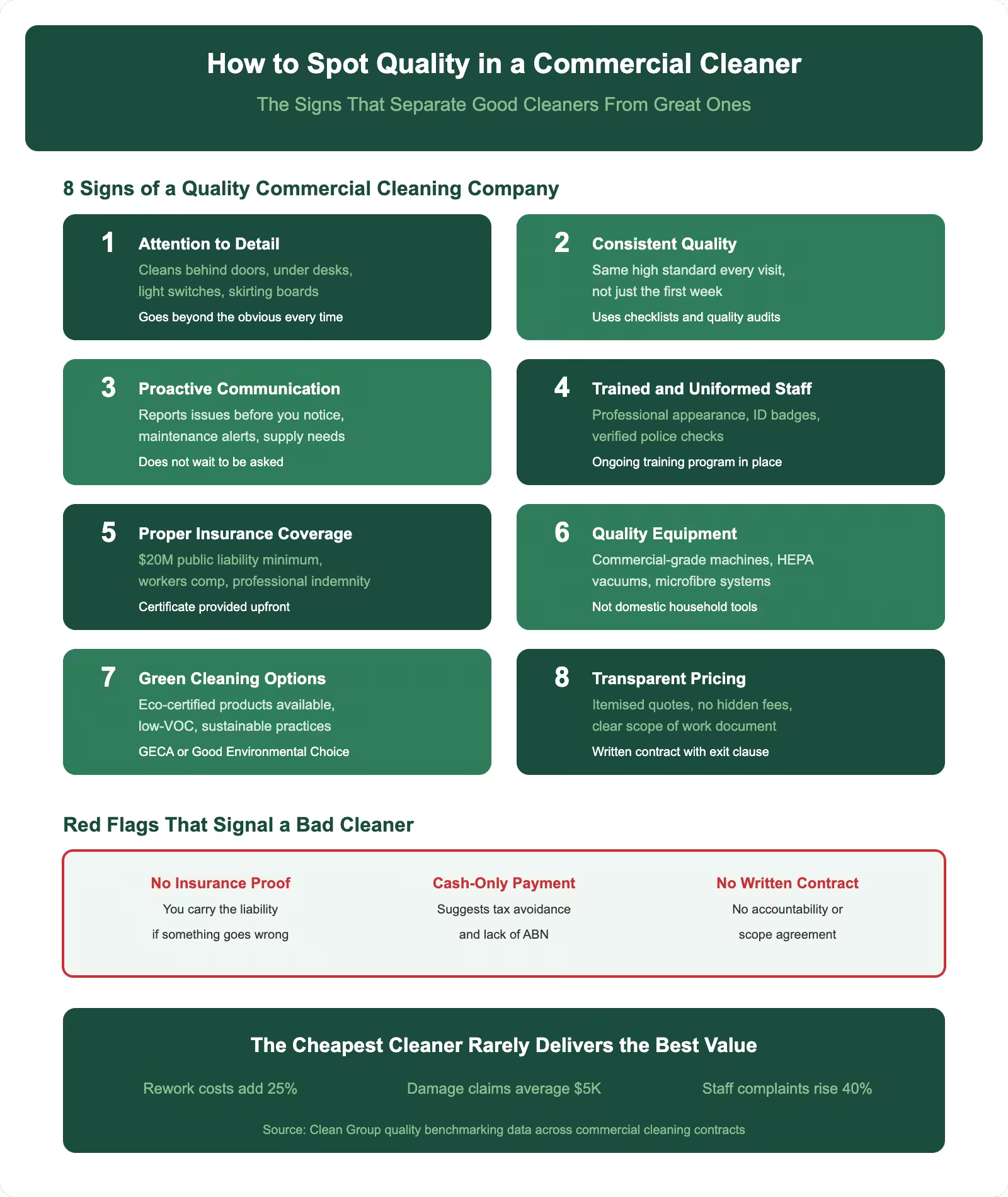
Sign 1: Attention to Detail That Goes Beyond the Obvious
Sign 1: Attention to Detail That Goes Beyond the Obvious involves specific protocols that we tailor to each facility based on its layout, traffic, and compliance requirements. We identify good cleaners by their instinct to notice and address details that average cleaners walk past without seeing. Our best team members consistently clean behind monitors, under desk edges, around power outlet plates, and along skirting junctions without being instructed because they have internalised a standard of thoroughness that drives their behaviour automatically. We track detail compliance across our teams using spot check audits, and our top performers in Malabar commercial sites score above 95 percent on detail items that are not included in the standard cleaning checklist but that clients notice and appreciate.
We test for attention to detail during our recruitment process by conducting practical assessments where candidates clean a prepared space containing deliberate detail challenges including fingerprints on glass partitions, dust on venetian blind slats, and marks on light switch plates. Our scoring system rewards candidates who identify and address these items without prompting, and we have found this practical assessment predicts on-the-job performance more accurately than any interview question or reference check. We refuse to compromise on this standard because our clients in La Perouse and surrounding areas expect the level of detail that only genuinely observant cleaners can deliver.
Office Area Cleaning Frequency Guide
| Area | Daily | Weekly | Monthly | Quarterly |
|---|---|---|---|---|
| Reception & Lobby | Vacuum, mop, wipe | Glass doors, furniture | Deep carpet clean | Window wash |
| Workstations | Surface wipe, bins | Monitor & keyboard | Drawer clean-out | Chair shampoo |
| Kitchen/Breakroom | Bench, sink, floor | Fridge, microwave | Deep degrease | Exhaust fan clean |
| Bathrooms | Full sanitise + restock | Grout scrub | Descale fixtures | Vent clean |
| Meeting Rooms | Table wipe, vacuum | AV equipment dust | Upholstery clean | Carpet extraction |
Sign 2: Consistent Performance Regardless of Supervision
Office Area Cleaning Frequency Guide requires specific protocols that we tailor to each facility based on its layout, traffic, and compliance requirements. We consider unsupervised consistency the hallmark of a truly good cleaner because anyone can perform well when they know the supervisor is watching. Our quality monitoring includes unannounced audits at random intervals, and the cleaners we rate highest are those whose scores show minimal variance between supervised and unsupervised visits. We have found that consistent performers share a common trait: they clean to satisfy their own standards rather than external expectations, which means their output remains steady regardless of who is or is not observing their work.
Sign 2: Consistent Performance Regardless of Supervision includes specific protocols that we tailor to each facility based on its layout, traffic, and compliance requirements. We measure this consistency using statistical variance analysis across our audit data, and our top-tier cleaners show score variance below 5 percent across twelve-month periods while average performers fluctuate by 15 to 20 percent. We use this data to inform our team assignments because clients who require the highest reliability levels receive our most consistent performers, and we have built long-term contracts in Matraville on the strength of this matching approach. We believe that consistency is ultimately about professional pride, and we hire people who take genuine satisfaction in delivering excellent work every single time.
Sign 3: Proper Chemical Knowledge and Safe Handling Practices
Sign 3: Proper Chemical Knowledge and Safe Handling Practices addresses specific protocols that we tailor to each facility based on its layout, traffic, and compliance requirements. We evaluate cleaners on their understanding of the chemicals they use because good cleaners know what each product does, why they use it, and what happens if they use it incorrectly. Our team members can explain the difference between a detergent, a disinfectant, and a sanitiser, and they understand why contact times matter for disinfection efficacy. We test chemical knowledge during induction and through annual refresher assessments because we have encountered experienced cleaners from other companies who could not identify the hazard symbols on their own chemical containers, which represents a safety failure that we find unacceptable.
We also assess practical chemical handling skills including correct dilution procedures, appropriate PPE selection for each chemical class, and proper storage and disposal practices. Our team references AS 3000 electrical safety standards when working near electrical equipment because chemical spills near electrical infrastructure create compound hazards that require specific response protocols. We encountered a situation at a Malabar office where a cleaner from a previous provider had sprayed glass cleaner directly onto a live power distribution board, and the resulting short circuit caused a building-wide power outage. Our training specifically addresses these scenarios because good cleaners understand that chemical safety extends beyond personal protection to environmental awareness.
Sign 4: Time Management and Efficient Work Patterns
We observe that good cleaners complete their assigned areas within allocated timeframes without rushing or cutting corners, which requires an efficient work pattern that minimises wasted movement and unnecessary backtracking. Our best performers follow systematic cleaning routes that they have optimised through experience, and they maintain a pace that looks unhurried but covers ground efficiently because they have eliminated the hesitation and indecision that slows less experienced cleaners. We time our cleaning processes across all sites and our top performers consistently finish within 90 to 95 percent of allocated time while achieving higher quality scores than colleagues who use the full allocation.
We have found that efficient cleaners share a common approach to workspace organisation: they prepare all equipment and chemicals before entering a cleaning area, they work in consistent directional patterns, and they handle each surface once rather than returning to rework areas they have already covered. We train these efficiency principles but our data shows that the cleaners who adopt them most naturally are those who display the organisational thinking and spatial awareness that characterise high performers across many disciplines.
Sign 5: Proactive Communication About Issues and Maintenance Needs
We value cleaners who report problems proactively because our experience shows that early identification of maintenance issues prevents escalation that costs our clients significantly more to resolve later. Our best team members report leaking taps, damaged ceiling tiles, flickering lights, pest evidence, and safety hazards as part of their routine service because they understand that their nightly presence in otherwise unoccupied spaces makes them the first line of observation for building maintenance. We have saved our La Perouse clients thousands of dollars in water damage costs because our cleaners reported slow leaks within hours of their first appearance rather than weeks later when visible damage had already occurred.
We also expect good cleaners to communicate openly about supply levels, equipment issues, and scope concerns rather than working around problems silently. Our team members flag when consumable stocks are running low, when equipment is not performing correctly, or when a new contamination source has appeared that the current cleaning scope does not address. We have built our reputation on this proactive communication because it transforms the cleaning service from a passive labour function into an active facility monitoring partnership that delivers value beyond clean surfaces.
Cost of Employing Quality Cleaners vs Budget Alternatives
We have calculated the total cost differential between employing good cleaners at appropriate rates and cycling through budget alternatives who cannot meet professional standards, and our data consistently shows that quality costs less over any period longer than three months. Our investment in a well-trained, properly equipped commercial cleaner for a standard office environment runs approximately $640 per week including wages, superannuation, insurance, equipment, chemicals, and supervision, and this investment delivers consistent results that eliminate the rework, client complaints, and contract losses that budget approaches inevitably generate.
We encourage facility managers to evaluate cleaning providers on total value rather than hourly rate because our experience across hundreds of contracts shows that the cheapest cleaner almost never delivers the lowest total cost. Our team has taken over contracts in Matraville where the previous budget provider’s inadequate cleaning had allowed soil accumulation that required expensive deep cleaning to rectify before our regular program could begin, and that remediation cost exceeded the annual savings the client thought they were achieving with cheaper rates. We believe quality cleaning is an investment that protects property value, occupant health, and professional reputation, and we encourage property managers to explore the pre-hire cleaning questions to make confident decisions.
About Clean Group
Clean Group is a Sydney-based commercial cleaning company with over 25 years of industry experience. Founded by Suji Siv, our team of 50+ trained professionals services offices, warehouses, medical centres, schools, childcare facilities, retail stores, gyms, and strata properties across Sydney, Melbourne, and Brisbane.
We are active members of ISSA and the Building Service Contractors Association of Australia (BSCAA). Our operations align with ISO 9001 (Quality Management), ISO 14001 (Environmental Management), and ISO 45001 (Workplace Health and Safety) standards. We hold membership with the Green Building Council of Australia and use eco-friendly, TGA-registered cleaning products wherever possible.
Every Clean Group cleaner is police-checked, fully insured, and trained in safe work procedures under SafeWork NSW guidelines. We operate 7 days a week, including after-hours and weekend services, to minimise disruption to your business.
About the Author

Suji Siv
/

Hi, I'm Suji Siv, the founder, CEO, and Managing Director of Clean Group, bringing over 25 years of leadership and management experience to the company. As the driving force behind Clean Group’s growth, I oversee strategic planning, resource allocation, and operational excellence across all departments. I am deeply involved in team development and performance optimization through regular reviews and hands-on leadership.
Read More About Suji 0291607469
 Get A Quote