When a commercial office cleaners contract involves a government department or corporate tenancy with restricted areas, the requirements go well beyond mops and microfibre cloths. Our team at Clean Group has serviced federal and state government offices across Sydney for over fifteen years, and every one of those contracts has required security-cleared staff, documented access protocols, and compliance frameworks that most cleaning providers never encounter. This guide covers what facilities managers need to know before engaging a cleaning contractor for any building where security clearances apply.
What Makes Government and Corporate Cleaning Different
What Makes Government and Corporate Cleaning Different covers specific protocols that we tailor to each facility based on its layout, traffic, and compliance requirements. We have cleaned government tenancies in Parramatta, the Sydney CBD, and at various Commonwealth buildings across the greater Sydney region, and the operational difference between a standard commercial office clean and a secure government facility is significant. The cleaning itself — vacuuming, mopping, bathroom sanitisation — is identical. What changes is everything around it: who is allowed on site, how they get in, what they can touch, what leaves the building, and how every one of those steps is documented.
Most commercial cleaning companies quote on government tenders without fully understanding these requirements. We have seen competitors win contracts at low margins only to discover that the cost of vetting, training, and managing a security-cleared workforce eats into the budget they did not plan for. We learned this early in our own operations and now price government work as a distinct category with its own cost structure.
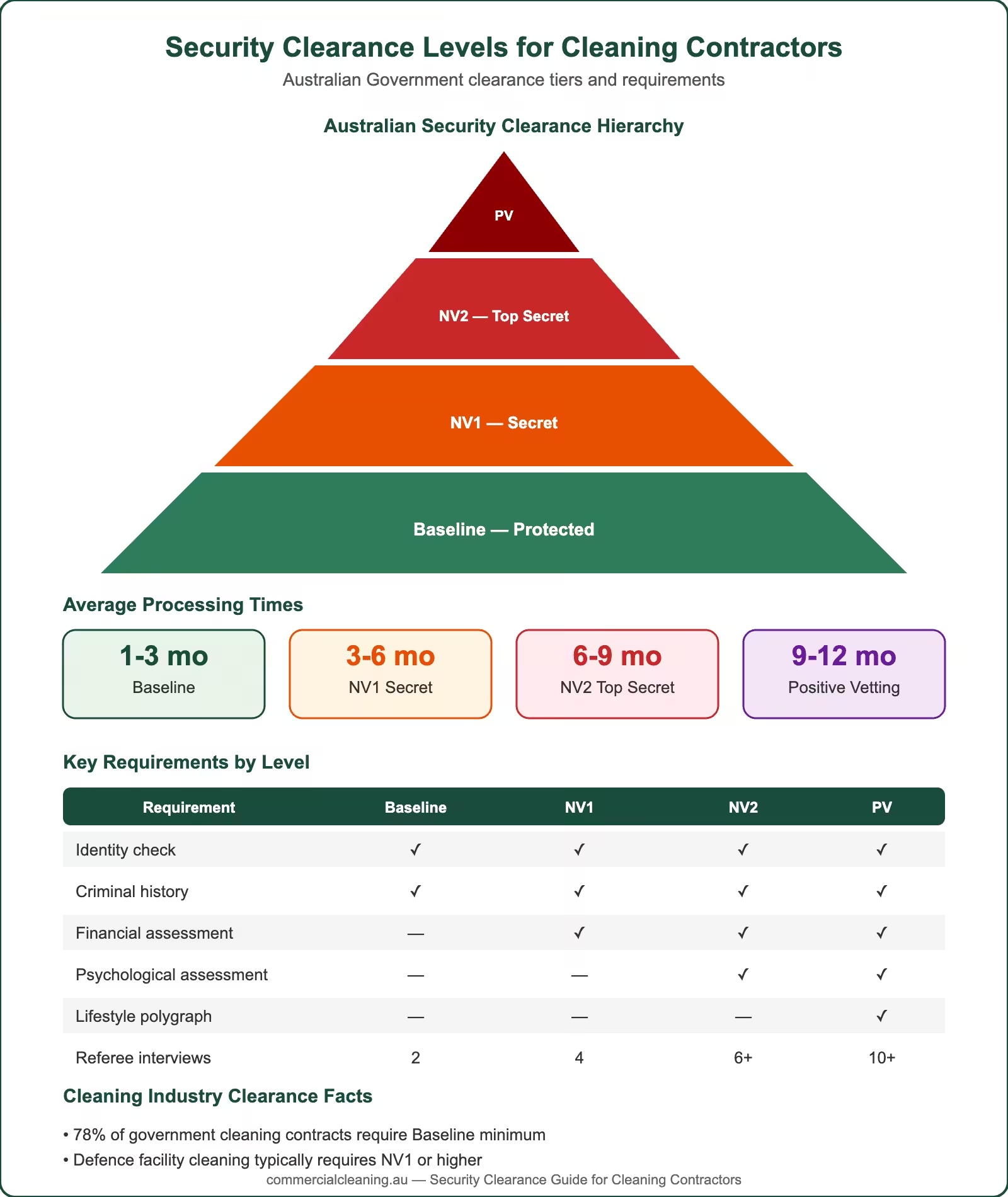
Security clearance levels for cleaning contractors in Australia infographic showing clearance hierarchy, processing times, requirements, and industry statistics
Security Clearance Levels for Cleaning Contractors in Australia
The Australian Government Security Vetting Agency (AGSVA), which sits within the Department of Defence, administers all government security clearances. Cleaning staff working in government premises need clearance levels that match the classification of the areas they will access. There are three tiers that apply to cleaning contractors.
Baseline Clearance
This is the entry-level clearance for accessing premises where PROTECTED-level information is stored or discussed. The vetting process includes identity verification, a criminal history check, a financial background assessment, and a review of the applicant’s personal associations. AGSVA currently processes Baseline clearances in approximately eight to twelve weeks, though we have experienced longer wait times during periods of high demand. Our operations team starts the paperwork for new staff the day they are assigned to a government contract so the clearance is in place well before their first shift.
Negative Vetting Level 1 (NV1)
NV1 clearance grants access to SECRET-classified areas and information. The vetting process is more intensive — it includes everything in a Baseline check plus a psychological assessment, detailed referee interviews, and an examination of the applicant’s overseas travel and contacts. Processing times run twelve to twenty weeks. In practice, very few commercial cleaning roles require NV1, but we maintain a small pool of NV1-cleared staff specifically for contracts that demand it. One Defence tenancy in the CBD required all after-hours contractors to hold NV1 minimum, including the cleaning team.
Negative Vetting Level 2 (NV2)
NV2 is the highest clearance level available to contractors and covers TOP SECRET areas. The assessment includes a full lifestyle polygraph in some cases, extensive background investigation going back ten or more years, and ongoing monitoring obligations. Processing can take six months or longer. We do not routinely carry NV2-cleared cleaning staff — the demand is rare and the vetting investment is substantial — but we can sponsor the process for specific contract requirements with sufficient lead time.
The Protective Security Policy Framework and Cleaning Contractors
Every Australian Government entity operates under the Protective Security Policy Framework, or PSPF, which replaced the earlier Australian Government Protective Security Manual in 2018. The PSPF sets out sixteen core requirements across governance, information, personnel, and physical security — and several of these directly affect how cleaning contractors operate inside government premises.
PSPF Policy 11 covers Strong ICT Systems, and while that sounds unrelated to cleaning, it means our teams cannot plug any device — including floor scrubbers with USB charging ports — into government network points. We brief every team member on this during their site induction. PSPF Policy 12 covers eligibility and suitability of personnel, which is the policy that drives the clearance requirements outlined above. Policy 8 covers sensitive and classified information, which directly governs how our teams handle waste in secure areas.
Security Zone Access Protocols for Cleaning Teams
Government and high-security corporate buildings divide their floor plates into zones with different access classifications. Our cleaning schedule for each zone has to match the access protocol — we cannot simply send a crew through the building from top to bottom the way we would in a standard commercial office.
Zone Classification and Cleaning Access
Zone Type
Typical Access
Cleaning Protocol
Public zone (Zone 1)
No clearance required
Standard commercial cleaning procedures
Administrative zone (Zone 2)
Baseline clearance or escort
Cleaning during approved hours only, desk surfaces cleared by staff beforehand
Secure zone (Zone 3)
NV1 minimum, logged entry and exit
Escorted cleaning, no access to locked cabinets or safes, classified waste handled separately
Restricted zone (Zone 4)
NV2 required, continuous escort
Cleaning only during specified windows with facility security officer present
Escort Requirements in Restricted Areas
In Zones 3 and above, our cleaners work with a government-appointed escort present at all times. The escort monitors which areas are accessed, confirms that no classified material is visible during the clean, and signs off on the completion of each room. This slows the work — a floor that takes our team ninety minutes unescorted takes two and a half hours with escort protocols — and we factor that into our pricing and scheduling from the start. Trying to absorb escort time into a standard cleaning rate is one of the common mistakes we see competitors make on government tenders.
We also coordinate cleaning times with the building’s security operations centre. Some zones can only be cleaned during specific windows — either when staff are present to supervise or during designated contractor access periods. Our scheduling team maintains a separate shift calendar for each government site that accounts for these windows, public holidays when access is restricted, and any temporary security upgrades such as during parliamentary sitting periods or high-profile visits.
Secure Waste Handling for Government Premises
Waste disposal in a secure building is not the same as emptying bins in a regular office. Government waste falls into categories — general waste, recyclable waste, and classified waste — and our teams must handle each category through separate streams that never mix. Classified waste includes anything with PROTECTED markings or above, and it goes into locked console bins that our cleaners empty into sealed bags for destruction by an approved provider. Our staff never open, read, or sort classified waste. The sealed bags go directly to the building’s secure destruction point.
We invested in staff training specifically for this after an incident at another company’s site — not ours — where a cleaner emptied a classified waste console into a general waste bag. The resulting security breach investigation shut the floor down for two days. Our induction for government sites now includes a twenty-minute practical module on waste stream identification, and every team member signs a declaration confirming they understand the handling requirements.
Insurance and Compliance Requirements for Secure Site Cleaning
Insurance and Compliance Requirements for Secure Site Cleaning targets specific protocols that we tailor to each facility based on its layout, traffic, and compliance requirements. Government and corporate tenancies with security classifications typically require higher insurance coverage than standard commercial offices. Our public liability policy runs to fifteen million dollars, which meets the threshold for most Commonwealth and NSW Government tenancies. Workers compensation coverage is mandatory under NSW legislation regardless, but government contracts also typically require us to demonstrate current certificates of currency before each contract renewal.
Beyond insurance, we maintain documented compliance with SafeWork NSW requirements under the WHS Act 2011, including site-specific safe work method statements for every government premises we service. Our chemical register meets AS 2243.4 standards, and we carry Safety Data Sheets for every product our team uses on site — a requirement that government building managers audit more rigorously than any private-sector client we have worked with.
If your facility requires cleaning staff with active security clearances, our team can discuss the specific requirements for your site and clearance level, including cleaning specifications tailored to secure environments.
Frequently Asked Questions
Do all cleaning staff need security clearances for government buildings?
It depends on the zone classification of the areas being cleaned. Public reception areas and common lobbies in Zone 1 can often be serviced by uncleared staff, while anything from Zone 2 upward — where PROTECTED or classified information may be present — requires a minimum Baseline clearance. The specific building’s security plan dictates the requirements, and we confirm the clearance level needed during our initial site assessment before assigning staff.
How long does it take to get a Baseline security clearance for cleaning staff?
AGSVA currently processes Baseline clearances in approximately eight to twelve weeks, though this can stretch during peak vetting periods. We start the application process as soon as a staff member is nominated for a government contract so the clearance is finalised before their scheduled start date. Incomplete applications are the most common cause of delays — our HR team reviews every submission for accuracy before lodging it with AGSVA.
Who pays for cleaning staff security clearances?
The sponsoring organisation typically covers AGSVA vetting fees. In most government cleaning contracts, the cleaning company acts as sponsor and absorbs the vetting cost into their contract pricing. We build clearance costs into our government tender pricing from the outset rather than treating them as a hidden expense. For larger contracts requiring ten or more cleared staff, this is a material cost line that should appear in the tender pricing schedule.
What happens if a cleared cleaner leaves the company mid-contract?
The clearance is held by the individual but sponsored by the employer. When a cleared staff member leaves, we notify AGSVA and the clearance is suspended. We then nominate and sponsor a replacement through the vetting process. For critical contracts, we maintain a standby pool of Baseline-cleared staff who can fill gaps while replacement clearances are processed, which avoids service disruption on the contract.
Can a cleaning company hold a facility clearance in Australia?
Yes. A facility security clearance, or FSC, is granted to organisations that need to access, store, or handle classified information and assets. It requires the company to demonstrate physical security measures at their premises, IT security compliance, and personnel security management processes. We hold a current facility clearance that allows us to tender for and service government contracts with classified requirements, which is a prerequisite for many Defence and intelligence community cleaning tenders.
About Clean Group
Clean Group is a leading commercial cleaning company in Sydney, providing professional cleaning services to offices, strata buildings, medical facilities, schools, gyms, and retail spaces across the greater Sydney region. With over 25 years of experience and a commitment to WHS compliance, eco-friendly practices, and consistent quality, Clean Group delivers tailored cleaning solutions backed by a 100% satisfaction guarantee.
Hi, I'm Suji Siv, the founder, CEO, and Managing Director of Clean Group, bringing over 25 years of leadership and management experience to the company. As the driving force behind Clean Group’s growth, I oversee strategic planning, resource allocation, and operational excellence across all departments. I am deeply involved in team development and performance optimization through regular reviews and hands-on leadership.