Warehouse Racking & Shelving Cleaning
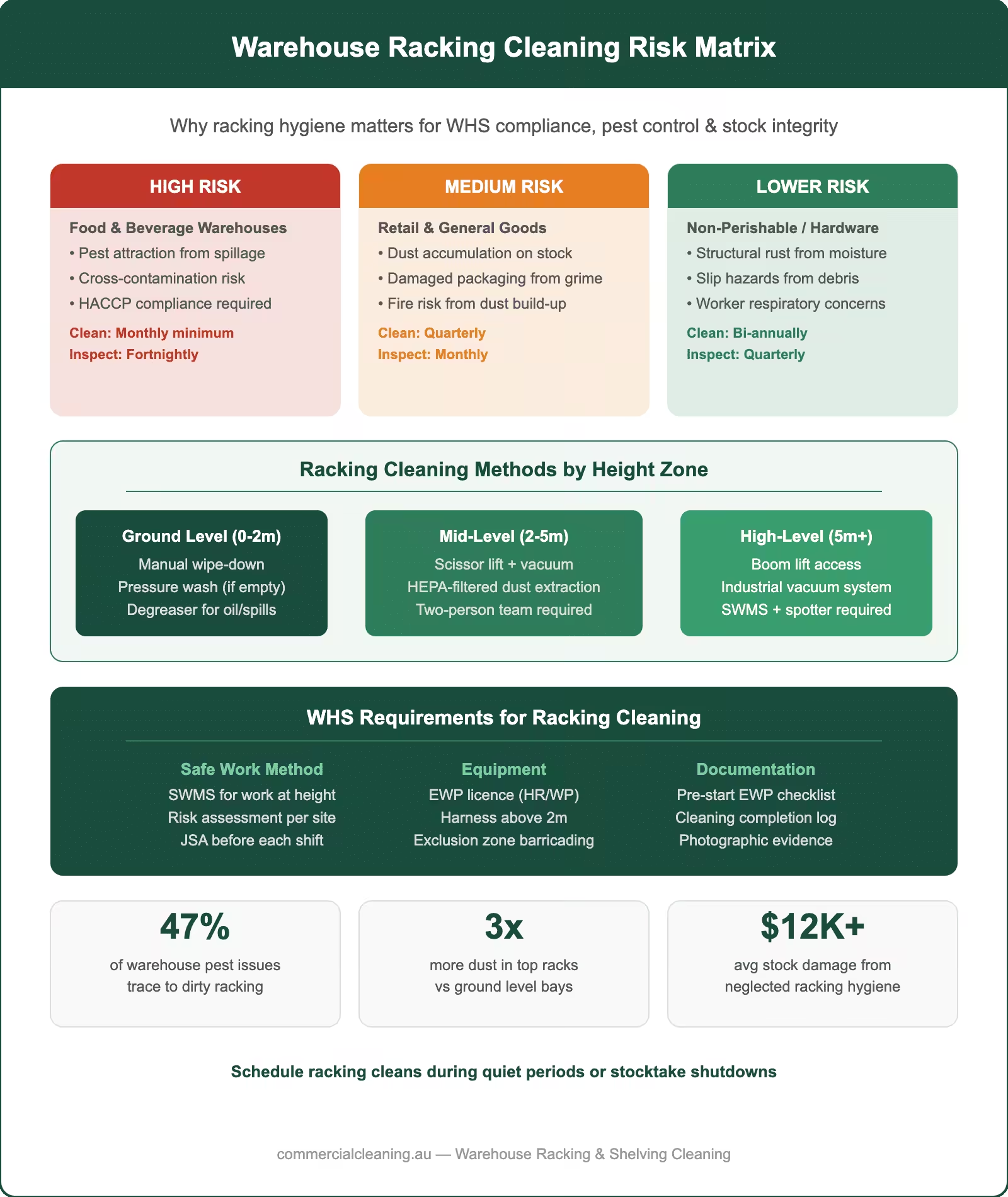
We clean warehouse racking systems that most cleaning companies will not touch because they do not have the equipment, the training, or the understanding of what is actually involved. Our team at Clean Group works as a specialist warehouse cleaning company that includes racking cleaning as a core service rather than an afterthought, and we have developed our racking cleaning methods through years of hands-on work in distribution centres across Sydney. When we first started offering racking cleaning services to our Horsley Park warehouse clients, we were genuinely shocked by the volume of dust and debris that had accumulated on racking crossbeams, uprights, and safety components — in some facilities, the dust layer on top-level beams was over two centimetres thick.
For more insights, see our guide on warehouse sweeping and scrubbing.
Why Racking Cleaning Matters More Than You Think
We find that most warehouse operators underestimate the importance of racking cleaning because the contamination is above eye level and easy to ignore. Our experience across Cecil Park distribution centres has taught us that neglected racking creates three serious problems: fire risk from combustible dust accumulation on overhead services and sprinkler pipework, structural inspection difficulty because damage and corrosion are hidden under layers of dirt, and product contamination from dust falling onto stored goods during picking and replenishment activities. We have cleaned racking systems where the dust accumulation was so heavy that structural damage to uprights was completely invisible until our cleaning revealed significant impact marks and corrosion.
Our teams also understand the compliance dimension of racking cleaning. AS 4084 governs the design, manufacture, assembly, and use of steel storage racking, and this standard includes requirements for regular structural inspections. We have found that meaningful inspections are impossible when racking components are coated in dust and debris, which means neglected cleaning directly undermines the facility’s compliance with AS 4084. Our cleaning service supports our clients’ racking inspection programs by ensuring all structural components are visible and accessible for assessment, and several of our Kemps Creek clients schedule our racking cleaning immediately before their annual structural inspection to confirm the inspector can properly evaluate every component.
Our Racking Cleaning Method
We use a systematic top-down approach to racking cleaning because gravity is both our friend and our enemy in this work. Our teams start at the highest beam level and work down, capturing displaced dust and debris as it falls onto lower levels. We use industrial vacuum systems with extended wand attachments that allow our operators to reach racking crossbeams from ground level for standard height racking, and we deploy scissor lifts for racking systems that exceed our vacuum reach. Our Horsley Park teams have refined this technique to the point where we can clean a standard selective racking bay — both sides, all beam levels — in approximately 15 minutes per bay.
Our cleaning includes all racking components, not just the crossbeams that accumulate the most visible dust. We clean uprights, bracing members, base plates, safety clips, and rack protection barriers because contamination on any of these elements can mask damage that compromises structural integrity. We pay particular attention to base plates where moisture can accumulate under dust layers, creating corrosion conditions that weaken the racking’s connection to the floor. We have documented base plate corrosion in several Cecil Park warehouses that was only discovered during our cleaning, and in two cases the corrosion was severe enough to require immediate engineering assessment.
Warehouse Cleaning Zone Guide
| Zone | Frequency | Method | Equipment | WHS Compliance |
|---|---|---|---|---|
| Loading Dock | Daily | Sweep + degrease spills | Ride-on sweeper | AS 4586 slip rating |
| Storage Aisles | Weekly | Machine sweep + scrub | Walk-behind scrubber | WHS clear aisle reg |
| Mezzanine/Office | Daily | Vacuum + wipe | Standard commercial | General duty of care |
| Washdown Bay | After each use | Pressure wash + drain clear | Pressure washer | EPA trade waste |
| External Hardstand | Monthly | Pressure wash | Industrial pressure unit | EPA stormwater |
Cleaning Different Racking Types
Warehouse Cleaning Zone Guide requires specific protocols that we tailor to each facility based on its layout, traffic, and compliance requirements. We adjust our method for different racking configurations because selective pallet racking, drive-in racking, cantilever racking, and mezzanine racking each present unique cleaning challenges. Our teams in Kemps Creek service warehouses with all these racking types, and we have developed specific protocols for each. Drive-in racking is the most challenging because the rail system and guide channels collect debris that affects pallet positioning, and the confined space between lanes limits equipment access. We use narrow-profile vacuum attachments and hand-held tools for drive-in systems, which is more labour-intensive but necessary for thorough cleaning.
Cantilever racking systems used for long or irregular product storage require different access methods because the open design means contamination accumulates on the arms and decking rather than on crossbeams. Our teams can often reach cantilever components with telescopic tools from the aisle, which is faster and safer than using elevated work platforms. We have found that cantilever systems in outdoor or semi-outdoor areas of Horsley Park warehouse facilities accumulate contamination faster due to weather exposure, and we adjust our cleaning frequency accordingly.
Cost and Scheduling for Racking Cleaning
We price racking cleaning based on the number of bays, the racking height, the racking type, and the level of contamination, because a simple per-square-metre rate would not reflect the actual work involved. Our 2024 pricing data shows that a detailed racking cleaning program for a typical warehouse in the Horsley Park, Cecil Park, or Kemps Creek industrial areas costs approximately $2,490 per quarter for a facility with 200 to 400 selective racking bays. We recommend quarterly racking cleaning for most warehouses, with monthly frequency for facilities that handle dusty products like paper, cardboard, or food ingredients.
We schedule racking cleaning during low-activity periods because our teams need clear access to aisles, and picking operations cannot continue safely while cleaning is underway above stored product. Our preferred approach is to clean one aisle at a time over several visits rather than attempting to clean the entire racking system in a single session. This minimises disruption and allows the warehouse to continue operating in aisles that are not being cleaned. We coordinate timing with our clients’ receiving and dispatch schedules to verify we are working in aisles that are not needed for immediate order fulfilment.
We encourage every warehouse operator to include racking cleaning in their maintenance program because the risks of neglect — hidden structural damage, fire hazard from dust, and product contamination — far outweigh the cost of regular cleaning. For a detailed look at all warehouse cleaning methods including sweeping, scrubbing, and degreasing, see our next guide in our warehouse cleaning series.
Frequently Asked Questions
How often should warehouse racking be cleaned?
We recommend quarterly cleaning for most warehouses and monthly for facilities handling dusty products like paper, cardboard, or food ingredients. Our cleaning frequencies are based on contamination accumulation rates we have measured across different warehouse types and product categories.
How much does racking cleaning cost?
Our data shows approximately $2,490 per quarter for a facility with 200 to 400 selective racking bays. We price based on bay count, racking height, type, and contamination level rather than simple per-square-metre rates. Drive-in racking costs more due to confined space access requirements.
Can the warehouse operate during racking cleaning?
We clean one aisle at a time over several visits to minimise disruption. Picking and storage operations continue in aisles not being cleaned. We coordinate with receiving and dispatch schedules to work in aisles not needed for immediate order fulfilment.
Why is racking cleaning important for structural compliance?
AS 4084 requires regular structural inspections of steel storage racking, and meaningful inspections are impossible when components are coated in dust. Our cleaning ensures all structural elements are visible for assessment, and clients often schedule our service before annual structural inspections.
What racking types do you clean?
We clean selective pallet racking, drive-in racking, cantilever racking, and mezzanine systems. Each type has specific protocols — drive-in requires narrow-profile tools for confined spaces, while cantilever systems can often be reached with telescopic tools from the aisle.
Can racking dust cause fire risks?
We have documented combustible dust accumulation on overhead services and sprinkler pipework that creates genuine fire risk. Our cleaning keeps dust below hazardous levels and ensures fire detection and suppression systems are unobstructed and functional.
Do you check for racking damage during cleaning?
We identify and report visible structural damage, impact marks, and corrosion as part of our cleaning service. We have discovered hidden damage including base plate corrosion severe enough to require immediate engineering assessment that was only visible after dust removal.
How long does racking cleaning take?
We clean a standard selective racking bay — both sides, all beam levels — in approximately 15 minutes per bay. A 200-bay warehouse typically requires multiple visits spread across the quarter. Drive-in and cantilever systems take longer due to access complexity.
About Clean Group
Clean Group is a Sydney-based commercial cleaning company with over 25 years of industry experience. Founded by Suji Siv, our team of 50+ trained professionals services offices, warehouses, medical centres, schools, childcare facilities, retail stores, gyms, and strata properties across Sydney, Melbourne, and Brisbane.
We are active members of ISSA and the Building Service Contractors Association of Australia (BSCAA). Our operations align with ISO 9001 (Quality Management), ISO 14001 (Environmental Management), and ISO 45001 (Workplace Health and Safety) standards. We hold membership with the Green Building Council of Australia and use eco-friendly, TGA-registered cleaning products wherever possible.
Every Clean Group cleaner is police-checked, fully insured, and trained in safe work procedures under SafeWork NSW guidelines. We operate 7 days a week, including after-hours and weekend services, to minimise disruption to your business.
About the Author

Suji Siv
/

Hi, I'm Suji Siv, the founder, CEO, and Managing Director of Clean Group, bringing over 25 years of leadership and management experience to the company. As the driving force behind Clean Group’s growth, I oversee strategic planning, resource allocation, and operational excellence across all departments. I am deeply involved in team development and performance optimization through regular reviews and hands-on leadership.
Read More About Suji 0291607469
 Get A Quote