PPE Requirements for Cleaners in Australia: What the Law Requires
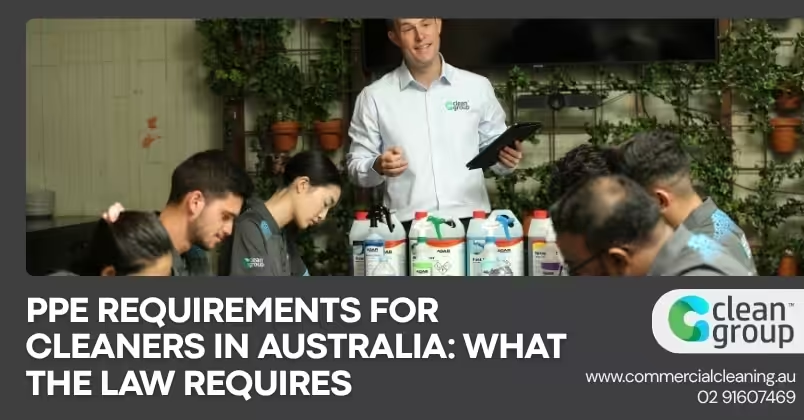
We supply and maintain PPE for every cleaner on our roster, and the legal framework behind those requirements is something we have navigated across dozens of commercial cleaners sydney contracts since 2006. The Work Health and Safety Act 2011 (NSW) places a duty on persons conducting a business or undertaking (PCBUs) to provide adequate personal protective equipment when risks cannot be eliminated through higher-order controls. Our Campbelltown depot stocks PPE for a forty-two-person cleaning workforce servicing commercial offices, medical suites, childcare centres, and industrial facilities across the Macarthur region. We budget approximately $1,850 per year for a ten-person team on PPE alone — gloves, eyewear, respirators, aprons, and non-slip footwear — and every dollar is justified by the alternative: exposure incidents, workers compensation claims, and SafeWork NSW penalty notices.
For more insights, see our guide on commercial cleaning Sydney.
For more insights, see our guide on workplace health and safety compliance.
Legal Framework: WHS Act and Hierarchy of Controls
Legal Framework: WHS Act and Hierarchy of Controls covers specific protocols that we tailor to each facility based on its layout, traffic, and compliance requirements. We approach PPE as the last line of defence, not the first. The WHS Regulation 2017 (NSW) requires PCBUs to work through the hierarchy of controls before relying on personal protective equipment: elimination, substitution, isolation, engineering controls, administrative controls, and finally PPE. For cleaning operations, this means we first assess whether a less hazardous chemical can achieve the same result (substitution), then whether ventilation or enclosed dispensing systems reduce exposure (engineering), before specifying PPE for residual risks. Our Campbelltown safety officer documents this hierarchy assessment for every chemical product on the approved list.
SafeWork NSW issued 147 improvement notices to cleaning contractors across the state in the 2023-24 financial year, and thirty-one per cent related to inadequate PPE provision or training. Our compliance record is clean — zero notices across all sites since 2019 — because we treat PPE as a managed system rather than a box of gloves left in a cupboard. Every item has a specification, a replacement schedule, and a training requirement attached to it.
Chemical-Resistant Gloves: Selection and Standards
Chemical-Resistant Gloves involves specific protocols that we tailor to each facility based on its layout, traffic, and compliance requirements. We stock three glove types across our Campbelltown depot to cover the full range of cleaning chemicals our teams use. For general-purpose cleaning with neutral detergents and glass cleaners, we issue nitrile examination gloves (AS/NZS 4011.1 compliant) that provide adequate barrier protection and dexterity. For acidic bathroom cleaners and alkaline degreasers, we upgrade to chemical-resistant nitrile gauntlets tested to AS/NZS 2161.10.1 (protective gloves against chemicals and micro-organisms — resistance to permeation). For solvent-based products used in graffiti removal and adhesive stripping, we specify butyl rubber gloves rated for the specific chemical class.
We replace gloves on a schedule rather than waiting for visible degradation. Our standard replacement cycle is: examination gloves after every shift, chemical-resistant gauntlets every two weeks or immediately after contact with concentrated product, and solvent-rated gloves monthly. Our Campbelltown storeman tracks glove consumption per site and flags any anomalies — if a site is burning through gloves faster than expected, it usually indicates a chemical handling issue that needs investigation rather than just more gloves.
Office Area Cleaning Frequency Guide
Office Area Cleaning Frequency Guide requires specific protocols that we tailor to each facility based on its layout, traffic, and compliance requirements. We require safety eyewear for any cleaning task involving spray application of chemicals, decanting of concentrated products, or high-pressure washing. Our standard-issue safety glasses comply with AS/NZS 1337.1 (Personal Eye Protection — Eye and Face Protectors for Occupational Applications) and carry a medium-impact rating. For tasks involving splashback risk — such as bathroom descaling with hydrochloric acid-based products — we upgrade to chemical splash goggles with indirect ventilation that form a sealed barrier around the eye socket.
We learned the importance of proper eye protection specification after a near-miss at a Campbelltown medical centre in 2022 where a cleaner using standard safety glasses experienced splashback from a bleach solution during toilet bowl cleaning. The open sides of the glasses allowed the splash to reach the eye area. We immediately switched to sealed goggles for all bleach and acid applications and retrained every team member on the distinction between impact protection and chemical splash protection. The cost difference between standard glasses ($8.50 per pair) and sealed goggles ($14.20 per pair) is negligible compared to the injury risk.
Respiratory Protection for Cleaning Operations
Respiratory Protection for Cleaning Operations includes specific protocols that we tailor to each facility based on its layout, traffic, and compliance requirements. We issue P2 disposable respirators (AS/NZS 1716 compliant) for any task generating airborne particulates or chemical vapours above the workplace exposure standard. This includes floor stripping with solvent-based products, spray buffing with crystallisation compounds, and large-area disinfection fogging in healthcare settings. Our respiratory protection program follows the SafeWork NSW code of practice for selecting, using, and maintaining respiratory protective equipment. Every cleaner who may need a respirator undergoes a qualitative fit test at our Campbelltown depot before their first assignment — the test costs $42 per person using 3M FT-30 Bitrex solution and takes approximately fifteen minutes.
We maintain fit-test records for two years and repeat the test annually or whenever a staff member reports a change in facial structure (weight change, dental work, facial hair growth). Our Campbelltown safety officer also conducts random fit-check observations during site visits — watching whether cleaners perform the positive and negative pressure seal checks before each use. Staff who fail to perform seal checks receive immediate retraining. We disposed of approximately 1,400 P2 respirators across our Macarthur contracts in the 2024-25 financial year, at an average cost of $3.80 per unit.
Non-Slip Footwear and Protective Clothing
We mandate closed-toe non-slip footwear for every shift, and we subsidise the purchase through a $60 annual footwear allowance paid in July. Our recommended specification is a shoe or boot meeting AS 2210.3 (Occupational Protective Footwear — Slip Resistance) with a rating suitable for wet tiled surfaces, which is the most common slip hazard in commercial cleaning. Brands like Oliver, Skechers Work, and Blundstone all offer compliant options in the $90 to $140 range. Our Campbelltown area supervisor checks footwear condition during monthly site audits and issues replacement directives when tread wear exceeds fifty per cent.
We also provide chemical-resistant aprons for washroom deep cleans and biohazard tasks. Our standard apron is a PVC-coated polyester that resists bleach, quaternary ammonium compounds, and acidic bathroom cleaners. We replace aprons every six months or upon visible degradation. For biohazard cleaning — blood spill response, sewage overflow remediation, and clinical waste area servicing — we issue full-length fluid-resistant gowns that comply with the NHMRC infection control guidelines. The total protective clothing cost per biohazard-rated cleaner is approximately $280 per year.
Frequently Asked Questions
What PPE are employers legally required to provide to cleaners?
Under the WHS Act 2011 and WHS Regulation 2017 (NSW), employers must provide PPE free of charge when risks cannot be adequately controlled through higher-order measures. For cleaning operations, this typically includes chemical-resistant gloves, safety eyewear or goggles, respiratory protection for tasks involving vapours or particulates, non-slip footwear (or a subsidy towards it), and protective clothing for biohazard tasks. The specific requirements depend on the chemicals used and the risk assessment for each site.
How much does a PPE program cost for a commercial cleaning team?
Our budget is approximately $1,850 per year for a ten-person team covering gloves, eyewear, respirators, aprons, and footwear allowances. Biohazard-rated teams with additional gowns and specialised respiratory equipment cost roughly $2,400 per year for the same team size. These figures include replacement cycles and fit testing but not initial setup costs for new contracts.
Do cleaners need fit-tested respirators?
Yes, if the risk assessment identifies tasks where airborne contaminants exceed workplace exposure standards. SafeWork NSW recommends qualitative fit testing for all tight-fitting respirators. We conduct fit tests at our Campbelltown depot using 3M Bitrex solution at a cost of $42 per person. Tests are repeated annually or when facial changes may affect the seal. Without a proper fit, a P2 respirator provides significantly reduced protection.
What standard should safety glasses meet for cleaning work?
Safety eyewear for cleaning operations should comply with AS/NZS 1337.1 (Personal Eye Protection). For tasks involving chemical spray or splashback risk, sealed chemical splash goggles with indirect ventilation are required rather than standard open-sided safety glasses. The distinction matters — impact-rated glasses protect against flying debris but do not prevent liquid splash from reaching the eye through the sides.
How often should cleaning PPE be replaced?
Replacement schedules depend on the item. We replace nitrile examination gloves after every shift, chemical-resistant gauntlets fortnightly, P2 respirators after each use or shift, safety eyewear when scratched or damaged, non-slip footwear when tread wear exceeds fifty per cent, and protective aprons every six months. These schedules are minimums — any visible damage or contamination triggers immediate replacement regardless of the schedule.
We have covered the full legal framework, glove standards, eye protection, respiratory requirements, footwear specifications, and PPE budgeting here. For a practical walkthrough of how these safety standards apply to daily cleaning routines, see our guide on chemical safety for cleaners.
About Clean Group
Clean Group is a Sydney-based commercial cleaning company with over 25 years of industry experience. Founded by Suji Siv, our team of 50+ trained professionals services offices, warehouses, medical centres, schools, childcare facilities, retail stores, gyms, and strata properties across Sydney, Melbourne, and Brisbane.
We are active members of ISSA and the Building Service Contractors Association of Australia (BSCAA). Our operations align with ISO 9001 (Quality Management), ISO 14001 (Environmental Management), and ISO 45001 (Workplace Health and Safety) standards. We hold membership with the Green Building Council of Australia and use eco-friendly, TGA-registered cleaning products wherever possible.
Every Clean Group cleaner is police-checked, fully insured, and trained in safe work procedures under SafeWork NSW guidelines. We operate 7 days a week, including after-hours and weekend services, to minimise disruption to your business.
About the Author

Suji Siv
/

Hi, I'm Suji Siv, the founder, CEO, and Managing Director of Clean Group, bringing over 25 years of leadership and management experience to the company. As the driving force behind Clean Group’s growth, I oversee strategic planning, resource allocation, and operational excellence across all departments. I am deeply involved in team development and performance optimization through regular reviews and hands-on leadership.
Read More About Suji 0291607469
 Get A Quote