We have managed pool maintenance programs alongside our commercial cleaning services for Sydney facilities since 2012, and the single biggest lesson is that pool costs are predictable if you plan them properly but devastating if you let them drift. Our team services commercial pools across the Northern Beaches, and we bring the same data-driven approach to aquatic maintenance that we apply to every other cleaning discipline. This guide breaks down the real costs, compliance requirements, and budget planning strategies that facility managers need to manage commercial pool maintenance effectively.
Pool Maintenance Cost Breakdown for Sydney Facilities
Sydney commercial pool maintenance does not reduce to a single per-metre figure, and any facility manager who has been quoted one should treat it as a red flag. Our pricing sits on three variables — water volume, bather traffic, and the compliance tier the facility falls under. Across our Manly portfolio the pools run from 15-metre boutique lap pools inside residential strata complexes up to 25-metre heated pools in commercial fitness centres, and the gap between the two on a monthly invoice is usually 120 to 180 per cent. Heated pools carry roughly double the chemical volatility and put measurably more wear on filtration media, so square-metre benchmarking alone routinely understates annual cost by 20 to 35 per cent.
Back in 2023 we spent $5,500 building a pool maintenance cost model calibrated specifically for Northern Beaches conditions, because the generic cost tables our operations team was using from industry magazines did not account for our actual operating environment. The model weights three local factors the off-the-shelf versions ignore: Sydney’s sharp winter-to-summer dosing swings, the accelerated corrosion that coastal salt spray inflicts on pump housings and heater elements, and the calcium-hardness profile of Sydney Water supply that drives our saturation index management. One of our Fairlight strata clients told us the first budget we produced from this model was the only accurate pool forecast they had seen in seven years of dealing with contractors.
The cost mix inside one of our contracts breaks down roughly into labour at 45 per cent, chemicals at 25 per cent, equipment maintenance at 20 per cent, and compliance documentation and testing at 10 per cent. A standard 25-metre commercial pool needs three service visits a week from our technicians at about 90 minutes each, and we refuse to quote lower frequencies during the warmer months. We tested twice-weekly schedules on two sites in 2022 and watched the chlorine residual drift outside NSW Health target bands within 72 hours on both occasions — that is not a corner we cut.
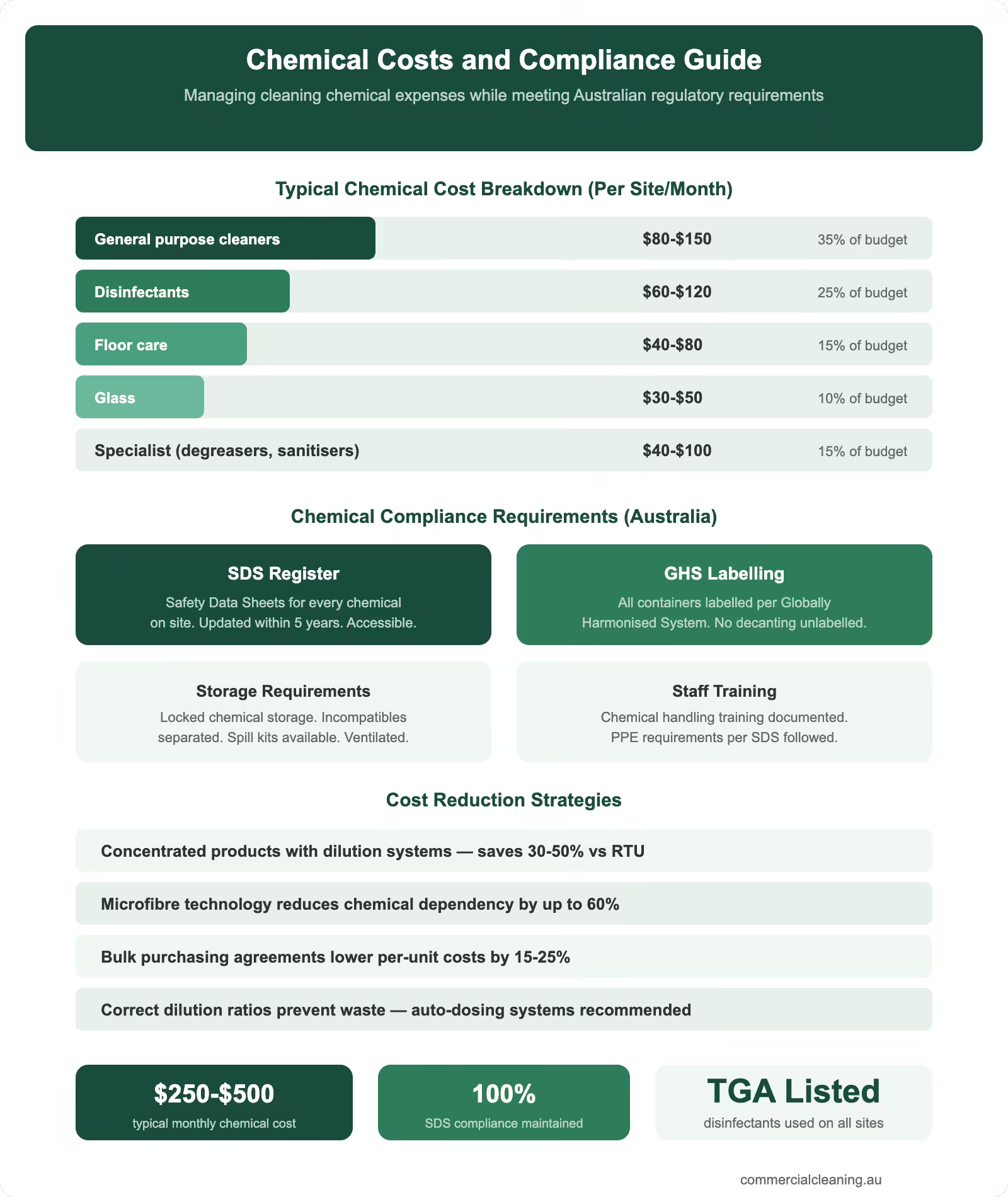
Chemical costs and compliance infographic showing monthly cost breakdown Australian regulatory requirements and cost reduction strategies for commercial cleaning
Chemical Costs and Compliance
Commercial pools in NSW sit under the Public Health Regulation 2022, and NSW Health’s advisory document on public swimming pools specifies the working targets our chemical dosing regime has to hit: free chlorine between 1 and 3 mg/L, pH between 7.0 and 7.8 with 7.4 as the operational sweet spot, and total alkalinity in the 80 to 120 mg/L ideal band. Disinfectants must be APVMA-approved — liquid chlorine, calcium hypochlorite, and salt chlorination all qualify, but any one of them used off-label will fail an inspection. On a typical Manly commercial pool our chemical spend runs at about $380 a month through winter and climbs toward $620 through the peak bather months from December to February, and we write that summer loading directly into every new 12-month budget so the spike is already reserved.
Every service visit starts with photometric water testing rather than the colour-match strips that still turn up in competitor vans. Strips have a failure mode that gets overlooked: they drift with age and humidity, and the drift is almost always in the optimistic direction. A fitness centre client of ours in Queenscliff handed us their previous contractor’s test logs last year, and we back-calculated an average chlorine overstatement of roughly 0.4 mg/L across six months — meaning their pool had been running under-chlorinated and nobody knew it. We rewrote their dosing protocol inside 48 hours and had the residual back on target by the following Monday.
Every pool on our run book keeps a live Daily Sample Log Sheet recording free chlorine, combined chlorine, pH, alkalinity, temperature, and bather load, alongside a chemical inventory log capturing product batch numbers, dosing volumes per visit, and the supplier’s certificate of analysis for each delivery. NSW Health requires those records to be retained for at least six months, and council inspectors expect to see them on arrival without scrambling through emails. Handing the whole package over as a single PDF is what turns a two-hour inspection into a 20-minute one. Since we took over pool maintenance on our Manly portfolio in 2019, every one of those sites has cleared council inspections on the first visit — a streak we protect with monthly internal audits rather than hoping the luck holds.
Equipment Maintenance and Replacement
Preventive equipment maintenance is the line item facility managers reach for first when they want to cut pool costs, and it is almost always the worst decision on the table. A pump that seizes on a Friday afternoon costs roughly three times what a scheduled service would have cost, because emergency call-out rates, overtime labour, and expedited parts freight all stack on top of each other. Our maintenance calendar for a commercial pool covers monthly filter inspections, quarterly pump seal checks, six-monthly heater servicing, and annual safety barrier assessments against AS 1926.1. Across the Northern Beaches portfolio that calendar has extended average equipment life by around 40 per cent compared with the reactive approach we inherited from previous contractors.
Equipment replacement is better framed as a lifecycle expense than a surprise capital item. Our Freshwater cost model sets aside $2,200 per year per pool into a replacement reserve, built from a ten-year pump lifecycle, a fifteen-year heater lifecycle, and a seven-year filtration media lifecycle. When we present the math to strata committees they nearly always adopt the reserve approach, because it converts a lumpy capital shock into a predictable operating line their board can sign off on without an extraordinary general meeting.
On high-failure items — mechanical seals, pressure gauges, chlorinator cells — we carry a rolling inventory at our Manly depot so our technicians can close most equipment faults on the same day the call goes in. The average turnaround from diagnosis to completion across our Northern Beaches sites is 18 hours. Competitor contractors we have inherited work from typically run three to five business days because they order parts reactively after failure, and pool closures over that window generate member refunds and complaint escalations that dwarf the cost of holding stock.
Annual Budget Planning
Every commercial pool on our book receives a written annual budget that rolls up base service costs, seasonal chemical loading, preventive maintenance, the equipment replacement reserve, and a 10 per cent contingency. We release the draft to Fairlight and Freshwater facility managers in the first week of October each year, which gives them eight weeks of lead time to query line items and slot the figure into the building’s operating budget before the new financial year begins.
Our budget assumptions get benchmarked against three years of actual spend data from comparable pools in the same suburb, then adjusted for known variables like bather load growth, equipment ageing, and regulatory changes such as the 2022 NSW Public Health Regulation update. Across the last five financial years our Queenscliff portfolio has tracked within 4 per cent of budget — a number our strata clients now rely on when they present operating budgets to building owners, because it means the pool line does not get challenged every cycle.
Facility managers should always insist on a line-itemised budget rather than a single lump-sum quote, because the itemisation is what makes the contract accountable. Every chlorine line in our budgets specifies product, dosing rate, and assumed bather load, so if a client believes a cheaper or more efficient product would work they can push back with numbers rather than a gut feel. That kind of transparency is uncomfortable for contractors who have been marking up consumables behind a vague labour rate, which is exactly why we volunteer it.
Frequently Asked Questions
How much does commercial pool maintenance cost per month in Sydney?
Light-traffic Sydney commercial pools typically cost $400 to $800 per month, while heated strata, fitness, and aquatic-centre pools push into the $1,200 to $3,500 band once the compliance, chemical, and service-frequency requirements scale up. Across our Northern Beaches portfolio in 2026 a standard 25-metre heated commercial pool averages around $2,100 per month inclusive of three weekly service visits, chemicals, preventive equipment maintenance, and full NSW Public Health Regulation 2022 compliance documentation. Unheated strata pools under 200 kL normally sit closer to the lower end of that band.
What NSW regulations apply to commercial pool cleaning?
Commercial pools operating in NSW sit under four instruments: the Public Health Act 2010, the Public Health Regulation 2022, the Swimming Pools Act 1992, and the specific health orders issued by the local council. Operators must notify their council on installation, disinfect using APVMA-approved chemicals, keep a Daily Sample Log Sheet for at least six months, and have barriers assessed annually against AS 1926.1. Our Manly and Freshwater sites have not triggered a council re-inspection since 2019 because we keep the full document set audit-ready in a single PDF.
Is salt chlorination cheaper than liquid chlorine?
Salt chlorination trades lower ongoing chemical spend for higher upfront capital and a replacement cell cycle that kicks in every three to five years. On our three-visit-per-week commercial contracts the ongoing chemistry saving sits around 15 to 20 per cent, but the cell replacement comes in between $800 and $1,500 depending on pool volume. For pools under 200 kL we normally recommend sticking with liquid chlorine — the payback on salt rarely clears four years, which is shorter than the cell itself.
How often should commercial pools be professionally cleaned?
Our contracts on pools with meaningful bather loads start at three professional service visits per week, and we will not drop below that during summer. Anything less and we cannot hold chlorine residuals inside the NSW Health target band consistently, filtration backpressures drift, and small equipment faults compound into weekend emergencies. On heavy-use sites like the fitness centre we service in Queenscliff we run five visits a week between December and February, then wind back to three through winter.
What qualifications do pool maintenance contractors need?
Any commercial pool technician operating in NSW should carry current CPO (Certified Pool Operator) certification from the Pool & Hot Tub Alliance (delivered in Australia through Aquatics Information), valid for five years and renewed with a 16-hour refresher. On top of that, they need chemical handling qualifications and public liability cover of at least $10 million. Every technician on our Northern Beaches run holds current CPO certification and completes an annual internal refresher covering water chemistry, equipment fault diagnosis, and AS 1926.1 barrier compliance. Ask any contractor for their technicians’ CPO certificate numbers before signing — the ones who hesitate are usually the ones you do not want on site.
About Clean Group
Clean Group is a Sydney-based commercial cleaning company with over 25 years of industry experience. Founded by Suji Siv, our team of 50+ trained professionals services offices, warehouses, medical centres, schools, childcare facilities, retail stores, gyms, and strata properties across Sydney, Melbourne, and Brisbane.
We are active members of ISSA and the Building Service Contractors Association of Australia (BSCAA). Our operations align with ISO 9001 (Quality Management), ISO 14001 (Environmental Management), and ISO 45001 (Workplace Health and Safety) standards. We hold membership with the Green Building Council of Australia and use eco-friendly, TGA-registered cleaning products wherever possible.
Every Clean Group cleaner is police-checked, fully insured, and trained in safe work procedures under SafeWork NSW guidelines. We operate 7 days a week, including after-hours and weekend services, to minimise disruption to your business.
Hi, I'm Suji Siv, the founder, CEO, and Managing Director of Clean Group, bringing over 25 years of leadership and management experience to the company. As the driving force behind Clean Group’s growth, I oversee strategic planning, resource allocation, and operational excellence across all departments. I am deeply involved in team development and performance optimization through regular reviews and hands-on leadership.