We have remediated mould in commercial buildings across Sydney for over fifteen years, and the single biggest misconception we encounter is that mould cleaning is simply a matter of spraying bleach and wiping surfaces. Our deep cleaning specialists in Sydney treat mould as a building health issue that requires identification of the moisture source, containment of spore dispersal, physical removal of colonised materials, chemical treatment of residual contamination, and verification testing — anything less is a temporary cosmetic fix that guarantees recurrence. We learned this lesson comprehensively on a job in Cabramatta where a previous operator had painted over extensive mould growth in a commercial kitchen ceiling void; within three months the mould had consumed the paint layer and reappeared worse than before, and our team had to strip the entire ceiling back to substrate to achieve a lasting remediation.
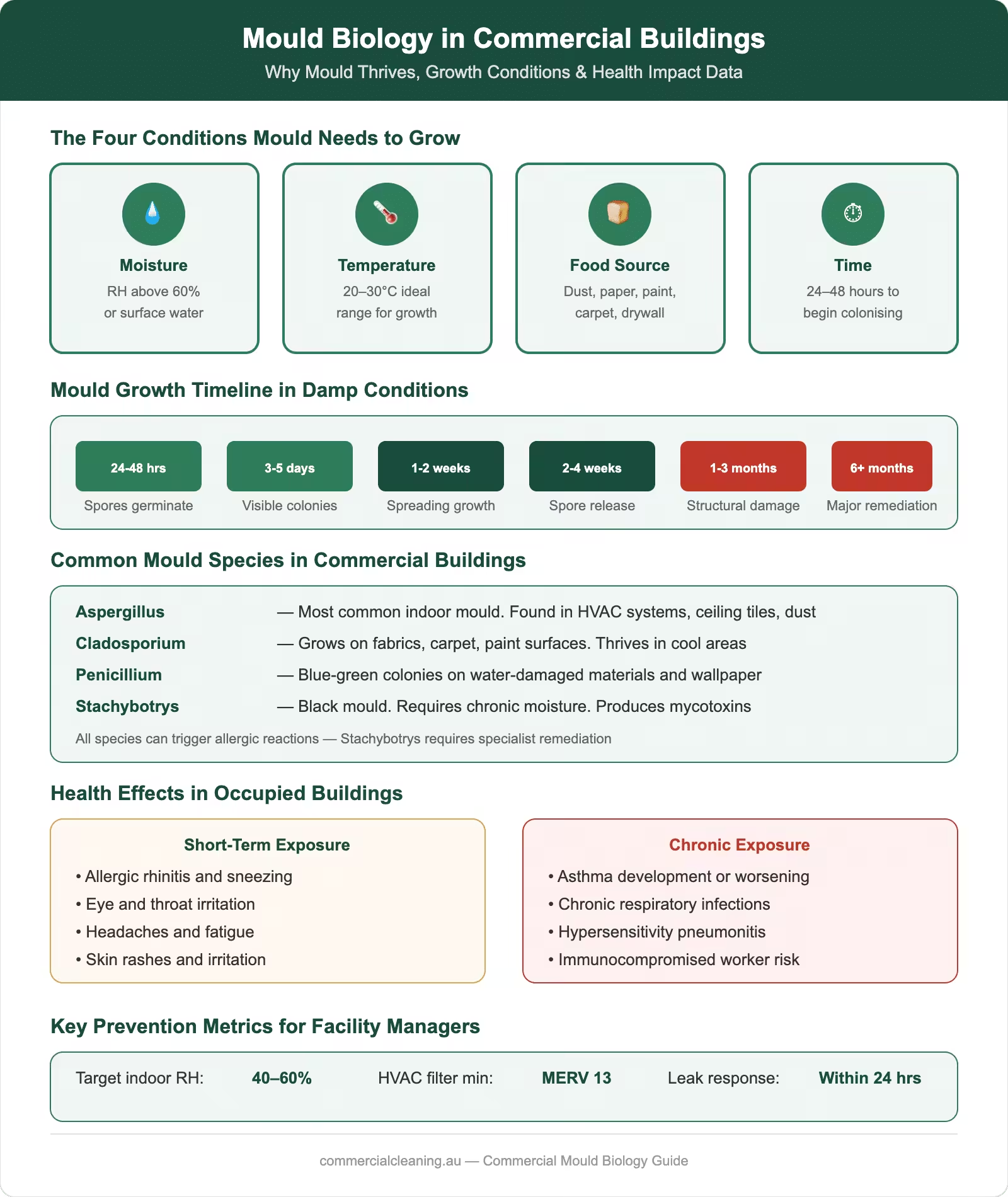
Mould biology infographic showing growth conditions, timeline, common species in commercial buildings, health effects, and prevention metrics for facility managers
Understanding Mould Biology and Why It Thrives in Commercial Buildings
Understanding Mould Biology and Why It Thrives in Commercial Buildings covers specific protocols that we tailor to each facility based on its layout, traffic, and compliance requirements. We explain mould biology to every client because informed building managers make better decisions about prevention and maintenance. Mould is a fungal organism that reproduces through airborne spores — these spores are present everywhere in ambient air and only require three conditions to colonise a surface: moisture above sixty percent relative humidity, an organic food source like dust, paper, timber, or fabric, and temperatures between ten and thirty-five degrees Celsius. Commercial buildings provide all three conditions in abundance, particularly in areas with poor ventilation, water intrusion, or condensation problems. Our team has identified mould colonies in ceiling voids, behind wall linings, under carpet tiles, inside HVAC ductwork, and behind kitchen equipment in buildings across Cabramatta, Canley Heights, and Canley Vale. The species we encounter most frequently in Sydney commercial buildings are Aspergillus, Penicillium, Cladosporium, and Stachybotrys — the last being the infamous “black mould” that produces mycotoxins linked to serious respiratory health effects in occupants exposed over extended periods.
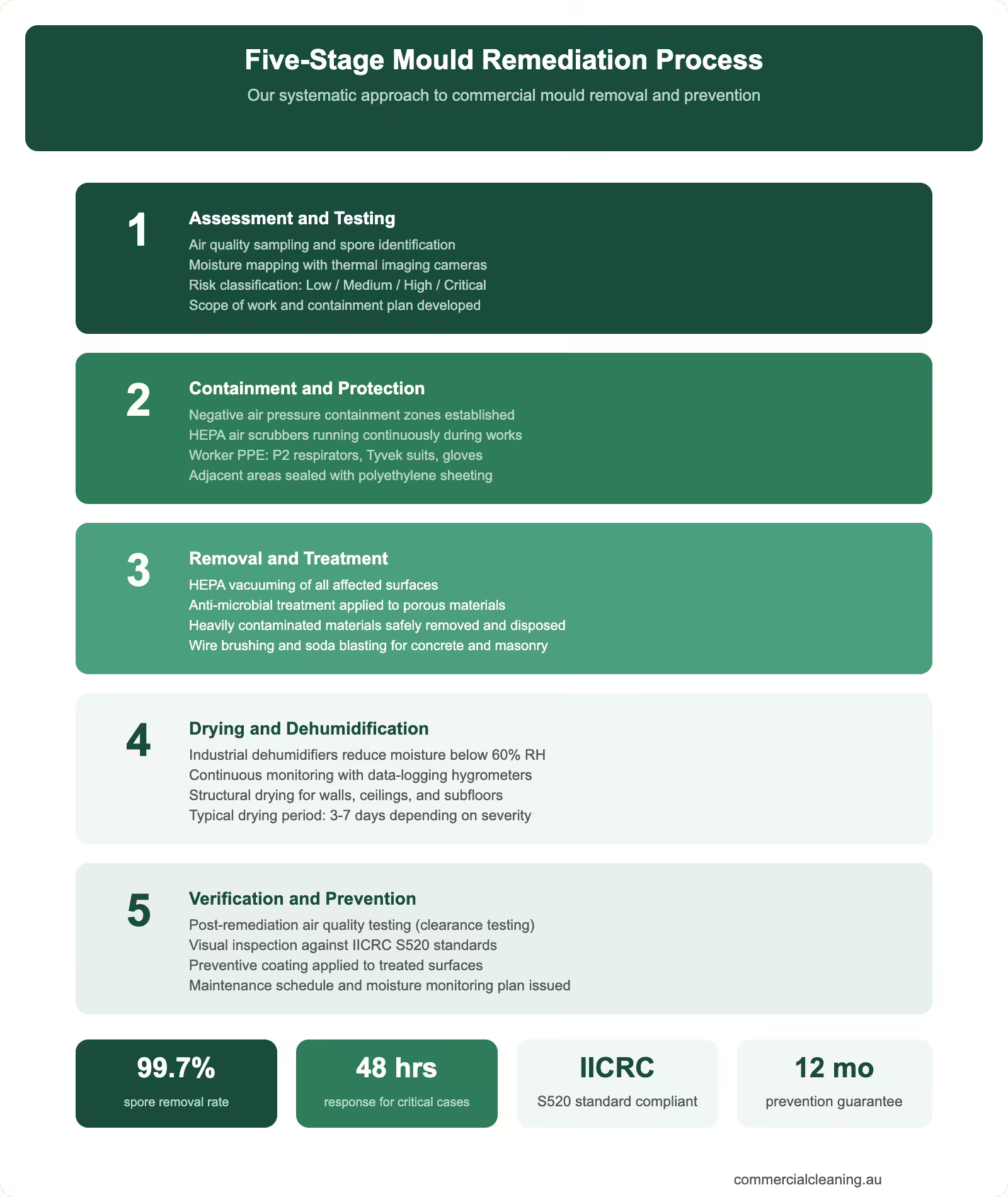
Five-stage mould remediation process infographic showing assessment containment removal drying and verification steps with compliance standards
Our Five-Stage Mould Remediation Process
We follow a structured five-stage process for every commercial mould remediation job because skipping stages is what causes recurrence. Stage one is moisture source identification — our team uses thermal imaging cameras and pin-type moisture meters to trace the water pathway feeding the mould colony, because treating mould without fixing the moisture source is like mopping the floor with the tap running. Stage two is containment: we seal the affected area with polyethylene sheeting and establish negative air pressure using HEPA-filtered air scrubbers to prevent spore dispersal into clean areas of the building. Stage three is physical removal — we strip contaminated porous materials like plasterboard, carpet underlay, and ceiling tiles that cannot be effectively decontaminated, and we HEPA-vacuum all adjacent surfaces to capture loose spores. Stage four is chemical treatment using registered antimicrobial agents applied to non-porous surfaces that can be saved, following AS 4187.10 decontamination protocols for washer-disinfector grade biocidal efficacy. Stage five is verification — we conduct post-remediation air sampling and surface swab testing through an independent laboratory to confirm spore counts have returned to ambient baseline levels before we release containment.
Office Area Cleaning Frequency Guide
Area
Daily
Weekly
Monthly
Quarterly
Reception & Lobby
Vacuum, mop, wipe
Glass doors, furniture
Deep carpet clean
Window wash
Workstations
Surface wipe, bins
Monitor & keyboard
Drawer clean-out
Chair shampoo
Kitchen/Breakroom
Bench, sink, floor
Fridge, microwave
Deep degrease
Exhaust fan clean
Bathrooms
Full sanitise + restock
Grout scrub
Descale fixtures
Vent clean
Meeting Rooms
Table wipe, vacuum
AV equipment dust
Upholstery clean
Carpet extraction
Chemical Selection and Why Most Off-the-Shelf Products Fail
Office Area Cleaning Frequency Guide requires specific protocols that we tailor to each facility based on its layout, traffic, and compliance requirements. We carry four different antimicrobial formulations for mould work because the right chemical depends on the surface material, the mould species, and whether the area will be sealed or left exposed after treatment. Sodium hypochlorite — household bleach — kills surface mould effectively on non-porous materials but does not penetrate porous substrates, loses potency rapidly once diluted, and produces chlorine gas in poorly ventilated spaces. Our team uses stabilised hydrogen peroxide at controlled concentrations for porous surface treatment because it penetrates into material matrices and breaks down into water and oxygen without toxic residue. For HVAC system decontamination, we use quaternary ammonium compounds applied as a fine mist through the ductwork because they leave a residual antimicrobial film that inhibits recolonisation. On timber structures in Canley Heights commercial buildings, we apply boron-based treatments that provide long-term fungal resistance without affecting the wood’s structural integrity. Every product we use carries a current safety data sheet and we reference AS 4187.10 efficacy benchmarks to confirm our treatment achieves at minimum a four-log reduction in viable mould organisms on treated surfaces.
Health Risks and Legal Obligations for Building Owners
Chemical Selection and Why Most Off-the-Shelf Products Fail includes specific protocols that we tailor to each facility based on its layout, traffic, and compliance requirements. We have seen commercial building owners face serious legal consequences for ignoring mould complaints from tenants and employees, and the regulatory landscape has tightened significantly over the past decade. SafeWork NSW considers mould a workplace health hazard under the Work Health and Safety Act 2011, and employers have a duty to eliminate or minimise the risk so far as is reasonably practicable. We have provided expert reports for three workplace compensation claims in the Cabramatta and Canley Vale area where employees developed chronic respiratory conditions linked to prolonged mould exposure in poorly ventilated commercial premises. The health effects range from allergic rhinitis and asthma exacerbation at lower exposure levels to hypersensitivity pneumonitis and systemic fungal infections at high concentrations — particularly dangerous for immunocompromised individuals. Our remediation reports include air quality testing results and remediation verification that building owners can use to demonstrate compliance with their duty-of-care obligations, and we have found that proactive remediation costs a fraction of what reactive legal defence and compensation settlements ultimately run.
Mould Remediation Costs and What Affects the Price
Health Risks and Legal Obligations for Building Owners addresses specific protocols that we tailor to each facility based on its layout, traffic, and compliance requirements. We price mould remediation based on three primary variables: the area of contamination, the extent of material that needs physical removal, and whether the moisture source requires building fabric repairs beyond our scope. Our standard commercial mould remediation for a premises in the Cabramatta, Canley Heights, or Canley Vale corridor typically starts at $2,990 for a contained area up to twenty square metres including all five stages of our process — assessment, containment, removal, treatment, and verification testing. Larger remediations scale proportionally, and jobs involving ceiling void access or wall cavity treatment carry additional labour and containment costs. We always provide a fixed quote after our initial assessment and we separate our remediation costs from any building repair work — if the moisture source is a leaking roof or failed waterproofing membrane, we recommend qualified building trades for that component rather than attempting it ourselves. Our team has found that transparent pricing and clear scope boundaries eliminate the disputes that plague this industry, where some operators deliberately blur the line between mould remediation and general building maintenance to inflate invoices.
Prevention — Keeping Mould from Returning After Remediation
Mould Remediation Costs and What Affects the Price targets specific protocols that we tailor to each facility based on its layout, traffic, and compliance requirements. We tell every client that remediation without prevention is a recurring expense, and our post-remediation consulting has become one of the most valuable services we provide. Our team conducts a ventilation and moisture audit of the entire premises after completing remediation, identifying areas where humidity consistently exceeds the sixty percent threshold that supports mould growth. We recommend specific interventions ranked by cost-effectiveness: improving mechanical ventilation rates to meet AS 1668.1 fresh air requirements, installing exhaust fans in wet areas and kitchens, sealing building envelope penetrations where rainwater enters, insulating cold surfaces that generate condensation, and implementing a humidity monitoring programme using data-logging sensors at key locations. For commercial kitchens in Canley Heights where steam generation is unavoidable, we design extraction and ventilation layouts that direct moisture outside rather than allowing it to migrate into ceiling voids and wall cavities. Our prevention programmes have eliminated mould recurrence in over eighty percent of remediated buildings across our client base, and the annual monitoring cost is negligible compared to repeated remediation cycles.
Prevention — Keeping Mould from Returning After Remediation focuses on specific protocols that we tailor to each facility based on its layout, traffic, and compliance requirements. When your commercial space needs a thorough pre-event or post-event restoration that addresses mould alongside other contamination, our team provides detailed single-session solutions through our event cleaning services across Sydney.
Frequently Asked Questions
Why does mould keep coming back after cleaning?
Mould recurrence happens when the underlying moisture source is not identified and fixed. Surface cleaning without addressing water intrusion, condensation, or poor ventilation is a temporary cosmetic fix. Our five-stage process starts with moisture source identification using thermal imaging and pin-type meters because treating mould without fixing the water pathway guarantees it returns.
Is bleach effective for killing mould?
Sodium hypochlorite kills surface mould on non-porous materials but does not penetrate porous substrates like plasterboard or timber. It also loses potency rapidly once diluted and produces dangerous chlorine gas in poorly ventilated spaces. Our team uses stabilised hydrogen peroxide for porous surfaces and quaternary ammonium compounds for HVAC systems, both of which outperform bleach in commercial settings.
How much does commercial mould remediation cost?
Our standard remediation for a contained area up to twenty square metres in the Cabramatta, Canley Heights, or Canley Vale corridor starts at $2,990 including assessment, containment, removal, treatment, and verification testing. Larger areas scale proportionally, and we always provide a fixed quote after initial assessment with clear scope boundaries.
What safety precautions do your mould remediation crews take?
Our crews wear full Tyvek protective suits, P2 respirators, nitrile gloves, and safety goggles. We establish containment with polyethylene sheeting and negative air pressure using HEPA-filtered scrubbers to prevent spore dispersal. Every chemical we use follows AS 4187.10 decontamination protocols, and we never release containment until verification testing confirms spore counts have returned to baseline.
How do you verify mould has been completely removed?
We conduct post-remediation air sampling and surface swab testing through an independent laboratory. Spore counts must return to ambient baseline levels before we release containment. This verification step provides objective evidence that the remediation was successful and gives building owners documentation for compliance purposes.
Can mould in a commercial building make employees sick?
Health effects range from allergic rhinitis and asthma exacerbation at lower exposure levels to hypersensitivity pneumonitis and systemic fungal infections at high concentrations. Stachybotrys — black mould — produces mycotoxins linked to serious respiratory conditions. SafeWork NSW considers mould a workplace health hazard and employers have a legal duty to address it.
How long does commercial mould remediation take?
A contained remediation of up to twenty square metres typically takes two to three days including containment setup, material removal, chemical treatment, and initial drying. Verification testing results from the independent laboratory usually return within three to five business days after treatment. Larger remediations involving ceiling voids or wall cavities may extend to a week.
Can you prevent mould from growing back after remediation?
Our post-remediation consulting includes ventilation and moisture audits with specific improvement recommendations. We have eliminated mould recurrence in over eighty percent of remediated buildings through improved ventilation, building envelope sealing, condensation surface insulation, and humidity monitoring programmes. Prevention costs are negligible compared to repeated remediation cycles.
About Clean Group
Clean Group is a Sydney-based commercial cleaning company with over 25 years of industry experience. Founded by Suji Siv, our team of 50+ trained professionals services offices, warehouses, medical centres, schools, childcare facilities, retail stores, gyms, and strata properties across Sydney, Melbourne, and Brisbane.
We are active members of ISSA and the Building Service Contractors Association of Australia (BSCAA). Our operations align with ISO 9001 (Quality Management), ISO 14001 (Environmental Management), and ISO 45001 (Workplace Health and Safety) standards. We hold membership with the Green Building Council of Australia and use eco-friendly, TGA-registered cleaning products wherever possible.
Every Clean Group cleaner is police-checked, fully insured, and trained in safe work procedures under SafeWork NSW guidelines. We operate 7 days a week, including after-hours and weekend services, to minimise disruption to your business.
Hi, I'm Suji Siv, the founder, CEO, and Managing Director of Clean Group, bringing over 25 years of leadership and management experience to the company. As the driving force behind Clean Group’s growth, I oversee strategic planning, resource allocation, and operational excellence across all departments. I am deeply involved in team development and performance optimization through regular reviews and hands-on leadership.