How Much Does cleaning for strata properties Cost? 2026 Pricing Guide
We get asked about strata cleaning costs more than almost any other question, and the honest answer is that pricing varies enormously depending on building size, scope of work, access complexity, and frequency. After quoting and servicing more than 300 strata schemes across Sydney, our team has built a detailed understanding of what drives costs up and down in this market. As a dedicated strata cleaning provider, we are transparent about pricing because we have seen too many owners corporations locked into contracts that either overcharge for basic work or undercharge in ways that guarantee corner-cutting.
What Determines the Cost of Strata Cleaning in Sydney
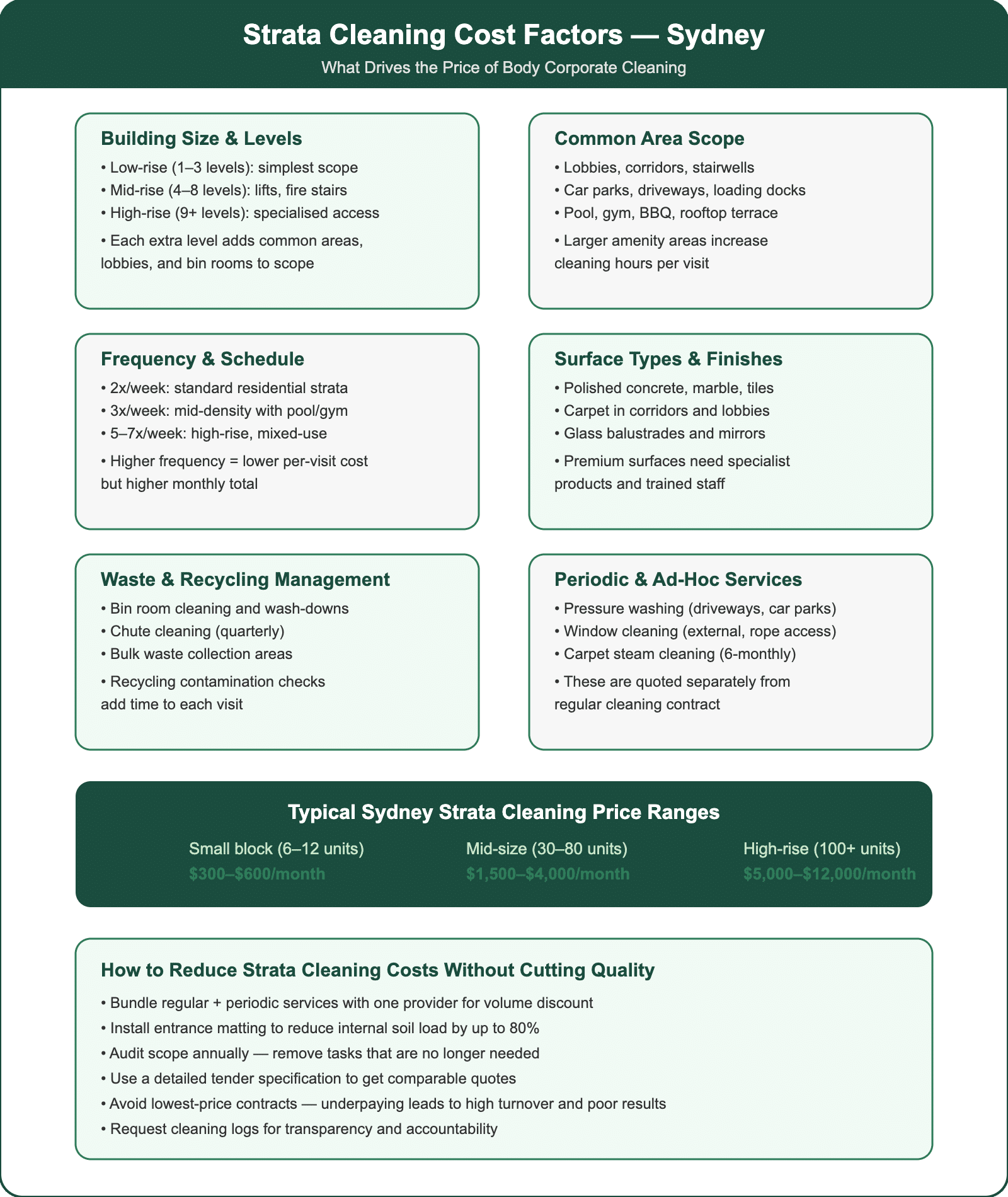
The four primary cost drivers in strata cleaning are building size (measured in common-area square metres rather than unit count), cleaning frequency, scope inclusions, and geographic location within Greater Sydney. A 12-unit walk-up in Marrickville with shared hallways, a stairwell, and a small courtyard typically costs $450 to $650 per month on a twice-weekly schedule. A 60-unit mid-rise in Chatswood with lifts, basement car parking, a pool area, and a gym adds complexity that pushes the monthly cost to $1,800 to $2,800 depending on the finish standards specified in the cleaning contract.
High-rise towers above 10 storeys introduce additional cost factors including lift access scheduling, window-cleaning coordination, fire-stair compliance cleaning, and the sheer volume of common-area floor space. We currently service towers in the CBD and Parramatta where monthly cleaning costs exceed $5,000, but the per-unit cost in those buildings often works out lower than a small walk-up because the fixed costs of mobilisation, supervision, and equipment transport are spread across more lot entitlements.
Cleaning Frequency and Its Impact on Monthly Pricing
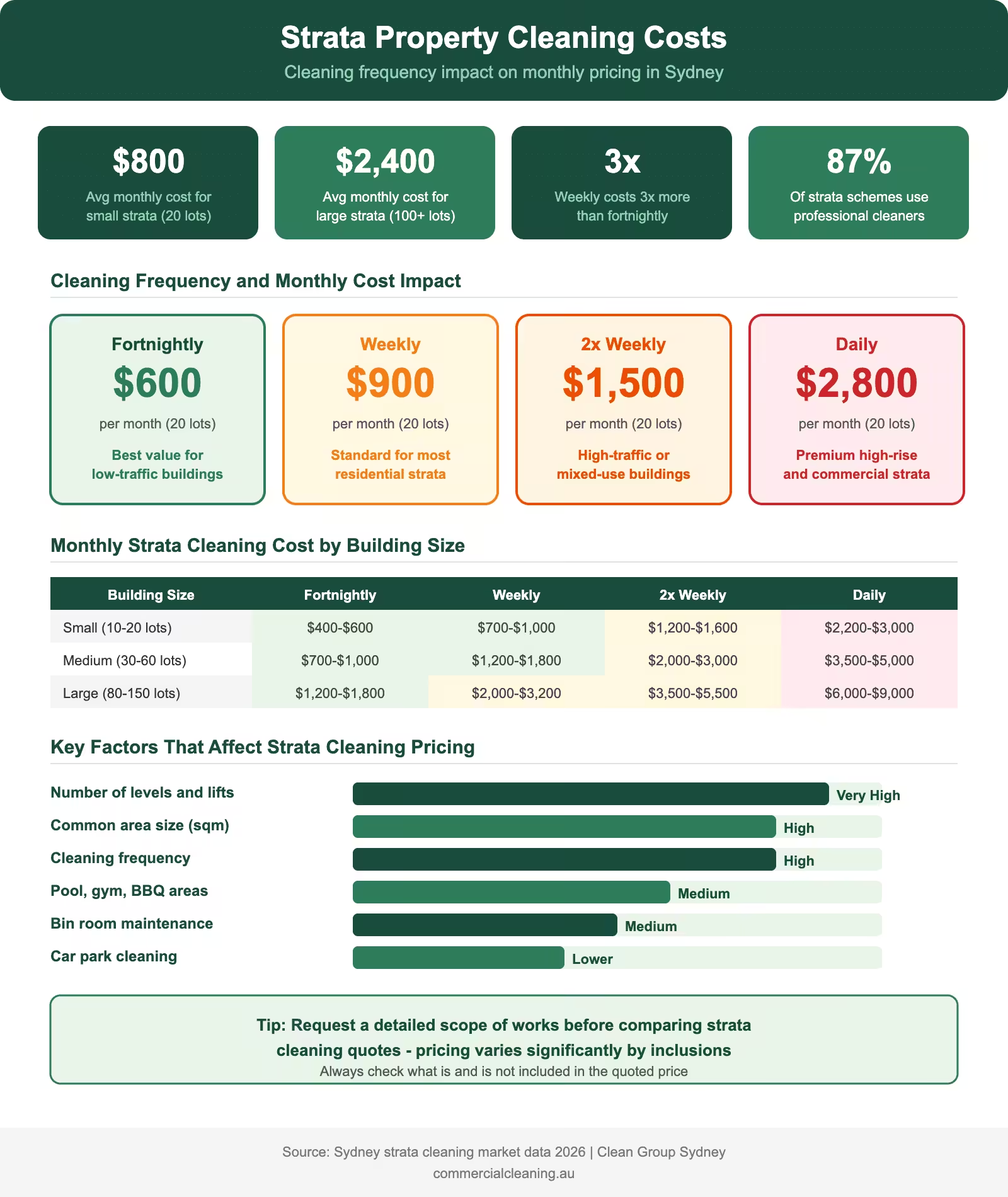
Frequency is the single biggest lever that strata committees can adjust to manage cleaning budgets. Our standard frequency tiers are twice-weekly, three times weekly, and daily, with pricing roughly scaling at 1x, 1.4x, and 2.2x respectively. The non-linear scaling reflects the fact that daily cleaning requires dedicated equipment stored on-site and a named cleaner assigned to the building, whereas twice-weekly work can be serviced by a roaming team that covers multiple buildings per shift.
We have found that buildings in Bankstown, Liverpool, and western Sydney with high foot traffic from ground-floor retail tenancies benefit from three times weekly cleaning even when the unit count alone would suggest twice-weekly is sufficient. The incremental cost of moving from twice to three times weekly is typically $180 to $350 per month depending on building size, but the reduction in complaint volume and the improvement in resident satisfaction scores consistently justify the investment. One Homebush building we service moved from twice-weekly to three times weekly in 2024 and saw owner satisfaction survey scores increase from 62 percent to 89 percent within a single quarter.
Strata Common Area Maintenance Schedule
| Area | Daily | Weekly | Monthly | Annual |
|---|---|---|---|---|
| Lobby & Foyer | Sweep, mop, glass | Deep mop, dust lights | Floor machine scrub | Strip & reseal |
| Lifts & Doors | Wipe panels + buttons | Full interior detail | Track & rail degrease | Deep restoration |
| Car Park | Litter patrol | Sweep + line check | Pressure wash bays | Full pressure + repaint |
| Pool/Gym | Sanitise surfaces | Deep clean equipment | Grout scrub | Full tile restoration |
| Bin Room | Hose down, deodorise | Deep scrub walls | Pest treatment | Full sanitise + repaint |
What Should Be Included in a Strata Cleaning Contract
Strata Common Area Maintenance Schedule requires specific protocols that we tailor to each facility based on its layout, traffic, and compliance requirements. A properly specified strata cleaning contract covers both routine tasks and periodic deep-clean items. Routine scope should include entrance and foyer mopping and glass cleaning, stairwell mopping and handrail sanitisation, lift interior cleaning and button-panel disinfection, bin-bay cleaning and deodorising, car park sweeping and spot-cleaning, and garden pathway clearing. Periodic items — typically quarterly — should include pressure cleaning of driveways and external hard surfaces, deep-clean of bin rooms with chlorinated detergent, window cleaning of common-area glazing, and carpet extraction in lobbies and corridors.
We specify every task with a defined frequency, method, and quality standard in our contracts because vague scope descriptions are the number-one source of disputes between strata managers and cleaning providers. Our contracts reference AS 4674 for food-contact surface standards in bin areas and AS 4586 for slip-resistance maintenance on tiled surfaces, giving both parties a measurable benchmark rather than a subjective opinion about what constitutes “clean”. This level of specification adds approximately $45 to $65 per month in administrative overhead but eliminates the ambiguity that leads to service complaints and contract terminations.
Hidden Costs and Common Pricing Traps in Strata Cleaning
Hidden Costs and Common Pricing Traps in Strata Cleaning addresses specific protocols that we tailor to each facility based on its layout, traffic, and compliance requirements. The cheapest quote is almost never the best value in strata cleaning. We regularly take over contracts from providers who won the tender at $200 to $400 per month below our quote but delivered service so poor that the strata committee spent more in complaint management, re-cleaning requests, and contract re-tendering than they saved on the cleaning fee. Common pricing traps include quotes that exclude consumables (toilet paper, hand soap, bin liners) which then appear as monthly add-ons, quotes based on inadequate frequency that will inevitably require paid extras, and quotes that omit periodic tasks like pressure cleaning or carpet extraction entirely.
Our pricing model includes all consumables for common-area amenities, all routine and periodic tasks specified in the contract, a dedicated site supervisor who conducts monthly quality audits, and a digital reporting portal that gives the strata manager real-time visibility of completed tasks. The total monthly cost is typically 10 to 15 percent higher than the cheapest market quote, but the total cost of ownership — including complaint handling time, re-cleaning costs, and the productivity cost of managing an unreliable provider — is consistently lower across every building size category we have analysed.
Regional Price Variations Across Greater Sydney
Regional Price Variations Across Greater Sydney targets specific protocols that we tailor to each facility based on its layout, traffic, and compliance requirements. Cleaning costs vary by region within Greater Sydney due to differences in labour availability, travel time, and building stock characteristics. Inner-city buildings in Surry Hills, Newtown, and the CBD typically carry a 15 to 20 percent premium over western Sydney equivalents because of parking constraints (our crews need permit-based loading zones), traffic-related scheduling inflexibility, and the higher finish expectations that come with premium-priced apartment stock. Buildings in Penrith, Campbelltown, and outer western Sydney benefit from lower base rates but may incur travel surcharges if they are outside the primary service coverage of the cleaning team.
The sweet spot for cost-efficiency is the middle ring — areas like Parramatta, Eastwood, Cabramatta, and Bankstown where labour availability is strong, building access is straightforward, and the volume of strata work in each suburb allows our teams to service multiple buildings per shift. We currently run dedicated strata teams in eight geographic clusters across Greater Sydney, and buildings within these clusters receive priority scheduling and the most competitive rates because the mobilisation cost per building is minimised.
How to Evaluate Strata Cleaning Quotes Effectively
When your strata committee reviews cleaning quotes, we recommend comparing on five dimensions rather than price alone: scope completeness (are all routine and periodic tasks listed?), frequency adequacy (does the proposed schedule match your building’s foot traffic?), consumable inclusions (are toilet supplies and bin liners included or extra?), quality assurance method (how does the provider verify work quality?), and reporting transparency (will you see what was done and when?). A quote that scores highly on all five dimensions at a slightly higher monthly cost will almost always deliver better value than the cheapest option that leaves gaps in three of them.
We provide a free building walkthrough and detailed scope-and-cost proposal for any strata scheme in Greater Sydney. This includes a common-area measurement, a recommended cleaning schedule based on building usage patterns, and a fixed monthly price with no hidden extras. For strata committees evaluating their current provider against alternatives, our guide on Sydney pricing details explains what drives costs across different building types and suburbs.

Frequently Asked Questions
How much does strata cleaning cost per unit monthly?
Per-unit monthly costs typically range from $31 to $361 depending on building size and service scope. A 100-unit mid-rise building with standard twice-weekly cleaning usually allocates $80 to $180 per unit monthly, or roughly $1,000 to $2,200 per unit annually.
What is included in standard strata cleaning contracts?
Standard contracts typically include lobby and entry area cleaning, common hallway vacuuming and mopping, stairwell and landing cleaning, lift cleaning (interior only), building exterior light sweeping, bin area tidying, and light dusting of common fixtures. Window cleaning, deep carpet extraction, pressure washing, pool maintenance, garden maintenance, and specialist disinfection are usually quoted separately.
How often should strata common areas be cleaned?
Standard practice is two to three times weekly for most residential strata buildings. High-traffic areas (lobbies, main stairs, lifts) warrant daily or near-daily cleaning. High-rise buildings (15+ storeys) and mixed-use properties typically require daily cleaning of lobbies and main common areas.
Can body corporates negotiate cleaning rates?
Yes. Bodies corporate should regularly tender cleaning contracts every 1 to 3 years to confirm competitive pricing. Negotiation levers include longer contract terms in exchange for lower annual rates, flexibility in cleaning hours, bundling multiple services, and willingness to extend the current contract if the incumbent reduces rates.
What is the difference between administrative levies and cleaning costs?
Strata levies cover all administrative fund costs (cleaning, insurance, management, utilities, repairs). Cleaning costs are a subset—typically 15 to 30 percent of total administrative levies. Capital works/sinking fund contributions are separate and cover major building replacements and renovations.
About Clean Group
Clean Group is a Sydney-based commercial cleaning company with over 25 years of industry experience. Founded by Suji Siv, our team of 50+ trained professionals services offices, warehouses, medical centres, schools, childcare facilities, retail stores, gyms, and strata properties across Sydney, Melbourne, and Brisbane.
We are active members of ISSA and the Building Service Contractors Association of Australia (BSCAA). Our operations align with ISO 9001 (Quality Management), ISO 14001 (Environmental Management), and ISO 45001 (Workplace Health and Safety) standards. We hold membership with the Green Building Council of Australia and use eco-friendly, TGA-registered cleaning products wherever possible.
Every Clean Group cleaner is police-checked, fully insured, and trained in safe work procedures under SafeWork NSW guidelines. We operate 7 days a week, including after-hours and weekend services, to minimise disruption to your business.
About the Author

Suji Siv
/

Hi, I'm Suji Siv, the founder, CEO, and Managing Director of Clean Group, bringing over 25 years of leadership and management experience to the company. As the driving force behind Clean Group’s growth, I oversee strategic planning, resource allocation, and operational excellence across all departments. I am deeply involved in team development and performance optimization through regular reviews and hands-on leadership.
Read More About Suji 0291607469
 Get A Quote