Integrated Office Facility Management vs Standalone Cleaning Services
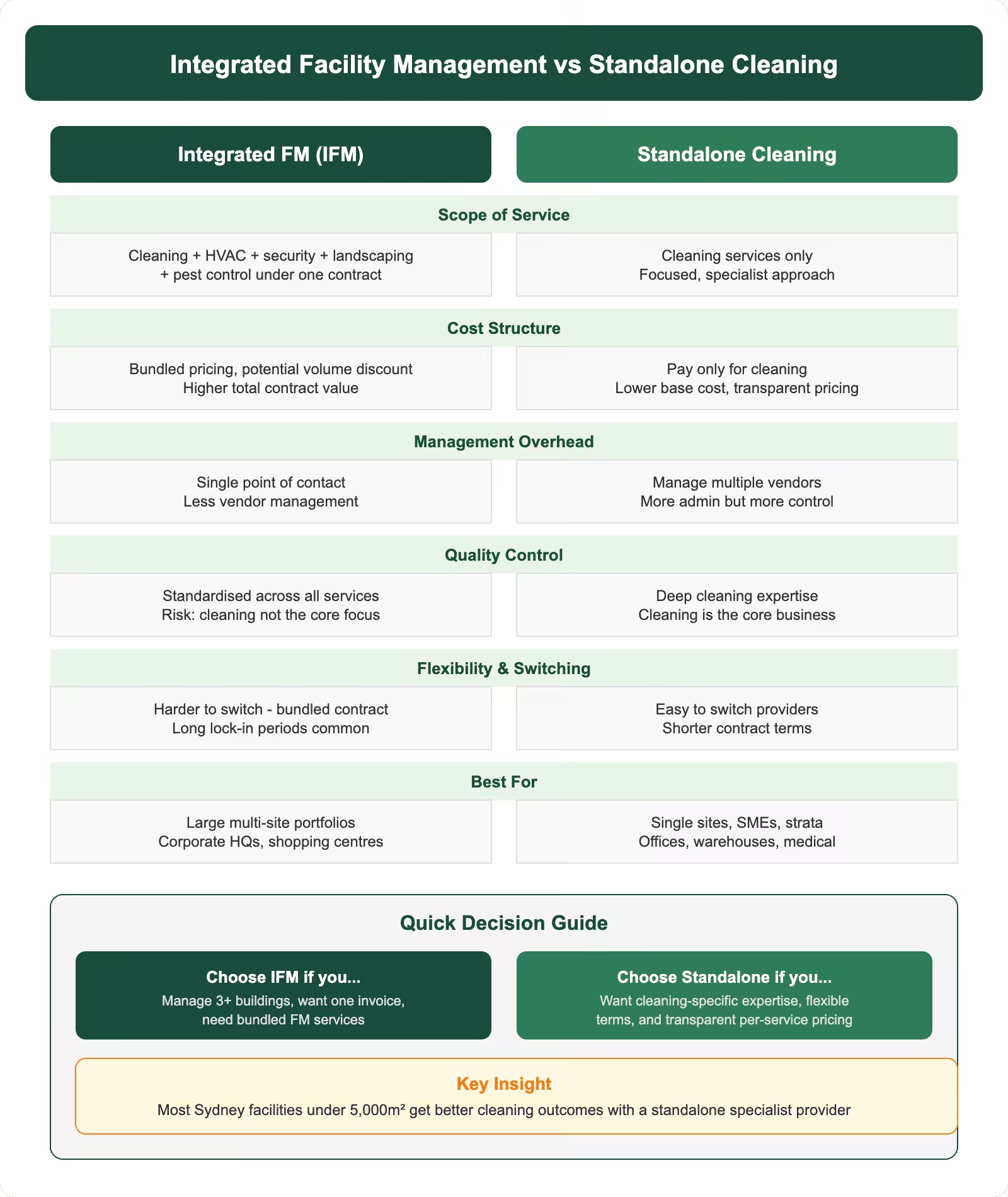
Choosing between integrated facility management and standalone cleaning services is one of the most consequential decisions a Sydney property manager or facility director can make. Both approaches have merits, but they differ fundamentally in scope, accountability, and cost structure. We at office cleaning services regularly work with clients navigating this choice. Understanding the distinction helps you align your decision with your building’s unique needs and budget constraints.
What Is Integrated Facility Management?
Integrated facility management (IFM) combines multiple services under a single provider or coordinated provider network. Rather than hiring separate companies for cleaning, maintenance, security, HVAC servicing, and pest control, you negotiate one master agreement covering all these functions.
In our experience, integrated models typically include:
- Cleaning services (daily, periodic, and deep clean schedules)
- Maintenance and repairs (preventative and reactive)
- Security and access control
- Pest and bird management
- Landscaping and grounds maintenance
- HVAC and mechanical systems oversight
- Waste and recycling management
- Compliance reporting and documentation
The provider becomes your single point of contact for building operations. They coordinate scheduling, manage vendor relationships, and take accountability for the overall condition of your facility.
What Is Standalone Cleaning?
Standalone cleaning services focus exclusively on cleaning. You contract with a cleaning company for their specific expertise, and you manage all other facility needs separately through different vendors.
Standalone providers deliver:
- Regular daily or weekly office cleaning
- Periodic deep cleans and sanitisation
- Floor polishing and specialist treatments
- Carpet and upholstery cleaning
- Window and high-reach cleaning
- Builders cleans and post-renovation work
- Bespoke cleaning for specific needs (medical facilities, laboratories)
Your cleaning provider is a specialist in their field. You manage relationships with your maintenance contractor, security firm, pest controller, and others separately.
Key Differences: IFM vs Standalone
| Factor | Integrated Facility Management | Standalone Cleaning |
|---|---|---|
| Scope of services | Multiple services (cleaning, maintenance, security, pest control) | Cleaning only |
| Number of vendors | One primary provider (or coordinated network) | Multiple independent vendors |
| Accountability structure | Single point of accountability for all building operations | Accountability limited to cleaning performance |
| Scheduling coordination | Provider coordinates all service schedules | You coordinate with multiple providers |
| Contract management | One master agreement | Multiple separate contracts |
| Cost transparency | Often opaque; bundled pricing | Clear line-item costs for cleaning |
| Flexibility | May be locked into services you don’t need | Choose each service independently |
| Specialisation | General competency across many areas | Deep expertise in cleaning |
| Typical facility size | Large complexes, multi-building campuses | Any size, especially SMEs and single buildings |
Advantages of Integrated Facility Management
Key Differences requires specific protocols that we tailor to each facility based on its layout, traffic, and compliance requirements. For large, complex facilities, integrated models simplify operations substantially. You have one service coordinator managing multiple vendors, reducing the administrative burden on your internal team. When something breaks down—say, your HVAC system fails and your offices become uncomfortably warm—the IFM provider addresses both the mechanical issue and adjusts cleaning schedules if needed due to unusual conditions.
Advantages of Integrated Facility Management includes specific protocols that we tailor to each facility based on its layout, traffic, and compliance requirements. Budget predictability improves under IFM, as you have a single master contract with fixed monthly costs. Over a multi-year agreement, IFM providers can achieve economies of scale, potentially reducing your per-service costs compared to paying multiple standalone vendors separately.
Compliance becomes simplified. Large organisations with complex WHS Act 2011 requirements can rely on their IFM provider to coordinate training, documentation, incident reporting, and compliance scheduling across all facility functions. This reduces your internal compliance burden and creates audit trails that satisfy regulators and insurers.
Disadvantages of Integrated Facility Management
Disadvantages of Integrated Facility Management addresses specific protocols that we tailor to each facility based on its layout, traffic, and compliance requirements. The primary drawback of IFM is loss of control and specialisation. When you bundle cleaning, maintenance, and pest control under one provider, you’re assuming that provider has deep expertise in all areas. In reality, they may excel at maintenance while treating cleaning as a secondary focus. Your cleaning quality may suffer as a result.
Cost transparency erodes under bundled agreements. You often don’t know how much you’re actually paying for cleaning versus maintenance versus other services. This makes it difficult to negotiate or challenge costs or benchmark against standalone alternatives.
Exit penalties can be substantial. If your IFM provider underperforms, switching to a new provider often requires renegotiating multiple service agreements simultaneously, creating disruption to your operations and potentially allowing the incumbent to demand higher prices to exit.
Advantages of Standalone Cleaning
Standalone cleaning providers are specialists. They invest in training, equipment, and techniques specific to cleaning excellence. We at Clean Group bring 20+ years focused exclusively on cleaning operations. This depth of expertise often delivers superior results compared to general facilities contractors juggling multiple service areas.
Cost clarity is stark. You know exactly how much you’re paying for cleaning. This allows you to benchmark your cleaning costs against industry standards, negotiate more effectively, and make data-driven decisions about your cleaning investment.
Flexibility is maximised. You can engage a specialist medical-facility cleaner for your clinic, a builders-clean expert for your renovation project, and a general office cleaner for your routine maintenance—all tailored to specific needs. You’re not locked into unnecessary services.
Disadvantages of Standalone Cleaning
Disadvantages of Standalone Cleaning focuses on specific protocols that we tailor to each facility based on its layout, traffic, and compliance requirements. Administrative burden increases. Managing multiple vendors requires more internal coordination. When your cleaning schedule conflicts with your maintenance schedule, you’re responsible for resolving the conflict, not relying on a single provider to coordinate.
You lose the economies of scale that large integrated providers achieve. You may pay more per unit for cleaning as a standalone service than you would as part of a large bundled contract.
Accountability becomes fragmented. If your facility has a problem—say, HVAC failure causes dust accumulation affecting carpet cleanliness—finger-pointing between your maintenance contractor and cleaning contractor is common. With IFM, that accountability sits clearly with one provider.
Which Approach Is Right for Your Sydney Facility?
Which Approach Is Right for Your Sydney Facility? covers specific protocols that we tailor to each facility based on its layout, traffic, and compliance requirements. Choose integrated facility management if:
- You operate a large, complex multi-building facility or campus
- You want to minimise internal administrative staff dedicated to vendor management
- You’re willing to trade specialisation for coordination convenience
- Your facility has complex WHS compliance requirements across multiple service areas
- You prefer fixed all-in-one monthly costs over multiple invoices
Choose standalone cleaning if:
- You operate a single building or modest facility footprint
- You want maximum control over your cleaning standards and costs
- You prioritise specialised cleaning expertise over convenience
- You benefit from cost transparency and competitive benchmarking
- You want flexibility to adjust cleaning services independently of other facility functions
- Your facility has specific cleaning needs (medical, laboratory, post-construction)
In our experience across Sydney offices, the majority of mid-sized organisations benefit from standalone cleaning contracts paired with separate maintenance and security providers. This approach delivers the cleaning expertise you need while maintaining flexibility and cost control.
How to Evaluate Standalone Cleaning Providers
If you’re considering moving from IFM to standalone cleaning, evaluate potential providers on these criteria:
- Specialisation: Do they have deep expertise in your industry? (Medical facility cleaning differs significantly from office cleaning.)
- Experience: How long have they been operating? Ask for references in your facility type.
- Certifications: Are they trained to relevant standards? (SafeWork NSW, WHS Act 2011 compliance, AS/NZS standards)
- Equipment: What technology do they use? Commercial-grade extraction equipment, HEPA filtration, and specialist tools indicate serious investment.
- Flexibility: Can they accommodate your building’s unique schedule or special requirements?
- Pricing: Request transparent line-item quotes for each service type. Avoid opaque bundled pricing.
Our team has worked with Parramatta offices, Sydney CBD towers, and Eastern Suburbs facilities across all approaches. We’re transparent about our costs, trained to SafeWork NSW standards, and equipped to handle any cleaning challenge your facility presents. Whether you’re evaluating us as a standalone provider or comparing us against your current IFM arrangement, we provide clear, accountable service.
Beyond evaluating your cleaning provider, confirm your broader facility strategy incorporates concrete floor polishing and specialist treatments into your maintenance planning, alongside well-defined janitorial duties that keep daily standards consistent.
Frequently Asked Questions
Can I combine IFM for some services with standalone providers for others?
Yes. Many mid-sized facilities use a hybrid approach: an IFM provider for maintenance and security, but a standalone specialist for cleaning. This balances convenience with cost control and specialisation.
What is the typical cost difference between IFM and standalone?
It depends on your facility size and services. For smaller buildings, standalone cleaning is typically 15–25% cheaper than paying the cleaning portion of an IFM contract. For large complexes, IFM may offer economies of scale that reduce overall costs by 10–15%.
How do I transition from IFM to standalone cleaning?
Carefully plan the transition to avoid service gaps. Notify your IFM provider of your decision, negotiate an exit date, and engage your new standalone provider 2–4 weeks before the handover. Conduct a detailed walk-through with both parties present to document baselines.
What SLAs should I negotiate with a standalone cleaner?
Specify response times for urgent issues (typically 24 hours), performance metrics (e.g., floor cleanliness standards), inspection procedures, and remediation protocols if standards aren’t met. Document everything in your contract.
Are standalone cleaners responsible for compliance as much as IFM providers?
Standalone cleaners are responsible for cleaning-related compliance (WHS Act 2011, use of appropriate chemicals, worker safety). You remain responsible for overall facility compliance. This clarity can actually simplify accountability.
About Clean Group
Clean Group is a leading commercial cleaning company in Sydney, serving offices, strata properties, medical centres, schools, and industrial facilities across the greater Sydney region. With over 25 years of experience and a team of fully trained, insured cleaners, we deliver consistent results backed by a 100% satisfaction guarantee. Our services are tailored to your schedule, your budget, and your industry’s compliance requirements.
About the Author

Suji Siv
/

Hi, I'm Suji Siv, the founder, CEO, and Managing Director of Clean Group, bringing over 25 years of leadership and management experience to the company. As the driving force behind Clean Group’s growth, I oversee strategic planning, resource allocation, and operational excellence across all departments. I am deeply involved in team development and performance optimization through regular reviews and hands-on leadership.
Read More About Suji 0291607469
 Get A Quote