We built our infection control cleaning program from scratch in 2016 after winning a contract for a Ryde medical centre that required documented evidence of pathogen-specific cleaning protocols. That single contract forced us to rethink everything we knew about disinfection, and the $5,100 we invested in developing our infection control framework — specialist training, TGA-registered product evaluation, and procedure documentation — has since become the foundation of how our commercial cleaning services teams approach hygiene across every site in Ryde, Macquarie Park, Eastwood and Gladesville. Infection control is not a niche service we bolt on for healthcare clients; it is a mindset that shapes our approach to every commercial environment because pathogens do not respect the boundary between a medical practice and the office building next door.
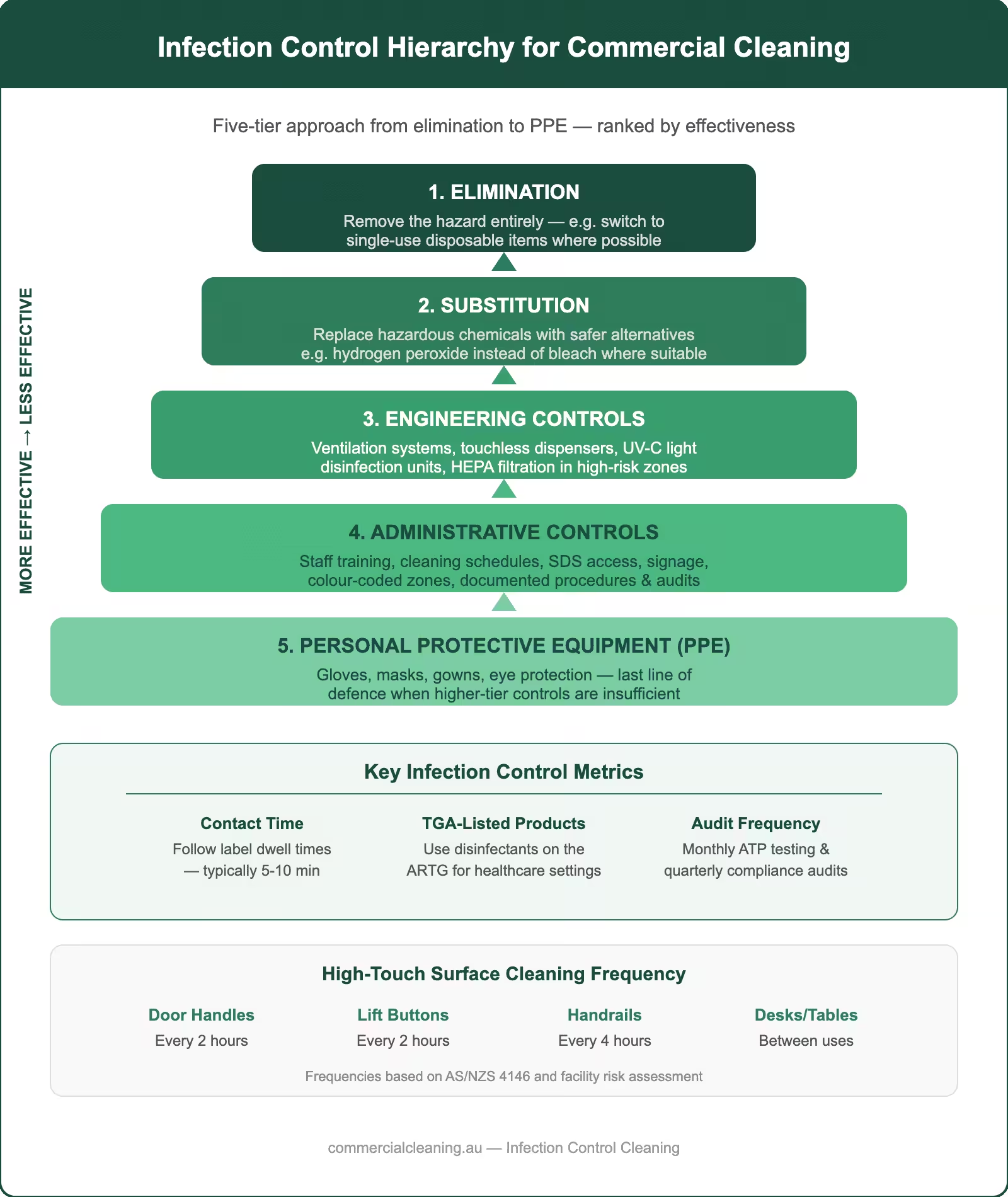
Infection control hierarchy for commercial cleaning showing five-tier approach from elimination to PPE with key metrics and high-touch surface cleaning frequencies
Understanding Infection Control Principles for Commercial Cleaning
Understanding Infection Control Principles for Commercial Cleaning covers specific protocols that we tailor to each facility based on its layout, traffic, and compliance requirements. We ground our infection control approach in the chain of infection model — the six-link sequence that must be intact for disease transmission to occur. Our Ryde training program teaches every cleaner to identify and break these links through cleaning interventions: eliminating the infectious agent through disinfection, removing the reservoir by cleaning contaminated surfaces, blocking the portal of exit through proper waste handling, interrupting the mode of transmission by targeting high-touch surfaces, protecting the portal of entry through hand hygiene promotion, and reducing susceptible host exposure through environmental decontamination. Our Macquarie Park team applies this framework daily, prioritising surfaces based on their role in the transmission chain rather than their visual appearance.
We also apply the Spaulding Classification system — developed for healthcare settings but valuable in any commercial environment — to categorise surfaces by infection transmission risk. Critical surfaces contact sterile tissue and require sterilisation; semi-critical surfaces contact mucous membranes and require high-level disinfection; and non-critical surfaces contact only intact skin and require routine cleaning with low-level disinfection. In a typical Eastwood commercial building, we classify approximately 12% of touchpoints as semi-critical — kitchen benches, bathroom taps, first-aid room surfaces — and assign these elevated cleaning protocols that exceed our standard commercial specification.
AS/NZS 4815 and Office-Based Healthcare Cleaning Standards
We reference AS/NZS 4815 — the standard for office-based health care facilities that are not hospitals — across our Ryde and Macquarie Park medical practice contracts. This standard provides the cleaning and disinfection framework for GP clinics, dental practices, physiotherapy centres, and allied health facilities that operate outside the hospital system but still require infection control measures appropriate to their clinical activities. Our experience implementing AS/NZS 4815 across 11 Ryde medical practices has taught us that the standard demands more than just using hospital-grade disinfectants — it requires documented cleaning schedules, defined surface risk classifications, staff competency evidence, and quality verification procedures.
We invest approximately $5,100 annually in maintaining our AS/NZS 4815-aligned infection control program across our Ryde division. This covers specialist training for 18 operatives who service medical and healthcare-adjacent clients, quarterly competency assessments, TGA-registered product procurement at premium pricing, and the ATP testing program that verifies cleaning outcomes objectively. Our Gladesville team services two dental practices where AS/NZS 4815 compliance is audited by the practice’s infection control consultant annually, and our procedures have passed every external audit without findings since we implemented the standard in 2017.
Office Area Cleaning Frequency Guide
Area
Daily
Weekly
Monthly
Quarterly
Reception & Lobby
Vacuum, mop, wipe
Glass doors, furniture
Deep carpet clean
Window wash
Workstations
Surface wipe, bins
Monitor & keyboard
Drawer clean-out
Chair shampoo
Kitchen/Breakroom
Bench, sink, floor
Fridge, microwave
Deep degrease
Exhaust fan clean
Bathrooms
Full sanitise + restock
Grout scrub
Descale fixtures
Vent clean
Meeting Rooms
Table wipe, vacuum
AV equipment dust
Upholstery clean
Carpet extraction
High-Touch Surface Identification and Prioritisation
We map high-touch surfaces at every new site during our onboarding risk assessment, and this mapping drives our cleaning frequency and product selection decisions across Ryde, Macquarie Park, Eastwood and Gladesville. Our methodology involves observing building occupant behaviour for a minimum of two hours during peak usage, documenting every surface contact, and ranking surfaces by touch frequency. In a typical Macquarie Park corporate office, our mapping identified 47 distinct high-touch surfaces, with door handles, lift call buttons, kitchen tap handles, photocopier controls, and bathroom light switches accounting for the top five by contact frequency.
We clean high-touch surfaces at double the frequency of general surfaces — twice daily in most commercial environments and three times daily in medical practices and childcare-adjacent offices. Our Ryde crew uses pre-impregnated disinfectant wipes for high-touch surface cleaning because they deliver consistent chemical contact time and eliminate the dilution errors that occur with spray-and-wipe methods. Each wipe contains 1,000 ppm quaternary ammonium compound, pre-measured to achieve the required contact time of 10 minutes specified on the product SDS. Our Eastwood team consumes approximately 1,200 disinfectant wipes per week across their portfolio of 14 commercial sites — a consumable cost of $168 weekly that delivers measurable infection risk reduction.
Disinfectant Selection and TGA Registration Requirements
We use exclusively TGA-registered disinfectants across our infection control program because TGA registration provides the only reliable assurance that a product meets Australian efficacy standards for pathogen elimination. Our Ryde inventory includes quaternary ammonium compounds for routine non-critical surface disinfection, sodium hypochlorite at 1,000 ppm for semi-critical surfaces and blood spill decontamination, and hydrogen peroxide-based products for surfaces where chlorine residue is unacceptable. Every product holds EN 14476 viral efficacy certification and EN 13727 bactericidal certification, verified through our quarterly product compliance review.
We learned the importance of TGA verification after a supplier in 2019 marketed a “hospital-grade” disinfectant to our Macquarie Park operations that turned out to be a sanitiser — not a disinfectant — with no TGA listing for therapeutic use. The product’s label used impressive language about killing 99.9% of germs, but its active ingredient concentration was insufficient for the contact time our protocols required. Our infection control coordinator caught the discrepancy during a routine product review and prevented the product from entering our Gladesville healthcare contracts. We now require TGA ARTG listing numbers for every disinfectant in our inventory, and our Ryde supervisors verify these numbers against the TGA database annually.
Outbreak Response and Enhanced Cleaning Protocols
We maintain a documented outbreak response protocol that activates when a client site in Ryde, Macquarie Park, Eastwood or Gladesville reports confirmed or suspected infectious disease cases. Our response escalates cleaning frequency to three times daily for all high-touch surfaces, introduces additional disinfection of soft furnishings and shared equipment, and deploys ATP testing at every cleaning event to verify decontamination effectiveness. Our outbreak protocol specifies a 72-hour enhanced cleaning period following the last confirmed case, during which our crews wear enhanced PPE including P2 respiratory protection and disposable gowns over their standard uniform.
We activated our outbreak protocol 14 times across our Ryde portfolio in the past two years — eight for gastroenteritis, four for influenza clusters, and two for confirmed COVID-19 cases. Each activation added approximately $850 in additional labour and consumable costs, borne by our company as part of our service commitment rather than charged back to the client. Our Macquarie Park corporate clients have recognised this outbreak response capability as a significant differentiator, and three clients specifically cited it as a factor in their contract renewal decisions. The ability to respond rapidly with documented, verifiable infection control measures provides peace of mind that generic cleaning services cannot match. For how cleaning types map to different commercial environments and risk profiles, explore our cleaning types guide that classifies every approach by setting and application.
Frequently Asked Questions
What is infection control cleaning and how does it differ from standard cleaning?
We define infection control cleaning as a systematic approach to surface decontamination that targets specific pathogens using TGA-registered disinfectants, documented procedures, and objective verification methods. Unlike standard cleaning which focuses on visual appearance and general soil removal, our Ryde infection control program uses the Spaulding Classification to assign risk-appropriate disinfection levels to every surface, verifies outcomes through ATP testing, and follows AS/NZS 4815 documentation requirements.
What qualifications should infection control cleaners hold?
We require all 18 operatives in our Ryde infection control division to hold current certificates in infection prevention principles, chemical safety handling, and bloodborne pathogen management. Our internal training program covers the chain of infection, Spaulding Classification, TGA-registered product usage, PPE donning and doffing procedures, and ATP verification methods. We also require annual competency reassessment and maintain individual training matrices that our Macquarie Park healthcare clients can audit on request.
How often should high-touch surfaces be disinfected?
We clean high-touch surfaces twice daily in standard commercial environments and three times daily in medical practices across our Ryde and Gladesville portfolio. During outbreak response, we escalate to three times daily across all affected sites. Our surface mapping methodology identifies site-specific high-touch points based on observed occupant behaviour, ensuring cleaning frequency matches actual transmission risk rather than applying a one-size-fits-all schedule.
What does AS/NZS 4815 require for cleaning in healthcare practices?
We implement AS/NZS 4815 across our 11 Ryde medical practice contracts. The standard requires documented cleaning schedules with defined frequencies for each area, surface risk classification using the Spaulding system, use of TGA-registered disinfectants appropriate to the risk level, staff competency evidence including training records, and quality verification procedures. Our $5,100 annual program investment covers all these requirements plus ATP testing verification.
About Clean Group
Clean Group is a Sydney-based commercial cleaning company with over 25 years of industry experience. Founded by Suji Siv, our team of 50+ trained professionals services offices, warehouses, medical centres, schools, childcare facilities, retail stores, gyms, and strata properties across Sydney, Melbourne, and Brisbane.
We are active members of ISSA and the Building Service Contractors Association of Australia (BSCAA). Our operations align with ISO 9001 (Quality Management), ISO 14001 (Environmental Management), and ISO 45001 (Workplace Health and Safety) standards. We hold membership with the Green Building Council of Australia and use eco-friendly, TGA-registered cleaning products wherever possible.
Every Clean Group cleaner is police-checked, fully insured, and trained in safe work procedures under SafeWork NSW guidelines. We operate 7 days a week, including after-hours and weekend services, to minimise disruption to your business.
Hi, I'm Suji Siv, the founder, CEO, and Managing Director of Clean Group, bringing over 25 years of leadership and management experience to the company. As the driving force behind Clean Group’s growth, I oversee strategic planning, resource allocation, and operational excellence across all departments. I am deeply involved in team development and performance optimization through regular reviews and hands-on leadership.