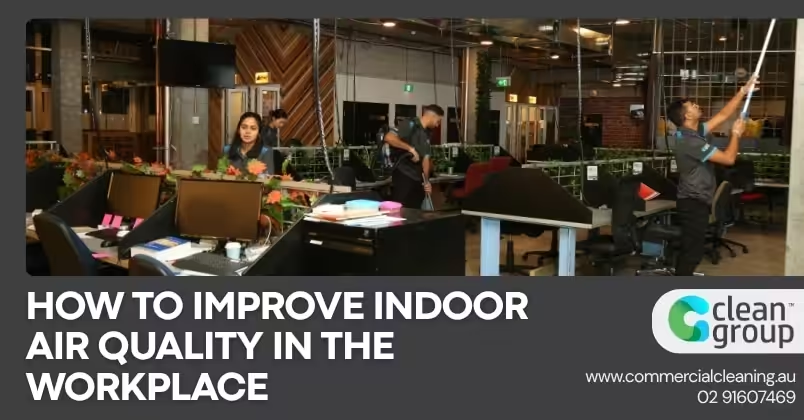
We wrote this guide because every week we walk into offices where staff complain about stuffy air, lingering odours or that vague “sick-building” feeling—and in almost every case the root cause is addressable with the right combination of cleaning practices, ventilation management and occupant awareness. Our team at Clean Group has spent years refining practical air-quality improvement strategies that work in real Sydney offices, not just in textbook scenarios. If your workplace is struggling with air quality and you want a partner who takes it seriously, our office cleaning services integrate air-quality management into every service agreement.
Assessing Your Current Air Quality
We always start with measurement because assumptions about air quality are almost always wrong. Our supervisors carry portable CO2 and particulate monitors that provide real-time readings at individual workstations, and we have found that even well-maintained buildings can harbour pockets of poor air quality that nobody has identified. Our assessments in offices across Peakhurst, Lugarno and Oatley have uncovered CO2 hotspots above 1,200 ppm in meeting rooms with undersized return-air grilles, while the open-plan area 10 metres away sat comfortably at 600 ppm.
We recommend every building undergo a baseline air-quality assessment before implementing any improvement strategy, because without data you are guessing at solutions. Our assessment covers CO2 mapping across all occupied zones, particulate measurement at desk level and ceiling level, humidity readings in wet areas and storage rooms, and a visual inspection of ventilation supply and return points. We compile everything into a prioritised action plan that ranks improvements by impact and cost, giving facility managers a clear roadmap rather than a vague list of suggestions.
Ventilation Optimisation Strategies
Ventilation Optimisation Strategies involves specific protocols that we tailor to each facility based on its layout, traffic, and compliance requirements. We have found that most air-quality problems in Sydney offices trace back to ventilation systems that are either undersized, poorly maintained or incorrectly programmed. Our team works with building managers to audit HVAC scheduling against actual occupancy patterns, and the mismatches we find are striking—systems that run at full capacity for two hours before anyone arrives but throttle back to economy mode during peak afternoon occupancy when CO2 levels are highest. We helped a client in Peakhurst reprogram their building-management system to match airflow to real occupancy data, and afternoon CO2 readings dropped from 1,100 ppm to 680 ppm within a week.
We also reference the ventilation design principles in AS 1170 for structural loading considerations that affect how rooftop plant rooms and ductwork perform under wind loading—a factor that building managers in exposed locations like the elevated sites around Oatley often overlook. Poorly secured ductwork connections can develop gaps under wind pressure that allow unfiltered air into the supply stream, and we have identified this issue on three separate buildings in our south-eastern Sydney portfolio. Our recommendation in each case was a duct-integrity inspection that resolved the contamination pathway at its source.
Office Area Cleaning Frequency Guide
Area
Daily
Weekly
Monthly
Quarterly
Reception & Lobby
Vacuum, mop, wipe
Glass doors, furniture
Deep carpet clean
Window wash
Workstations
Surface wipe, bins
Monitor & keyboard
Drawer clean-out
Chair shampoo
Kitchen/Breakroom
Bench, sink, floor
Fridge, microwave
Deep degrease
Exhaust fan clean
Bathrooms
Full sanitise + restock
Grout scrub
Descale fixtures
Vent clean
Meeting Rooms
Table wipe, vacuum
AV equipment dust
Upholstery clean
Carpet extraction
Cleaning Practices That Improve Air Quality
Office Area Cleaning Frequency Guide requires specific protocols that we tailor to each facility based on its layout, traffic, and compliance requirements. We have restructured our entire cleaning methodology around air-quality outcomes because we realised that traditional cleaning techniques often made the problem worse. Our team uses HEPA-filtered backpack vacuums exclusively—no upright vacuums with standard bags that blow fine particles back into the room. We vacuum before wiping so that airborne dust from vacuuming settles onto surfaces we have not yet cleaned, and we use damp microfibre cloths rather than spray bottles to eliminate chemical aerosol drift. Our particulate monitoring across Lugarno offices shows that this sequence produces 30 per cent lower airborne dust readings one hour after cleaning compared to our old approach.
Cleaning Practices That Improve Air Quality includes specific protocols that we tailor to each facility based on its layout, traffic, and compliance requirements. We are equally deliberate about product selection. Every chemical in our kit is low-VOC and fragrance-free unless a client specifically requests otherwise. We phased out all aerosol products three years ago and switched to trigger sprays applied directly onto cloths rather than onto surfaces, which eliminated the spray-mist overshoot that was contributing to indoor VOC levels. Our air-sampling data from a controlled trial across two identical office floors in Peakhurst confirmed that the low-VOC protocol reduced total volatile organic compounds by 45 per cent within the first month.
Humidity and Moisture Management
We monitor humidity as closely as we monitor CO2 because excessive moisture creates conditions for mould growth, dust-mite proliferation and bacterial amplification on surfaces. Our target range is 40 to 60 per cent relative humidity in occupied spaces, and we flag any reading outside this band during our routine site visits. Buildings in the Oatley and Lugarno area near the Georges River tend to run high on humidity during summer, and we have worked with several clients to implement dehumidifier programs in basement storage areas and server rooms where moisture accumulates without adequate ventilation.
We also pay attention to condensation on cold surfaces like single-glazed windows and uninsulated pipe runs, which create localised moisture sources that feed mould colonies even when overall building humidity is acceptable. Our cleaners are trained to report condensation patterns during their shifts so we can advise the facility manager before mould establishes. This early-warning system has prevented three significant mould remediation projects across our Peakhurst portfolio in the past two years, saving clients thousands of dollars in remediation costs.
Air Purification and Filtration Options
Air Purification and Filtration Options targets specific protocols that we tailor to each facility based on its layout, traffic, and compliance requirements. We recommend standalone air purifiers as a supplement—not a replacement—for properly functioning ventilation in buildings where air quality remains stubbornly poor despite other interventions. Our preferred units use true HEPA filtration with activated carbon stages that capture both particulates and VOCs. We have deployed these units in meeting rooms and reception areas across our Lugarno and Oatley contracts where ventilation upgrades were not feasible, and the particulate reduction in those spaces has been measurable and sustained.
We advise against ioniser-based units and ozone generators because our research and testing show that they can produce secondary pollutants that create new air-quality problems. Our approach is always to address the source of contamination first—improve ventilation, fix moisture issues, upgrade cleaning products—and add filtration only where those primary measures cannot fully resolve the problem. This layered strategy produces better outcomes and avoids the expense of equipment that may not address the actual issue. Our air-quality program pricing for a typical 40–60 person office in the Peakhurst–Oatley area comes in around $1,690 per month including cleaning, monitoring and quarterly reporting.
Occupant Education and Behavioural Change
Occupant Education and Behavioural Change focuses on specific protocols that we tailor to each facility based on its layout, traffic, and compliance requirements. We run short awareness briefings for our clients’ staff because we have learned that occupant behaviour has a significant impact on indoor air quality that no amount of cleaning can fully offset. Our briefings cover practical habits like keeping desk areas uncluttered to allow airflow, reporting water leaks and condensation promptly, using kitchen exhaust fans when cooking, and avoiding personal fragrance products that contribute to indoor VOC loads. We have found that buildings where staff engage with these briefings show measurably better air-quality readings within three months.
We also work with facility managers to establish simple policies that support air quality—things like prohibiting aerosol air fresheners in restrooms, scheduling deliveries and fitout work outside occupied hours to minimise dust and fume exposure, and ensuring print rooms and copy areas have dedicated exhaust ventilation. Our advisory role extends beyond cleaning into workplace health consulting, and our clients across the St George region value this broader perspective because it addresses air quality holistically rather than through cleaning alone.
Long-Term Air Quality Management
We design every air-quality program as a continuous improvement cycle rather than a one-off intervention. Our quarterly reviews analyse monitoring data trends, compare readings against previous periods and benchmark each building against our portfolio averages. We present findings in a format that facility managers can share with building owners and workplace health committees, giving them the evidence base they need to secure budget for ventilation upgrades or maintenance improvements.
Our longest-running air-quality programs in Peakhurst and Oatley are now in their fifth year, and the trend data shows sustained improvement across every metric—CO2, particulates, humidity and VOC levels have all decreased progressively as we have refined cleaning methods, addressed moisture issues and supported ventilation upgrades. We are proud of these long-term outcomes because they prove that structured, data-driven air-quality management delivers compounding benefits. For more information on how to integrate air-quality improvements with other workplace care strategies, explore our washroom hygiene guide for offices.
Frequently Asked Questions
How do I know if my office has poor air quality? Common signs include staff complaints about stuffy air, lingering odours, headaches or fatigue during afternoon hours. We recommend a baseline assessment using portable CO2 and particulate monitors to identify specific problem zones.
What is the most effective way to improve office air quality? We find the biggest improvements come from optimising ventilation scheduling to match actual occupancy, switching to low-VOC cleaning products and HEPA-filtered vacuums, and managing humidity to prevent mould growth.
How much does an air quality improvement program cost? Our integrated air-quality program for a 40 to 60 person office in south-eastern Sydney costs around $1,690 per month including cleaning, air-quality monitoring and quarterly reporting with recommendations.
Do air purifiers help in commercial offices? Standalone HEPA air purifiers with activated carbon stages can help in spaces where ventilation upgrades are not feasible. We recommend them as a supplement to proper ventilation and cleaning rather than a standalone solution.
How often should air quality be monitored? We include spot checks during every supervisory visit and compile monthly dashboards for clients. Quarterly reviews analyse trends and benchmark readings against portfolio averages to track improvement over time.
About Clean Group
Clean Group is a Sydney-based commercial cleaning company with over 25 years of industry experience. Founded by Suji Siv, our team of 50+ trained professionals services offices, warehouses, medical centres, schools, childcare facilities, retail stores, gyms, and strata properties across Sydney, Melbourne, and Brisbane.
We are active members of ISSA and the Building Service Contractors Association of Australia (BSCAA). Our operations align with ISO 9001 (Quality Management), ISO 14001 (Environmental Management), and ISO 45001 (Workplace Health and Safety) standards. We hold membership with the Green Building Council of Australia and use eco-friendly, TGA-registered cleaning products wherever possible.
Every Clean Group cleaner is police-checked, fully insured, and trained in safe work procedures under SafeWork NSW guidelines. We operate 7 days a week, including after-hours and weekend services, to minimise disruption to your business.
Hi, I'm Suji Siv, the founder, CEO, and Managing Director of Clean Group, bringing over 25 years of leadership and management experience to the company. As the driving force behind Clean Group’s growth, I oversee strategic planning, resource allocation, and operational excellence across all departments. I am deeply involved in team development and performance optimization through regular reviews and hands-on leadership.