Why Do You Need The Highest Standard of Cleaning for Your Office?
Every workspace we clean tells a story about priorities. After twenty-six years as trusted sydney office cleaners, our team has seen first-hand what happens when cleaning standards slip — and what changes when they are raised. This guide explains why the highest standard of cleaning is not a luxury for your workspace but a measurable business requirement backed by legislation, health data, and hard financial evidence.
For more insights, see our guide on office cleaning.
Why Do You Need The Highest Standard of Cleaning for Your Workspace?
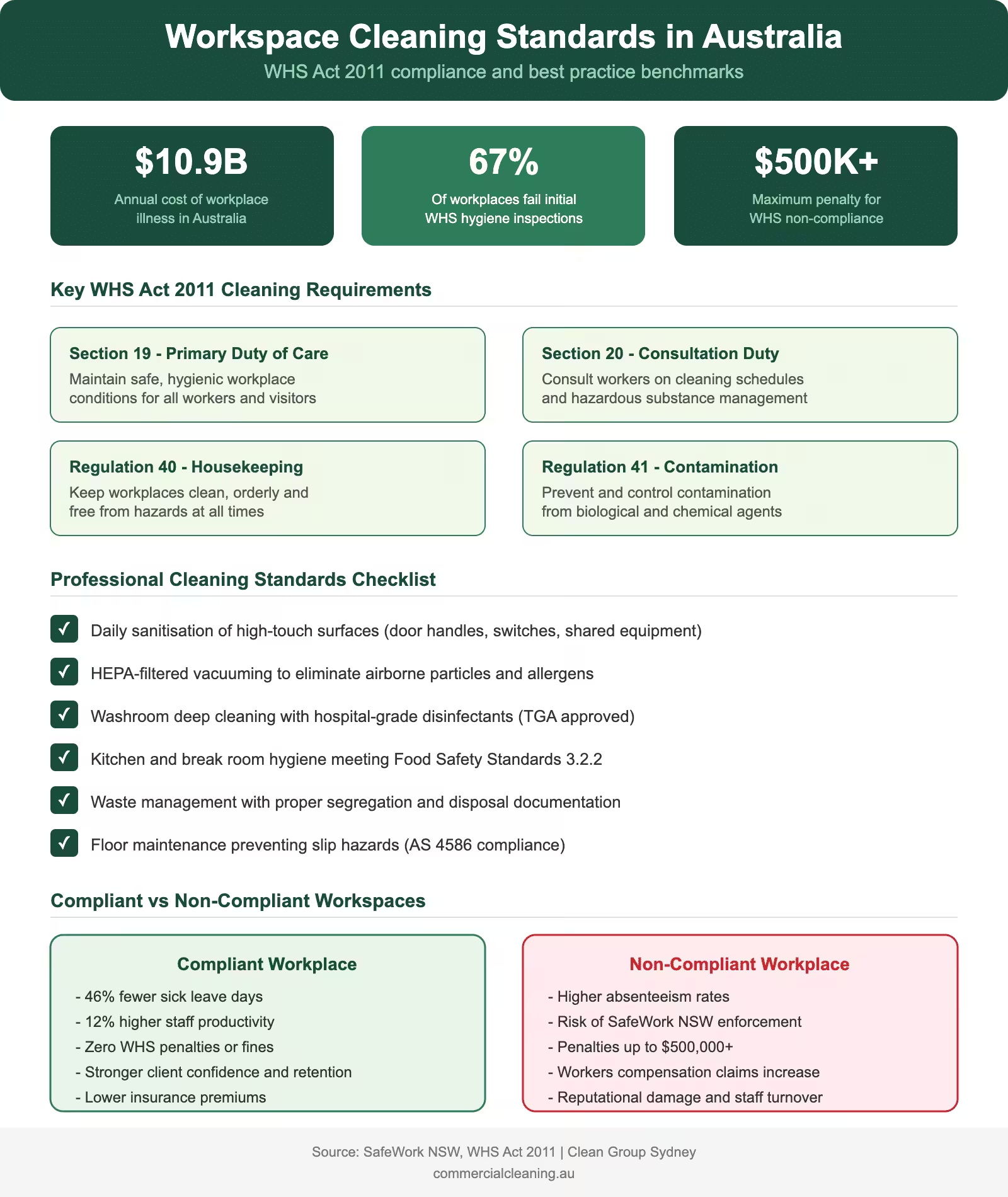
The short answer is that your legal obligations demand it, your employees deserve it, and your bottom line benefits from it. Under the Work Health and Safety Act 2011 (NSW), every person conducting a business or undertaking has a primary duty of care to confirm the health and safety of workers — and that explicitly includes maintaining a clean and hygienic work environment. We have audited sites in Parramatta, Chatswood, and the CBD where facilities managers assumed a basic wipe-down was enough. In every case, a structured cleaning programme aligned to Australian Standards delivered measurable improvements in air quality, surface hygiene, and occupant satisfaction within ninety days.
Regulatory Compliance Under WHS Act 2011
The WHS Act places positive duties on building owners and tenants. Section 19 requires eliminating or minimising health risks so far as is reasonably practicable, and a contaminated or poorly maintained workspace is a foreseeable hazard. Safe Work Australia’s Model Code of Practice for Managing the Work Environment and Facilities specifically references cleaning frequency, waste removal, and ventilation as compliance indicators.
Our compliance team reviews every client’s cleaning scope against these codes before we sign a contract. We have found that roughly one in three scopes we inherit from previous contractors fail to address amenity deep-cleaning frequencies, which is a gap that exposes the building owner to regulatory risk. We document every service we deliver against a digital checklist so our clients have an auditable compliance trail — something we consider non-negotiable for any workspace above five hundred square metres.
Office Area Cleaning Frequency Guide
| Area | Daily | Weekly | Monthly | Quarterly |
|---|---|---|---|---|
| Reception & Lobby | Vacuum, mop, wipe | Glass doors, furniture | Deep carpet clean | Window wash |
| Workstations | Surface wipe, bins | Monitor & keyboard | Drawer clean-out | Chair shampoo |
| Kitchen/Breakroom | Bench, sink, floor | Fridge, microwave | Deep degrease | Exhaust fan clean |
| Bathrooms | Full sanitise + restock | Grout scrub | Descale fixtures | Vent clean |
| Meeting Rooms | Table wipe, vacuum | AV equipment dust | Upholstery clean | Carpet extraction |
Health Outcome Data and Facility-Specific Standards
Australian research published by the National Health and Medical Research Council links indoor air quality directly to respiratory health outcomes. Dust, volatile organic compounds, and biological contaminants accumulate in workspaces that receive only surface-level cleaning. Our team uses HEPA H13-rated vacuums across all CBD and North Sydney sites because standard vacuums recirculate fine particles rather than capturing them.
We also follow AS 1668.2 for ventilation and indoor air quality in buildings. Our supervisors check that cleaning activities — particularly chemical application and floor stripping — are scheduled outside occupied hours to prevent exposure. In a Lane Cove corporate campus, switching to low-VOC GECA-certified chemicals and adjusting our cleaning window from six PM to four AM reduced staff-reported headache incidents by thirty-five per cent within one quarter.
Liability and Insurance Implications
Inadequate cleaning creates slip, trip, and fall hazards that account for a significant proportion of workplace injury claims in New South Wales. Our team carries twenty million dollars in public liability coverage specifically because we understand the exposure. But insurance is a backstop, not a strategy. We train every cleaner to identify and report hazards during their shift — wet floors without signage, frayed entrance matting, obstructed fire exits — because preventing the incident is always cheaper than managing the claim.
We have seen cases where a facilities manager’s insurance premium increased after a pattern of slip-and-fall claims linked to inconsistent floor maintenance. In Surry Hills, one strata client reduced their annual premium by fourteen per cent after we implemented a documented floor care programme with daily inspection logs. That kind of result only comes from cleaning at the highest standard, not the cheapest price.
Carpet and Flooring Standards: AS/NZS 3733:2018
AS/NZS 3733 sets out the standard for textile floor coverings maintenance, and we reference it in every carpet care programme we design. The standard specifies extraction cleaning frequencies based on traffic classification — high-traffic lobbies and corridors require extraction every three to six months, while low-traffic meeting rooms can extend to twelve months. We have found that most buildings we take over have no documented carpet maintenance schedule at all.
Our Homebush depot maintains a fleet of truck-mounted extraction units that deliver consistent water temperature and vacuum pressure across large floor plates. We pre-treat high-soil areas with encapsulation chemistry before extraction, which extends carpet life and reduces replacement costs. For a Barangaroo commercial tower, our scheduled carpet programme extended the carpet asset life from seven years to an estimated eleven years — a saving the facilities manager could demonstrate directly to the building owner.
TGA-Regulated Disinfectants and Sanitisers
Since 2020, the Therapeutic Goods Administration has tightened regulation of disinfectant products used in commercial settings. Any product making antimicrobial claims must be listed on the Australian Register of Therapeutic Goods. We exclusively use TGA-listed disinfectants across all sites and maintain a chemical register that our clients can audit at any time.
Our chemical management team reviews Safety Data Sheets quarterly and cross-references them against the Globally Harmonised System classifications. We removed three products from our approved list last year after reformulation changed their hazard profile. This level of diligence matters because the wrong chemical applied to the wrong surface can damage finishes, void warranties, or create health risks. In Macquarie Park, we identified that a previous contractor had been using a chlorine-based sanitiser on stainless steel fixtures, causing visible pitting that required replacement.
Employee Productivity and Attendance Impact
A clean workspace is not just about aesthetics — it directly affects how people work. Research from the University of Arizona found that office workers in regularly cleaned environments reported twenty-five per cent fewer sick days compared to those in minimally maintained spaces. Our own data across thirty-five Sydney sites shows a correlation between cleaning audit scores and tenant satisfaction ratings, which in turn influence lease renewal decisions.
We track absenteeism data for clients who share it with us, and in Chatswood one corporate tenant saw their flu-season absence rate drop from eight point two per cent to five point one per cent after we introduced touchpoint sanitisation three times daily during winter months. The cost of that additional service was roughly sixty-five dollars per day — a fraction of the productivity loss from even one absent employee.
Client Perception and Brand Risk
Your workspace is a physical expression of your brand. We clean reception areas, boardrooms, and client-facing zones to a higher specification than back-of-house areas because first impressions carry commercial weight. A stained carpet tile in a law firm lobby or a smudged glass partition in a consulting firm’s meeting room sends a message that no amount of marketing can undo.
Our team conducts quarterly perception audits where we photograph high-visibility areas and score them against a presentation standard we developed with input from several Tier 1 property managers in Sydney. We share those audit results with facilities managers alongside our cleaning reports. One client in the CBD told us that their tenant retention rate improved after we elevated the common-area presentation — a tangible business outcome tied directly to cleaning quality.
Audit Frameworks and Performance Measurement
You cannot manage what you do not measure. Our quality assurance programme uses a sixty-five-point audit checklist aligned to ISO 9001 principles. Each site is audited unannounced at least once per month, and results feed into a dashboard that flags trends over time. We score every area on a five-point scale and calculate a weighted site score that accounts for zone priority — a defect in a reception area carries more weight than one in a storage room.
We also benchmark our performance against the Building Owners and Managers Association cleaning standards, which provide objective thresholds for appearance levels across different space types. Our average audit score across all Sydney sites currently sits at ninety-three per cent, and any site falling below ninety per cent for two consecutive months triggers a mandatory corrective action plan. This systematic approach is what differentiates cleaning at the highest standard from cleaning that simply gets done.
Cost of Non-Compliance
The financial consequences of poor cleaning extend well beyond the cleaning contract itself. Regulatory fines under the WHS Act can reach significant figures for serious breaches. But the real cost is less visible — accelerated asset depreciation, higher insurance premiums, increased tenant turnover, and reputational damage that takes years to repair.
We modelled the total cost of non-compliance for a typical ten-thousand-square-metre CBD office building and found that substandard cleaning added an estimated forty-two thousand dollars per year in hidden costs compared to a standards-aligned programme. That figure includes carpet replacement brought forward by three years, additional pest control treatments, and the administrative burden of managing tenant complaints. The cheapest cleaning contract is almost never the most economical.
Choosing a Standards-Aligned Cleaning Provider
When you evaluate cleaning providers, ask for evidence of their compliance framework — not just certificates on a wall. Request their audit methodology, their incident and defect register, their chemical management policy, and their training records. A provider operating at the highest standard will welcome that scrutiny because transparency is part of their operating model.
Our team is always happy to share our full compliance documentation with prospective clients because we believe the detail speaks for itself. We also recommend checking whether your provider aligns to the Cleaning Accountability Framework, which sets benchmarks for wages, safety, and transparency across the industry. If you want to understand what a structured routine cleaning programme delivers in practice, we have broken it down in our guide on the benefits of routine cleaning. See our cleaning checklist for offices to ensure no detail is overlooked.
Frequently Asked Questions
What Australian Standards apply to commercial cleaning?
The key standards include AS/NZS 3733:2018 for textile floor covering maintenance, AS 1668.2 for ventilation and indoor air quality, and the WHS codes of practice under the Work Health and Safety Act 2011. Our cleaning programmes reference all of these in the scope of works for every site.
How often should a commercial workspace be deep-cleaned?
Deep-cleaning frequency depends on traffic levels and space type. High-traffic areas like lobbies and amenities typically require monthly deep-cleans, while standard office floors benefit from quarterly deep-cleans. We tailor frequencies to each site based on usage data and audit results.
What should I look for in a cleaning audit report?
A quality audit report should include scored checklists by zone, photographic evidence, defect tracking with resolution timelines, and trend analysis over time. Our reports also include occupant feedback summaries and recommendations for scope adjustments.
Does higher-standard cleaning cost significantly more?
Not necessarily. A well-structured programme that prevents issues — carpet degradation, pest infestations, indoor air quality complaints — often costs less over the asset lifecycle than reactive cleaning. Our cost modelling shows standards-aligned cleaning adds roughly eight to twelve per cent to the base contract but delivers savings of three to five times that amount in avoided costs.
How do you measure indoor air quality improvements from cleaning?
We monitor particulate matter levels using handheld particle counters before and after cleaning interventions. On sites where we have switched to HEPA filtration vacuums and low-VOC chemicals, we have documented reductions in airborne particulates of between thirty and forty-five per cent.
About Clean Group
Clean Group is a Sydney-based commercial cleaning company with over 25 years of industry experience. Founded by Suji Siv, our team of 50+ trained professionals services offices, warehouses, medical centres, schools, childcare facilities, retail stores, gyms, and strata properties across Sydney, Melbourne, and Brisbane.
We are active members of ISSA and the Building Service Contractors Association of Australia (BSCAA). Our operations align with ISO 9001 (Quality Management), ISO 14001 (Environmental Management), and ISO 45001 (Workplace Health and Safety) standards. We hold membership with the Green Building Council of Australia and use eco-friendly, TGA-registered cleaning products wherever possible.
Every Clean Group cleaner is police-checked, fully insured, and trained in safe work procedures under SafeWork NSW guidelines. We operate 7 days a week, including after-hours and weekend services, to minimise disruption to your business.
About the Author
Stephen Matthews
Hi, my name is Steve. I have been working as a Regional Operations Manager in Sydney Clean Group for almost four years now and manage a team of 10. I have more than three decades of experience in the commercial cleaning industry. My responsibilities include the day-to-day management of cleaning operations, planning, online quotation to clients, managing cleaners’ performance, collecting clients\' feedback, and ensuring proper & regular maintenance of cleaning equipment. Get in touch for a quick chat about your cleaning needs.
Read More About Stephen
