Flood Damage Restoration for Buildings in Sydney
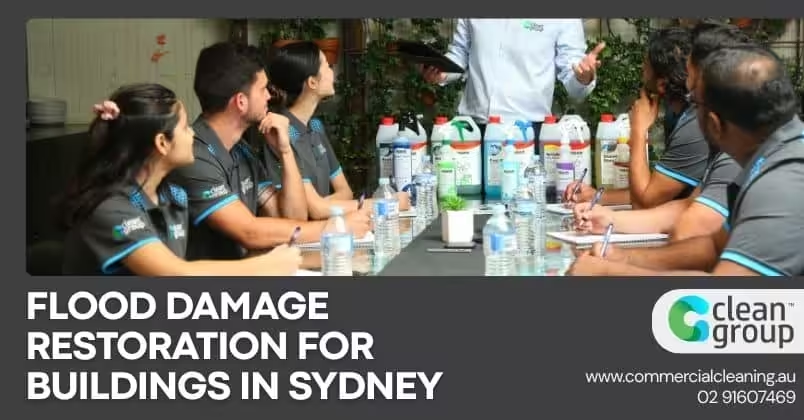
Deep cleaning services professionals need to understand this. We have restored flood-damaged commercial and residential buildings across southwest Sydney for over twelve years, and every job has reinforced our belief that the quality of the initial restoration determines whether a building recovers fully or suffers ongoing problems for years afterward. Our team has worked on properties in Bankstown, Revesby, and Padstow where the Georges River and Salt Pan Creek catchments create flood risk that affects dozens of buildings during major storm events. We bring a complete restoration capability to every job, from emergency water extraction through structural drying, contamination treatment, and final reinstatement cleaning, because splitting these stages across multiple contractors introduces delays and communication gaps that always cost the building owner more in the end. As experienced commercial cleaning sydney providers, we have built our flood restoration division specifically to handle the full scope of work under a single contract so our clients have one point of accountability from the day the water enters to the day they move back in.
For more insights, see our guide on disinfection protocols for workplaces.
Assessing Flood Damage in Commercial and Strata Buildings
Assessing Flood Damage in Commercial and Strata Buildings covers specific protocols that we tailor to each facility based on its layout, traffic, and compliance requirements. We begin every flood restoration project with a detailed damage assessment that maps the affected areas, identifies the contamination category, and evaluates the structural condition of the building. Our assessors use thermal imaging cameras and pin-type moisture meters to detect water that has migrated behind wall linings, under floor coverings, and into ceiling voids where it is invisible to the naked eye. At a Bankstown strata building we assessed after a 2023 storm event, our thermal scan revealed water tracking through the slab from the car park level into the ground-floor commercial tenancies, which meant the restoration scope was three times larger than the strata manager initially estimated based on what was visible from inside the affected units.
We also assess the foundation and slab condition where flood water has been in prolonged contact with the building substructure. In the Bankstown and Revesby area, many buildings sit on reactive clay soils where moisture changes can cause differential movement in accordance with the soil reactivity principles described in AS 2870. While we are not structural engineers, our assessors are trained to identify signs of slab heave, cracking, and differential settlement that may have been caused or worsened by the flood event, and we include these observations in our report with a recommendation for engineering review where warranted. This proactive approach has saved several of our clients from commencing cosmetic restoration on buildings that needed structural remediation first.
Water Extraction and Contamination Management
We classify flood water contamination using the three-category system established by the IICRC S500 standard, and this classification drives every decision we make about extraction methods, PPE requirements, and disposal protocols. Category 3 water, which includes sewage overflow and external floodwater containing chemical and biological contaminants, is what we encounter on the vast majority of our Bankstown and Padstow flood jobs because the stormwater and sewer systems in these catchments frequently surcharge during heavy rainfall. Our extraction crews wear full Tyvek suits, P2 respirators, and nitrile gloves when handling Category 3 water, and we decontaminate all equipment on site before loading it back onto our vehicles to prevent cross-contamination between jobs.
Our extraction equipment includes truck-mounted pumps, portable submersible units, and weighted extraction tools designed to pull water from carpet and underlay without damaging the subfloor. We prioritise the removal of standing water because every hour of contact increases the absorption depth in porous materials like timber framing, plasterboard, and concrete, which extends the drying time and cost proportionally. At a Revesby retail strip we restored after flash flooding in 2024, we had all standing water extracted within four hours of arrival and the drying equipment operational before midnight on the same day. That speed of response meant the tenants lost only three trading days instead of the two to three weeks that would have been necessary if the water had remained overnight and saturated the wall framing to the point where replacement was required.
Office Area Cleaning Frequency Guide
| Area | Daily | Weekly | Monthly | Quarterly |
|---|---|---|---|---|
| Reception & Lobby | Vacuum, mop, wipe | Glass doors, furniture | Deep carpet clean | Window wash |
| Workstations | Surface wipe, bins | Monitor & keyboard | Drawer clean-out | Chair shampoo |
| Kitchen/Breakroom | Bench, sink, floor | Fridge, microwave | Deep degrease | Exhaust fan clean |
| Bathrooms | Full sanitise + restock | Grout scrub | Descale fixtures | Vent clean |
| Meeting Rooms | Table wipe, vacuum | AV equipment dust | Upholstery clean | Carpet extraction |
Structural Drying Programs for Multi-Storey Buildings
Office Area Cleaning Frequency Guide requires specific protocols that we tailor to each facility based on its layout, traffic, and compliance requirements. We design bespoke drying programs for each building based on the construction type, the extent of water penetration, and the materials affected. A timber-framed building in Padstow dries very differently from a concrete and steel commercial building in Bankstown, and applying the same equipment configuration to both would be either inadequate or wasteful. Our drying technicians calculate the specific dehumidification capacity required using the grain depression formula from the IICRC S500 standard, which accounts for the volume of the affected space, the target humidity, and the moisture load from wet building materials. We then deploy the right combination of LGR dehumidifiers, desiccant units, and axial air movers to achieve the required drying rate.
Structural Drying Programs for Multi-Storey Buildings includes specific protocols that we tailor to each facility based on its layout, traffic, and compliance requirements. We monitor every drying program with twice-daily moisture readings taken from a grid of predetermined test points across the affected area. Our readings are logged digitally with timestamps and GPS coordinates so the insurer can verify that monitoring was conducted at the specified intervals. At a three-storey Bankstown office building we dried after a water main burst flooded the ground floor and basement, our monitoring data showed that the basement concrete slab took eleven days to reach target moisture levels even though the ground-floor timber framing was dry within five days. Without granular monitoring, the builder would have begun floor covering installation over a slab that was still too wet, which would have caused adhesive failure and mould growth within months. Our data prevented that outcome and saved the building owner a costly rework.
Mould Prevention and Remediation After Flooding
We treat mould prevention as an integral part of every flood restoration rather than a separate service that only gets attention if visible growth appears. Mould spores begin colonising wet building materials within twenty-four to forty-eight hours of water contact, which means any delay in starting the drying and antimicrobial treatment increases the likelihood that active mould growth will develop behind wall linings and inside ceiling voids where it cannot be seen. Our antimicrobial treatment protocol starts immediately after extraction: we fog the entire affected area with a registered biocide that kills existing spores and provides residual protection during the drying phase. We then apply a surface-active antimicrobial to all exposed building materials including timber framing, concrete, and the back face of plasterboard that will remain in place.
When we encounter established mould growth during a flood restoration, we contain the affected area with polyethylene sheeting and negative air pressure before any removal work begins. Our mould remediation technicians remove contaminated porous materials including plasterboard, insulation, and carpet that cannot be effectively decontaminated, and clean non-porous materials using HEPA-filtered vacuuming followed by damp wiping with an antifungal solution. We have remediated mould in over thirty flood-affected buildings across the Revesby and Padstow area in the past three years, and our post-remediation air quality testing has confirmed clearance on the first attempt in every case. That success rate reflects the thoroughness of our containment and removal procedures, which we will not compromise even when there is pressure to rush the restoration timeline.
Flood Restoration Costs for Sydney Buildings
We price flood restoration based on the affected floor area, contamination category, number of storeys involved, and the extent of material removal and replacement required. A typical ground-floor commercial tenancy of around 250 square metres in the Bankstown or Padstow area costs approximately $4,200 for the complete restoration program including extraction, antimicrobial treatment, structural drying with daily monitoring, and a final reinstatement clean. Multi-storey projects where water has migrated between levels attract higher costs because the drying equipment needs to be deployed on each affected floor and the monitoring program runs for longer. We provide a detailed scope and estimate within twenty-four hours of our initial assessment so the building owner can lodge their insurance claim without delay.
We have found that buildings restored promptly and thoroughly after flooding maintain their market value and tenant satisfaction far better than those where corners were cut during the restoration process. A strata scheme in Revesby that engaged us for a detailed flood restoration in early 2024 was able to re-let their ground-floor commercial suite within two weeks of our completion at the same rental rate, while a neighbouring building that used a budget restoration provider was still dealing with mould complaints and tenant rent reductions six months later. That comparison illustrates why we always recommend investing in a proper restoration from the outset rather than trying to save money during the emergency phase and paying more for remediation later. For properties where smoke rather than water is the primary damage vector, our smoke damage restoration guide covers the specialised techniques we use for fire-affected buildings.
Frequently Asked Questions
How long does flood restoration take for a commercial building?
The timeline depends on the severity of the damage and the building construction. A typical single-storey commercial tenancy takes seven to fourteen days from extraction through to reinstatement cleaning. Multi-storey buildings or those with extensive structural damage may require three to four weeks. We provide a projected timeline during our initial assessment and update it daily as the drying program progresses.
Do you work with insurance companies on flood claims?
Yes. We produce detailed documentation including moisture mapping, daily drying logs, photographic records, and itemised cost breakdowns that are formatted for insurance claim submission. We can liaise directly with your loss adjuster or insurer if you authorise us to do so, and we have established working relationships with most major insurance companies operating in the Sydney market.
Can flood-damaged carpet be saved?
Carpet exposed to Category 1 clean water can sometimes be salvaged through extraction, cleaning, and sanitising. Carpet exposed to Category 3 flood water, which includes sewage or external floodwater, must be removed and disposed of because the contamination cannot be reliably eliminated from the carpet fibres and backing. We assess every carpet on a case-by-case basis and provide an honest recommendation rather than automatically replacing materials that could be saved.
What happens if mould develops after the restoration is complete?
If mould develops within the areas we restored, we return to investigate and remediate at no additional cost provided the building owner has maintained the environmental conditions we specified in our handover report. This typically means keeping the HVAC system operational and maintaining indoor humidity below sixty per cent. We stand behind our work because our drying and antimicrobial protocols are designed to prevent mould recurrence when the building is operated correctly.
Do you restore both commercial and residential buildings?
Yes. Our flood restoration team handles commercial tenancies, strata common areas, individual residential units, and mixed-use buildings. The restoration principles are the same regardless of building use, although commercial properties often have additional requirements around business continuity and insurance documentation that we accommodate as part of our standard service.
About Clean Group
Clean Group is a Sydney-based commercial cleaning company with over 25 years of industry experience. Founded by Suji Siv, our team of 50+ trained professionals services offices, warehouses, medical centres, schools, childcare facilities, retail stores, gyms, and strata properties across Sydney, Melbourne, and Brisbane.
We are active members of ISSA and the Building Service Contractors Association of Australia (BSCAA). Our operations align with ISO 9001 (Quality Management), ISO 14001 (Environmental Management), and ISO 45001 (Workplace Health and Safety) standards. We hold membership with the Green Building Council of Australia and use eco-friendly, TGA-registered cleaning products wherever possible.
Every Clean Group cleaner is police-checked, fully insured, and trained in safe work procedures under SafeWork NSW guidelines. We operate 7 days a week, including after-hours and weekend services, to minimise disruption to your business.
About the Author

Suji Siv
/

Hi, I'm Suji Siv, the founder, CEO, and Managing Director of Clean Group, bringing over 25 years of leadership and management experience to the company. As the driving force behind Clean Group’s growth, I oversee strategic planning, resource allocation, and operational excellence across all departments. I am deeply involved in team development and performance optimization through regular reviews and hands-on leadership.
Read More About Suji 0291607469
 Get A Quote