We started pursuing green certification for our cleaning operations in 2017, and it has transformed the way we select products, train staff, and report environmental performance to our clients. Our office cleaning services team now operates under a certified environmental management system that covers every aspect of service delivery—from chemical procurement through to waste disposal. This guide explains the major green certification frameworks that affect commercial cleaning in Australia and shows facility managers how to align their cleaning program with sustainability targets.
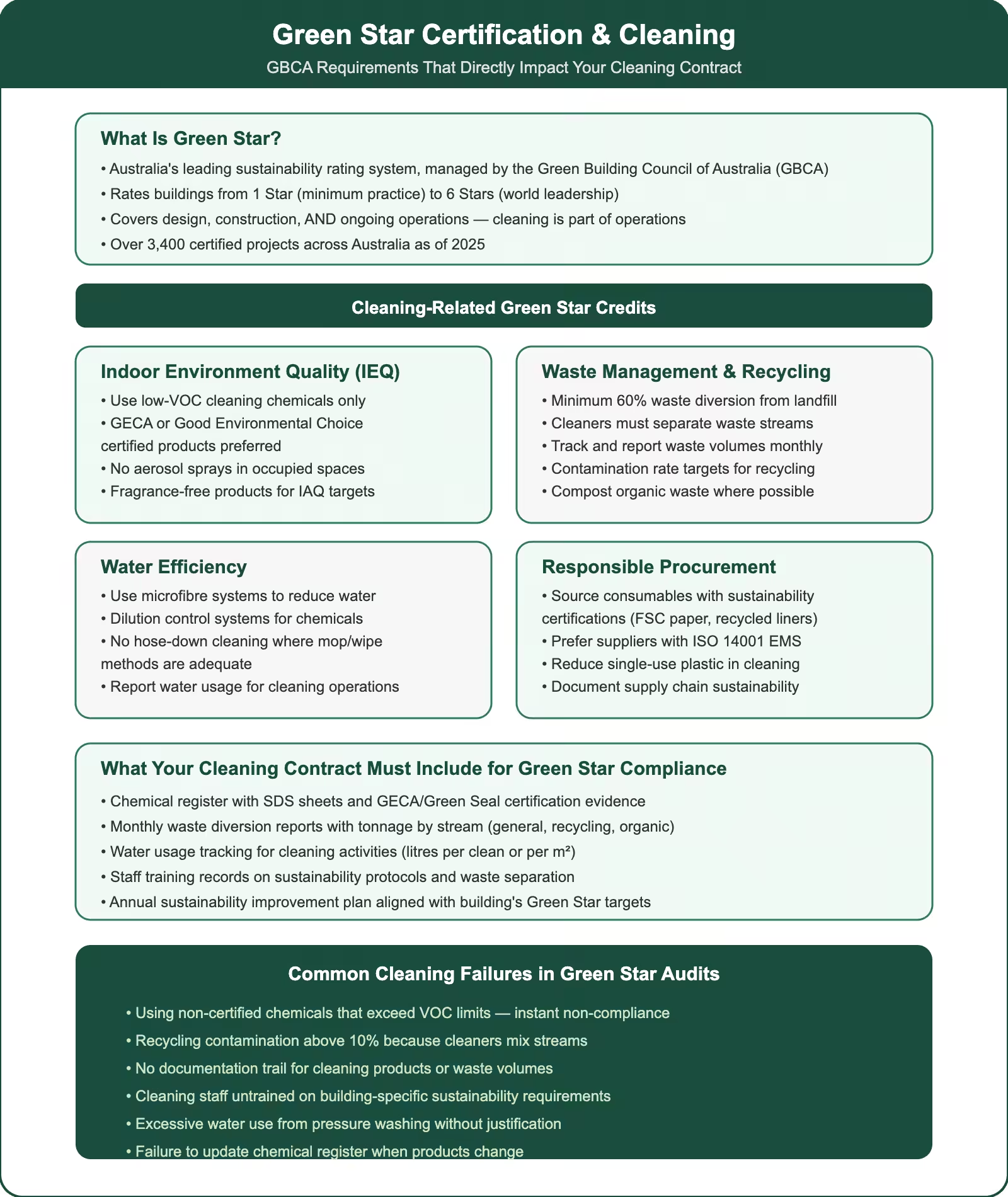
Green Star certification and cleaning requirements covering GBCA indoor environment quality, waste management, water efficiency, responsible procurement, and common audit failures
Green Building Council of Australia Certification and Cleaning Requirements
We align our cleaning operations with Green Star certification requirements because an increasing number of our Sydney clients pursue Green Star ratings for their commercial buildings. Our team understands that cleaning directly affects several Green Star credit categories—indoor environment quality, materials selection, and management practices—and we structure our service to maximise the credits available to the building owner. We have contributed to Green Star submissions for three Dee Why commercial buildings, providing the cleaning-specific documentation that assessors require for the indoor environment quality credits.
We specify GECA-certified or Good Environmental Choice Australia products as standard across all Green Star-rated buildings we service, because these products carry third-party verification of reduced environmental impact. Our chemical register for Brookvale facilities lists fourteen GECA-certified products covering every cleaning application from glass to hard floors, and we maintain certificates of conformity that the building’s Green Star assessor can reference directly. We invested $3,100 in obtaining green certification alignment for our operations, covering product transitions, staff training, and the documentation system that tracks our environmental performance against Green Star benchmarks.
We track and report the cleaning-related data points that Green Star assessors need, including chemical usage volumes, waste diversion rates, and energy consumption from cleaning equipment. Our Dee Why portfolio produces quarterly sustainability reports that building managers incorporate directly into their Green Star performance submissions. We have found that proactive data collection during the contract—rather than retrospective evidence gathering at assessment time—reduces the administrative burden on both parties and produces higher-quality submissions.
NABERS Indoor Environment Ratings and Cleaning Inputs
We understand that NABERS Indoor Environment ratings depend partly on cleaning practices because indoor air quality, surface hygiene, and occupant satisfaction all fall within the assessment scope. Our team manages cleaning programs in several NABERS-rated buildings across the Northern Beaches, and we tailor our operations to support the building’s target rating. We have found that the cleaning practices most relevant to NABERS are chemical VOC levels, dust management effectiveness, and restroom hygiene standards—all of which we measure and report quarterly.
We specify low-VOC cleaning products for all NABERS-rated buildings because volatile organic compounds from cleaning chemicals can measurably degrade indoor air quality. Our product selection for Curl Curl commercial premises uses a maximum VOC threshold of 5 percent by weight for general-purpose cleaners and zero VOC for glass and surface sprays used in occupied spaces. We test indoor air quality annually in partnership with the building’s environmental consultant, and our cleaning products have never been identified as a contributing factor to IAQ exceedances.
We contribute to NABERS tenant satisfaction surveys by maintaining washroom and common area standards that score above 90 percent in our internal audits. Our data from North Curl Curl offices shows a direct correlation between cleaning audit scores and NABERS tenant satisfaction results—when our audit scores increased from 85 to 93 over twelve months, the building’s NABERS tenant satisfaction score improved by 8 percentage points in the same period. We believe this correlation validates our approach of treating cleaning quality as a measurable input to building performance rather than a background service.
Eco-Friendly vs Traditional Cleaning Comparison
Factor
Eco-Friendly
Traditional Chemical
Impact Difference
VOC Emissions
Near zero
15–45 g/L
95% lower indoor pollution
Waterway Impact
Biodegradable in 7 days
Persistent 30–90 days
Safer for marine life
Cleaning Power
85–95% vs traditional
Baseline 100%
Negligible for routine tasks
Cost per Litre
$8–$15 (concentrated)
$4–$9
15–25% higher upfront
Staff Health
No PPE for routine use
Gloves + ventilation needed
60% fewer skin reactions
GECA Product Certification and Chemical Selection
Eco-Friendly vs Traditional Cleaning Comparison requires specific protocols that we tailor to each facility based on its layout, traffic, and compliance requirements. We transitioned our entire chemical inventory to GECA-certified products in 2019 because we needed a credible, third-party-verified standard that our clients could trust. Our procurement team evaluated four certification frameworks—GECA, EU Ecolabel, Nordic Swan, and Green Seal—and selected GECA because it is the only scheme specifically designed for the Australian market and recognised by the Green Building Council of Australia. We now maintain a GECA-certified product for every cleaning application in our portfolio, from heavy-duty degreasers to hand soaps.
We audit our chemical supply chain annually to verify that every product we use retains its current GECA certification, because certifications can lapse if the manufacturer changes formulations or fails to renew. Our Brookvale warehouse stocks only products with valid certificates, and our procurement system automatically flags any product whose certification is within 60 days of expiry. We have rejected two supplier products in the past twelve months because their GECA certification had lapsed—a discipline that protects our clients’ Green Star compliance and our own credibility.
We train every crew member on the environmental rationale behind our product selection, because we have found that understanding the “why” drives better compliance than simply mandating product use. Our Dee Why induction program includes a thirty-minute module on environmental certification, covering what GECA means, why VOC levels matter for indoor air quality, and how chemical selection connects to the building’s sustainability goals. We test comprehension with a short assessment, and crew members who score below 80 percent repeat the module before starting on-site.
AS/NZS ISO 14001 Environmental Management and Cleaning Operations
We operate under an environmental management system aligned with AS/NZS ISO 14001, which provides the framework for setting environmental objectives, measuring performance, and driving continuous improvement across our cleaning operations. Our system covers six environmental aspects: chemical usage and disposal, water consumption, energy consumption from equipment, waste generation and diversion, packaging waste, and transport emissions. We set annual reduction targets for each aspect and report progress quarterly to our management team and to clients who request environmental performance data.
We conduct an annual environmental aspects and impacts assessment for every site in our portfolio, identifying the environmental risks specific to each building and developing controls proportionate to those risks. Our Curl Curl assessment identified stormwater contamination from external cleaning as the highest-risk aspect, which prompted us to implement a closed-loop water capture system for all external wash-down activities at that site. We documented this control in our ISO 14001 register and verified its effectiveness through quarterly stormwater sampling.
We track our portfolio-wide environmental performance using a dashboard that aggregates data from every site into key metrics: chemical consumption per square metre, waste diversion rate, water consumption per clean, and carbon emissions per contract dollar. Our Northern Beaches portfolio achieved a 22 percent reduction in chemical consumption per square metre over three years through product concentration optimisation and microfibre technology adoption—a result that we attribute directly to the systematic improvement cycle that ISO 14001 requires.
We encourage facility managers to ask their cleaning provider for evidence of environmental management system certification, because self-declared “green cleaning” claims are unverifiable without a structured management framework behind them. Our ISO 14001 alignment gives our clients documented assurance that our environmental commitments are systematic, measurable, and subject to internal audit. For a broader understanding of how cleaning integrates with overall facility management strategy, we recommend reading our guide on how cleaning fits into facility management.
Clean Group is a Sydney-based commercial cleaning company with over 25 years of industry experience. Founded by Suji Siv, our team of 50+ trained professionals services offices, warehouses, medical centres, schools, childcare facilities, retail stores, gyms, and strata properties across Sydney, Melbourne, and Brisbane.
We are active members of ISSA and the Building Service Contractors Association of Australia (BSCAA). Our operations align with ISO 9001 (Quality Management), ISO 14001 (Environmental Management), and ISO 45001 (Workplace Health and Safety) standards. We hold membership with the Green Building Council of Australia and use eco-friendly, TGA-registered cleaning products wherever possible.
Every Clean Group cleaner is police-checked, fully insured, and trained in safe work procedures under SafeWork NSW guidelines. We operate 7 days a week, including after-hours and weekend services, to minimise disruption to your business.
What is GECA certification for cleaning products?
GECA (Good Environmental Choice Australia) is a third-party ecolabel that certifies cleaning products meet strict environmental and health criteria. We use GECA-certified products across our portfolio because GECA is the only Australian certification recognised by the Green Building Council of Australia for Green Star credit purposes.
Does green certification cost more for cleaning services?
Green-certified cleaning typically adds 5 to 10 percent to chemical costs compared to conventional products, but this premium is often offset by reduced consumption through concentrated formulations and microfibre technology. We invested $3,100 in transitioning our operations to green certification and found that the net cost impact was negligible once efficiency gains were factored in.
How does cleaning affect a building’s NABERS rating?
Cleaning affects NABERS ratings through indoor air quality (chemical VOC emissions), tenant satisfaction (washroom and common area standards), and waste management (diversion rates). We manage all three aspects as part of our standard service and provide quarterly data that building managers use in their NABERS submissions.
What is the Cleaning Accountability Framework?
The Cleaning Accountability Framework (CAF) is an Australian initiative that promotes fair labour practices and ethical procurement in the cleaning industry. CAF certification verifies that cleaning contractors comply with award rates, workplace safety obligations, and ethical business practices. We support CAF principles and maintain documentation that demonstrates compliance with all framework requirements.
Can a building achieve Green Star certification without green cleaning?
Green Star certification is possible without green cleaning, but the building would miss credits in the indoor environment quality and management categories that cleaning directly influences. We recommend aligning cleaning operations with Green Star requirements because these credits are relatively easy to achieve compared to capital-intensive building upgrade credits.
Hi, I'm Suji Siv, the founder, CEO, and Managing Director of Clean Group, bringing over 25 years of leadership and management experience to the company. As the driving force behind Clean Group’s growth, I oversee strategic planning, resource allocation, and operational excellence across all departments. I am deeply involved in team development and performance optimization through regular reviews and hands-on leadership.