AS 1851 is the Australian Standard that governs the routine maintenance of fire protection systems, and for any commercial kitchen running a rangehood and exhaust duct system, it is not optional — it is a legal requirement enforced through your building’s Annual Fire Safety Statement. We have been cleaning kitchen exhaust systems across Sydney for over fifteen years as part of our commercial restaurant cleaning service, and the number of kitchens we find operating outside AS 1851 compliance is genuinely alarming. Grease-laden ductwork is the single most common cause of commercial kitchen fires in Australia, and the standard exists specifically to prevent those fires through scheduled inspection and cleaning.
What AS 1851 Actually Requires for Kitchen Exhaust Systems
AS 1851-2012 (Routine service of fire protection systems and equipment) dedicates Section 14 to kitchen exhaust systems. The standard specifies inspection and cleaning frequencies based on the type of cooking conducted in the premises. High-volume cooking operations — restaurants frying, grilling, or wok-cooking for more than 12 hours per day — require exhaust system cleaning every six months at minimum. Medium-volume operations get an annual cycle, and low-volume operations such as café warming ovens operate on an 18-month to 24-month schedule.
The critical requirement that most kitchen operators miss is that AS 1851 mandates the entire exhaust pathway be inspected, not just the visible rangehood and filters. That means the canopy, baffle filters, plenum chamber, vertical and horizontal ductwork, fan housing, and discharge point on the roof must all be assessed for grease accumulation. We have inspected systems in Haymarket and Chatswood restaurants where the rangehood looked clean but the ductwork contained grease deposits exceeding 200 microns — well above the 50-micron maximum that AS 1851 Section 14.2.3 sets as the acceptable residue threshold after cleaning.
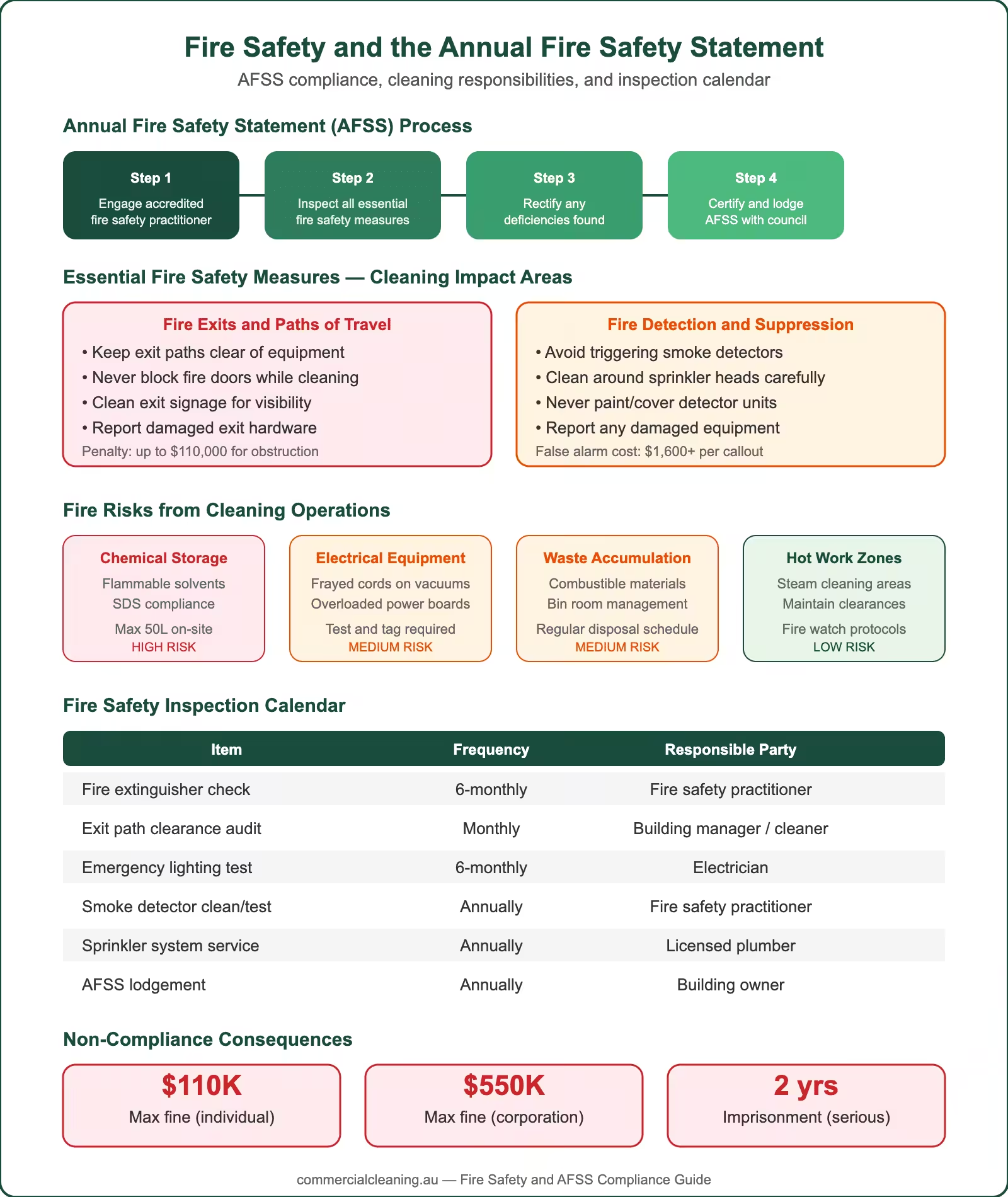
Fire safety and annual fire safety statement infographic showing AFSS process, cleaning impact areas, fire risks, inspection calendar, and penalties
Fire Safety and the Annual Fire Safety Statement
Every commercial building in NSW must submit an Annual Fire Safety Statement (AFSS) to the local council and Fire and Rescue NSW, certifying that all fire protection systems have been maintained in accordance with the relevant Australian Standards. Kitchen exhaust systems fall under this requirement, and failure to maintain compliance can void your building insurance, expose the building owner to personal liability, and result in Fire and Rescue NSW issuing a Fire Safety Order under the Environmental Planning and Assessment Act 1979.
We have accompanied clients through Fire and Rescue inspections in Parramatta, Bankstown, and the CBD where inadequate kitchen exhaust maintenance triggered immediate rectification notices. The cost of emergency cleaning under a rectification deadline runs $2,500 to $4,000 more than a scheduled AS 1851 clean because of the urgency premium and the additional documentation required. Our scheduled maintenance program eliminates that risk entirely — every client receives their compliance certificate within 48 hours of the completed clean, ready for inclusion in the AFSS submission.
Commercial Kitchen Cleaning Zone Guide
Zone
Clean Frequency
Method
Compliance
Penalty Risk
Cooking Line
After each service
Degrease + sanitise
Food Standards 3.2.2
Up to $275,000
Cold Storage
Weekly deep clean
Strip, clean, temp log
Food Standards 3.2.2
Closure risk
Exhaust Hood & Filters
Monthly
Chemical soak + pressure
AS 1851 (fire safety)
Insurance void
Dining Floor
After each service
Sweep, mop, spot treat
WHS Reg 2017
Slip injury claim
Grease Trap
Quarterly pump-out
Licensed contractor
EPA Protection Act
Up to $1M fine
Our Kitchen Exhaust Cleaning Process: Step by Step
Our AS 1851 exhaust cleaning follows a documented eight-stage process that we have standardised across every commercial kitchen we service in Greater Sydney. Stage one is a pre-clean inspection with photographic documentation of grease accumulation levels at each access point along the exhaust pathway. Stage two is baffle-filter removal — we pull every filter from the canopy, soak them in a heated alkaline degreasing tank at 60°C for 30 minutes, pressure-wash, and inspect for damage. Bent or perforated baffles get flagged for replacement because a damaged filter allows grease-laden vapour to bypass the filtration stage and deposit directly into the ductwork.
Stages three through five cover the canopy interior, plenum chamber, and ductwork respectively. We use a combination of hand scraping for heavy deposits and hot-water pressure washing at 3,000 psi for the ductwork interior. Our crew accesses horizontal duct runs through AS 1851-compliant access panels — if your system lacks adequate access panels, we install them as part of the first service at an additional cost of $180 to $350 per panel depending on duct size and material. Stages six and seven address the fan housing and roof discharge cowl. Stage eight is the post-clean inspection with photographic verification that every section falls below the 50-micron residue threshold specified in AS 1851.
Grease Measurement and the 50-Micron Standard
Grease Measurement and the 50-Micron Standard addresses specific protocols that we tailor to each facility based on its layout, traffic, and compliance requirements. The 50-micron maximum residue thickness after cleaning is the quantifiable benchmark that AS 1851 Section 14.2.3 establishes for compliance. We measure this using a calibrated wet-film thickness gauge at a minimum of six points along the exhaust pathway. Pre-clean readings in kitchens we service for the first time in Surry Hills and Liverpool regularly exceed 500 microns in horizontal duct sections and 1,000 microns in plenum chambers where grease has pooled over years of inadequate maintenance.
Our post-clean readings consistently fall below 30 microns — well within the 50-micron limit. We record every measurement in our digital compliance report alongside the GPS-tagged photographs taken at each access point. This documentation provides building owners with auditable evidence that the system meets AS 1851 requirements, and it protects the kitchen operator in the event of a fire investigation where exhaust maintenance records are scrutinised by insurance assessors and fire investigators.
Common Compliance Failures We Find in Sydney Kitchens
In twelve years of AS 1851 kitchen exhaust work across Sydney, we have catalogued the recurring compliance failures that put commercial kitchens at risk. The most common is inadequate cleaning frequency — restaurants operating high-volume wok cooking on a 12-month cycle when AS 1851 requires six-monthly cleaning. We have found this violation in approximately 40 percent of Asian restaurants in Eastwood, Cabramatta, and Haymarket that we audit for the first time. The second most common failure is cleaning that addresses only the canopy and filters while leaving the ductwork untouched. A clean rangehood with a grease-filled duct behind it provides zero fire protection and creates a false sense of compliance.
The third failure is missing or inadequate access panels. AS 1851 requires that ductwork be accessible for inspection and cleaning along its entire length. We have encountered systems in Homebush and Penrith where access panels were sealed shut, painted over, or never installed in the first place. Without access, there is no way to verify that the ductwork interior meets the 50-micron standard, and the building cannot truthfully certify compliance on the AFSS. Our standard scope includes an access-panel audit on the first visit, with installation recommendations for any sections that cannot be reached.
Fan Motor and Roof Discharge Maintenance
Fan Motor and Roof Discharge Maintenance focuses on specific protocols that we tailor to each facility based on its layout, traffic, and compliance requirements. The exhaust fan is the mechanical heart of the kitchen ventilation system, and grease accumulation on fan blades creates an imbalance that accelerates bearing wear and reduces extraction efficiency. We clean fan blades, housings, and belt-drive assemblies as part of every AS 1851 service. Our crew checks belt tension, bearing condition, and motor amperage draw against the manufacturer’s specifications — if the motor is drawing more than 10 percent above rated amps, it typically indicates grease loading on the fan blades that is reducing airflow and forcing the motor to work harder.
Roof discharge cowls and weather protection hoods accumulate external grease deposits that attract vermin and create slip hazards for anyone accessing the roof for other maintenance purposes. We clean the discharge area and surrounding roof surface within a 1.5-metre radius, and we install or replace grease-collection gutters where the discharge point allows runoff onto pedestrian areas below. One restaurant in Newtown had a persistent grease-drip problem onto the footpath outside their premises that was generating complaints to the local council — our installation of a collection gutter and quarterly discharge-area clean eliminated the issue entirely at a cost of $420 for the initial installation.
Compliance Certificates and Documentation
Compliance Certificates and Documentation covers specific protocols that we tailor to each facility based on its layout, traffic, and compliance requirements. Every AS 1851 kitchen exhaust clean we complete generates a formal compliance certificate that includes the date of service, the cleaning operative’s certification details, pre-clean and post-clean grease thickness measurements at each test point, photographic evidence of the system condition before and after cleaning, and the recommended date for the next scheduled service based on the cooking volume assessment. This certificate is the document your building manager needs for the Annual Fire Safety Statement, and it is the document your insurance company will ask for if a fire occurs.
We maintain digital copies of all compliance certificates in our cloud-based portal, accessible to building owners, facility managers, and fire-safety auditors on demand. Our Marrickville and CBD restaurant clients consistently report that having audit-ready documentation available within minutes of an inspector’s request has transformed their relationship with Fire and Rescue NSW from adversarial to cooperative. For kitchens that are new to structured maintenance programs and want to understand the full scope of what ongoing compliance looks like, our overview of keeping food courts clean and hygiene-compliant provides the foundation we build every maintenance program upon.
Frequently Asked Questions
How often must kitchen exhaust systems be cleaned under AS 1851?
It depends on usage: heavy-use systems with solid fuel or high-grease cooking require quarterly cleaning, standard restaurant kitchens need six-monthly cleaning, and light-use systems require annual cleaning. A competent person must assess the correct frequency based on actual cooking operations.
Who can perform AS 1851 kitchen exhaust cleaning?
AS 1851 requires a competent person with the knowledge and skills to perform the service correctly. This typically means a specialist kitchen exhaust cleaning contractor rather than a general cleaner. The competent person must be able to assess the system, identify deficiencies, and issue a valid compliance certificate.
What happens if my kitchen exhaust system fails a fire inspection?
Fire and Rescue NSW can issue a fire safety order requiring immediate rectification. In serious cases, the kitchen may be ordered to cease operations until the exhaust system is brought into compliance. The building owner receives the order and is responsible for engaging a competent contractor to perform the required cleaning and repairs.
Does kitchen exhaust cleaning satisfy both fire safety and food safety requirements?
A compliant AS 1851 exhaust clean addresses the fire safety requirement. HACCP and food safety auditors also check exhaust system hygiene for contamination risks. Our service reports are formatted to satisfy both fire safety and food safety documentation requirements in a single document.
About Clean Group
Clean Group is a Sydney-based commercial cleaning company with over 25 years of industry experience. Founded by Suji Siv, our team of 50+ trained professionals services offices, warehouses, medical centres, schools, childcare facilities, retail stores, gyms, and strata properties across Sydney, Melbourne, and Brisbane.
We are active members of ISSA and the Building Service Contractors Association of Australia (BSCAA). Our operations align with ISO 9001 (Quality Management), ISO 14001 (Environmental Management), and ISO 45001 (Workplace Health and Safety) standards. We hold membership with the Green Building Council of Australia and use eco-friendly, TGA-registered cleaning products wherever possible.
Every Clean Group cleaner is police-checked, fully insured, and trained in safe work procedures under SafeWork NSW guidelines. We operate 7 days a week, including after-hours and weekend services, to minimise disruption to your business.
Hi, I'm Suji Siv, the founder, CEO, and Managing Director of Clean Group, bringing over 25 years of leadership and management experience to the company. As the driving force behind Clean Group’s growth, I oversee strategic planning, resource allocation, and operational excellence across all departments. I am deeply involved in team development and performance optimization through regular reviews and hands-on leadership.