Getting the right cleaning contractor into your building isn’t a random choice. After servicing strata properties across Sydney—from Chatswood to Bondi Junction—our team has seen what separates buildings with clean common areas from those constantly chasing problems. A formal request for proposal (RFP) process is your best defence against pricing wars that sacrifice quality. This guide walks you through creating a tender that attracts qualified contractors and gives your strata cleaning committee genuine grounds to make a decision beyond the cheapest quote.
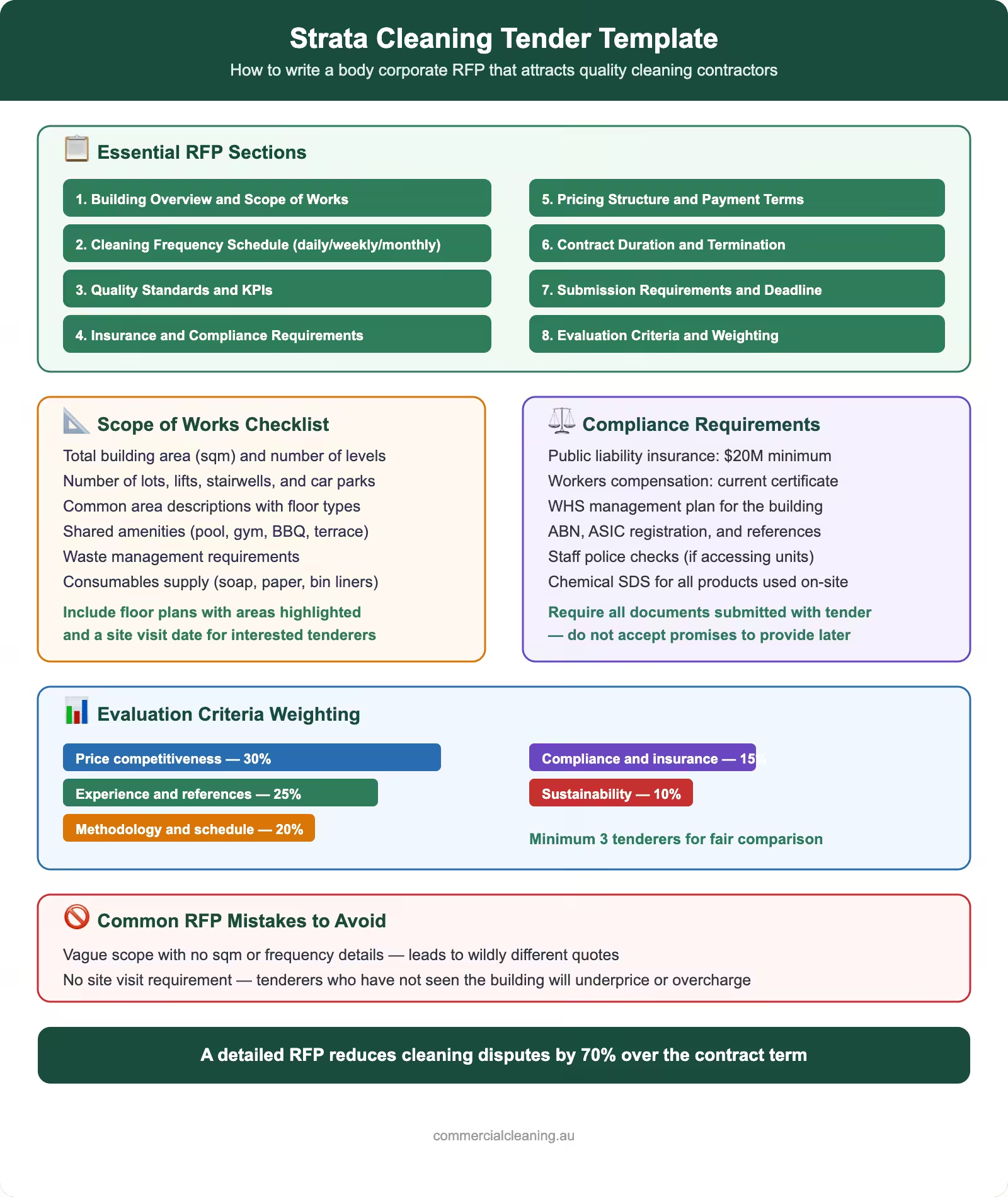
Strata cleaning tender template showing essential RFP sections, scope of works checklist, compliance requirements, and evaluation criteria weighting
Download Your Strata Cleaning Tender Template (PDF) Use this ready-made RFP checklist to compare cleaning contractors, set evaluation criteria, and streamline your strata tender process. Download PDF Checklist
Why a Written Tender Matters for Strata Cleaning
Why a Written Tender Matters for Strata Cleaning covers specific protocols that we tailor to each facility based on its layout, traffic, and compliance requirements. Strata committees often fall into the same trap: find three quotes, pick the lowest, sign a contract. That approach works—until it doesn’t. The contractor you choose at the lowest price might be cutting corners on labour hours, using substandard products, or skipping training on WHS Act 2011 compliance.
A written tender changes the game. When you document what you want cleaned, how often, and to what standard, every contractor is bidding on the same job. They’re not guessing. That transparency protects you in three ways: you get honest quotes, you can genuinely compare contractors, and you have a defence if someone disputes the decision later.
In our experience managing cleaning contracts across strata buildings in North Sydney and Surry Hills, the buildings with the tightest specs—those that defined cleaning scope in square metres and listed exact surfaces—ended up with the best outcomes. Their contractors knew exactly what they were signing up for, no surprises when the invoice arrived.
What to Include in Your Strata Cleaning RFP
What to Include in Your Strata Cleaning RFP involves specific protocols that we tailor to each facility based on its layout, traffic, and compliance requirements. An RFP is not a five-sentence email. It needs structure. Think of it as a blueprint: you’re telling contractors what the job is, where it is, what you’re measuring them against, when you need it done, and what rules they have to follow.
Scope of Works
This is the heart of your tender. List every area that gets cleaned: lobbies, lifts, corridors, common staircases, car park entrances, gardens, pool areas (if applicable), and gym facilities. For each area, specify the frequency (daily, weekly, monthly) and the cleaning task. “Clean the lobby” is too vague. “Sweep and mop hard floors daily, wipe down lift buttons and walls twice weekly, empty bins daily” is actionable.
Site Details and Access
Contractors need to know the building layout. Include the number of storeys, square footage of common areas, the number of bins, the size of each floor’s lobby, how many lifts, and any restricted access times. If cleaning happens after hours, say so. If contractors need key card access or parking permits, specify that. These details affect their pricing and scheduling.
Evaluation Criteria
Tell bidders how you’ll judge them. Will price be the only factor, or will you consider experience, insurance, WHS compliance, and sustainability? If price isn’t everything, say so upfront. Contractors can then decide whether to bid and will craft their proposal accordingly.
Timeline and Contract Terms
State when you need the work to start, how long the contract will run (one year, three years, with renewal options), and when you expect bids back. Include payment terms—do you pay weekly, monthly, or on invoice?
Compliance Requirements
This is where legal obligations come in. List what contractors must provide: proof of public liability insurance (minimum $10 million for strata), workers compensation insurance, a Safe Work Method Statement (SWMS) under the WHS Act 2011, police checks for all staff, and any specific by-law compliance rules your building enforces. If your building is near a pool or gym, contractors may need additional qualifications.
Specifying Cleanable Square Metres by Floor Type
Specifying Cleanable Square Metres by Floor Type requires specific protocols that we tailor to each facility based on its layout, traffic, and compliance requirements. Here’s where most RFPs fail: they don’t give contractors enough data to quote accurately. A contractor who bids on “clean the common areas” is guessing. They might estimate 500 labour hours and be wrong by half.
The Stathakis method—used by facility managers across Australia—breaks down cleaning by surface type. You measure how many square metres of carpet you have, how many square metres of hard flooring (tiles, polished concrete), and how many square metres of wet areas (bathrooms, pool surrounds). This matters because cleaning carpet takes different time and effort than mopping hard floors.
Here’s a practical example from a North Sydney building we service. The lobby was 200 sqm of polished concrete, the corridors 600 sqm of commercial carpet, and the washrooms 80 sqm of tiles and grout. When we specified those numbers in our tender, contractors could use ISSA cleaning time standards to estimate hours. One contractor returned a quote for 8 hours daily; another said 12. We could ask why the difference. Turns out the second contractor was including more detailed grout cleaning—which we actually wanted. The first would have skipped it.
Break down your RFP this way:
Carpet: X sqm, cleaned [frequency], method [vacuum and spot clean / full shampoo] (ISSA standard: 18 minutes per 100 sqm for routine vacuuming)
Hard floors: X sqm, cleaned [frequency], method [sweep and mop / strip and seal quarterly] (ISSA standard: 12 minutes per 100 sqm for mopping)
Wet areas: X sqm, cleaned [frequency], specific tasks [grout scrubbing, mould treatment, etc.] (ISSA standard: 30 minutes per 100 sqm including grout)
Contractors will respect an RFP that shows you’ve done this homework. They’ll price more confidently and deliver more predictably.
Evaluation Criteria and Weighted Scoring
Evaluation Criteria and Weighted Scoring includes specific protocols that we tailor to each facility based on its layout, traffic, and compliance requirements. Once bids arrive, how do you compare them fairly? A scoring system removes bias and ensures accountability. Here’s a methodology adapted from Facility Management Association of Australia (FMAA) best practice and aligned with the Cleaning Accountability Framework (CAF):
Criterion
Weight
Assessment
Methodology & Understanding of Scope
40%
Does the contractor’s proposal show they understand your building? Have they asked detailed questions? Do they have a plan for each area?
Price
25%
Cost per sqm, cost per hour, total contract value. Is the price in line with market rates for your region?
Experience & Track Record
20%
How many strata buildings have they serviced? Can they provide references? What’s their tenure with existing clients?
Sustainability & WHS Compliance
15%
Do they use eco-friendly products? Are their staff trained under SafeWork NSW? Do they hold ISO certifications?
Once you’ve assigned scores, multiply each criterion by its weight and add them up. The highest scoring contractor isn’t necessarily the cheapest, but the best fit. This method also proves defensible in any owners corporation dispute: you can show you weighted factors proportionally and didn’t just chase the lowest bid.
Visible Cleaning Checklists in Common Areas
Visible Cleaning Checklists in Common Areas addresses specific protocols that we tailor to each facility based on its layout, traffic, and compliance requirements. Here’s an accountability practice that’s standard in the UK but rare in Australia: post a cleaning log in the lobby and lift showing when each task was completed and who did it. A simple sheet on a clipboard, updated daily, transforms how tenants and the committee see cleaning. When someone asks “was that cleaned today?”, there’s proof.
Our team in Parramatta manages two strata buildings that use this system. Within weeks, the perception shifted. Tenants stopped assuming cleaning wasn’t happening—they could see the checkbox marked “lobby mopped 9:30am”. The contractor felt accountable too. No sneaking out early if you have to sign off on tasks.
Include this in your RFP: “Contractor will maintain a daily cleaning log in the lobby (provided by owners corporation) showing all completed tasks, times, and contractor initials. Log to be reviewed fortnightly by the caretaker.” It costs nothing, adds accountability, and gives you documentation if cleaning quality ever becomes a dispute.
Legal Requirements Under the Strata Schemes Management Act 2015
If your building is in NSW, the Strata Schemes Management Act 2015 sets obligations for owners corporations. A few clauses directly affect how you tender and approve cleaning contracts.
Contract Approval and Quorum
If your cleaning contract exceeds a certain expenditure threshold, it can’t just be approved by the strata committee. You may need to put it to a vote at an AGM (Annual General Meeting) or EGM (Extraordinary General Meeting), with a quorum of owners present. Check your by-laws and the Act: typically, any contract over three months or a certain dollar value (often $3,000–$5,000 depending on building size) needs owners corporation approval, not just committee approval.
This means your tender process needs to account for AGM/EGM timing. If you issue an RFP in January but your AGM isn’t until April, the contract can’t start in February.
By-Law Compliance
Your building’s by-laws may impose specific cleaning standards, restricted hours, or noise limits. A contractor agreed to common law terms but not your by-laws will cause friction. Your RFP should explicitly reference by-law compliance: “Contractor agrees to comply with all by-laws registered on the building, including [list key ones: noise restrictions after 6pm, no use of certain products, etc.].”
Insurance and Indemnity
Under the Act, an owners corporation can be liable if a cleaner is injured or a third party is harmed. Your RFP must require the contractor to hold public liability insurance and workers compensation insurance, and to indemnify the owners corporation. This is non-negotiable.
WHS Obligations
The WHS Act 2011 and SafeWork NSW guidelines apply. Your RFP should state: “Contractor must comply with all WHS Act 2011 requirements and provide a Safe Work Method Statement (SWMS) for all cleaning tasks before commencing work.”
Sample Tender Template
Sample Tender Template focuses on specific protocols that we tailor to each facility based on its layout, traffic, and compliance requirements. Below is a boilerplate RFP structure you can adapt for your building:
Section
What to Include
1. Introduction & Background
Building name, address, number of lots, number of storeys, year built. Brief context: e.g., “This RFP is issued by the owners corporation for [Building Name] to engage a cleaning contractor for a 12-month term commencing [date].”
2. Scope of Works
List all areas and cleaning tasks. Use the sqm breakdown (carpet, hard floor, wet areas). Specify frequency and method for each.
3. Site Details & Access
Building layout, common area access, parking, key card requirements, after-hours access, restricted times, caretaker contact details.
Deadline, format (email, hard copy), what to include (company details, methodology, pricing breakdown, references, proof of insurance, SWMS outline, answers to specific questions like “How do you handle emergency cleaning requests?”).
8. Timeline
RFP issued [date], submissions due [date], interviews (if applicable) [dates], contract signed [date], cleaning starts [date].
9. Contact & Questions
Committee member or building manager email, deadline for questions (typically 7–10 days before RFP closes).
When you send this RFP out, you’re not just asking for a price. You’re setting a professional standard. Contractors who are serious will respond seriously. For a complete overview of property standards, see our body corporate guide.
Frequently Asked Questions
How long should the RFP be?
An RFP can range from 4 to 10 pages, depending on building complexity. A 20-lot apartment block needs less detail than a 100-lot mixed-use complex. Include what’s necessary; don’t pad. Our experience is that a focused, well-written RFP attracts better bids than a rambling one.
Should I ask contractors to attend a site inspection?
Yes. Include a line: “Contractors are invited to inspect the site on [dates/times]. This is optional but strongly encouraged.” On-site visits let contractors see the layout, ask questions, and understand labour logistics. Those who show up are usually the ones taking the job seriously.
Can I negotiate price after bids are submitted?
You can, but be transparent about it. If you’re considering a contractor but their price is slightly high, ask them to clarify their methodology or see if they’ll trim costs without cutting scope. Don’t pit bidders against each other in a silent auction—that erodes trust and often leads to the lowest bidder who can’t actually deliver. Make one clear decision and stick to it.
How should I handle ongoing performance if the contractor doesn’t meet standards?
Build a review clause into the contract: “Owners corporation reserves the right to conduct monthly inspections and provide feedback. If performance drops below agreed standards, contractor has 14 days to remediate. Repeated failures may trigger contract review.” Cleaning is a service; you should see improvements, not decline, as months go on. Our team in Epping found that monthly check-ins prevent small issues becoming big disputes.
What if no bidders meet my criteria?
You can re-issue the RFP with adjusted terms—perhaps higher pricing, longer contract, or clarified scope. You’re not obligated to accept an unsuitable bid just because the process is done. Sometimes a second round yields better results because bidders now know what the market expects.
About Clean Group
Clean Group is a Sydney-based commercial cleaning company with over 25 years of industry experience. Founded by Suji Siv, our team of 50+ trained professionals services offices, warehouses, medical centres, schools, childcare facilities, retail stores, gyms, and strata properties across Sydney, Melbourne, and Brisbane.
We are active members of ISSA and the Building Service Contractors Association of Australia (BSCAA). Our operations align with ISO 9001 (Quality Management), ISO 14001 (Environmental Management), and ISO 45001 (Workplace Health and Safety) standards. We hold membership with the Green Building Council of Australia and use eco-friendly, TGA-registered cleaning products wherever possible.
Every Clean Group cleaner is police-checked, fully insured, and trained in safe work procedures under SafeWork NSW guidelines. We operate 7 days a week, including after-hours and weekend services, to minimise disruption to your business.
When you’re ready to issue a tender for your strata building, these steps create a professional, defensible process. You’ll attract quality contractors, compare apples to apples, and end up with cleaner common areas and fewer disputes. For guidance on lobby and lift cleaning for strata, our team at Clean Group is here to help.
Hi, I'm Suji Siv, the founder, CEO, and Managing Director of Clean Group, bringing over 25 years of leadership and management experience to the company. As the driving force behind Clean Group’s growth, I oversee strategic planning, resource allocation, and operational excellence across all departments. I am deeply involved in team development and performance optimization through regular reviews and hands-on leadership.