HACCP is the framework that separates a kitchen running on guesswork from one running on verified, documented food-safety controls. We have implemented HACCP-aligned cleaning programs in more than sixty commercial kitchens across Sydney, and the difference between a venue that treats HACCP as a paper exercise and one that embeds it into daily operations is visible the moment our crew walks through the door. As a trusted restaurant cleaning company, we build every cleaning schedule around the seven HACCP principles because they give our clients provable compliance rather than assumptions.
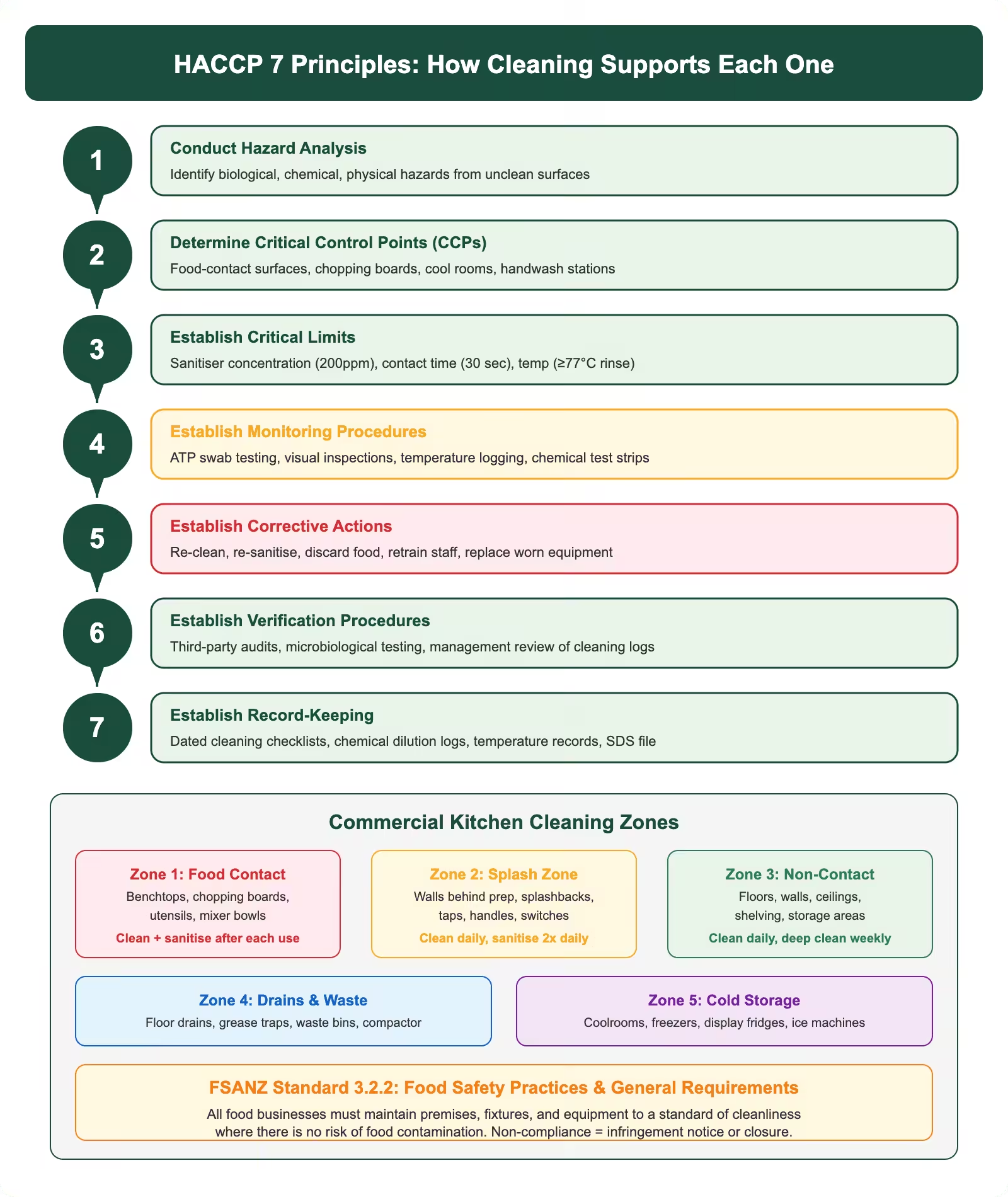
HACCP 7 principles flowchart showing how cleaning supports each principle with commercial kitchen zone cleaning guide
The Seven HACCP Principles and How Cleaning Supports Each One
HACCP stands for Hazard Analysis Critical Control Points, and its seven principles map directly onto the cleaning obligations that commercial kitchens must meet under FSANZ Standard 3.2.1. Principle 1 — hazard analysis — requires identifying biological, chemical, and physical hazards, and cleaning failures feature in all three categories. Biological hazards include Salmonella and Listeria surviving on inadequately sanitised food-contact surfaces. Chemical hazards include cleaning-product residue left on prep benches when rinse protocols are skipped. Physical hazards include metal fragments from degraded scouring pads embedding in soft food products.
Our team addresses each HACCP principle through specific cleaning actions. For Principle 2 — identifying critical control points — we map every surface in the kitchen that could introduce contamination if cleaning fails, from the slicer blade assembly to the coolroom door gasket. Principles 3 through 5 cover establishing limits, monitoring, and corrective actions, which in cleaning terms means setting ATP thresholds (we use 100 RLU from AS 4187), testing surfaces on every visit, and re-cleaning any surface that exceeds the threshold. Principles 6 and 7 — verification and record-keeping — are built into our digital compliance portal where every clean is timestamped, photo-documented, and ATP-verified.
FSANZ 3.2.1 Food Safety Program Requirements
FSANZ Standard 3.2.1 mandates food safety programs for specific categories of food businesses, and cleaning is a foundational element of every compliant program. The standard requires businesses to systematically identify potential hazards, implement controls, and maintain records. We have worked with food-safety auditors in Parramatta, Chatswood, and the CBD who consistently flag inadequate cleaning documentation as the most common non-conformance in HACCP audits. Our cleaning logs provide the evidence trail that auditors look for: what was cleaned, when, by whom, with what chemical at what dilution, and the ATP verification result.
For businesses in NSW, the Food Act 2003 gives the NSW Food Authority power to require food safety programs and conduct compliance audits. The penalty notice register shows that $880 on-the-spot fines for inadequate cleaning records are among the most frequent enforcement actions. We have helped fourteen restaurant clients in Greater Sydney avoid repeat penalties by implementing our structured HACCP-aligned cleaning documentation within their existing food safety programs.
Commercial Kitchen Cleaning Zone Guide
Zone
Clean Frequency
Method
Compliance
Penalty Risk
Cooking Line
After each service
Degrease + sanitise
Food Standards 3.2.2
Up to $275,000
Cold Storage
Weekly deep clean
Strip, clean, temp log
Food Standards 3.2.2
Closure risk
Exhaust Hood & Filters
Monthly
Chemical soak + pressure
AS 1851 (fire safety)
Insurance void
Dining Floor
After each service
Sweep, mop, spot treat
WHS Reg 2017
Slip injury claim
Grease Trap
Quarterly pump-out
Licensed contractor
EPA Protection Act
Up to $1M fine
Critical Control Points in Kitchen Cleaning
Critical Control Points in Kitchen Cleaning includes specific protocols that we tailor to each facility based on its layout, traffic, and compliance requirements. Not every surface in a commercial kitchen carries equal HACCP risk. We identify critical control points specific to each venue’s menu, layout, and workflow, then prioritise cleaning intensity accordingly. In a Japanese restaurant in Haymarket, the sashimi prep station is a CCP that requires sanitisation between every protein changeover. In a Bankstown bakery, the flour-handling zone is a CCP for allergen cross-contact and physical-hazard control. Our site-specific HACCP cleaning plans assign risk ratings of high, medium, or low to every defined zone, and cleaning frequency and chemical strength scale with the rating.
High-risk CCPs in most kitchens include raw-protein cutting boards and benchtops, blast-chiller interiors, coolroom shelving where raw and cooked products are stored in proximity, and any shared equipment used across allergen groups. We clean high-risk CCPs with alkaline detergent at 3 percent concentration followed by a food-safe sanitiser at 400 ppm, verified with ATP swabbing to below 50 RLU. Medium-risk zones — general prep benches, dry-storage shelving, floor areas — receive standard two-stage cleaning at 2 percent detergent concentration with a 200 ppm sanitiser and a 100 RLU verification threshold.
Cleaning Chemical Selection for HACCP Compliance
Chemical selection is a HACCP consideration in itself because the wrong product introduces chemical contamination — a Principle 1 hazard. We maintain a restricted chemical register for every kitchen we service, listing only products that carry TGA registration, FSANZ food-contact approval, and compatibility with the kitchen’s surface materials. Our standard register includes four products: an alkaline detergent for general degreasing, a chlorinated alkaline foam for heavy organic soiling, a quaternary ammonium sanitiser for food-contact surface disinfection, and an enzymatic drain cleaner for grease-trap and floor-drain maintenance.
Dilution accuracy matters more than most kitchens realise. We have tested cleaning solutions mixed by kitchen staff in Surry Hills and Liverpool venues and found dilution errors ranging from 50 percent under-strength to 300 percent over-strength. Under-diluted product fails to sanitise effectively — a direct HACCP non-conformance. Over-diluted product leaves chemical residue that constitutes a contamination hazard. Our crew uses calibrated auto-dilution systems mounted at each cleaning station, eliminating the guesswork. Each unit is serviced quarterly and verified against a known reference concentration using test strips rated to AS 1210 standards.
ATP Testing and Verification Protocols
ATP bioluminescence testing is the verification backbone of our HACCP cleaning program. The test detects adenosine triphosphate — a molecule present in all living cells — on swabbed surfaces, returning a result in relative light units within 15 seconds. We test a minimum of six predetermined surfaces per kitchen per visit, selected based on the HACCP risk map for that venue. Results are logged digitally with the surface identifier, timestamp, cleaning operative name, and RLU reading.
Our pass threshold of 100 RLU aligns with AS 4187 benchmarks, but we apply a tighter 50 RLU limit on high-risk CCPs. Over 18 months of data across our Sydney restaurant portfolio, our first-pass clean achieves below 100 RLU on 94 percent of tested surfaces. The remaining 6 percent trigger our corrective-action protocol: immediate re-clean with fresh chemical, extended contact time, and re-swab. We have never recorded a surface failing on the second test. This data set — spanning more than 12,000 individual swab results — provides our clients with statistically strong evidence of cleaning efficacy that satisfies even the most rigorous HACCP auditor.
Staff Training and HACCP Documentation
Staff Training and HACCP Documentation focuses on specific protocols that we tailor to each facility based on its layout, traffic, and compliance requirements. Every cleaner we assign to a HACCP-regulated kitchen completes our internal food-safety certification covering the seven HACCP principles, chemical safety data sheet interpretation, correct PPE usage, and ATP testing procedures. We refresh this training annually and maintain competency records in our cloud-based compliance portal alongside cleaning logs and ATP results. Our Eastwood and Homebush teams consistently score above 93 percent on HACCP competency assessments, and we make these records available to food-safety auditors on request.
Documentation is where most HACCP cleaning programs fall apart. A cleaning log that says “kitchen cleaned” with a tick and a signature tells an auditor nothing. Our logs record each surface cleaned, the chemical used and its batch number, the dilution ratio, the contact time, the rinse method, the ATP result, and the name of the operative. This level of detail costs approximately $45 more per clean in administrative time compared to a basic tick-sheet system, but it transforms cleaning from an unverifiable claim into auditable evidence. Every client on our HACCP cleaning program can produce a complete 12-month cleaning history within five minutes of an auditor’s request.
When HACCP Cleaning Reveals Deeper Kitchen Issues
When HACCP Cleaning Reveals Deeper Kitchen Issues covers specific protocols that we tailor to each facility based on its layout, traffic, and compliance requirements. Our HACCP cleaning audits regularly uncover problems that go beyond surface contamination. Persistent high ATP readings on a specific coolroom shelf despite repeated cleaning often indicate a condensation leak from the evaporator housing above — a maintenance issue, not a cleaning failure. Recurring biofilm in floor drains can signal a grease-trap capacity issue rather than inadequate drain cleaning. We have identified both scenarios in Penrith and Marrickville kitchens, saving our clients from wasting cleaning labour on symptoms rather than causes. When we find facility-level issues, we document them with photos and recommended trades so the kitchen operator can address the root cause. For kitchens that also need to confirm their exhaust systems meet fire-safety and hygiene standards as part of their HACCP program, our guide on AS 1851 kitchen exhaust compliance covers the inspection and cleaning requirements we follow across every venue.
Frequently Asked Questions
How often should a commercial kitchen be deep cleaned for HACCP compliance?
Daily cleaning of food contact surfaces and floors is mandatory. Weekly deep cleans of major equipment — ovens, fryers, coolrooms — are standard. Monthly structural cleans covering walls, ceilings, and drainage complete the cycle. The exact frequency should be documented in a site-specific master cleaning schedule reviewed during each HACCP audit.
What is ATP testing and why does it matter for HACCP?
ATP bioluminescence testing measures organic residue on surfaces by detecting adenosine triphosphate. It provides objective, quantified evidence that a surface has been effectively cleaned — replacing visual inspection with measurable data. HACCP auditors increasingly require ATP verification records as part of the cleaning documentation package.
Do all food businesses in Australia need HACCP?
Food Standards Australia New Zealand requires all food businesses to have food safety programs based on HACCP principles under the Food Standards Code. The specific requirements vary by state — in NSW, the Food Act 2003 and associated regulations mandate food safety programs for certain categories of food business, with local councils enforcing compliance through inspections.
Can the same cleaning company handle both kitchen cleaning and exhaust system cleaning?
Yes, and there are advantages to bundling both services. A single provider ensures the cleaning schedule aligns across both food contact surfaces and exhaust infrastructure, avoids gaps between contractors, and produces unified documentation that satisfies both food safety and fire safety auditors. We provide both services across all our commercial kitchen contracts in Sydney.
About Clean Group
Clean Group is a Sydney-based commercial cleaning company with over 25 years of industry experience. Founded by Suji Siv, our team of 50+ trained professionals services offices, warehouses, medical centres, schools, childcare facilities, retail stores, gyms, and strata properties across Sydney, Melbourne, and Brisbane.
We are active members of ISSA and the Building Service Contractors Association of Australia (BSCAA). Our operations align with ISO 9001 (Quality Management), ISO 14001 (Environmental Management), and ISO 45001 (Workplace Health and Safety) standards. We hold membership with the Green Building Council of Australia and use eco-friendly, TGA-registered cleaning products wherever possible.
Every Clean Group cleaner is police-checked, fully insured, and trained in safe work procedures under SafeWork NSW guidelines. We operate 7 days a week, including after-hours and weekend services, to minimise disruption to your business.
Hi, I'm Suji Siv, the founder, CEO, and Managing Director of Clean Group, bringing over 25 years of leadership and management experience to the company. As the driving force behind Clean Group’s growth, I oversee strategic planning, resource allocation, and operational excellence across all departments. I am deeply involved in team development and performance optimization through regular reviews and hands-on leadership.