Last year we tracked every callback, re-clean request, and surface damage complaint across our Sydney portfolio — 340 commercial properties in total. The single biggest driver of avoidable costs was not labour inefficiency or scheduling errors. It was cleaning products. Specifically, it was the gap between what a $4 supermarket spray promises on its label and what actually happens when you use it on 2,000 square metres of office floor five nights a week. Our chemical procurement manager at our Waterloo warehouse has spent nineteen years quantifying that gap, and the numbers are blunt: consumer-grade products cost our clients between 60 and 80 per cent more per clean when you factor in re-application rates, surface degradation, and WHS incident risk.
Concentration and Dilution: Where the Real Difference Starts
A 750 ml trigger bottle of bathroom cleaner from Woolworths contains roughly 0.5 per cent active surfactant in ready-to-use form. A 5-litre drum of Agar Exit — the professional concentrate we use across most of our office and strata contracts — ships at 15 per cent active surfactant and dilutes at 1:20. That single drum produces 100 litres of working solution. One consumer bottle covers maybe four bathroom cleans in a mid-sized Parramatta office. One drum of Exit covers the same bathrooms for three months.
We switched our Waterloo warehouse to proportioning dispensers in 2019 after finding that hand-mixing concentrates was producing inconsistent dilution ratios — some cleaners were mixing too strong (wasting product and leaving residue) and others too weak (requiring a second pass). The dispensers lock the ratio at the manufacturer’s specification. Our re-clean rate on bathroom surfaces dropped 34 per cent within the first quarter after the changeover, which tells you how much the dilution accuracy problem was costing us in labour hours alone.
Concentration also determines drying time and residue. Over-concentrated consumer sprays — the ones that smell strong because the fragrance load is doing the heavy lifting instead of the active ingredient — leave a sticky film on laminate desks and glass partitions. We see this constantly when onboarding new clients who previously used in-house cleaning with supermarket products. The desks look dull, glass has a haze, and vinyl floors have a tacky layer that traps grit and accelerates wear. Fixing that residue problem usually takes two to three deep-clean visits before surfaces return to their factory finish.
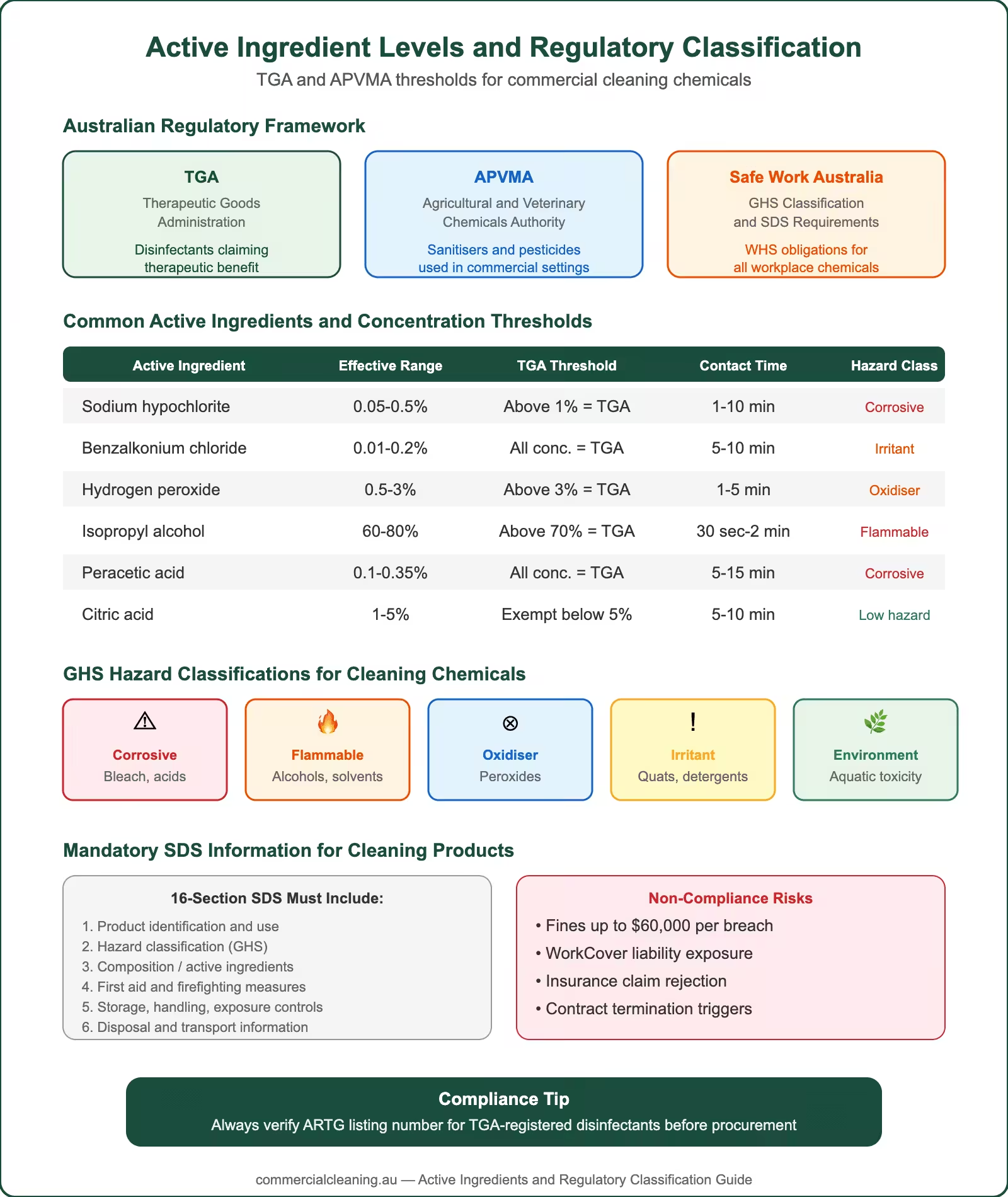
Active Ingredient Levels and Regulatory Classification
The active ingredients in professional disinfectants sit in a fundamentally different concentration band to consumer products, and that difference determines whether the product actually kills what the label says it kills. Our approved hospital-grade disinfectants contain benzalkonium chloride or didecyldimethylammonium chloride at 5 to 15 per cent in concentrate form, diluting to an effective use concentration of 500 to 1,500 parts per million. Consumer disinfectant sprays from Coles or Woolworths typically contain the same active ingredients at 0.1 to 0.5 per cent ready-to-use — a concentration that may not achieve the listed contact-time kill claims under real-world conditions where surfaces dry before the required dwell time elapses.
Every disinfectant on our approved list is cross-referenced against the Australian Pesticides and Veterinary Medicines Authority (APVMA) register, because any product making antimicrobial efficacy claims in Australia must be registered. We currently hold eighteen APVMA-registered disinfectant products across general-purpose, bathroom, food-safe, and hospital-grade categories at our Waterloo stores. One issue we see regularly on Sydney job sites is facility managers assuming a consumer “antibacterial” spray carries the same regulatory weight as a registered hospital-grade disinfectant — it does not. The APVMA registration number on the label is the only reliable indicator that the product’s efficacy claims have been independently validated.
Commercial Cleaning Product Comparison
Hidden Cost Factor
Consumer-Grade Product
Professional Concentrate
Annual Cost Impact (Mid-Size Office)
Re-application rate
2-3 passes on greasy surfaces
Single pass at correct dilution
+$1,400 in extra labour hours
Surface damage (residue build-up)
Sticky film on laminate, haze on glass
No residue at manufacturer dilution ratio
+$800 in corrective deep cleans
Packaging waste
26 trigger bottles per 100L
1 drum per 100L
+$200 in waste disposal
SDS compliance gaps
Often missing or hard to obtain
Supplied at point of sale, updated proactively
$2,000–$50,000 per SafeWork NSW infringement
Disinfection efficacy
May not meet contact-time kill claims
APVMA-registered, validated kill rates
Unquantifiable liability risk
Staff training burden
Inconsistent; no manufacturer support
Supplier-provided training + SDS briefings
+$600 in ad-hoc training time
Safety Data Sheets and Compliance Obligations
Under the Work Health and Safety Regulation 2017 (NSW), every hazardous chemical used on a commercial site must have a current Safety Data Sheet accessible to workers within the workplace. Not filed away at head office — physically present or digitally accessible on-site. We maintain a laminated SDS folder at every client location and a digital backup on our internal system, updated within two weeks of any manufacturer revision notice. Our Waterloo chemical stores currently hold SDS documentation for all eighteen registered products, and our chemical procurement manager verifies each SDS annually during the supplier audit cycle.
This is where consumer products create a genuine compliance risk that most facility managers do not think about until SafeWork NSW turns up. Retail cleaning products sold through supermarkets do carry SDS documentation, but obtaining it often requires searching the manufacturer’s website or calling a consumer hotline that was not designed for commercial compliance enquiries. We onboarded a 3,200 sqm office in North Sydney last year where the previous cleaning contractor had been using a mix of Woolworths and Bunnings products — not one SDS was on file at the site. That is a recordable WHS non-compliance under Regulation 346, and penalties start at $2,000 per infringement for a body corporate and scale significantly for repeat offences.
Professional chemical suppliers like Agar, Diversey, and Oates provide SDS documentation proactively at the point of sale and send revision notices when formulations change. That supply chain discipline is invisible until something goes wrong — a staff member has a skin reaction, a spill requires emergency response, or an auditor walks through and asks to see the register. In our experience, the SDS compliance gap is the single most underestimated risk of using consumer-grade products in a commercial setting.
Cost-Per-Use Analysis and Business Case
We run a cost-per-use analysis for every product category on our approved list and present the results to new clients during onboarding, because the sticker shock of professional concentrate pricing is real — a 5-litre drum of Agar Exit costs $22.80 versus a $4.20 Woolworths bathroom spray. But the drum dilutes to 100 litres of working solution at $0.23 per litre. The consumer spray delivers 0.75 litres at $5.60 per litre. That is a 24:1 cost ratio on the actual liquid hitting the surface.
Across a standard 1,500 sqm office contract running five-night cleaning, we calculated annual chemical expenditure of $1,840 using our professional concentrate program versus $4,680 using equivalent consumer products — a saving of $2,840 per year on chemicals alone, before accounting for the labour efficiency gains from single-pass cleaning and the elimination of corrective deep cleans for residue damage. After servicing over 340 properties across Sydney, we have never seen a scenario where consumer products deliver a lower total cost of ownership than professional concentrates. The upfront drum price is higher. Everything else is cheaper.
Environmental and Sustainability Considerations
We factor environmental impact into every procurement decision because our clients increasingly require sustainability reporting for NABERS and Green Star certification programs. Professional concentrate systems generate substantially less packaging waste — roughly one 5-litre drum replaces twenty-six consumer trigger bottles. Across our 340-property portfolio, that single substitution eliminates approximately 8,840 plastic trigger bottles from the waste stream annually.
Six of our eighteen core products carry GECA (Good Environmental Choice Australia) certification, covering neutral detergent, glass cleaner, hand wash, and toilet cleaner categories. Our clients in Waterloo and Zetland — particularly the tech companies — specifically request GECA-certified products as part of their corporate sustainability commitments. Consumer products occasionally carry ecolabel certifications, but the range is narrow and the performance specifications often fall short in high-traffic commercial environments where the product needs to work on the first pass, not the third.
How We Decide Which Products Make Our Approved List
Calculate cost-per-use vs current approved product
▼
Decision: Cost-per-use lower AND efficacy equal or better?
Yes ▼
No → Stays on watch list
Check: GECA certified or low-VOC formulation?
Yes = Priority ▼
No = Standard ▼
4-week field trial on 3 client sites
▼
Added to Approved Product List — SDS filed at Waterloo warehouse
Frequently Asked Questions
Why are professional cleaning products more expensive upfront?
The price on the drum label is misleading because you are buying concentrate, not a finished product. A $22.80 drum of Agar Exit dilutes to 100 litres of bathroom cleaner — that works out to $0.23 per litre of working solution. A $4.20 consumer spray gives you 0.75 litres at $5.60 per litre. We have run this comparison across every product category on our approved list, and professional concentrates consistently cost 60 to 80 per cent less per litre of actual cleaning solution. The upfront number looks bigger; the per-clean cost is dramatically smaller.
Can I use supermarket cleaning products for commercial cleaning?
Technically nothing stops you, but we have seen it go wrong enough times to advise against it for any site over 200 sqm. Consumer formulations are designed for light domestic use — a single kitchen bench, one bathroom mirror. In a 1,500 sqm office cleaned five nights a week, those dilution ratios and active ingredient concentrations simply cannot keep up. We onboarded a North Sydney office last year that had been using Woolworths products exclusively. Their vinyl floors had a visible residue layer, the glass partitions were hazed, and not a single SDS was on file — a direct WHS non-compliance under NSW Regulation 346.
What is the cost saving of switching to professional-grade chemicals?
Our data across 340 Sydney properties shows annual chemical savings of approximately $2,840 for a standard 1,500 sqm office when switching from consumer products to our professional concentrate program. That figure covers chemicals only — it does not include the labour savings from eliminating re-application passes or the avoided cost of corrective deep cleans to fix residue damage. When we include labour efficiency, the total saving typically lands between $4,000 and $5,500 per year for a mid-sized commercial property.
Do professional cleaning products require special training to use?
Yes, and that training requirement is actually a safety feature, not a drawback. Professional concentrates have higher active ingredient levels, which means incorrect dilution creates real risks — skin irritation, respiratory sensitisation, or surface damage from over-concentrated solution. Every Clean Group cleaner completes product-specific training before handling any chemical on our approved list, covering correct dilution ratios, PPE requirements, and the SDS first-aid procedures for each product. Our suppliers — Agar, Diversey, and Oates — provide training materials and on-site sessions as part of their commercial supply agreements, a level of support that consumer product manufacturers simply do not offer.
Are professional cleaning products better for the environment?
On packaging waste alone, the difference is stark: one 5-litre drum replaces twenty-six consumer trigger bottles. Across our portfolio that eliminates nearly 9,000 plastic bottles annually. Six of our core products carry GECA (Good Environmental Choice Australia) certification, which verifies low-toxicity formulations and reduced aquatic impact. The one caveat is that professional concentrates carry higher environmental risk if disposed of improperly in undiluted form — which is why we train every staff member on correct waste handling procedures and never pour concentrates down drains without dilution to the manufacturer’s specified ratio.
We have covered concentration economics, active ingredient analysis, SDS compliance, cost-per-use modelling, and environmental considerations. For a practical guide to interpreting the safety data sheets that accompany every product we have discussed, see our safety data sheets reading guide.
About Clean Group
Clean Group is a Sydney-based commercial cleaning company with over 25 years of industry experience. Founded by Suji Siv, our team of 50+ trained professionals services offices, warehouses, medical centres, schools, childcare facilities, retail stores, gyms, and strata properties across Sydney, Melbourne, and Brisbane.
We are active members of ISSA and the Building Service Contractors Association of Australia (BSCAA). Our operations align with ISO 9001 (Quality Management), ISO 14001 (Environmental Management), and ISO 45001 (Workplace Health and Safety) standards. We hold membership with the Green Building Council of Australia and use eco-friendly, TGA-registered cleaning products wherever possible.
Every Clean Group cleaner is police-checked, fully insured, and trained in safe work procedures under SafeWork NSW guidelines. We operate 7 days a week, including after-hours and weekend services, to minimise disruption to your business.
Hi, I'm Suji Siv, the founder, CEO, and Managing Director of Clean Group, bringing over 25 years of leadership and management experience to the company. As the driving force behind Clean Group’s growth, I oversee strategic planning, resource allocation, and operational excellence across all departments. I am deeply involved in team development and performance optimization through regular reviews and hands-on leadership.