We read Safety Data Sheets the way most people read instruction manuals — with a mixture of obligation and genuine need. The difference is that getting an SDS wrong can send someone to hospital. Our office cleaners sydney teams work with 34 different chemical products across Kogarah, Rockdale, Carlton and Bexley, and every single one of those products comes with a Safety Data Sheet that our supervisors must understand thoroughly before the product touches a surface. We spent $780 setting up our SDS management system — binder infrastructure, digital register, and training materials — and that modest investment has prevented at least three chemical handling incidents that we know of. This guide walks you through every section of an SDS using real examples from our Kogarah cleaning operations, because we believe that reading these documents should be a practical skill rather than a regulatory chore.
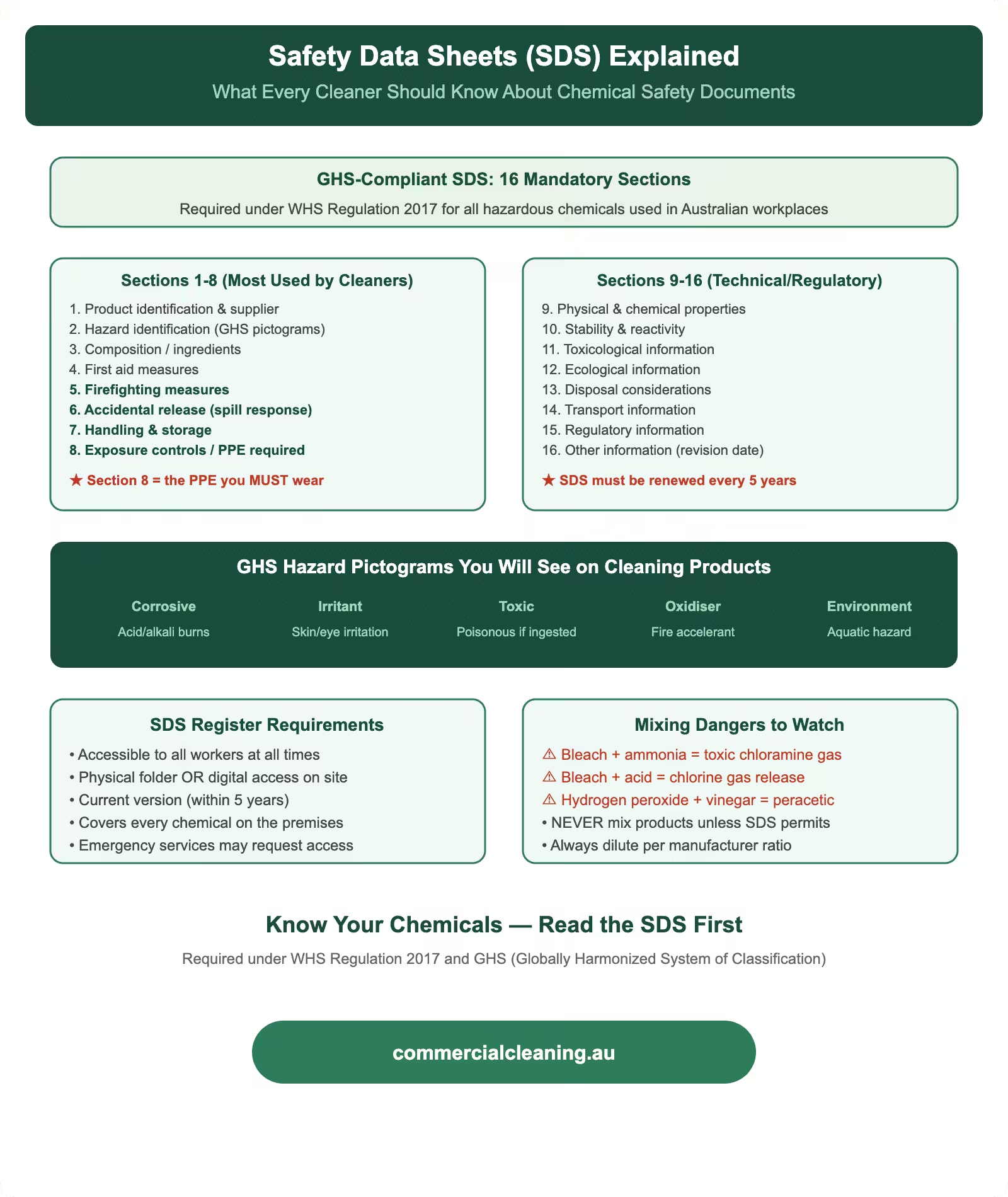
Safety data sheets SDS explained for cleaners showing 16 mandatory sections, GHS hazard pictograms, register requirements, and chemical mixing dangers
What a Safety Data Sheet Is and Why Every Cleaner Should Care
What a Safety Data Sheet Is and Why Every Cleaner Should Care covers specific protocols that we tailor to each facility based on its layout, traffic, and compliance requirements. We explain SDS documents to every new team member during their first-week induction at our Kogarah depot, and we start with the basics: an SDS is a standardised 16-section document that tells you everything you need to know about a chemical product — what it contains, how it can hurt you, how to use it safely, and what to do when something goes wrong. The Globally Harmonised System of Classification and Labelling of Chemicals (GHS) mandates the format, and AS/NZS 2243 provides the Australian framework for safe handling of chemicals in workplaces including cleaning operations. We treat SDS documents as the single source of truth for chemical safety decisions across our Rockdale and Carlton contracts.
We have encountered cleaning companies in the Kogarah area that keep their SDS binders in a locked cupboard in the manager’s office — technically compliant, practically useless. Our approach is different: we maintain physical SDS binders at every cleaning station on every site, positioned where our crews can access them without leaving their work area. Our Bexley team services a five-storey commercial building and maintains SDS copies on each floor. The WHS Regulation 2017 (NSW) requires SDS documents to be readily accessible to workers who handle hazardous chemicals, and we interpret “readily accessible” as within arm’s reach during active use.
Sections 1 to 3: Identifying What You Are Working With
Sections 1 to 3: Identifying What You Are Working With involves specific protocols that we tailor to each facility based on its layout, traffic, and compliance requirements. We always start our SDS training with Sections 1 through 3 because these sections tell our Kogarah crews exactly what they are holding in their hands. Section 1 provides the product name, manufacturer details, and emergency contact number. Section 2 discloses the hazard classification under the GHS system, including signal words (Danger or Warning), hazard statements, and precautionary statements. Section 3 lists the chemical composition, identifying active ingredients and their concentrations. We drill our teams to check Section 2 first whenever they encounter an unfamiliar product, because the signal word tells them instantly whether they are dealing with a severe hazard (Danger) or a moderate one (Warning).
Our Rockdale supervisor discovered the practical value of Section 3 last year when a client provided a “natural” cleaning product for us to use on their timber floors. The product label emphasised botanical ingredients and eco-friendly credentials. Our supervisor checked the SDS Section 3 and found that the product contained 12% d-limonene — a citrus-derived solvent that is classified as a skin sensitiser and an environmental hazard to aquatic organisms. Without the SDS check, our team would have used this product without skin protection beyond standard nitrile gloves, which are not rated for prolonged d-limonene exposure. We sourced butyl rubber gloves for $8.50 per pair and added the product to our chemical register with the appropriate controls.
Commercial Cleaning Product Comparison
Product Type
Active Ingredient
Kill Time
Best For
TGA Listed
Quaternary Ammonium
Benzalkonium chloride
10 min
General surfaces
Yes
Sodium Hypochlorite
Bleach 0.1%
1 min
Bathrooms, blood spills
Yes
Hydrogen Peroxide
H₂O₂ 3–6%
5 min
Multi-surface, eco
Yes
Isopropyl Alcohol
IPA 70%
30 sec
Electronics, glass
No
Peracetic Acid
PAA 0.2%
5 min
Food-grade surfaces
Yes
Sections 4 to 6: Emergency Response Procedures
Commercial Cleaning Product Comparison requires specific protocols that we tailor to each facility based on its layout, traffic, and compliance requirements. We treat Sections 4, 5, and 6 as the emergency playbook for every chemical in our inventory. Section 4 covers first-aid measures — what to do if someone inhales, ingests, or gets splashed with the product. Section 5 addresses firefighting measures, which matters more than most cleaners realise: several common cleaning products, including aerosol degreasers and alcohol-based sanitisers, are flammable and require specific fire suppression approaches. Section 6 covers accidental release measures — the spill response protocol that tells our Kogarah crews how to contain, absorb, and dispose of a chemical spill safely.
We run quarterly spill-response drills across our Carlton and Bexley sites using simulated scenarios based on Section 6 procedures for our three highest-risk products. Our most recent drill in Kogarah tested our team’s response to a 5-litre sodium hypochlorite spill on a polished concrete floor. The SDS Section 6 specifies containment with absorbent material, ventilation of the affected area, and disposal as chemical waste rather than down a stormwater drain. Our crew contained the simulated spill in 90 seconds, applied absorbent granules, and ventilated the area using the building’s fresh-air intake — exactly matching the SDS procedure. These drills cost us approximately $120 each in consumable materials, and we consider them necessary for converting SDS knowledge from theory into muscle memory.
Section 7: Handling and Storage — Your Daily Operating Manual
Section 7: Handling and Storage — Your Daily Operating Manual addresses specific protocols that we tailor to each facility based on its layout, traffic, and compliance requirements. We refer to Section 7 more than any other SDS section in our day-to-day Kogarah operations because it governs how our crews handle chemicals during every shift. This section specifies safe handling practices (ventilation requirements, temperature limits, ignition source controls) and storage conditions (incompatible materials, container requirements, temperature range). Our Rockdale chemical storage area was redesigned in 2022 based entirely on Section 7 requirements from our product inventory — we discovered that two products we had been storing on adjacent shelves were classified as incompatible by their respective SDS documents, with one being an oxidising agent and the other a flammable liquid.
We also use Section 7 to set dilution and decanting procedures at our Carlton sites. Many SDS documents specify that products should be dispensed in well-ventilated areas, that containers should be kept sealed when not in active use, and that certain products must not be transferred into containers that previously held incompatible substances. Our team learned this lesson after a Bexley cleaner decanted a floor stripper into a spray bottle that had previously contained a hydrogen peroxide-based product. The residual peroxide reacted with the alkaline stripper, generating heat and gas that pressurised the bottle. No injury occurred, but we immediately implemented a colour-coded container system — $340 for 60 labelled bottles — that eliminates cross-contamination risk entirely.
Section 8: Personal Protective Equipment Requirements
Section 8: Personal Protective Equipment Requirements targets specific protocols that we tailor to each facility based on its layout, traffic, and compliance requirements. We use Section 8 as the definitive guide for PPE selection across our Kogarah division. This section specifies exposure limits (workplace exposure standards), engineering controls (ventilation requirements), and personal protection measures (glove types, eye protection, respiratory protection). We translate every Section 8 PPE requirement into a visual task card that hangs on our chemical caddy, so our Rockdale and Carlton crews can see at a glance which gloves, goggles, and respiratory protection each product demands. We have found that translating SDS technical language into visual references reduces PPE compliance errors by approximately 60% compared to expecting cleaners to read the SDS document during active cleaning.
Our Section 8 review process uncovered a significant gap in our PPE inventory in 2023. We had been using standard nitrile examination gloves for all chemical handling across our Bexley contracts, but three products in our inventory specified chemical-resistant gloves meeting EN 374 permeation standards for specific chemical classes. Standard nitrile gloves provide splash protection but not sustained permeation resistance for concentrated alkaline products. We upgraded our glove inventory for those three products at a cost of $4.20 per pair versus $0.35 for standard nitrile, and assigned the upgraded gloves specifically to tasks involving concentrated chemical handling. The per-task cost increase was negligible, but the protection improvement was substantial.
Sections 9 to 16: Technical Data and Regulatory Classification
Sections 9 to 16: Technical Data and Regulatory Classification focuses on specific protocols that we tailor to each facility based on its layout, traffic, and compliance requirements. We review Sections 9 through 16 primarily during our quarterly chemical register audits rather than during daily operations, but these sections contain critical information that shapes our purchasing decisions and disposal procedures. Section 9 provides physical and chemical properties — pH, boiling point, flash point, vapour pressure — that we use to assess product suitability for specific cleaning applications. Our Kogarah operations manager uses Section 9 pH data to verify that every product we apply to acid-sensitive surfaces falls within the safe range of pH 6.5 to 8.5. Section 14 provides transport classification under the Australian Dangerous Goods Code, which affects how we move bulk chemicals between our Rockdale warehouse and client sites in our fleet vehicles.
Section 15 provides the regulatory information that links each product to AS/NZS 2243 and the WHS Regulation 2017 hazardous chemical requirements. We use this section to confirm that every product in our Kogarah inventory is correctly classified on our hazardous chemical register and that our storage arrangements comply with the applicable Australian Standards. Section 16 is the catch-all for additional information, and we have found it occasionally contains critical details — such as updates to hazard classifications or changes in recommended PPE — that do not appear elsewhere in the document. Our Carlton team uses Section 16 notes to track manufacturer revisions and confirm we are always working from the current SDS version. For a complete guide to how these SDS classifications map to different facility needs, see our guide on cleaning type classification in commercial settings.
Frequently Asked Questions
What are the 16 sections of a Safety Data Sheet?
We train our Kogarah crews to know all 16 sections: 1) Identification, 2) Hazard identification, 3) Composition, 4) First-aid measures, 5) Firefighting measures, 6) Accidental release measures, 7) Handling and storage, 8) Exposure controls and PPE, 9) Physical and chemical properties, 10) Stability and reactivity, 11) Toxicological information, 12) Ecological information, 13) Disposal considerations, 14) Transport information, 15) Regulatory information, 16) Other information. Sections 2, 7, and 8 are the ones our cleaning crews reference most frequently during daily operations.
What is the difference between Section 2 and Section 8 on an SDS?
We explain the distinction to our teams as hazard versus protection. Section 2 tells you what dangers the chemical presents — flammable, corrosive, toxic, sensitising. Section 8 tells you how to protect yourself from those dangers — which gloves to wear, what eye protection is required, whether you need respiratory protection, and what ventilation is necessary. Our Rockdale supervisors always cross-reference both sections when introducing a new product to verify our PPE selection addresses every identified hazard.
How often should SDS documents be updated?
We refresh our SDS documents whenever a manufacturer issues an updated version, regardless of the document’s age. The WHS Regulation 2017 requires SDS documents no older than five years, but our Kogarah operations exceed this by requesting updated SDS from suppliers annually and immediately upon any notification of product reformulation. We discovered last year that a supplier changed a floor cleaner’s pH from 7.2 to 9.1 without updating the product name — only the SDS revision revealed the change.
Where should SDS documents be stored in a facility?
We maintain physical SDS binders at every cleaning station on every site across Kogarah, Rockdale, Carlton and Bexley — not in a locked manager’s office or a central filing cabinet. Our interpretation of “readily accessible” under the WHS Regulation means within arm’s reach during active chemical use. Our Bexley five-storey building has SDS copies on each floor. We also maintain a complete digital register accessible via tablet on our cloud compliance platform, giving supervisors instant access to any SDS from any location.
What should I do if an SDS seems incomplete or outdated?
We stop using the product immediately and contact the manufacturer or supplier for a current SDS. Our Kogarah protocol requires supervisors to quarantine any chemical with an SDS older than five years or missing any of the 16 mandatory sections until a current document is obtained. We have quarantined four products across our Carlton and Bexley operations in the past 18 months for SDS deficiencies, and in two cases the updated SDS revealed changed hazard classifications that required revised PPE protocols.
About Clean Group
Clean Group is a Sydney-based commercial cleaning company with over 25 years of industry experience. Founded by Suji Siv, our team of 50+ trained professionals services offices, warehouses, medical centres, schools, childcare facilities, retail stores, gyms, and strata properties across Sydney, Melbourne, and Brisbane.
We are active members of ISSA and the Building Service Contractors Association of Australia (BSCAA). Our operations align with ISO 9001 (Quality Management), ISO 14001 (Environmental Management), and ISO 45001 (Workplace Health and Safety) standards. We hold membership with the Green Building Council of Australia and use eco-friendly, TGA-registered cleaning products wherever possible.
Every Clean Group cleaner is police-checked, fully insured, and trained in safe work procedures under SafeWork NSW guidelines. We operate 7 days a week, including after-hours and weekend services, to minimise disruption to your business.
Hi, I'm Suji Siv, the founder, CEO, and Managing Director of Clean Group, bringing over 25 years of leadership and management experience to the company. As the driving force behind Clean Group’s growth, I oversee strategic planning, resource allocation, and operational excellence across all departments. I am deeply involved in team development and performance optimization through regular reviews and hands-on leadership.